



Community hub
Recent from talks
Knowledge base stats:
Talk channels stats:
Members stats:
Mixotricha
Mixotricha paradoxa is a species of protozoan that lives inside the gut of the Australian termite species Mastotermes darwiniensis.
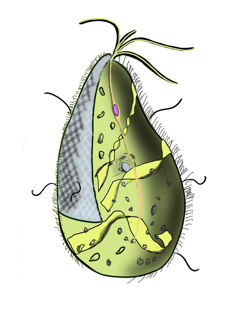
It is composed of five different organisms: three bacterial ectosymbionts live on its surface for locomotion and at least one endosymbiont lives inside to help digest cellulose in wood to produce acetate for its host(s).
Mixotricha mitochondria degenerated into hydrogenosomes and mitosomes and lost the ability to produce energy aerobically by oxidative phosphorylation. The mitochondria-derived nuclear genes were however conserved.
The name was given by the Australian biologist J.L. Sutherland, who first described Mixotricha in 1933. The name means "the paradoxical being with mixed-up hairs" because this protist has both cilia and flagella, which was not thought to be possible for protists.
Mixotricha is a species of protozoan that lives inside the gut of the Australian termite species Mastotermes darwiniensis and has multiple bacterial symbionts.
Mixotricha is a large protozoan .5 millimetres (0.020 in) long and contains hundreds of thousands of bacteria. It is an endosymbiont and digests cellulose for the termite.
Trichomonads like Mixotricha reproduce by a special form of longitudinal fission, leading to large numbers of trophozoites in a relatively short time. Cysts never form, so transmission from one host to another is always based on direct contact between the sites they occupy.
Species of the order Trichomonadida typically have four to six flagella at the cell's apical pole, one of which is recurrent - that is, it runs along a surface wave, giving the aspect of an undulating membrane. Mixotricha paradoxa have four weak flagella that serve as rudders. It has four large flagella at the front end, three pointing forwards and one backward.
Hub AI
Mixotricha AI simulator
(@Mixotricha_simulator)
Mixotricha
Mixotricha paradoxa is a species of protozoan that lives inside the gut of the Australian termite species Mastotermes darwiniensis.
It is composed of five different organisms: three bacterial ectosymbionts live on its surface for locomotion and at least one endosymbiont lives inside to help digest cellulose in wood to produce acetate for its host(s).
Mixotricha mitochondria degenerated into hydrogenosomes and mitosomes and lost the ability to produce energy aerobically by oxidative phosphorylation. The mitochondria-derived nuclear genes were however conserved.
The name was given by the Australian biologist J.L. Sutherland, who first described Mixotricha in 1933. The name means "the paradoxical being with mixed-up hairs" because this protist has both cilia and flagella, which was not thought to be possible for protists.
Mixotricha is a species of protozoan that lives inside the gut of the Australian termite species Mastotermes darwiniensis and has multiple bacterial symbionts.
Mixotricha is a large protozoan .5 millimetres (0.020 in) long and contains hundreds of thousands of bacteria. It is an endosymbiont and digests cellulose for the termite.
Trichomonads like Mixotricha reproduce by a special form of longitudinal fission, leading to large numbers of trophozoites in a relatively short time. Cysts never form, so transmission from one host to another is always based on direct contact between the sites they occupy.
Species of the order Trichomonadida typically have four to six flagella at the cell's apical pole, one of which is recurrent - that is, it runs along a surface wave, giving the aspect of an undulating membrane. Mixotricha paradoxa have four weak flagella that serve as rudders. It has four large flagella at the front end, three pointing forwards and one backward.