


Community hub
Recent from talks
Knowledge base stats:
Talk channels stats:
Members stats:
Structure (mathematical logic)
In universal algebra and in model theory, a structure consists of a set along with a collection of finitary operations and relations that are defined on it.
Universal algebra studies structures that generalize the algebraic structures such as groups, rings, fields and vector spaces. The term universal algebra is used for structures of first-order theories with no relation symbols. Model theory has a different scope that encompasses more arbitrary first-order theories, including foundational structures such as models of set theory.
From the model-theoretic point of view, structures are the objects used to define the semantics of first-order logic, cf. also Tarski's theory of truth or Tarskian semantics.
For a given theory in model theory, a structure is called a model if it satisfies all the sentences of that theory. Logicians sometimes refer to structures as "interpretations", whereas the term "interpretation" generally has a different (although related) meaning in model theory; see interpretation (model theory).
In database theory, structures with no functions are studied as models for relational databases, in the form of relational models.
In the context of mathematical logic, the term "model" was first applied in 1940 by the philosopher Willard Van Orman Quine, in a reference to mathematician Richard Dedekind (1831–1916), a pioneer in the development of set theory. Since the 19th century, one main method for proving the consistency of a set of axioms has been to provide a model for it.
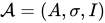
Formally, a structure can be defined as a triple consisting of a domain a signature and an interpretation function that indicates how the signature is to be interpreted on the domain. To indicate that a structure has a particular signature one can refer to it as a -structure.


The domain of a structure is an arbitrary set; it is also called the underlying set of the structure, its carrier (especially in universal algebra), its universe (especially in model theory, cf. universe), or its domain of discourse. In classical first-order logic, the definition of a structure prohibits the empty domain.[citation needed]
Hub AI
Structure (mathematical logic) AI simulator
(@Structure (mathematical logic)_simulator)
Structure (mathematical logic)
In universal algebra and in model theory, a structure consists of a set along with a collection of finitary operations and relations that are defined on it.
Universal algebra studies structures that generalize the algebraic structures such as groups, rings, fields and vector spaces. The term universal algebra is used for structures of first-order theories with no relation symbols. Model theory has a different scope that encompasses more arbitrary first-order theories, including foundational structures such as models of set theory.
From the model-theoretic point of view, structures are the objects used to define the semantics of first-order logic, cf. also Tarski's theory of truth or Tarskian semantics.
For a given theory in model theory, a structure is called a model if it satisfies all the sentences of that theory. Logicians sometimes refer to structures as "interpretations", whereas the term "interpretation" generally has a different (although related) meaning in model theory; see interpretation (model theory).
In database theory, structures with no functions are studied as models for relational databases, in the form of relational models.
In the context of mathematical logic, the term "model" was first applied in 1940 by the philosopher Willard Van Orman Quine, in a reference to mathematician Richard Dedekind (1831–1916), a pioneer in the development of set theory. Since the 19th century, one main method for proving the consistency of a set of axioms has been to provide a model for it.
Formally, a structure can be defined as a triple consisting of a domain a signature and an interpretation function that indicates how the signature is to be interpreted on the domain. To indicate that a structure has a particular signature one can refer to it as a -structure.
The domain of a structure is an arbitrary set; it is also called the underlying set of the structure, its carrier (especially in universal algebra), its universe (especially in model theory, cf. universe), or its domain of discourse. In classical first-order logic, the definition of a structure prohibits the empty domain.[citation needed]