



Community hub
Recent from talks
Knowledge base stats:
Talk channels stats:
Members stats:
Modern furniture
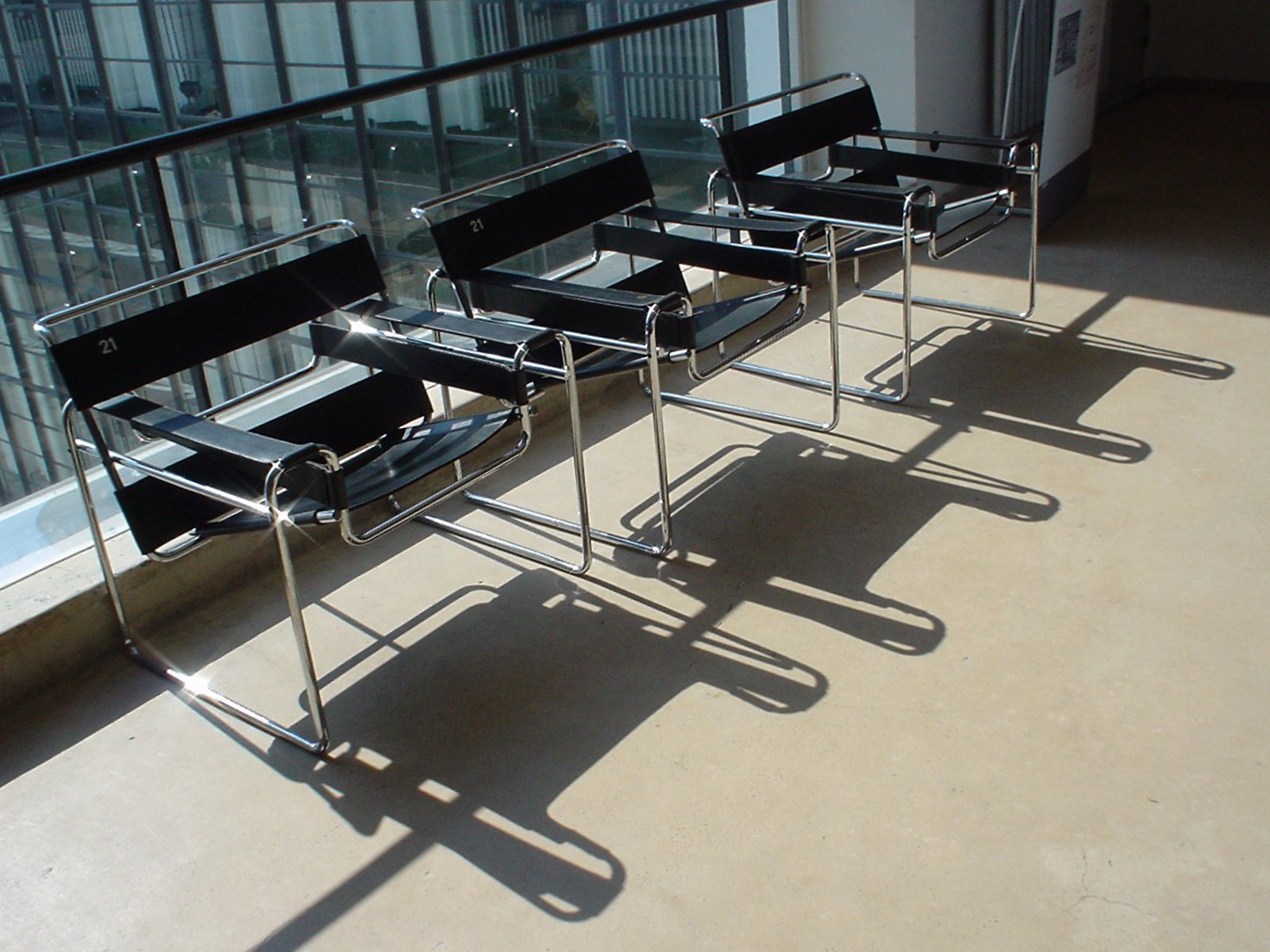
Modern furniture refers to furniture produced from the late 19th century through the present that is influenced by modernism. Post-World War II ideals of cutting excess, commodification, and practicality of materials in design heavily influenced the aesthetic of the furniture. It was a tremendous departure from all furniture design that had gone before it. There was an opposition to the decorative arts, which included Art Nouveau, Neoclassical, and Victorian styles. Dark or gilded carved wood and richly patterned fabrics gave way to the glittering simplicity and geometry of polished metal. The forms of furniture evolved from visually heavy to visually light. This shift from decorative to minimalist principles of design can be attributed to the introduction of new technology, changes in philosophy, and the influences of the principles of architecture. As Philip Johnson, the founder of the Department of Architecture and Design at the Museum of Modern Art articulates:
"Today industrial design is functionally motivated and follows the same principles as modern architecture: machine-like simplicity, smoothness of surface, avoidance of ornament ... It is perhaps the most fundamental contrast between the two periods of design that in 1900 the Decorative Arts possessed ..."
With the machine aesthetic, modern furniture easily came to promote factory modules, which emphasized the time-managing, efficient ideals of the period. Modernist design was able to strip down decorative elements and focus on the design of the object in order to save time, money, material, and labour. The goal of modern design was to capture timeless beauty in spare precision.
Prior to the modernist design movement, there was an emphasis on furniture as an ornament. The length of time a piece took to create was often a measure of its value and desirability. The origins of modernist design can be traced back to the Industrial Revolution and the birth of mechanized production. With new resources and advancements, a new philosophy emerged, one that shifted the emphasis of objects being created for decorative purposes to being designs that promote functionality, accessibility, and production.
The idea of accessible, mass-produced design that is affordable to anyone was not only applied to industrial mechanics, but also to the aesthetics of architecture and furniture. This philosophy of practicality came to be called Functionalism. It became a popular "catchword" and played a large role in theories of modern design. Functionalism rejected the imitation of stylistic and historical forms and sought an establishment of functionality in a piece. Functionalist designers would consider the interaction of the design with its user and how many of the features, such as shape, colour, and size, would conform to the human posture. Western design generally, whether architectural or design of furniture, had for millennia sought to convey an idea of lineage, a connection with tradition and history. However, the modern movement sought newness, originality, technical innovation, and ultimately the message that it conveyed spoke of the present and the future, rather than of what had gone before it.
The modernist design seems to have evolved out of a combination of influences: technically innovative materials and new manufacturing methods. Following the Second Industrial Revolution, new philosophies and artists emerged from the De Stijl movement in the Netherlands, the Deutscher Werkbund and the Bauhaus school, both located in Germany.
The De Stijl (The Style) movement, was founded in 1917 by Theo Van Doesburg in Amsterdam. The movement was based on the principles of promoting abstraction and universality by reducing excessive elements down to the essentials of form and colour. Dutch design generally has shown a preference for simple materials and construction, but De Stijl artists, architects, and designers strove to combine these elements to create a new visual culture. Characteristics of furniture from this movement include simplified geometry of vertical and horizontal compositions and pure primary colours and black and white. It was the rejection of the decorative excesses from Art Nouveau and promoted logicality through construction and function. Influential artists from this movement include Gerrit Rietveld, Piet Mondrian, and Mies van der Rohe, who continued to evolve the ideas of modernist design.
Founded in 1907 in Munich, Germany, the Deutscher Werkbund was an organization of artists, designers, and manufacturers that pushed to create a cultural utopia achieved through a design and new ideas in the early twentieth century. They shared the Modern thought of "form follows function" as well as the "ethnically pure" design principles such as quality, material honestly, functionality, and sustainability. The DWB played a key role in advocating these to other German artists and designers, which inspired the development of many Modern design institutions. Among the most notable architects and designers from the DWB are: Hermann Muthesius, Peter Behrens, and Ludwig Mies van der Rohe.
Hub AI
Modern furniture AI simulator
(@Modern furniture_simulator)
Modern furniture
Modern furniture refers to furniture produced from the late 19th century through the present that is influenced by modernism. Post-World War II ideals of cutting excess, commodification, and practicality of materials in design heavily influenced the aesthetic of the furniture. It was a tremendous departure from all furniture design that had gone before it. There was an opposition to the decorative arts, which included Art Nouveau, Neoclassical, and Victorian styles. Dark or gilded carved wood and richly patterned fabrics gave way to the glittering simplicity and geometry of polished metal. The forms of furniture evolved from visually heavy to visually light. This shift from decorative to minimalist principles of design can be attributed to the introduction of new technology, changes in philosophy, and the influences of the principles of architecture. As Philip Johnson, the founder of the Department of Architecture and Design at the Museum of Modern Art articulates:
"Today industrial design is functionally motivated and follows the same principles as modern architecture: machine-like simplicity, smoothness of surface, avoidance of ornament ... It is perhaps the most fundamental contrast between the two periods of design that in 1900 the Decorative Arts possessed ..."
With the machine aesthetic, modern furniture easily came to promote factory modules, which emphasized the time-managing, efficient ideals of the period. Modernist design was able to strip down decorative elements and focus on the design of the object in order to save time, money, material, and labour. The goal of modern design was to capture timeless beauty in spare precision.
Prior to the modernist design movement, there was an emphasis on furniture as an ornament. The length of time a piece took to create was often a measure of its value and desirability. The origins of modernist design can be traced back to the Industrial Revolution and the birth of mechanized production. With new resources and advancements, a new philosophy emerged, one that shifted the emphasis of objects being created for decorative purposes to being designs that promote functionality, accessibility, and production.
The idea of accessible, mass-produced design that is affordable to anyone was not only applied to industrial mechanics, but also to the aesthetics of architecture and furniture. This philosophy of practicality came to be called Functionalism. It became a popular "catchword" and played a large role in theories of modern design. Functionalism rejected the imitation of stylistic and historical forms and sought an establishment of functionality in a piece. Functionalist designers would consider the interaction of the design with its user and how many of the features, such as shape, colour, and size, would conform to the human posture. Western design generally, whether architectural or design of furniture, had for millennia sought to convey an idea of lineage, a connection with tradition and history. However, the modern movement sought newness, originality, technical innovation, and ultimately the message that it conveyed spoke of the present and the future, rather than of what had gone before it.
The modernist design seems to have evolved out of a combination of influences: technically innovative materials and new manufacturing methods. Following the Second Industrial Revolution, new philosophies and artists emerged from the De Stijl movement in the Netherlands, the Deutscher Werkbund and the Bauhaus school, both located in Germany.
The De Stijl (The Style) movement, was founded in 1917 by Theo Van Doesburg in Amsterdam. The movement was based on the principles of promoting abstraction and universality by reducing excessive elements down to the essentials of form and colour. Dutch design generally has shown a preference for simple materials and construction, but De Stijl artists, architects, and designers strove to combine these elements to create a new visual culture. Characteristics of furniture from this movement include simplified geometry of vertical and horizontal compositions and pure primary colours and black and white. It was the rejection of the decorative excesses from Art Nouveau and promoted logicality through construction and function. Influential artists from this movement include Gerrit Rietveld, Piet Mondrian, and Mies van der Rohe, who continued to evolve the ideas of modernist design.
Founded in 1907 in Munich, Germany, the Deutscher Werkbund was an organization of artists, designers, and manufacturers that pushed to create a cultural utopia achieved through a design and new ideas in the early twentieth century. They shared the Modern thought of "form follows function" as well as the "ethnically pure" design principles such as quality, material honestly, functionality, and sustainability. The DWB played a key role in advocating these to other German artists and designers, which inspired the development of many Modern design institutions. Among the most notable architects and designers from the DWB are: Hermann Muthesius, Peter Behrens, and Ludwig Mies van der Rohe.