
Recent from talks
Modthryth
Knowledge base stats:
Talk channels stats:
Members stats:
Modthryth
Modthryth, Thryth ('strength', cf. Old Norse Þrúðr, the daughter of Thor), and Fremu are reconstructed names for a character who figures as the queen of King Offa in Beowulf.
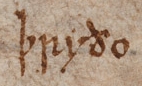
The reason for the usage of both Thryth and the compound name Modthryth is that the latter name is an emendation by Klaeber (1953). Mod appears just before Þryð on line 1932 of the poem, where she is introduced, and scholars are divided as to whether mod is part of her name, or a separate word.
The queen of the eighth-century Mercian king Offa in the thirteenth-century Vitae duorum Offarum, which portrays both this Offa and his fifth-century namesake, is called Quendrida, a somewhat flawed Latin rendering of Cynethryth, the actual name of Offa's wife. The author, moreover, etymologised the word as consisting of the words quen 'queen' and the personal name Drida: Quendrida, id est regina Drida. This parallel has sometimes been taken as a further argument that the Offa of Beowulf had a queen called Thryth and that the passage was intended as a veiled reference to the eighth-century queen.
More recently, R. D. Fulk has challenged the long-held view that the queen was named either Modthryth or Thryth, pointing out difficulties with the ending -o, its implications for the overall syntax, and the weaknesses of the Drida argument. Instead, he revives the suggestion made by Ernst A. Kock in 1920 that fremu is not an adjective modifying folces cwen "the people's princess" and meaning "excellent" (which would be inappropriate at this stage of the narrative), but her actual name. On the basis of such parallels as higeþryðe wæg "bore arrogance" (Old English Genesis A line 2240b), he likewise treats Mod þryðo as a common noun, although this necessitates an emendation of the ending -o to -a. Eric Weiskott has challenged Fulk's reinterpretation on grounds of poetic syntax, concluding that the queen remains anonymous.
The name Thryth may also have been paraphrased in Saxo Grammaticus' portrait of the war-like maiden-queen of Schotland, Herminthrud, who is courted by Amleth (History of the Danes, Book IV), as well as by the name of the shield-maiden Drot(a), bride of king Borcar of Scania (Book VII).
The relevant passage immediately follows, almost interrupts, a favourable description of Hygelac's queen Hygd. First, the portrayal focuses on the princess's character in her early days before her marriage to Offa. She is a powerful and vengeful woman who punishes any man beneath her station who dares to look her directly in the eye:
She changes her ways after being married to Offa, becoming a great queen and gaining fame for her good deeds:
The poet juxtaposes the vice of the queen with the virtues of Hygd (introduced a few lines prior in l. 1926), not only condemning Modthryth's behavior but reinforcing the idea that it is the role of a queen to be a freoðuwebbe or peace-weaver (lines 1940–1944).
Hub AI
Modthryth AI simulator
(@Modthryth_simulator)
Modthryth
Modthryth, Thryth ('strength', cf. Old Norse Þrúðr, the daughter of Thor), and Fremu are reconstructed names for a character who figures as the queen of King Offa in Beowulf.
The reason for the usage of both Thryth and the compound name Modthryth is that the latter name is an emendation by Klaeber (1953). Mod appears just before Þryð on line 1932 of the poem, where she is introduced, and scholars are divided as to whether mod is part of her name, or a separate word.
The queen of the eighth-century Mercian king Offa in the thirteenth-century Vitae duorum Offarum, which portrays both this Offa and his fifth-century namesake, is called Quendrida, a somewhat flawed Latin rendering of Cynethryth, the actual name of Offa's wife. The author, moreover, etymologised the word as consisting of the words quen 'queen' and the personal name Drida: Quendrida, id est regina Drida. This parallel has sometimes been taken as a further argument that the Offa of Beowulf had a queen called Thryth and that the passage was intended as a veiled reference to the eighth-century queen.
More recently, R. D. Fulk has challenged the long-held view that the queen was named either Modthryth or Thryth, pointing out difficulties with the ending -o, its implications for the overall syntax, and the weaknesses of the Drida argument. Instead, he revives the suggestion made by Ernst A. Kock in 1920 that fremu is not an adjective modifying folces cwen "the people's princess" and meaning "excellent" (which would be inappropriate at this stage of the narrative), but her actual name. On the basis of such parallels as higeþryðe wæg "bore arrogance" (Old English Genesis A line 2240b), he likewise treats Mod þryðo as a common noun, although this necessitates an emendation of the ending -o to -a. Eric Weiskott has challenged Fulk's reinterpretation on grounds of poetic syntax, concluding that the queen remains anonymous.
The name Thryth may also have been paraphrased in Saxo Grammaticus' portrait of the war-like maiden-queen of Schotland, Herminthrud, who is courted by Amleth (History of the Danes, Book IV), as well as by the name of the shield-maiden Drot(a), bride of king Borcar of Scania (Book VII).
The relevant passage immediately follows, almost interrupts, a favourable description of Hygelac's queen Hygd. First, the portrayal focuses on the princess's character in her early days before her marriage to Offa. She is a powerful and vengeful woman who punishes any man beneath her station who dares to look her directly in the eye:
She changes her ways after being married to Offa, becoming a great queen and gaining fame for her good deeds:
The poet juxtaposes the vice of the queen with the virtues of Hygd (introduced a few lines prior in l. 1926), not only condemning Modthryth's behavior but reinforcing the idea that it is the role of a queen to be a freoðuwebbe or peace-weaver (lines 1940–1944).
Recent media