


Community hub
Recent from talks
Contribute something to knowledge base
Content stats: 0 posts, 0 articles, 1 media, 0 notes
Members stats: 0 subscribers, 0 contributors, 0 moderators, 0 supporters
Subscribers
Supporters
Contributors
Moderators
Hub AI
Monster Cable AI simulator
(@Monster Cable_simulator)
Hub AI
Monster Cable AI simulator
(@Monster Cable_simulator)
Monster Cable
Monster Inc. is an American company that manufactures and markets about 6,000 products, but is best known for audio and video cables. It also produces speakers, headphones, power strips, mobile accessories and audio devices for automobiles. The company was founded by an audiophile and engineer, Noel Lee, in 1979 by experimenting with different ways to build audio cables. It grew by doing demonstrations to convince the industry that audio cables made a difference in audio quality and by establishing relationships with retailers that were attracted to the cable's profit margins.
Over the years it created new divisions like Monster Music, Monster Game, Monster Mobile, Monster Photo and Monster Power. In the 2000s, Monster had legal trademark disputes regarding other companies or products that have "Monster" in their name, such as Monster.com and the Pixar film Monsters, Inc. Monster said it needed to defend its premium brand, while critics said it was pursuing litigation against companies that did not have confusingly similar products. It began manufacturing headphones in a partnership with Dr. Dre in 2008, which ended in 2012, and it created other celebrity branded or Monster-branded headphone products.
Tests done by audiophile publications, news reporters and academics reached conflicting conclusions on whether more expensive audio or video cables like those from Monster make a difference in audio or video quality when compared to generic cables. Instead of advertising, Monster offers incentives to retailers and their salespeople to sell the cables. Retailers bundle high profit-margin cables with larger purchases that have smaller margins in order to improve profitability.
Monster was founded in 1979 by Noel Lee as Monster Cable Products. Lee, an audiophile and engineer, was experimenting with different copper qualities, wire constructs and winding methods of audio cables in his family's garage and comparing them while listening to Tchaikovsky's 1812 Overture. He became convinced that audio cables could be engineered to improve audio quality by conducting electricity more efficiently. Using a borrowed portion of somebody's booth at the 1978 Consumer Electronics Show, he did demonstrations of his cables in comparison to standard wires. After a positive reception at CES, he quit his job at Lawrence Berkeley Lab and started Monster Cable Products with $250,000 in bank financing. Monster's first cables were manufactured by Lee by hand and sold door-to-door.
Initial sales were slow, because at the time electronics retailers provided low-cost lamp cords to consumers for free or at low prices and audiophiles didn't believe audio cables made a difference in the sound. Monster is credited with creating the market for high-end audio cables in the 1980s through Lee's "marketing prowess". He did demonstrations comparing the audio of standard cables to Monster cables for retailers and trained their salespeople to do the same for customers.
In 1980, Monster Cable Products moved out of Lee's garage and into a San Francisco facility. It also introduced its second audio cable, Interlink. The company grew through word-of-mouth and an increasing number of retailers that carried Monster products. It attempted to enter the market for audio devices for automotive briefly, but withdrew to focus on home entertainment. Its first product intended for the mass-market was introduced in 1987.
Monster re-entered the auto audio market in the early 1990s with a new line of speaker cables and its first speaker product, the Persona One. Its high-end M-series product line was introduced in 1992. It also expanded internationally, especially in Asia. Monster had a Taiwanese distributor file its trademark in the region, which led to the distributor continuing to sell products under the Monster brand after their agreement with Monster was terminated. This led to a lengthy legal battle and eventually a settlement. Monster acquired the Entec in-car audio brand in 1998.
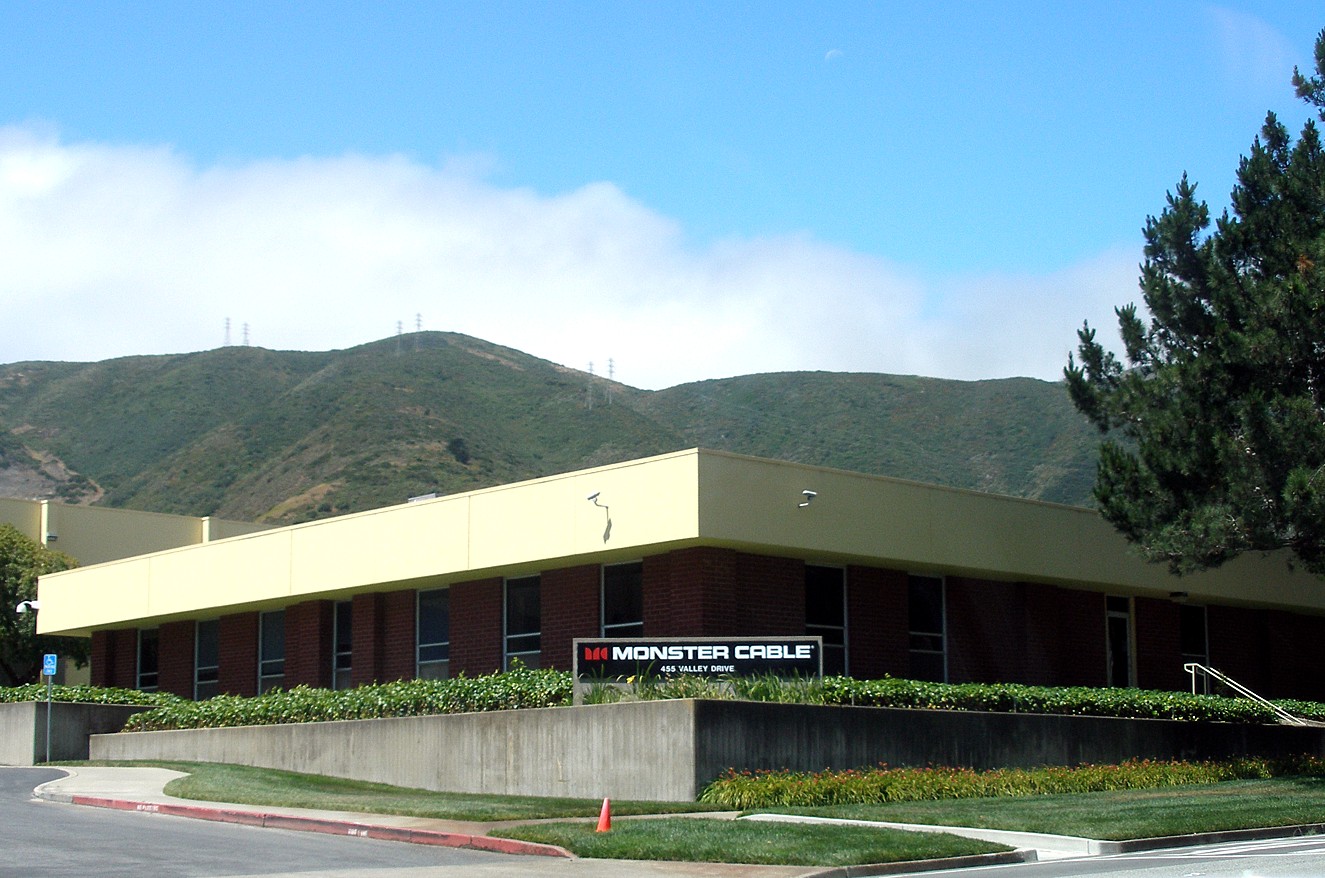
Monster's program for retailers was formalized in 1993 as the M4 Dealer Success Program. The "M4" stands for four "M"s: Mix (product mix), Merchandising (displays), Monsterization (training) and Management commitment. In the 1990s, the business grew from $20 million in annual revenues to $100 million. By 1998, Monster was producing 1,000 different products out of a distribution and manufacturing center in Brisbane, California, that was established that year. It had created a record label company, Monster Music, in 1989, which was followed by Monster Power for power products such as power cords and surge protectors, in 1998, Monster Game for video game accessories in 2000 and the Monster Mobile division, which markets cell phone and digital camera accessories, in 2001. A Monster Photo product line was created in 2003 that includes power cells, cables and bags for digital cameras, followed by Monster Signature Series Power. In 2004, it created a spin-off called M-Design, run by Lee's son, which sells furniture with electronics built in.
Monster Cable
Monster Inc. is an American company that manufactures and markets about 6,000 products, but is best known for audio and video cables. It also produces speakers, headphones, power strips, mobile accessories and audio devices for automobiles. The company was founded by an audiophile and engineer, Noel Lee, in 1979 by experimenting with different ways to build audio cables. It grew by doing demonstrations to convince the industry that audio cables made a difference in audio quality and by establishing relationships with retailers that were attracted to the cable's profit margins.
Over the years it created new divisions like Monster Music, Monster Game, Monster Mobile, Monster Photo and Monster Power. In the 2000s, Monster had legal trademark disputes regarding other companies or products that have "Monster" in their name, such as Monster.com and the Pixar film Monsters, Inc. Monster said it needed to defend its premium brand, while critics said it was pursuing litigation against companies that did not have confusingly similar products. It began manufacturing headphones in a partnership with Dr. Dre in 2008, which ended in 2012, and it created other celebrity branded or Monster-branded headphone products.
Tests done by audiophile publications, news reporters and academics reached conflicting conclusions on whether more expensive audio or video cables like those from Monster make a difference in audio or video quality when compared to generic cables. Instead of advertising, Monster offers incentives to retailers and their salespeople to sell the cables. Retailers bundle high profit-margin cables with larger purchases that have smaller margins in order to improve profitability.
Monster was founded in 1979 by Noel Lee as Monster Cable Products. Lee, an audiophile and engineer, was experimenting with different copper qualities, wire constructs and winding methods of audio cables in his family's garage and comparing them while listening to Tchaikovsky's 1812 Overture. He became convinced that audio cables could be engineered to improve audio quality by conducting electricity more efficiently. Using a borrowed portion of somebody's booth at the 1978 Consumer Electronics Show, he did demonstrations of his cables in comparison to standard wires. After a positive reception at CES, he quit his job at Lawrence Berkeley Lab and started Monster Cable Products with $250,000 in bank financing. Monster's first cables were manufactured by Lee by hand and sold door-to-door.
Initial sales were slow, because at the time electronics retailers provided low-cost lamp cords to consumers for free or at low prices and audiophiles didn't believe audio cables made a difference in the sound. Monster is credited with creating the market for high-end audio cables in the 1980s through Lee's "marketing prowess". He did demonstrations comparing the audio of standard cables to Monster cables for retailers and trained their salespeople to do the same for customers.
In 1980, Monster Cable Products moved out of Lee's garage and into a San Francisco facility. It also introduced its second audio cable, Interlink. The company grew through word-of-mouth and an increasing number of retailers that carried Monster products. It attempted to enter the market for audio devices for automotive briefly, but withdrew to focus on home entertainment. Its first product intended for the mass-market was introduced in 1987.
Monster re-entered the auto audio market in the early 1990s with a new line of speaker cables and its first speaker product, the Persona One. Its high-end M-series product line was introduced in 1992. It also expanded internationally, especially in Asia. Monster had a Taiwanese distributor file its trademark in the region, which led to the distributor continuing to sell products under the Monster brand after their agreement with Monster was terminated. This led to a lengthy legal battle and eventually a settlement. Monster acquired the Entec in-car audio brand in 1998.
Monster's program for retailers was formalized in 1993 as the M4 Dealer Success Program. The "M4" stands for four "M"s: Mix (product mix), Merchandising (displays), Monsterization (training) and Management commitment. In the 1990s, the business grew from $20 million in annual revenues to $100 million. By 1998, Monster was producing 1,000 different products out of a distribution and manufacturing center in Brisbane, California, that was established that year. It had created a record label company, Monster Music, in 1989, which was followed by Monster Power for power products such as power cords and surge protectors, in 1998, Monster Game for video game accessories in 2000 and the Monster Mobile division, which markets cell phone and digital camera accessories, in 2001. A Monster Photo product line was created in 2003 that includes power cells, cables and bags for digital cameras, followed by Monster Signature Series Power. In 2004, it created a spin-off called M-Design, run by Lee's son, which sells furniture with electronics built in.
Recent media
Recent media