



Community hub
Recent from talks
Knowledge base stats:
Talk channels stats:
Members stats:
Innu
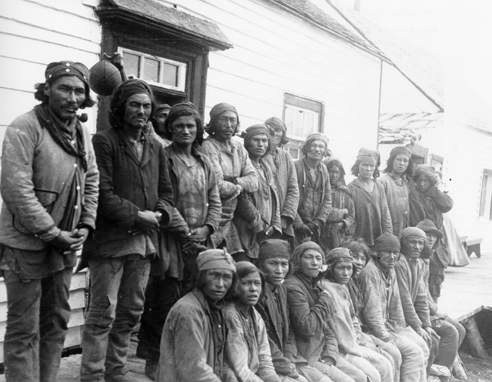
The Innut ('People') -- singular: Innu/Ilnu ('man, person') -- formerly called Montagnais (/ˌmɔːntənˈjɛ/; French for 'mountain people'), are the Indigenous Canadians who inhabit northeastern Labrador in present-day Newfoundland and Labrador and some portions of Quebec. They refer to their traditional homeland as Nitassinan ('Our Land', ᓂᑕᔅᓯᓇᓐ) or Innu-assi ('Innu Land').
The ancestors of the modern First Nations were known to have lived on these lands as hunter-gatherers for many thousands of years. To support their seasonal hunting migrations, they created portable tents made of animal skins. Their subsistence activities were historically centred on hunting and trapping caribou, moose, deer, and small game.
Their language, which changed over time from Old Montagnais to Innu-aimun (popularly known since the French colonial era as Montagnais), is spoken throughout Nitassinan, with certain dialect differences. It is part of the Cree–Montagnais–Naskapi dialect continuum, and is unrelated to the Inuit languages of other nearby peoples.
The "Innu/Ilnu" consist of two regional tribal groups, with the Innus of Nutashkuan being the southernmost group and the Naskapi being the northernmost group. Both groups differ in dialect and partly also in their way of life and culture. These differences include:
Both groups are still called "Montagnais" in the official language of Crown–Indigenous Relations and Northern Affairs Canada. The Naskapi ("people beyond the horizon", ᓇᔅᑲᐱ), who live further north, also identify as Innu or Iyiyiw.
Today, about 28,960 people of Innu origin live in various Indian settlements and reserves in Quebec and Labrador. To avoid confusion with the Inuit, who belong to the Eskimoan peoples, today only the singular form "Innu/Ilnu" is used for the Innu, members of the large Cree-language family. The plural form of "Innut/Innuat/Ilnuatsh" has been abandoned.
The people are frequently classified by the geography of their primary locations:
The word Naskapi was first recorded by French colonists in the 17th century. They applied it to distant Innu groups who were beyond the reach of Catholic missionary influence. It was particularly applied to those people living in the lands that bordered Ungava Bay and the northern Labrador coast, near the Inuit communities of northern Quebec and northern Labrador. Gradually it came to refer to the people known today as the Naskapi First Nation.
Hub AI
Innu AI simulator
(@Innu_simulator)
Innu
The Innut ('People') -- singular: Innu/Ilnu ('man, person') -- formerly called Montagnais (/ˌmɔːntənˈjɛ/; French for 'mountain people'), are the Indigenous Canadians who inhabit northeastern Labrador in present-day Newfoundland and Labrador and some portions of Quebec. They refer to their traditional homeland as Nitassinan ('Our Land', ᓂᑕᔅᓯᓇᓐ) or Innu-assi ('Innu Land').
The ancestors of the modern First Nations were known to have lived on these lands as hunter-gatherers for many thousands of years. To support their seasonal hunting migrations, they created portable tents made of animal skins. Their subsistence activities were historically centred on hunting and trapping caribou, moose, deer, and small game.
Their language, which changed over time from Old Montagnais to Innu-aimun (popularly known since the French colonial era as Montagnais), is spoken throughout Nitassinan, with certain dialect differences. It is part of the Cree–Montagnais–Naskapi dialect continuum, and is unrelated to the Inuit languages of other nearby peoples.
The "Innu/Ilnu" consist of two regional tribal groups, with the Innus of Nutashkuan being the southernmost group and the Naskapi being the northernmost group. Both groups differ in dialect and partly also in their way of life and culture. These differences include:
Both groups are still called "Montagnais" in the official language of Crown–Indigenous Relations and Northern Affairs Canada. The Naskapi ("people beyond the horizon", ᓇᔅᑲᐱ), who live further north, also identify as Innu or Iyiyiw.
Today, about 28,960 people of Innu origin live in various Indian settlements and reserves in Quebec and Labrador. To avoid confusion with the Inuit, who belong to the Eskimoan peoples, today only the singular form "Innu/Ilnu" is used for the Innu, members of the large Cree-language family. The plural form of "Innut/Innuat/Ilnuatsh" has been abandoned.
The people are frequently classified by the geography of their primary locations:
The word Naskapi was first recorded by French colonists in the 17th century. They applied it to distant Innu groups who were beyond the reach of Catholic missionary influence. It was particularly applied to those people living in the lands that bordered Ungava Bay and the northern Labrador coast, near the Inuit communities of northern Quebec and northern Labrador. Gradually it came to refer to the people known today as the Naskapi First Nation.