Hubbry Logo
InnuInnuMain
Open search
Innu
Community hub
Innu
logo
8 pages, 0 posts
0 subscribers
Be the first to start a discussion here.
Contribute something
Innu
Innu
from Wikipedia

Key Information

Innu, Ilnu / assi
"person" / "land"
PersonInnu / Ilnu
PeopleInnut / Innuat / Ilnuatsh
LanguageInnu-aimun
CountryNitassinan

The Innut ('People') -- singular: Innu/Ilnu ('man, person') -- formerly called Montagnais (/ˌmɔːntənˈjɛ/; French for 'mountain people'), are the Indigenous Canadians who inhabit northeastern Labrador in present-day Newfoundland and Labrador and some portions of Quebec. They refer to their traditional homeland as Nitassinan ('Our Land', ᓂᑕᔅᓯᓇᓐ) or Innu-assi ('Innu Land').

The ancestors of the modern First Nations were known to have lived on these lands as hunter-gatherers for many thousands of years. To support their seasonal hunting migrations, they created portable tents made of animal skins. Their subsistence activities were historically centred on hunting and trapping caribou, moose, deer, and small game.

Their language, which changed over time from Old Montagnais to Innu-aimun (popularly known since the French colonial era as Montagnais),[2] is spoken throughout Nitassinan, with certain dialect differences. It is part of the Cree–Montagnais–Naskapi dialect continuum, and is unrelated to the Inuit languages of other nearby peoples.

The "Innu/Ilnu" consist of two regional tribal groups, with the Innus of Nutashkuan being the southernmost group and the Naskapi being the northernmost group. Both groups differ in dialect and partly also in their way of life and culture. These differences include:

  • the Ilnu, Nehilaw or "Western/Southern Montagnais" in the south, speak the "l"-dialect (Ilnu-Aimun or Nenueun / Neːhlweːuːn), and
  • the Innu or "Eastern Montagnais" ("Central/Moisie Montagnais", "Eastern/Lower North Shore Montagnais", and "Labrador/North West River Montagnais") live further north; they speak the "n"-dialect (Innu-Aimun)

Both groups are still called "Montagnais" in the official language of Crown–Indigenous Relations and Northern Affairs Canada. The Naskapi ("people beyond the horizon", ᓇᔅᑲᐱ), who live further north, also identify as Innu or Iyiyiw.

Today, about 28,960[1] people of Innu origin live in various Indian settlements and reserves in Quebec and Labrador. To avoid confusion with the Inuit, who belong to the Eskimoan peoples, today only the singular form "Innu/Ilnu" is used for the Innu, members of the large Cree-language family. The plural form of "Innut/Innuat/Ilnuatsh" has been abandoned.

Montagnais, Naskapi or Innu

[edit]
Lands traditionally inhabited by the Innu. Naskapi land is shown in yellow and Montagnais land in red

The people are frequently classified by the geography of their primary locations:

  • the Neenoilno, live along the north shore of the Gulf of St. Lawrence, in Quebec; they have historically been referred to by Europeans as Montagnais (French for "mountain people", English pronunciation: /ˌmɔːntənˈj/),[3] or Innu proper (Nehilaw and Ilniw – "people")
  • The Naskapi (also known as Innu and Iyiyiw), live farther north and are less numerous. The Innu recognize several distinctions among their people (e.g. Mushuau Innuat, Maskuanu, Uashau Innuat) based on different regional affiliations and speakers of various dialects of the Innu language.
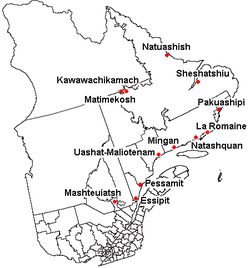
    Innu communities of Quebec and Labrador and the two Naskapi communities (Kawawachikamach and Natuashish)

The word Naskapi was first recorded by French colonists in the 17th century. They applied it to distant Innu groups who were beyond the reach of Catholic missionary influence. It was particularly applied to those people living in the lands that bordered Ungava Bay and the northern Labrador coast, near the Inuit communities of northern Quebec and northern Labrador. Gradually it came to refer to the people known today as the Naskapi First Nation.

The Naskapi are traditionally nomadic peoples, in contrast with the more sedentary Montagnais, who establish settled territories.

The Mushuau Innuat (plural), while related to the Naskapi, split off from the tribe in the 1900s. They were subject to a government relocation program at Davis Inlet. Some of the families of the Naskapi Nation of Kawawachikamach have close relatives in the Cree village of Whapmagoostui, on the eastern shore of Hudson Bay.

Since 1990, the Montagnais people have generally chosen to be officially referred to as the Innu, which means human being in Innu-aimun. The Naskapi have continued to use the word Naskapi.

Innu communities

[edit]

Labrador communities

[edit]
Peoples[a] Population
(2024)
Reserve or
Settlement
On reserve
population (2024)
Reserve area
ha acre sq mi
Mushuau Innu First Nation[5][6] 1,210 Natuashish 2[b] 1,115 4,267.3 42.67 16.48
Sheshatshiu Innu First Nation[8][9] 1,994 Sheshatshiu 1,773 804 8.04 3.10

Quebec communities

[edit]

Conseil tribal Mamit Innuat

[edit]

About 3,700 members

Peoples Population
(2024)
Reserve or
Settlement
On reserve
population (2024)
Reserve area
ha acre sq mi
Innus of Ekuanitshit[10][11] 732 Mingan 672 3,838 38.38 14.82
Première Nation des Innus de Nutashkuan[12][13] 1,274 Nutashkuan 1,148 118.9 1.19 0.46
Montagnais de Pakua Shipi (St-Augustin Indian Settlement)[14][15] 413 Pakuashipi[c] 41 0 0 0
Montagnais de Unamen Shipu[16][17] 1,286 Romaine 2[d] 1,135 69.4 0.69 0.27

Conseil tribal Mamuitun

[edit]

Over 23,000 members

Peoples Population
(2024)
Reserve or
Settlement
On reserve
population (2024)
Reserve area
ha acre sq mi
Innu Nation of Matimekush-Lac John[18][19][20] 1,065 Lac-John 3,621 23.5 0.24 0.09
Matimekosh 3[e] 65.4 0.65 0.25
Innu Takuaikan Uashat Mak Mani-Utenam[21][22][23] 5,039 Maliotenam 27A 3,621 527 5.27 2.03
Uashat 27 210 2.10 0.81
Innue Essipit[24][25] 2,032 Innue Essipit 261 86.5 0.87 0.33
Pekuakamiulnuatsh First Nation[26][27] 11,037 Mashteuiatsh 2,115 1,626.9 16.27 6.28
Pessamit Innu Band[28][29] 4,185 Betsiamites (Pessamit) 2,849 25,205 252.05 97.32

Kawawachikamach

[edit]
Peoples Population
(2024)
Reserve or
Settlement
On reserve
population (2024)
Reserve area
ha acre sq mi
Naskapi Nation of Kawawachikamach[30][31] 817 Kawawachikamach
(Kawawachikamach (Naskapi village municipality))
704 0 0 0

History

[edit]
Reindeer hunting in Labrador

The Innu were possibly the group identified in Greenlandic Norse by Norsemen as Skrælings. They referred to Nitassinan as Markland.

The Innu were historically allied with neighbouring Atikamekw, Wolastoqiyik (Maliseet) and Algonquin peoples against their enemies, the Algonquian-speaking Mi'kmaq and Iroquoian-speaking Five Nations of the Iroquois Confederacy (known as Haudenosaunee. During the Beaver Wars (1609–1701), the Iroquois repeatedly invaded the Innu territories from their homelands south of the Great Lakes. They took women and young males as captive slaves, and plundered their hunting grounds in search of more furs. Since these raids were made by the Iroquois with unprecedented brutality, the Innu themselves adopted the torment, torture, and cruelty of their enemies.

The Naskapi, on the other hand, usually had to confront the southward advancing Inuit in the east of the peninsula.

Roman Catholic procession of First Nations people in the Labrador peninsula

Innu oral tradition describes the original encounters of the Innu and the French explorers led by Samuel de Champlain as fraught with distrust. Neither group understood the language of the other, and the Innu were concerned about the motives of the French explorers.[32]

The French asked permission to settle on the Innu's coastal land, which the Innu called Uepishtikueiau. This eventually developed as Quebec City. According to oral tradition, the Innu at first declined their request. The French demonstrated their ability to farm wheat on the land and promised they would share their bounty with the Innu in the future, which the Innu accepted.[33]

Two distinct versions of the oral history describe the outcome. In the first, the French used gifts of farmed food and manufactured goods to encourage the Innu to become dependent on them. Then, the French changed it to a mercantile relationship: trading these items to the Innu in exchange for furs. When the nomadic Innu went inland for the winter, the French increased the size and population of their settlement considerably, eventually completely displacing the Innu.[34]

The second, and more widespread, version of the oral history describes a more immediate conflict. In this version, the Innu taught the French how to survive in their traditional lands. Once the French had learned enough to survive on their own, they began to resent the Innu. The French began to attack the Innu, who retaliated in an attempt to reclaim their ancestral territory. The Innu had a disadvantage in numbers and weaponry, and eventually began to avoid the area rather than risk further defeat. During this conflict, the French colonists took many Innu women as wives. French women did not immigrate to New France in the early period.[35]

French explorer Samuel de Champlain eventually became involved in the Innu's conflict with the Iroquois, who were ranging north from their traditional territory around the Great Lakes in present-day New York and Pennsylvania. On July 29, 1609, at Ticonderoga or Crown Point, New York, (historians are not sure which of these two places), Champlain and his party encountered a group of Iroquois, likely Mohawk, who were the easternmost tribe of the Five Nations of the Iroquois Confederacy. A battle began the next day. As two hundred Iroquois advanced on Champlain's position, a native guide pointed out the three enemy chiefs to the French. According to legend, Champlain fired his arquebus and killed two of the Mohawk chiefs with one shot; one of his men shot and killed the third. The Mohawk reportedly fled the scene. Although the French also traded extensively with the Mohawk and other Iroquois, and converted some to Catholicism, they also continued to have armed conflicts with them.

Historical bands

[edit]

The southern bands of the Montagnais-Naksapi were encountered by Europeans early in the seventeenth century while the northern ones, except for some on James Bay, were not well known until the nineteenth century.

The following are bands of the Montagnais-Naksapi in the 17th century:

By 1850, the Chisedec, Oumamiwek, and Papinachois had disappeared or been renamed, and many new bands in the north of Nitassinan were discovered:

Present status

[edit]

The Innu of Labrador and those living on the north shore of the Gulf of St. Lawrence in the Canadian Shield region have never officially ceded their territory to Canada by way of treaty or other agreement. But, as European-Canadians began widespread forest and mining operations at the turn of the 20th century, the Innu became increasingly settled in coastal communities and in the interior of Quebec. The Canadian and provincial governments, the Catholic, Moravian, and Anglican churches, all encouraged the Innu to settle in more permanent, majority-style communities, in the belief that their lives would improve with this adaptation. This coercive assimilation resulted in the Innue giving up some traditional activities (hunting, trapping, fishing). Because of these social disruptions and the systemic disadvantages faced by Indigenous peoples, community life in the permanent settlements often became associated with high levels of substance abuse, domestic violence, and suicide among the Innu.

Labrador Innu organizations and land claims

[edit]

In 1999, Survival International published a study of the Innu communities of Labrador. It assessed the adverse effects of the Canadian government's relocating the people far from their ancestral lands and preventing them from practising their ancient way of life.[37]

The Innu people of Labrador formally organized the Naskapi Montagnais Innu Association in 1976 to protect their rights, lands, and way of life against industrialization and other outside forces. The organization changed its name to the Innu Nation in 1990 and functions today as the governing body of the Labrador Innu. The group has won recognition for its members as status Indians under Canada's Indian Act in 2002 and is currently involved in land claim and self-governance negotiations with the federal and provincial governments.[4]

In addition to the Innu Nation, residents at both Natuashish and Sheshatshiu elect Band Councils to represent community concerns. The chiefs of both councils sit on the Innu Nation's board of directors and the three groups work in cooperation with one another.

The Innu Nation's efforts to raise awareness about the environmental impacts of a mining project in Voisey's Bay were documented in Marjorie Beaucage's 1997 film Ntapueu ... i am telling the truth.[38]: 342 

Davis Inlet, Labrador

[edit]

In the 1999 study of Innu communities in Labrador, Survival International concluded that government policies violated contemporary international law in human rights, and drew parallels with the treatment of Tibetans by the People's Republic of China. According to the study, from 1990 to 1997, the Innu community of Davis Inlet had a suicide rate more than twelve times the Canadian average, and well over three times the rate often observed in isolated northern villages.[37]

By 2000, the Innu island community of Davis Inlet asked the Canadian government to assist with a local addiction public health crisis. At their request, the community was relocated to a nearby mainland site, now known as Natuashish.[39][40][41] At the same time, the Canadian government created the Natuashish and Sheshatshiu band councils under the Indian Act.

Kawawachikamach, Quebec

[edit]

Naskapi Nation of Kawawachikamach, Quebec, signed a comprehensive land claims settlement, the Northeastern Quebec Agreement; they did so in 1978. As a consequence, the Naskapi of Kawawachikamach are no longer subject to certain provisions of the Indian Act. All the Innu communities of Quebec are still subject to the Act.

New York Power Authority controversy

[edit]

The New York Power Authority's proposed contract in 2009 with the province of Quebec to buy power from its extensive hydroelectric dam facilities has generated controversy, because it was dependent on construction of a new dam complex and transmission lines that would have interfered with the traditional ways of the Innu.[42] According to the Sierra Club:

[t]he "New York Power Authority is in preliminary discussions and considering the liability of a new contract with Hydro Quebec," a Canadian supplier of hydroelectricity.

— Legislative Gazette[42]

The Innu community, the Sierra Club, and the National Lawyers Guild are fighting to prevent this proposed contract, which would have to be approved by New York's Governor, under his regulatory authority.[42] The problem is that construction of required electric transmission lines would hinder the Innu's hunting-gathering-fishing lifestyle:

Chief Georges-Ernest Grégoire of the Innu community in Eastern Quebec urged the governor not to proceed with a plan to buy hydroelectric power from Canada, saying the dam complex that would be built would affect the traditional way of life for his people.

— Legislative Gazette (caption for a photo of Chief Grégoire)[42]

Chief Grégoire's comments at a press conference in Albany, New York were translated, but whether from French or Innu-aimun is not clear.[42]

Natuashish and Sheshatshiu, Newfoundland and Labrador

[edit]

Innu have only been in Sheshatshiu since fur trading posts were established by the Hudson's Bay Company in North West River in the mid-1700s and only in Davis Inlet / Natuashish since 1771, when the Moravian Church set up the first mission at Nuneingoak on the Labrador coast.[43] Danny Williams, the then Premier of Newfoundland and Labrador struck a deal on September 26, 2008, with Labrador's Innu to permit construction of Muskrat Falls Generating Station, a hydroelectric megaproject to proceed on the proposed Lower Churchill site. They also negotiated compensation for another project on the Upper Churchill, where large tracts of traditional Innu hunting lands were flooded.

Culture

[edit]
"Buckle up your children" sign in Innu-aimun language, in the Pointe-Parent reserve near Natasquan, Quebec.
Housing

The Innu people grate the inner bark of Abies balsamea (balsam fir) and eat it to benefit the diet.[44]

Traditional crafts

[edit]

Traditional Innu craft is demonstrated in the Innu tea doll. These children's toys originally served a dual purpose for nomadic Innu tribes. When travelling vast distances over challenging terrain, the people left nothing behind. They believed that "Crow" would take it away. Everyone, including young children, helped to transport essential goods. Innu women made intricate dolls from caribou hides and scraps of cloth. They filled the dolls with tea and gave them to young girls to carry on long journeys. The girls could play with the dolls while also carrying important goods. Every able-bodied person carried something. Men generally carried the heavier bags and women would carry young children.

Traditional clothing, style and accessories

[edit]

Men wore caribou pants and boots with a buckskin long shirt, all made by women. With the introduction of trade cloth from the French and English, people began replacing the buckskin shirts with ones made of cloth. Most still wore boots and pants made from caribou hide. Women wore long dresses of buckskin. Contemporary Innu women have often replaced these with manufactured pants and jackets. Women traditionally wore their hair long or in two coils. Men wore theirs long.

Both genders wore necklaces made of bone and bead. Smoke pipes were used by both genders, marked for women as shorter. If a man killed a bear, it was a sign of joy and initiation into adulthood and the man would wear a necklace made from the bear's claws.

Housing

[edit]

The houses of the Montagnais were cone shaped. The Naskapi made long, domed houses covered in caribou hides. These days the hearth is a metal stove in the centre of the house.

Traditional foods

[edit]

Animals traditionally eaten included moose, caribou, porcupine, rabbits, marten, woodchuck, squirrel; Canada goose, snow goose, brants, ducks, teal, loons, spruce grouse, woodcock, snipe, passenger pigeons, ptarmigan; whitefish, lake trout, salmon, Arctic char, seal (naskapi) pike, walleye, suckerfish (Catostomidae), sturgeon, catfish, lamprey, and smelt. Fish were eaten roasted or smoke-dried. Moose meat and several types of fish were also smoked. Oat bannock, introduced by the French in the 16th century, became a staple and Indigenous bannock is still eaten today. Meat was eaten frozen, raw or roasted, and caribou was sometimes boiled in a stew. Pemmican was made with moose or caribou.

Plants traditionally eaten included raspberries, blueberries, strawberries, cherries, wild grapes, hazelnuts, crab apples, red martagon bulbs, Indian potato, and maple-tree sap for sweetening. Cornmeal was traded with other First Nations peoples, such as the Iroquois, Algonquin, and Abenaki, and made into apon (cornbread), which sometimes also included oat or wheat flour when it became available. Pine needle tea was meant to keep away infections and colds resulting from the harsh weather.

Buckskin

[edit]

Traditionally, buckskin leather was a most important material used for clothing, boots, moccasins, house covers and storage. Women prepared the hides and many of the products made from it. They scraped the hides to remove all fur, then left them outside to freeze. The next step was to stretch the hide on a frame. They rubbed it with a mixture of animal brain and pine needle tea to soften it. The dampened hide was formed into a ball and left overnight. In the morning, it would be stretched again, then placed over a smoker to smoke and tan it. The hide was left overnight. The finished hide was called buckskin.

Mythology

[edit]

The oral traditions of the Innu are noted as similar to those of other Cree-speaking cultures.[45] Of particular relevance is Tshakapesh, a lunar folk hero.[46]

Canoes

The spirits they believed in are Caribou Master, Atshen, and Matshishkapeu.

Film and television

[edit]

The Innu people were profiled in Carcajou et le péril blanc (Kauapishit Miam Kuakuatshen Etentakuess), a documentary film series by Arthur Lamothe which were among the first films in the history of cinema to depict indigenous peoples speaking their own languages.[47]

Other important later films set in Innu communities have included the narrative feature films Le Dep, Mesnak and Kuessipan, and the documentary films Innu Nikamu: Resist and Sing and Call Me Human.

Transportation

[edit]

In traditional Innu communities, people walked or used snowshoes. While people still walk and use snowshoes where necessary for hunting or trapping, many Innu communities rely heavily on trucks, SUVs, and cars; in northern Innu communities, people use snowmobiles for hunting and general transportation.

Notable people

[edit]

See also

[edit]

Notes

[edit]

Citations

[edit]
  1. ^ a b "Indigenous Population Profile, 2021 Census of Population Profile table: Canada [Country]". www12.statcan.gc.ca. Statistics Canada. June 8, 2023. Retrieved June 15, 2024.
  2. ^ "Innu-Aimun - the language of the Innu (Montagnais)". Archived from the original on September 30, 2011.
  3. ^ Rogers & Leacock (1981:169)
  4. ^ a b Higgins, Jenny (2008). "Innu Rights and Government in Labrador". Archived from the original on June 8, 2023. Retrieved June 15, 2024.
  5. ^ "Registered Population - Mushuau Innu First Nation". fnp-ppn.aadnc-aandc.gc.ca. Government of Canada; Crown–Indigenous Relations and Northern Affairs Canada; Communications Branch. May 3, 2024. Retrieved June 15, 2024.
  6. ^ Reserve, settlement or village details for Natuashish 2 Reserve at Indigenous and Northern Affairs Canada. Retrieved June 15, 2024.
  7. ^ "Davis Inlet Innu get new home". Aboriginal Multi-Media Society of Alberta (AMMSA). 1996. Retrieved June 15, 2024.
  8. ^ "Registered Population - Sheshatshiu Innu First Nation". fnp-ppn.aadnc-aandc.gc.ca. Government of Canada; Crown–Indigenous Relations and Northern Affairs Canada; Communications Branch. May 3, 2024. Retrieved June 15, 2024.
  9. ^ Reserve, settlement or village details for Sheshatshiu 3 Reserve at Indigenous and Northern Affairs Canada. Retrieved June 15, 2024.
  10. ^ "Registered Population - Les Innus de Ekuanitshit". fnp-ppn.aadnc-aandc.gc.ca. Government of Canada; Crown–Indigenous Relations and Northern Affairs Canada; Communications Branch. May 3, 2024. Retrieved June 15, 2024.
  11. ^ Reserve, settlement or village details for Mingan Reserve at Indigenous and Northern Affairs Canada. Retrieved June 15, 2024.
  12. ^ "Registered Population - Première Nation des Innus de Nutashkuan". fnp-ppn.aadnc-aandc.gc.ca. Government of Canada; Crown–Indigenous Relations and Northern Affairs Canada; Communications Branch. May 3, 2024. Retrieved June 15, 2024.
  13. ^ Reserve, settlement or village details for Nutashkuan Reserve at Indigenous and Northern Affairs Canada. Retrieved June 15, 2024.
  14. ^ "Registered Population - Montagnais de Pakua Shipi". fnp-ppn.aadnc-aandc.gc.ca. Government of Canada; Crown–Indigenous Relations and Northern Affairs Canada; Communications Branch. May 3, 2024. Retrieved June 15, 2024.
  15. ^ Reserve, settlement or village details for St. Augustin Indian Settlement Reserve at Indigenous and Northern Affairs Canada. Retrieved June 15, 2024.
  16. ^ "Registered Population - Montagnais de Pakua Shipi". fnp-ppn.aadnc-aandc.gc.ca. Government of Canada; Crown–Indigenous Relations and Northern Affairs Canada; Communications Branch. May 3, 2024. Retrieved June 15, 2024.
  17. ^ Reserve, settlement or village details for Romaine 2 Reserve at Indigenous and Northern Affairs Canada. Retrieved June 15, 2024.
  18. ^ "Registered Population - La Nation Innu Matimekush-Lac John". fnp-ppn.aadnc-aandc.gc.ca. Government of Canada; Crown–Indigenous Relations and Northern Affairs Canada; Communications Branch. May 3, 2024. Retrieved June 15, 2024.
  19. ^ Reserve, settlement or village details for Lac John Reserve at Indigenous and Northern Affairs Canada. Retrieved June 15, 2024.
  20. ^ Reserve, settlement or village details for Matimekosh 3 Reserve at Indigenous and Northern Affairs Canada. Retrieved June 15, 2024.
  21. ^ "Registered Population - Innu Takuaikan Uashat Mak Mani-Utenam". fnp-ppn.aadnc-aandc.gc.ca. Government of Canada; Crown–Indigenous Relations and Northern Affairs Canada; Communications Branch. May 3, 2024. Retrieved June 15, 2024.
  22. ^ Reserve, settlement or village details for Maliotenam 27A Reserve at Indigenous and Northern Affairs Canada. Retrieved June 15, 2024.
  23. ^ Reserve, settlement or village details for Uashat 27 Reserve at Indigenous and Northern Affairs Canada. Retrieved June 15, 2024.
  24. ^ "Registered Population - Essipit". fnp-ppn.aadnc-aandc.gc.ca. Government of Canada; Crown–Indigenous Relations and Northern Affairs Canada; Communications Branch. May 3, 2024. Retrieved June 15, 2024.
  25. ^ Reserve, settlement or village details for Innue Essipit Reserve at Indigenous and Northern Affairs Canada. Retrieved June 15, 2024.
  26. ^ "Registered Population - Première Nation des Pekuakamiulnuatsht". fnp-ppn.aadnc-aandc.gc.ca. Government of Canada; Crown–Indigenous Relations and Northern Affairs Canada; Communications Branch. May 3, 2024. Retrieved June 15, 2024.
  27. ^ Reserve, settlement or village details for Mashteuiatsh Reserve at Indigenous and Northern Affairs Canada. Retrieved June 15, 2024.
  28. ^ "Registered Population - Bande des Innus de Pessamit". fnp-ppn.aadnc-aandc.gc.ca. Government of Canada; Crown–Indigenous Relations and Northern Affairs Canada; Communications Branch. May 3, 2024. Retrieved June 15, 2024.
  29. ^ Reserve, settlement or village details for Betsiamites Reserve at Indigenous and Northern Affairs Canada. Retrieved June 15, 2024.
  30. ^ "Registered Population - Naskapi Nation of Kawawachikamach". fnp-ppn.aadnc-aandc.gc.ca. Government of Canada; Crown–Indigenous Relations and Northern Affairs Canada; Communications Branch. May 3, 2024. Retrieved June 15, 2024.
  31. ^ Reserve, settlement or village details for Kawawachikamach Reserve at Indigenous and Northern Affairs Canada. Retrieved June 15, 2024.
  32. ^ Vincent, Sylvie (2006). "The Uepishtikueiau Narrative: The Arrival of the French at the site of Québec City according to Innu Oral Tradition". In Christie, Gordon (ed.). Aboriginality and Governance: A Multidisciplinary Approach. Penticton Indian Reserve, British Columbia: Theytus Books. pp. 7–9. ISBN 1894778243.
  33. ^ Vincent 2006, p. 10.
  34. ^ Vincent 2006, p. 12–15.
  35. ^ Vincent 2006, p. 15–17.
  36. ^ "Montagnais-Naskapi Indians of Canada". www.canadiangenealogy.net. Retrieved July 15, 2024.
  37. ^ a b Canada's Tibet: The Killing of the Innu, a report from Survival International (PDF file)
  38. ^ Bell, Lynne; Williamson, Janice (2002). "In the Hands of the People: A Conversation with Marjorie Beaucage". In Beard, William; White, Jerry (eds.). North of Everything: English-Canadian Cinema Since 1980. University of Alberta. ISBN 9780888643902.
  39. ^ "Davis Inlet Innu get new home". Aboriginal Multi-Media Society of Alberta (AMMSA). 1996. Retrieved October 16, 2020.
  40. ^ "The Innu of Labrador: From Davis Inlet to Natuashish". CBC News. February 14, 2005. Archived from the original on July 23, 2012. Retrieved October 27, 2020.
  41. ^ Fennell, Tom (February 15, 1993). "Horror in Davis Inlet". Maclean's. Archived from the original on November 29, 2020. Retrieved October 27, 2020.
  42. ^ a b c d e Katrina Kieltyka, "Sierra Club fighting plan to buy Canadian power: Say hydroelectric dams would harm indigenous people," Legislative Gazette, March 16, 2009, p. 21, available at Legislative Gazette archives Archived 2009-03-25 at the Wayback Machine (.pdf file). Retrieved March 20, 2009.
  43. ^ Rivet, France (February 7, 2006). "Moravian Missions in Labrador". www.thecanadianencyclopedia.ca. The Canadian Encyclopedia . Retrieved June 17, 2024.
  44. ^ Speck, Frank G., 1917, Medicine Practices of the Northeastern Algonquians, Proceedings of the 19th International Congress of Americanists Pp. 303–321, page 313
  45. ^ "Naskapi and Montagnais Innu Legends (Folklore, Myths, and Traditional Indian Stories)".
  46. ^ "Tshakapesh (Chakabesh), dwarf hero of the Innu and Cree".
  47. ^ Isabelle Morissette, "Carcajou et le péril blanc/Kauapishit Miam Kuakuatshen Etentakuess" (pp. 29–30) in Guide to the Cinema(s) of Canada (Peter H. Rist, ed.) Bloomsbury Publishing, 2002. ISBN 9780313017254.
  48. ^ "Meet Canada's first Innu MP, the Bloc's Bernard Cleary". The Hill Times, November 8, 2004.
  49. ^ Sylvain Turcotte, "Sharon Fontaine-Ishpatao se plaît à jouer". Le Nord-Côtier, August 2, 2022.
  50. ^ a b "Kashtin". The Canadian Encyclopedia. Historica Canada. September 19, 2023. Archived from the original on May 18, 2005. Retrieved October 3, 2009.
  51. ^ "Penashue appointed to federal cabinet". Canadian Broadcasting Corporation. May 18, 2011. Retrieved May 18, 2011.

General bibliography

[edit]
[edit]
Revisions and contributorsEdit on WikipediaRead on Wikipedia
from Grokipedia
The Innu are Algonquian-speaking Indigenous peoples whose traditional territory, Nitassinan, encompasses the eastern Quebec-Labrador peninsula in subarctic Canada, including forests, tundra, rivers, and coastal areas. With a total population exceeding 27,000, they reside primarily in eleven communities in Quebec and two in Labrador, speaking the Innu-aimun language, which serves as the first language for most members. Historically nomadic hunters reliant on caribou migrations for sustenance, clothing, and tools, the Innu maintained small family bands using seasonal camps, with their culture deeply intertwined with the land and animal spirits. Traditionally divided into Montagnais (Iyinu) groups in southern areas and Naskapi (Iyiyiu) in northern Labrador, the Innu faced early European contact through fur trade but experienced profound disruptions in the 19th and 20th centuries from disease, resource competition, and government-imposed sedentarization into permanent villages during the 1950s-1960s. This relocation, often coerced by Canadian authorities and religious institutions, contributed to severe social challenges including high rates of alcoholism, solvent abuse, violence, and suicide, eroding traditional lifestyles and community structures. In recent decades, the Innu have pursued land claims, self-governance negotiations, and cultural revitalization, while contesting industrial developments like hydroelectric dams and mining that have flooded lands and disrupted caribou herds essential to their heritage. Efforts in language preservation, such as dictionary creation in communities like Pessamit, underscore ongoing commitments to maintaining Innu-aimun amid French and English dominance.

Terminology and Identity

Names, Subgroups, and Self-Identification

The Innu primarily self-identify as Innu, an autonym from their language Innu-aimun that translates to "the people". This term has become the predominant designation, unifying groups historically known by other names and reflecting a collective identity across the Labrador-Quebec peninsula. Historically, European and Indigenous descriptors divided the Innu into subgroups: Montagnais, a French term meaning "mountain people", applied to bands in the southern forested regions; and Naskapi, referring to those in the northern subarctic barrens. These labels originated from territorial adaptations and dialect variations within the Cree-Montagnais-Naskapi linguistic continuum, with Montagnais bands speaking southern dialects and Naskapi using northern ones distinguished by phonetic shifts, such as the pronunciation of certain Proto-Algonquian sounds. In modern contexts, the Innu are geographically categorized into Labrador Innu and Quebec Innu, corresponding to provincial jurisdictions rather than stark cultural separations; Labrador communities include Sheshatshiu and Natuashish, while Quebec ones encompass Pessamit, Uashat mak Mani-utenam, and Kawawachikamach, the latter retaining a distinct Naskapi identity. Dialectal differences persist mildly between these regional groups, enabling mutual intelligibility yet marking subtle variations in vocabulary and pronunciation. The 2021 Canadian Census recorded 17,970 individuals identifying as Innu or Montagnais and 735 as Naskapi, indicating strong preference for the broader Innu self-identification.

Geography and Demographics

Traditional Territories and Migration Patterns

The traditional territories of the Innu, known as Nitassinan or "Our Land," encompass the eastern portion of the Quebec-Labrador peninsula, spanning from the coastal regions of Labrador to the interior of northeastern Quebec. This vast subarctic landscape includes key areas such as Grand Lake (Kakatshu-utshishtun), Lake Melville (Atatshuinipeku), and the offshore island of Davis Inlet (Utshimassit). The Innu maintained occupancy through resource use rather than fixed settlements, with families and bands holding customary rights to specific hunting grounds within Nitassinan. The Innu practiced a nomadic lifestyle organized into small family bands, moving seasonally to follow the migrations of caribou, fish, and birds, which dictated their economic and subsistence patterns. In winter, when waterways froze, bands snow-shoed across the interior barrens in pursuit of caribou herds, such as those of the George River, relying on these animals for food, clothing, and tools. This mobility allowed intimate knowledge of the terrain, enabling adaptation to harsh subarctic conditions through portable skin tents and specialized equipment like snowshoes. During summer, groups shifted toward coastal zones for salmon fishing and gathering, reversing the inland focus of colder months. Nomadism followed a cyclical pattern tied to seasonal changes: fall preparations for winter hunts, extended interior pursuits through winter and spring, and coastal relocations in summer. Archaeological and oral historical evidence confirms this pattern persisted for millennia, with Innu presence in Nitassinan dating back approximately 8,000 years prior to European contact. Such movements ensured sustainable resource exploitation, as bands avoided over-depleting local game by relocating before scarcity set in.

Current Population and Community Locations

As of the 2021 Canadian Census, 28,225 individuals self-identified as Innu (Montagnais), not otherwise specified, representing the core of the contemporary Innu population. This figure encompasses those reporting Innu ancestry or identity, though registered band membership may differ slightly due to eligibility criteria under the Indian Act. The population is concentrated in 13 communities, with two in Newfoundland and Labrador and 11 in Quebec, primarily along the Labrador-Quebec peninsula known traditionally as Nitassinan. In eastern Labrador, the Innu Nation comprises approximately 3,200 members residing mainly in Sheshatshiu, located on the shores of Lake Micmac near Happy Valley-Goose Bay, and Natuashish, situated inland along the Trans-Labrador Highway. Sheshatshiu serves as the administrative center for the Sheshatshiu Innu First Nation, while Natuashish is the home of the Mushuau Innu First Nation, relocated from Davis Inlet in 2002 to address social challenges. Quebec's Innu communities are distributed across the Côte-Nord region and Saguenay–Lac-Saint-Jean, including:
  • Innu Takuaikan Uashat mak Mani-utenam, near Sept-Îles, with reserves at Uashat and Maliotenam;
  • Pessamit Innu Band, at Betsiamites on the St. Lawrence River's north shore;
  • Les Innus de Ekuanitshit, at Mingan;
  • Innu of Unamen Shipu, at La Romaine;
  • Innu of Pakua Shipi, at Pakuashipi;
  • Innu of Natashquan, at Natashquan;
  • Innu of Matimekosh and Lac-John, near Schefferville;
  • Innu of Sheshatshit, at La Romaine;
  • Essipit Innu Band, near Tadoussac;
  • Mashteuiatsh, near Roberval.
These communities vary in size, with larger ones like Pessamit reporting over 4,000 registered members as of 2024, reflecting ongoing demographic growth driven by high birth rates and cultural retention efforts. Urban migration to cities such as Sept-Îles, Baie-Comeau, and Labrador City also influences distribution, with some Innu living off-reserve while maintaining ties to their communities.

Historical Overview

Pre-Contact Society and Economy

The Innu, Algonquian-speaking Indigenous peoples of the Labrador-Quebec peninsula, organized pre-contact society into small, nomadic bands comprising extended bilateral kin groups with fluid membership, typically numbering 20 to 50 individuals who cooperated in hunting and resource sharing. Leadership emerged consensually through respected male elders skilled in hunting and decision-making, without formalized hierarchies or coercive authority, emphasizing harmony and collective survival in the subarctic environment. Kinship ties governed social relations, with bilateral descent facilitating flexible alliances and inheritance of knowledge about territories known as nutshimit, family-specific hunting grounds passed down through generations. Spiritual beliefs centered on animism, where natural elements and animals possessed manitou—supernatural power—and shamans served as diviners, curers, and mediators with spirits through dreams, rituals, and trance states to ensure successful hunts and communal well-being. Respect for animal spirits was integral, involving post-kill rituals such as bone disposal and food taboos to maintain balance with the environment, particularly revering caribou as a central life-sustaining entity. These practices reinforced social cohesion, as subsistence success depended on spiritual harmony rather than individual prowess alone. The pre-contact economy was entirely subsistence-oriented, relying on seasonal nomadic cycles of hunting large game like caribou (the primary resource providing meat, hides, and tools), supplemented by fishing salmon and seals, trapping smaller mammals, and limited gathering of berries and roots, without agriculture due to the harsh taiga and tundra climate. Bands migrated inland during winter for caribou herds using snowshoes and toboggans, shifting to coastal areas in summer for marine mammals and fish via birchbark canoes, achieving self-sufficiency through intimate environmental knowledge accumulated over millennia. Inter-group trade was minimal and localized, involving exchange of tools, hides, or meat with neighboring Algonquian peoples like the Cree, but not forming extensive networks, as bands prioritized autonomy within their nutshimit. Tools included stone-tipped spears, bows, and bone implements, with hides fashioned into clothing and shelters like conical tipis or lean-tos adapted to mobility. This hunter-gatherer system supported population densities of roughly one person per 100 square kilometers, sustained by sustainable yields from renewable resources.

European Contact and Fur Trade Era


The first recorded European contacts with the Innu occurred in the 16th century along the Gulf of St. Lawrence and southern Labrador coasts, where Basque and Breton fishermen established seasonal cod-fishing operations. Innu groups, who traditionally migrated to coastal areas in summer for fishing and sealing, likely initiated commercial exchanges with these fishermen, trading furs and other goods for metal tools and European items. By 1534, Jacques Cartier documented encounters with Breton crews west of Blanc-Sablon, indicating established presence in the Strait of Belle-Isle region.
The advent of organized fur trade intensified interactions following the establishment of the first permanent French trading post at Tadoussac in 1599. Innu, particularly the Montagnais subgroups, served as key middlemen, procuring furs such as beaver, marten, and mink from northern territories and relaying them southward along established Indigenous networks to French merchants. This role was formalized through alliances, notably Samuel de Champlain's pact with a Montagnais group in 1603, which integrated Innu into French trade systems and military coalitions against the Haudenosaunee (Iroquois). Trading posts proliferated along the St. Lawrence north shore, drawing Innu to river mouths and fostering a mixed economy blending subsistence hunting with commercial trapping. Initially, these contacts minimally disrupted Innu nomadic patterns, with fur trapping remaining secondary to caribou and seal hunts. However, the influx of European goods—including iron implements, firearms, fabric, and alcohol—gradually altered economic priorities, creating dependencies through debt-based advances from traders. European diseases, to which Innu lacked immunity, contributed to high mortality rates, exacerbating vulnerabilities in remote communities. By the early 19th century, British entities like the Hudson's Bay Company extended posts into northern Innu territories, such as those supplied from Fort Chimo starting in 1830, further embedding fur procurement into seasonal cycles. Despite these shifts, Innu maintained autonomy in trade relations, often regulating exchanges to sustain ecological balances.

19th-Century Transitions and Band Structures

In the early 19th century, the Hudson's Bay Company expanded fur trading posts into northern Innu territories starting around 1830, integrating Innu hunters into a mixed economy of subsistence caribou hunting and trapping for European markets, particularly beaver and other furs. This period intensified dependency on trade goods like guns, ammunition, and metal tools, while traditional practices persisted, with Innu maintaining seasonal migrations between interior winter hunting grounds and coastal summer fishing sites. However, by the mid-19th century, over-hunting depleted key fur-bearing animals, exacerbating food shortages and forcing some groups, especially in southern Quebec, to seek aid from missionaries. The second half of the 19th century marked a significant transition as the fur trade declined sharply, leading to the closure of many interior trading posts across the Labrador Peninsula. This economic contraction reduced Innu mobility, as smaller bands previously centered on remote posts could no longer sustain independent operations, prompting mergers into larger aggregations at surviving coastal trading centers and mission stations. Traders' pressures to prioritize trapping over caribou hunting further disrupted traditional subsistence, contributing to starvation episodes among northern Labrador Innu who became reliant on inconsistent trade supplies. Band structures remained rooted in kinship and hunting prowess, with flexible groups of 20–50 individuals led informally by skilled hunters rather than hereditary chiefs, adapting to these changes through seasonal gatherings at posts rather than rigid hierarchies. Social cohesion was reinforced by practices like meat sharing, which denoted status, though missionary influences—such as Catholic and Moravian efforts in Labrador and Quebec—introduced external pressures for sedentism and Christian observance without formal treaties recognizing Innu land rights. These shifts foreshadowed 20th-century sedentarization but preserved core nomadic elements into the early 1900s.

20th-Century Government Policies and Relocations

In the 20th century, Canadian federal and provincial governments implemented policies aimed at sedentarizing the traditionally nomadic Innu, confining them to fixed settlements to facilitate administration, welfare distribution, and control over land use, which disrupted seasonal migration patterns and contributed to economic dependency. In Labrador, after Newfoundland's entry into Confederation in 1949, the Innu fell under provincial jurisdiction initially, with no immediate extension of the Indian Act, limiting access to federal status and services until negotiations in the late 20th century. This framework prioritized village-based living, as by the 1950s, growing reliance on government aid and social assistance effectively restricted Innu mobility to community vicinities, undermining traditional hunting economies. The Mushuau Innu of Labrador experienced multiple forced or encouraged relocations emblematic of these policies. In 1948, amid post-Second World War resettlement efforts, the group was moved to the Inuit community of Nutak, but many returned on foot to preferred coastal areas near Davis Inlet due to cultural and environmental incompatibility. Seasonal use of Davis Inlet shores began in the mid-1920s during caribou scarcity, evolving into semi-permanent summer camps for fur trading. By 1967, under provincial government and Roman Catholic Church initiatives, the Mushuau Innu were relocated from inland and "Old Davis Inlet" sites to a new permanent settlement on Iluikoyak Island, intended to provide housing, schools, and services but sited on rocky terrain lacking fresh water and suitable for construction, exacerbating poverty and social dislocation. These 1967 arrangements, poorly planned without adequate community input or environmental assessment, led to infrastructure failures, high unemployment, substance abuse, and youth suicide rates exceeding 100 per 100,000 by the 1990s, prompting federal-provincial recognition of the settlement's unsustainability. In response, the Mushuau Innu Relocation Agreement was signed in 1996 between the federal government, Newfoundland and Labrador, and the band council, planning a move to Sango Pond (later Natuashish) to enable culturally appropriate housing and healing programs, though execution extended into 2002 amid delays and costs exceeding CAD $150 million. Federal recognition of Labrador Innu as status Indians under the Indian Act followed in 2002 for Sheshatshiu and 2005 for Natuashish, formalizing reserves and enabling fuller access to programs but highlighting prior decades of administrative neglect. In Quebec, where Innu (often termed Montagnais) had earlier reserve establishments from the 19th century, 20th-century policies under the Indian Act emphasized band governance and land restrictions amid industrialization, with provincial resistance to expanding reserves after the 1850s. Forestry, mining, and hydroelectric developments from the early 1900s onward pressured Innu into coastal settlements along the St. Lawrence North Shore, enforcing game laws that curtailed inland hunting and fostering welfare reliance, though without the large-scale relocations seen in Labrador. These measures, administered through federal agents, prioritized resource extraction over Indigenous land rights, contributing to cultural erosion without treaty cessions.

Governance and Political Relations

Traditional Leadership and Decision-Making

Traditional Innu society, encompassing both Montagnais and Naskapi subgroups, operated without formalized hierarchical political structures, relying instead on small, autonomous bands or lodge groups typically comprising 15 to 50 individuals organized around kinship and seasonal hunting needs. These units dispersed in winter for hunting and reconvened in summer at coastal or lakeside gatherings, with decisions emerging from collective discussions rather than imposed directives. Leadership roles were informal and situational, often held by mature men over 40 years of age who demonstrated expertise in hunting, religious knowledge, and practical skills such as navigation or shamanistic practices. In certain nomadic tundra bands, particularly among Naskapi groups focused on communal caribou hunts, a designated chief might emerge with responsibilities for directing group movements and resolving disputes, sometimes through hereditary lines from father to eldest son; however, authority remained contingent on personal prowess and community approval, diminishing if a leader's hunting success waned. Forest-dwelling Montagnais bands emphasized more fluid influence, where no single figure dominated, and European attempts in the 17th century to institute permanent chieftainships, such as by Jesuit missionaries, largely failed to take root. Decision-making processes centered on consensus achieved through open group deliberations within the band or lodge, prioritizing harmony, generosity, and cooperation to maintain social cohesion. Leaders proposed courses of action, such as hunting territories or migration routes, but implementation required broad support; coercion was ineffective and could lead to the leader's ostracism or replacement by public opinion. Disputes over resources, like trapping rights, were typically settled informally via elder mediation or shamanistic intervention, with non-conformers facing social sanctions like ridicule rather than punitive measures. This egalitarian approach reflected the demands of a mobile, subsistence-based economy, where survival depended on collective input and adaptability rather than rigid command.

Modern Tribal Councils and Organizations

The Innu of Labrador are primarily represented by the Innu Nation, a tribal organization formed in 1976 as the Naskapi Montagnais Innu Association to advocate for Innu rights, lands, and culture, and renamed in 1990. It serves as the political body for approximately 3,200 members across the Sheshatshiu Innu First Nation and Mushuau Innu First Nation communities in Sheshatshiu and Natuashish, respectively, handling negotiations on land claims, self-governance, and resource development with federal and provincial governments. Each community maintains its own band council under the Indian Act, with Sheshatshiu featuring one chief and six councillors, and Natuashish one chief and four councillors; these councils collaborate with the Innu Nation, whose board includes the chiefs, and the communities gained reserve status in 2003 and 2006. The Innu Nation's recognition under Section 35 of the Constitution Act, 1982, and the Indian Act since 2002 supports its role in advancing economic and social initiatives. In Quebec, the Innu, numbering nearly 24,500 members across eleven communities, operate through individual band councils governing reserves such as Uashat mak Mani-utenam, Pessamit, Ekuanitshit, and Matimekush-Lac John. These councils manage local administration, services, and adherence to the Indian Act, often coordinating via regional tribal councils for collective pursuits like land claims and economic partnerships. The Mamuitun mak Nutashkuan Tribal Council, for instance, represents bands including Essipit, Mashteuiatsh, and Nutashkuan, facilitating negotiations such as the 2004 Agreement-in-Principle with Canada and Quebec on comprehensive land claims. Similarly, the Conseil Tribal Mamuitun affiliates communities like Pessamit and Uashat mak Mani-utenam, enabling joint efforts on development and rights assertion without a singular overarching structure akin to the Labrador Innu Nation. These organizations reflect adaptations to modern governance frameworks, balancing traditional decision-making influences with statutory band structures established post-Indian Act amendments, while pursuing self-determination through ongoing treaty processes.

Land Claims and Self-Government Negotiations

The Innu have pursued comprehensive land claims and self-government negotiations with the governments of Canada, Newfoundland and Labrador, and Quebec to address historical assertions of aboriginal title over traditional territories, secure resource management rights, and establish governance frameworks. These processes recognize the Innu's unextinguished rights while aiming to reconcile with Crown sovereignty, often involving tripartite talks among federal, provincial, and Innu representatives. Negotiations typically cover land selection, financial compensation, wildlife harvesting, and self-government jurisdictions such as education, health, and justice. In Labrador, the Innu Nation, representing the communities of Sheshatshiu and Natuashish with approximately 2,600 members, signed an Agreement-in-Principle (AIP) on November 4, 2011, for a combined land claims and self-government treaty. The AIP outlines potential Innu ownership of around 4,000 square kilometers of fee-simple lands, co-management of larger areas for conservation and harvesting, capital transfers exceeding $200 million over 25 years, and self-government authority in areas like language preservation and community laws, subject to federal and provincial concurrence. Negotiations for a final agreement have continued since 2011, focusing on refining fiscal financing, environmental protections, and integration with projects like the Lower Churchill hydroelectric development, but remain unresolved as of 2025. Relatedly, in October 2025, the Innu Nation announced a proposed $87 million settlement with Hydro-Québec to compensate for ecological and cultural impacts from the Churchill Falls hydroelectric project, including annual payments into a reconciliation fund, pending community ratification. In Quebec, negotiations involve seven Innu First Nations, including those in the Nitassinan region along the North Shore and Saguenay-Lac-Saint-Jean, covering claims to territories used for hunting, fishing, and seasonal migration. Tripartite discussions commenced in 1980 under the Regroupement Petapan framework, seeking to define land rights, revenue-sharing from resource extraction like mining and forestry, and self-government powers over internal affairs. Progress has been incremental, with agreements-in-principle on specific issues such as wildlife management, but no comprehensive final treaty has been ratified, leaving many claims in active negotiation as of 2025. These talks emphasize Innu participation in decision-making for developments impacting traditional lands, amid ongoing legal assertions of title.

Interactions with Provincial and Federal Governments

The Innu of Labrador, represented by the Innu Nation, have engaged in protracted negotiations with the federal government of Canada and the provincial government of Newfoundland and Labrador since 1977 to resolve comprehensive land claims and self-government aspirations, culminating in an Agreement-in-Principle signed on November 4, 2011, which outlines jurisdictions in areas such as governance, resource management, and economic development but remains short of a final treaty. These talks address historical dispossession without prior treaties or cessions, including impacts from resource extraction and military activities. In parallel, the federal government facilitated the relocation of the Mushuau Innu from Davis Inlet to Natuashish in 2002 at a cost of $152 million, prompted by severe social crises including high rates of substance abuse and suicide, though critics argue the move exacerbated issues without resolving underlying land rights disputes. Tensions peaked in the 1980s and 1990s over NATO low-level flight training at Canadian Forces Base Goose Bay, where Innu protested the environmental disruption to caribou herds, noise pollution affecting traditional hunting, and cultural desecration of Nitassinan lands, leading to occupations, legal challenges, and international advocacy that pressured the Canadian military to review operations but did not halt foreign training programs. The Innu Nation has also challenged federal decisions, such as the 2024 recognition of NunatuKavut Community Council claims overlapping Innu territory, filing a Federal Court action asserting improper consultation and infringement on unceded lands. In Quebec, the Innu Takuaikan Uashat Mak Mani-utenam and other communities have pursued category 1 land regime negotiations with the provincial and federal governments since the 1970s, involving seven of nine Innu communities in talks for defined territories, self-governance, and resource-sharing, though progress has been uneven amid disputes over hydro-electric developments. Recent federal initiatives include a March 22, 2025, consultation protocol with the Pekuakamiulnuatsh, Essipit Innu, and Nutashkuan Innu to enhance nation-to-nation dialogue on projects affecting rights. Provincially, the Innu Council of Pessamit signed a $45 million economic framework agreement with Quebec on February 15, 2024, focusing on energy exploration and community benefits from mining and forestry, while three communities accused the province of bad faith in Petapan Treaty negotiations after a 2023 deadline lapsed without resolution.

Economic Development and Resource Use

Traditional Subsistence Practices

The Innu traditionally relied on a subsistence economy centered on hunting, fishing, trapping, and limited gathering, with activities organized around family hunting groups that moved seasonally to follow resources across the Labrador Peninsula and northern Quebec. Caribou formed the core of this system for the northern Innu (Naskapi), providing meat, hides for clothing and shelters, sinew, bone, and antler for tools, while moose played a similar role for the southern Innu (Montagnais). These practices emphasized mobility, with groups dispersing in winter for inland pursuits and congregating in summer near rivers and coasts. Hunting techniques were adapted to terrain and season, utilizing bows, arrows, spears, deadfalls, and snares. For caribou, Innu constructed extensive V-shaped fences of logs, brush, or rocks—sometimes spanning kilometers—collaboratively built by multiple families to drive herds into corrals for spearing or snaring; alternative methods included pursuing animals on snowshoes through deep winter snow or herding them into lakes for canoe-based interception. Moose were similarly pursued on snowshoes, while bears were taken from hibernation dens using deadfalls or snares, and smaller game like beaver and porcupine supplemented diets year-round. Trapping targeted fur-bearing animals such as fox, marten, wolf, wolverine, and muskrat, yielding both pelts and food. Fishing complemented hunting, particularly in summer and fall, with species including salmon, lake trout, pike, walleye, sturgeon, whitefish, and smelt harvested from rivers and lakes using spears, hooks, or stone weirs. Eel fishing occurred at night in fall, employing spears or weirs, while salmon were netted or speared from birchbark canoes during upstream migrations from late June. Gathering focused on plant foods in southern regions during summer, including berries (such as crowberries), fruits, nuts, and tubers, often collected by women to provide essential vitamins alongside protein-heavy animal sources; these were preserved through drying or smoking for winter use. Seasonal cycles dictated movements: winter emphasized caribou and moose inland, spring and summer bear, beaver, fowl, and gathering near coasts, and fall eel and early trapping. Tools like snowshoes, toboggans, and cedar-ribbed birchbark canoes facilitated these nomadic patterns.

Modern Economic Activities and Employment

The Innu have transitioned from primarily subsistence-based economies to participation in wage labor and resource development sectors, particularly mining, hydroelectric projects, and forestry, facilitated by impact and benefit agreements (IBAs) with industry partners. These agreements prioritize Innu hiring, training, and business opportunities, leading to employment in roles such as heavy equipment operation, catering, maintenance, and technical positions. For instance, at Vale's Voisey's Bay nickel mine in Labrador, dedicated Innu employment coordinators support recruitment and training for community members. Similarly, Hydro-Québec offers targeted jobs in trades, engineering, and operations for Indigenous workers on projects like the Romaine River hydroelectric complex in Innu territory. In Labrador, the Innu Development Labour Pool (IDLP), the economic arm of the Innu Nation, focuses on securing employment across job levels in resource industries, including the Muskrat Falls hydroelectric project, where Innu workers have gained skills in construction and operations. Forestry and fisheries also provide seasonal and ongoing jobs, bolstered by provincial agreements like the 2001 Forest Process Agreement, which allocates revenues and opportunities to the Innu Nation. In Quebec's North Shore region, Innu communities engage in mining and forestry expansion, with settlement patterns tied to these industries since the mid-20th century. Additionally, the Innu Nation Environmental Guardians program employs about 15 individuals in Labrador to monitor hydro, forestry, and wildlife activities, blending traditional knowledge with modern environmental management. Employment challenges persist, with Indigenous labour market conditions in Newfoundland and Labrador described as more difficult than the provincial average, reflecting barriers like skill gaps and remote locations, though IBAs and training initiatives aim to address these through targeted programs. Public sector roles in tribal councils, education, and health services supplement resource jobs, while small-scale ventures in crafts and eco-tourism emerge in some communities. Overall, resource agreements have generated millions in revenues—such as $4 million from mining by 2007 in Labrador—supporting community economic development, though dependency on extractive industries raises sustainability concerns amid environmental impacts.

Resource Extraction Agreements and Royalties

The Innu Nation of Labrador signed a Memorandum of Agreement with the Province of Newfoundland and Labrador in 2001 regarding the Voisey's Bay nickel-copper-cobalt mining project, establishing frameworks for environmental protection, cultural impacts, and economic benefits on Innu lands. This complemented the 1996 Voisey's Bay Development Agreement between the province, Voisey's Bay Nickel Company Limited, and Inco Limited, which incorporated Innu participation through impact and benefit agreements providing for jobs, training, business opportunities, and financial payments tied to project phases. In the hydroelectric sector, the Innu Nation reached a 2011 agreement with Nalcor Energy for the Lower Churchill Project (including Muskrat Falls), granting the Innu an equity stake, annual compensation of $2 million for historical flooding impacts from Churchill Falls, and royalties projected to generate millions annually from power sales and resource revenues. A separate 2025 agreement-in-principle with Hydro-Québec addressed grievances from the 1969 Churchill Falls contract, including reconciliation payments and future collaboration, though specific royalty details remain under negotiation amid ongoing disputes over historical revenue shares. Quebec Innu communities, such as those in the Nitassinan territory, have entered impact and benefit agreements with mining firms under the provincial Plan Nord initiative, focusing on iron ore and other minerals in the Labrador Trough; these typically include revenue-sharing mechanisms, employment quotas, and community funds rather than direct crown royalties, which accrue primarily to Quebec. A 2025 Hydro-Québec deal with an Innu community provided $32 million in royalties over 23 years linked to energy infrastructure supporting battery mineral development. Such agreements often prioritize confidentiality, limiting public disclosure of exact royalty formulas, which are calculated based on production volumes and commodity prices.

Social Conditions and Challenges

The Innu population totals approximately 27,000 individuals across Quebec and Labrador, with nearly 24,500 registered members primarily in eleven Quebec communities and around 3,000 in the two Labrador communities of Sheshatshiu and Natuashish. In the 2021 Census, the on-reserve population in Sheshatshiu stood at 1,225, reflecting an 18.3% decline from 2016, while Natuashish recorded 845 residents, down 9.6% over the same period. Demographic trends indicate a youthful profile, with median ages as low as 21 in Sheshatshiu and a quarter of residents under 19, alongside slower growth or declines in reserve populations amid off-reserve migration. The number of Innu language speakers fell 21.3% to 1,715 between censuses, signaling cultural assimilation pressures. Health outcomes among the Innu reveal stark disparities, particularly in Labrador communities, where age-standardized all-cause mortality rates reached 999.8 per 100,000 from 1993 to 2018, exceeding Canada's peak annual rate of 825.6 in 2003 and rising 9.1% over the period while declining elsewhere in Labrador and Newfoundland. Life expectancy in Sheshatshiu and Natuashish averaged 48 and 47 years, respectively, as of 2016, compared to Canada's national figure of 81. Suicide rates in Labrador Innu communities were exceptionally elevated at 114.0 per 100,000 person-years (age-standardized) from 1993 to 2009, with males at 223.2—14.2 times Newfoundland's rate overall and 15.9 times for males—far surpassing Labrador's 31.8 and the provincial 8.0. Leading natural causes of death included neoplasms (18.1%), circulatory diseases, and respiratory conditions, with external causes like suicides contributing to higher home-based deaths (37.3%) relative to hospital settings in non-Innu areas. Chronic issues such as diabetes persist at elevated levels, linked to socio-economic factors in remote settings.

Education, Family Structures, and Youth Issues

Innu education has historically faced significant challenges, including low high school completion rates attributed to cultural mismatches between oral traditions and formal schooling systems. Prior to 2009, only approximately 30 students graduated from high schools in the Sheshatshiu and Natuashish communities over four decades, reflecting broader patterns of educational disengagement linked to rapid sedentarization in the 1960s and limited incorporation of Innu language and knowledge systems. Since the Innu assumed control of schooling through Mamu Tshishkutamashutau Innu Education in 2009, over 150 students have graduated from these communities, with curricula integrating provincial standards alongside Innu-aimun language instruction, elder-led teachings on traditional skills like hunting and hide preparation, and land-based learning to foster cultural relevance. Persistent issues include chronic underfunding, prompting a 2023 human rights complaint against the federal government, and attendance barriers tied to socioeconomic factors, though student enrollment has grown to over 550 across pre-K to Grade 12. Traditional Innu family structures emphasized extended kinship networks without formal clans, with groups of several related families sharing conical tents (mamateeks) for seasonal mobility and communal child-rearing focused on connections to land, elders, and relational identity. Customary practices allowed broad flexibility in reorganizing relations, including informal adoptions to distribute child-rearing responsibilities and strengthen ties, reflecting a normativity prioritizing individual and communal adaptation over rigid lineages. Modern structures retain close-knit kinship but have been disrupted by mid-20th-century forced settlement, which correlated with rising alcohol use, domestic violence, and family breakdowns, exacerbating child welfare interventions. Ongoing provincial child protection involvement, critiqued in a 2024-2025 inquiry for perpetuating cultural disconnection akin to residential school legacies—though Innu attendance was limited compared to other groups—has led to high rates of youth in foster care, often resulting in lost language and familial bonds. Innu youth face compounded challenges from intergenerational trauma, including elevated unemployment rates exceeding 50% in some Labrador communities, driven by limited local opportunities and educational gaps, alongside emerging drug crises involving opioids and alcohol bootlegging in areas like Sheshatshiu. Youth represent a growing demographic due to high birth rates, yet many experience cultural alienation from urban schooling models and child welfare removals, contributing to identity disconnection and social isolation. Community responses include youth guardianship programs and marine science initiatives to build skills and pride, though systemic barriers like inadequate transition support from care to adulthood persist, fueling cycles of poverty.

Substance Abuse, Suicide Rates, and Community Interventions

Substance abuse, particularly alcohol and solvents, has been a persistent issue in Innu communities, especially in Labrador's Natuashish and Sheshatshiu, where historical relocations and social disruptions exacerbated vulnerabilities to addiction. Evaluations of community health programs indicate that alcohol and drug use contributed to elevated rates of related harms, including fetal alcohol spectrum disorder and domestic violence, with bootlegging persisting despite local bans as of 2017. In Quebec Innu communities like Uashat mak Mani-utenam, alcohol and drug abuse similarly correlates with family violence and intergenerational trauma, though quantitative prevalence data remains limited compared to Labrador. Suicide rates among Labrador Innu are among the highest documented for Indigenous groups in Canada, with age-standardized rates reaching 114 per 100,000 person-years in communities like Sheshatshiu and Natuashish over a 17-year period ending in 2009—14 times the non-Indigenous Newfoundland rate of 8 per 100,000. From 1993 to 2018, external causes including suicides accounted for 36% of the 237 recorded deaths in these communities, far exceeding patterns in broader Labrador or Newfoundland populations, where hospital-based mortality dominates. Youth, particularly males, bear a disproportionate burden, with crises like the 2019 cluster in Sheshatshiu highlighting ongoing risks tied to substance use, abuse histories, and social isolation. Quebec Innu experience elevated rates as well, though specific figures are less granular, often intersecting with broader Indigenous youth trends. Community interventions have centered on holistic healing strategies, such as the Labrador Innu Comprehensive Healing Strategy (LICHS) implemented since the early 2000s in Natuashish and Sheshatshiu to target substance abuse, suicide, and related social issues through culturally grounded programs. Impact evaluations of LICHS report reductions in alcohol and drug use among participants, alongside gains in self-esteem and family cohesion, though challenges like incomplete relocation from Davis Inlet persisted. Innu-led initiatives emphasize spiritual and land-based practices to build resilience, with federal support for youth prevention projects addressing trauma and addiction, yet evaluations stress the need for sustained, Innu-directed governance to overcome external dependencies. Recent efforts include provincial inquiries into child welfare links to suicide, prompted by cases like a 2023 youth death in care, aiming to integrate community protocols.

Cultural Practices and Preservation

Language, Mythology, and Oral Traditions

The Innu language, known as Innu-aimun, belongs to the Algonquian language family and is spoken by approximately 10,000 individuals across 11 communities in Quebec and Labrador. It encompasses two primary dialect clusters: the western dialects, prevalent in Quebec communities such as Mashteuiatsh, Essipit, Pessamit, and Uashat mak Mani-utenam, characterized by phonetic features like the retention of the 'l' sound; and the Labrador dialects, spoken in Sheshatshiu, Natuashish, and Nain, which exhibit distinct vowel shifts and consonantal variations. These dialects reflect historical migrations and geographic isolation, with efforts toward standardization ongoing since the 1970s to facilitate writing systems and education, though full unification remains challenged by linguistic diversity. Innu-aimun's vitality is supported by community immersion programs and digital resources, yet it confronts assimilation pressures from dominant languages, with intergenerational transmission declining; as of 2021, it ranked among Canada's top 10 most reported Indigenous mother tongues but requires active revitalization to prevent further erosion. Innu mythology features a pantheon of spirits and animal transformers integral to explaining natural phenomena and moral order. Central figures include Tshakapesh, a resourceful trickster-hero embodying courage and ingenuity in tales of survival against formidable adversaries, such as giants or environmental perils, which underscore themes of perseverance and harmony with the land. Other key entities encompass guardian spirits like Matshishkapeu, the Caribou Master, who oversees caribou herds vital for sustenance and is invoked in rituals to ensure abundance, reflecting the Innu's dependence on migratory game. Malevolent beings, such as Uentshukumishiteu, an ice-breaking monster disrupting rivers, appear in cautionary narratives warning of hubris and ecological disruption. These myths, transmitted orally, parallel Cree traditions in emphasizing animistic worldviews where animals and landscapes possess agency, with shamans mediating spirit interactions through dreams and ceremonies to maintain balance. Oral traditions form the bedrock of Innu knowledge systems, encoding genealogies, hunting techniques, territorial boundaries, and ethical codes via elder-led storytelling during winter gatherings. Creation narratives, for instance, describe the world as an island formed by Kuekuatsheu (Wolverine) and Atshakash (Mink) post-flood, establishing animals as progenitors and reinforcing animistic reciprocity with the environment. This corpus not only preserves pre-contact history but also adapts to contemporary issues, aiding language retention by embedding Innu-aimun vocabulary in performative contexts resistant to written standardization. Documented collections from the 20th century highlight their role in cultural resilience amid colonial disruptions, though urbanization threatens fluency among youth.

Traditional Technologies, Crafts, and Foods

The Innu developed specialized technologies for subarctic mobility and subsistence, including snowshoes known as asham in their Innu-aimun language, crafted from bent birch or tamarack wood frames laced with caribou or sealskin rawhide. These came in varied shapes suited to terrain and purpose, such as the beaver-tail kautapishusht for hauling toboggans during trapline checks or firewood gathering, the swallow-tail ushuiakusham for long-distance travel, and compact bearpaw mashkusham for quick movement in wooded hills. Toboggans, pulled by hand or dogs, facilitated winter transport of game and gear, while birchbark canoes with wooden ribs and root cordage enabled summer navigation of rivers and lakes for fishing and hunting. Hunting and processing tools included stone arrowheads, axes, scrapers, and bone punches for skinning, alongside wooden traps and oars. Crafts emphasized utilitarian items from local materials, such as birchbark baskets and containers for storage and transport, often sewn with roots or sinew. Clothing production involved tanning caribou hides via smoking or brain-fat mixtures to create durable jackets, mittens, leggings, and moccasins, with children's versions sewn in Labrador styles using cotton thread post-contact but retaining traditional forms. Distinctive caribou-skin coats, sometimes painted with geometric or symbolic designs in the "Naskapi" tradition, served both functional and aesthetic roles, reflecting expertise in hide preparation and decoration. Traditional Innu foods centered on high-fat, high-protein sources from caribou herds, which provided meat, marrow, organs, and fat consumed fresh, dried, or boiled, with nearly all parts utilized during communal hunts and feasts like the mokushan ritual honoring the animal. Fish, waterfowl, and seasonal berries supplemented the diet, cooked over open fires or preserved through drying to sustain nomadic groups through lean periods, prioritizing energy-dense animal products over carbohydrates in the subarctic environment. Bone marrow and rendered fat were prized for their caloric value, integral to survival in harsh winters.

Contemporary Cultural Expressions and Revitalization Efforts

The Innu Nikamu Festival, founded in 1985 in Maliotenam, Quebec, exemplifies contemporary Innu cultural expression through music, dance, singing, and visual arts, drawing thousands annually and featuring both traditional performances and modern Indigenous artists from across North America. The event, meaning "the Innu sings," spans four days—such as July 31 to August 3 in 2025 for its 41st edition—and integrates Innu storytelling with contemporary genres, fostering intergenerational transmission of cultural knowledge. Innu musicians like Florent Vollant blend traditional rhythms with modern styles, performing at festivals such as Innu Nikamu and the Montréal First Peoples' Festival, where premieres highlight Innu song as a vehicle for cultural continuity and emotional resilience. Community powwow revitalizations, often tied to these events, emphasize healing through music amid social challenges. Revitalization initiatives prioritize Innu-aimun language preservation via community workshops, digital tools, and archival digitization; for instance, Memorial University of Newfoundland released online audio recordings in 2023 to aid transmission in Labrador and Quebec Innu communities. Integrated web-based projects target bilingual Innu-French speakers in Quebec, enabling self-directed maintenance of oral traditions and vocabulary. The Mushuau Innu First Nation in Labrador hosts annual cultural events rooted in land-based practices, such as caribou-honoring ceremonies adapted for youth engagement. Land-centered programs counteract assimilation pressures, with Innu groups organizing returns to Nitassinan territories since the late 20th century to revive subsistence skills and spiritual connections, supported by empirical studies linking these efforts to improved community wellbeing. Despite risks to Innu-aitun (way of life) from external developments, these grassroots actions emphasize empirical cultural transmission over institutional dependencies.

Major Controversies

Hydroelectric Developments and Environmental Impacts

The Churchill Falls hydroelectric project, operational since 1974, flooded approximately 6,500 square kilometers of Innu ancestral lands in Nitassinan without prior consultation or consent from the Innu Nation, leading to the destruction of traditional hunting grounds, caribou migration routes, and sacred sites. This development, primarily benefiting Quebec through a long-term power purchase agreement with Hydro-Québec, resulted in elevated methylmercury levels in reservoirs that contaminated fish and wildlife, posing health risks to Innu communities reliant on subsistence harvesting. In response, the Innu Nation filed a $4 billion lawsuit against Hydro-Québec in October 2020, alleging infringement on aboriginal title and rights, which culminated in a 2025 agreement-in-principle for reconciliation, including unspecified compensation and collaboration on future projects. Subsequent hydroelectric initiatives, such as the Romaine complex in eastern Quebec (with four dams under construction from 2009 onward), have similarly altered Innu land use and occupation, prompting environmental monitoring programs to assess impacts on biodiversity and traditional activities like trapping and fishing. These projects have accelerated habitat fragmentation, reduced water quality through sedimentation and nutrient loading, and contributed to net greenhouse gas emissions from decaying organic matter in flooded areas—emissions that exceed those of some fossil fuel alternatives in boreal regions. Innu communities report diminished populations of key species, including Atlantic salmon and moose, correlating with altered river flows and reservoir creation, which disrupt seasonal cycles essential for cultural practices. Ongoing proposals, including Hydro-Québec's exploration of Gull Island on the Churchill River, have faced direct opposition through blockades in July 2025, halting site surveys amid claims of inadequate free, prior, and informed consent. Environmental assessments highlight risks of further mercury bioaccumulation and ecosystem imbalance, with Innu leaders emphasizing that such developments perpetuate disproportionate burdens on Indigenous territories while external beneficiaries gain economic advantages. In 2025, Hydro-Québec was fined $5 million for institutional bad faith in dealings with an Innu community over transmission lines traversing Nitassinan, underscoring persistent tensions in negotiation processes. Despite mitigation efforts like impact benefit agreements, empirical data from affected sites indicate long-term, irreversible alterations to hydrological regimes and wildlife corridors, challenging narratives of hydroelectricity as environmentally benign.

Child Welfare Systems and Historical Abuses

Innu children in Newfoundland and Labrador were subjected to residential schools operated by religious and government entities from the mid-20th century onward, where they endured physical, sexual, emotional, and psychological abuse as part of efforts to assimilate Indigenous populations. Survivors, such as Joanna Michel, have testified to experiencing such abuses beginning at age eight in institutions like the North West River residential school, contributing to long-term intergenerational trauma. In November 2017, Prime Minister Justin Trudeau issued a formal apology on behalf of the Government of Canada to former students of these schools, acknowledging neglect and abuse affecting Innu, Inuit, and NunatuKavut children, and committing funds for healing and commemoration as part of a settlement agreement. Provincial child welfare systems in Newfoundland and Labrador have continued patterns of overrepresentation and harm for Innu children, with inquiries revealing systemic racism, cultural disconnection, and inadequate support mirroring residential school legacies. The Innu Roundtable Public Inquiry into Children in Care, launched in recent years, has documented histories of children being promised "better places" in care but facing further emotional, physical, and sexual abuse, including in facilities like the notorious Mount Cashel orphanage. In Labrador Innu communities such as Sheshatshiu and Natuashish (formerly Davis Inlet), high rates of parental substance abuse—exacerbated by relocations in the 1960s that disrupted traditional lifestyles—have led to elevated child neglect and apprehension risks, with 47 children identified as chronic solvent abusers in Davis Inlet by the early 1990s, some as young as five. In Quebec, Innu children from communities like Uashat mak Mani-utenam face similar overrepresentation in foster care, consistent with broader First Nations trends where Indigenous youth comprise over 50% of children in care despite representing under 8% of the child population, driven by factors including family breakdowns from historical policies and ongoing socioeconomic challenges. Government reports and studies highlight that interventions often prioritize removal over culturally appropriate family supports, perpetuating cycles of trauma, though community leaders advocate for Innu-led services to address root causes like addiction and housing instability. Formal hearings in the Newfoundland and Labrador inquiry, concluded in early 2024, emphasized the need for prevention-focused reforms to mitigate suicides and abuses in care, with witnesses calling for greater family preservation.

Territorial Disputes with Other Indigenous Groups

The Innu have engaged in territorial disputes with several other Indigenous groups in Canada, primarily concerning overlapping land claims and resource use in Quebec and Labrador. These conflicts often arise from historical migrations, undefined treaty boundaries, and competing assertions of aboriginal rights in shared ancestral territories. A prominent dispute involves the Innu Nation of Labrador and the NunatuKavut Community Council (NCC), which claims Southern Inuit heritage and seeks recognition of land rights in central and western Labrador. The Innu contend that NCC's asserted territory overlaps with Innu Nitassinan and that NCC lacks verifiable Inuit ancestry, accusing them of cultural appropriation to advance claims. In October 2019, the Innu Nation filed a court challenge against Canada's recognition of NCC, arguing it undermines established Innu rights; the Federal Court dismissed the case on June 12, 2024, though the Innu maintain the decision does not resolve underlying territorial overlaps. In Quebec, tensions have escalated between the Innu and the Huron-Wendat Nation over ancestral lands, particularly in areas like the Saguenay-Lac-Saint-Jean region. The conflict intensified in early 2023, with mutual allegations of property damage and unauthorized activities on disputed sites. For instance, in February 2024, an Innu resident's attempt to build a cottage on land claimed by both groups highlighted enforcement challenges stemming from the Huron-Wendat's 1760 treaty, which protected rights but failed to delineate boundaries. This has led to blockades and legal standoffs, complicating development projects like wind farms where consultation duties remain contested. Hunting rights over migratory caribou herds have also sparked disagreements with Cree communities in northeastern Quebec. In January 2021, the Innu Takuaikan Uashat Mak Mani-utenam band's traditional cull prompted objections from neighboring First Nations, including Cree groups, due to the absence of formal agreements on harvesting in overlapping territories; similar incidents in 2025 involved Cree denunciations of unauthorized Innu and Naskapi hunts in Eeyou Istchee areas, raising concerns over endangered boreal caribou populations. Despite these frictions, Cree and Innu leaders, following discussions starting in 2019, signed a mutual understanding in 2022 to promote sustainable practices, indicating efforts toward resolution amid shared conservation goals.

Notable Individuals

Leaders and Activists

Peter Penashue (born 1957) served as president of the Innu Nation in Labrador from 1999 to 2009 and was elected as the first Innu Member of Parliament for Labrador in 2011, representing the Conservative Party until his resignation in 2013 amid election spending irregularities. He gained prominence through civil disobedience campaigns in the 1980s and 1990s, including blockades and arrests protesting low-level military flight training over Innu lands in Goose Bay, which he argued disrupted caribou migration and traditional hunting without adequate consultation or compensation. Penashue also advocated for the relocation of the Mushuau Innu from the flood-prone community of Davis Inlet to Natuashish in 2002, citing chronic social issues like substance abuse and suicide linked to inadequate housing and isolation. Georges-Ernest Grégoire, chief of the Uashat mak Mani-Utenam Innu community in Quebec from the early 2000s to at least 2010, led opposition to resource extraction projects threatening traditional territories, including calls for a moratorium on uranium exploration in 2010 due to health risks from radiation and lack of environmental assessments. He initiated legal challenges against Hydro-Québec's La Romaine hydroelectric complex, asserting Innu sovereignty over Nitassinan lands and demanding veto rights or revenue sharing, which culminated in a 2011 agreement providing $125 million in compensation while dropping lawsuits. Grégoire's activism emphasized empirical impacts on wildlife, such as caribou herd declines attributed to habitat disruption, and criticized federal and provincial governments for prioritizing economic development over Indigenous consent. Valérie Courtois, an Innu from Mashteuiatsh, has directed the Indigenous Guardians program since 2018, training over 2,500 Indigenous stewards to monitor and protect 400 million hectares of land across Canada, focusing on ecosystem-based management and opposing industrial encroachment in boreal forests. As a registered forester, she previously advised the Innu Nation on forestry policy from 2003 to 2009, advocating for data-driven conservation that integrates traditional knowledge with scientific monitoring to address threats like mining and logging. Courtois received the 2023 Whitley Award for her leadership in Indigenous-led initiatives, which have secured protections for key habitats while generating employment in remote communities. Stanley Vollant (born 1965), the first Innu surgeon trained in Quebec from the Pessamit community, undertook the Innu Meshkenu pilgrimage from 2010 to 2017, walking 6,000 kilometers along ancestral routes to promote physical health, cultural reconnection, and youth resilience amid high suicide rates in Innu communities. Appointed to the Order of Canada in 2023, Vollant has testified at inquiries into Indigenous healthcare disparities, such as the 2021 Joyce Echaquan inquest, urging systemic reforms based on his experiences with institutional racism in medicine. His efforts emphasize causal links between land dispossession, residential school legacies, and social crises, advocating evidence-based interventions like community-led wellness programs. Simon Pokue, elected Grand Chief of the Innu Nation in Labrador in August 2023, has prioritized advancing unresolved land claims covering 70% of Labrador, including a $4 billion lawsuit against Hydro-Québec filed in 2023 over uncompensated impacts from the Upper Churchill hydroelectric project initiated in 1967. Pokue's platform stresses negotiation frameworks to secure self-government and resource revenues, drawing on historical precedents like the 2011 New Dawn Agreement that resolved partial claims but left core Nitassinan territories contested.

Artists, Scholars, and Professionals

Florent Vollant, born August 10, 1959, in Labrador and raised in Maliotenam, Quebec, is an Innu singer-songwriter known for his contributions to Indigenous music. He co-founded the duo Kashtin with Claude McKenzie in 1988, releasing albums that fused Innu language lyrics with folk and rock elements, achieving commercial success including four Félix Awards in Quebec. After Kashtin's disbandment in 1999, Vollant pursued a solo career, producing works like Puamuna (2015) that emphasize Innu cultural themes and environmental concerns. In literature, Joséphine Bacon, born in 1947 in Pessamit, Quebec, is a prominent Innu poet whose bilingual works explore identity, land, and spirituality. Her collections, such as Uiesh / Somewhere, integrate Innu-aimun with French to convey oral traditions and personal narratives. Similarly, Natasha Kanapé Fontaine, born in 1991 in Pessamit, has gained recognition as a poet, performer, actress, and visual artist, with publications like Assi Manifesto addressing Innu heritage, feminism, and reconciliation; she performs spoken-word pieces that revive ancestral voices. Visual artist Mary Ann Penashue, born in 1964 near Goose Bay, Newfoundland and Labrador, creates works inspired by Innu landscapes and daily life, residing in Sheshatshiu. Among professionals, Jolene Ashini of Sheshatshiu Innu First Nation became the first Labrador Innu lawyer called to the bar in Newfoundland and Labrador in January 2024, after earning her law degree from the University of Victoria; her work focuses on Indigenous rights. Innu involvement in academia remains emerging, with community members contributing to language documentation efforts like the Innu Language Project, though prominent Innu-held professorships are limited in available records.

References

Add your contribution
Related Hubs
Contribute something
User Avatar
No comments yet.