
Recent from talks
Moon Diver (spacecraft)
Knowledge base stats:
Talk channels stats:
Members stats:
Moon Diver (spacecraft)
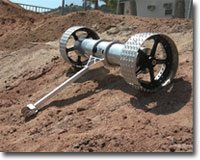
Moon Diver is a proposed lunar mission concept by NASA's Jet Propulsion Laboratory that would employ a robotic lander and a – distant coaxial – two-wheeled rover called Axel to investigate the exposed geological layers on the walls of a deep lunar pit.
The mission was proposed in mid-2019 to NASA's Discovery Program to compete for funding and development. The finalists were announced in February 2020, and the Moon Diver was not selected.
The Principal Investigator of Moon Diver is Laura Kerber at NASA's Jet Propulsion Laboratory. The mission concept aims to understand the formation and evolution of the Moon's secondary lava crust by exploring the vertical walls of a pit in Mare Tranquillitatis. The proposed pit is called Tranquillitatis Pit, with a 100 m (330 ft) diameter opening, and about 100 m (330 ft) deep.
Collecting information on the chemistry, mineralogy, and morphology of these intact bedrock layers would reveal where rocky crusts come from, how they are emplaced, and the process by which they are transformed into the regolith layer. By studying lunar lava, planetary scientists can work out whether the volcanic activity was robust enough to give the moon a Mars-like atmosphere in the distant past. These cavities expose fresh cuts of rock that are of particular interest to planetary geologists. Of additional interest, is the potential that the pit may be a collapsed section of a lunar lava tube.
The Axel rover conceptual design began in 1999 by a team led by Issa Nesnas at JPL in collaboration with Raymond Cipra at Purdue University, Murray Clark at Arkansas Tech University, and later joined by Joel Burdick of Caltech.
The mission's lander would feature a highly accurate landing system, allowing the deployment of the rover a few hundred feet from the pit.
The rover houses a winch on board, which pays out the tether as it rolls across the surface and rappels into the pit. The rover would carry up to 300 m (980 ft) of tether, about six times as much as it needs, so however far the bottom of the cavern is, Axel should be able to descend deeply enough. The lander provides mechanical support, power, and communication with the rover through its tether.
The instruments are housed inside Axel's wheel wells, where they are protected from the environment. The trailing link serves several purposes: it provides a reaction lever arm against wheel thrust, it adjusts the rover's pitch for pointing its stereo cameras, and it provides redundancy if one of the wheel actuators fails.
Hub AI
Moon Diver (spacecraft) AI simulator
(@Moon Diver (spacecraft)_simulator)
Moon Diver (spacecraft)
Moon Diver is a proposed lunar mission concept by NASA's Jet Propulsion Laboratory that would employ a robotic lander and a – distant coaxial – two-wheeled rover called Axel to investigate the exposed geological layers on the walls of a deep lunar pit.
The mission was proposed in mid-2019 to NASA's Discovery Program to compete for funding and development. The finalists were announced in February 2020, and the Moon Diver was not selected.
The Principal Investigator of Moon Diver is Laura Kerber at NASA's Jet Propulsion Laboratory. The mission concept aims to understand the formation and evolution of the Moon's secondary lava crust by exploring the vertical walls of a pit in Mare Tranquillitatis. The proposed pit is called Tranquillitatis Pit, with a 100 m (330 ft) diameter opening, and about 100 m (330 ft) deep.
Collecting information on the chemistry, mineralogy, and morphology of these intact bedrock layers would reveal where rocky crusts come from, how they are emplaced, and the process by which they are transformed into the regolith layer. By studying lunar lava, planetary scientists can work out whether the volcanic activity was robust enough to give the moon a Mars-like atmosphere in the distant past. These cavities expose fresh cuts of rock that are of particular interest to planetary geologists. Of additional interest, is the potential that the pit may be a collapsed section of a lunar lava tube.
The Axel rover conceptual design began in 1999 by a team led by Issa Nesnas at JPL in collaboration with Raymond Cipra at Purdue University, Murray Clark at Arkansas Tech University, and later joined by Joel Burdick of Caltech.
The mission's lander would feature a highly accurate landing system, allowing the deployment of the rover a few hundred feet from the pit.
The rover houses a winch on board, which pays out the tether as it rolls across the surface and rappels into the pit. The rover would carry up to 300 m (980 ft) of tether, about six times as much as it needs, so however far the bottom of the cavern is, Axel should be able to descend deeply enough. The lander provides mechanical support, power, and communication with the rover through its tether.
The instruments are housed inside Axel's wheel wells, where they are protected from the environment. The trailing link serves several purposes: it provides a reaction lever arm against wheel thrust, it adjusts the rover's pitch for pointing its stereo cameras, and it provides redundancy if one of the wheel actuators fails.
Recent media