
Recent from talks
Moon illusion
Knowledge base stats:
Talk channels stats:
Members stats:
Moon illusion
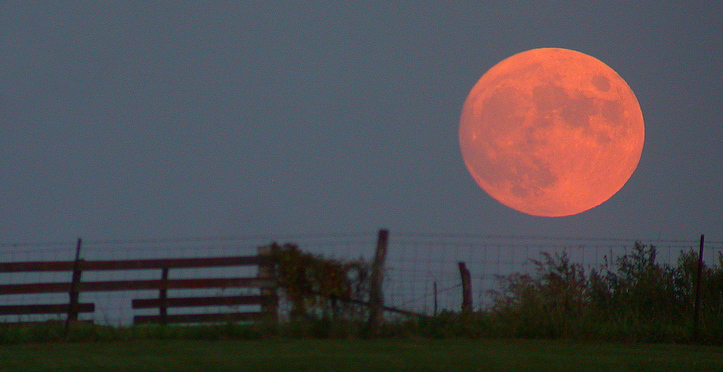
The Moon illusion is the optical illusion of the Moon appearing larger near the horizon than it does higher up in the sky. It has been known since ancient times and recorded by various cultures.
The illusion is seen also with other celestial objects (such as in a sunset or sunrise, and constellation) and remains inconclusively explained, with the ponzo illusion as a popular explanation.
Actually the Moon is 1.5 % further away and thus smaller in angular size when at the horizon than when above.
The angle that the diameter of the full Moon subtends at an observer's eye can be measured directly with a theodolite to show that it remains constant as the Moon rises or sinks in the sky. Photographs of the Moon at different elevations also show that its size remains the same. A simple way of demonstrating that the effect is an illusion is to hold a small pebble (say, 0.33 inches or 8.4 millimetres wide) at arm's length (25 inches or 64 centimetres) with one eye closed, positioning the pebble so that it covers (eclipses) the full Moon when high in the night sky. Then, when the seemingly very large Moon is on the horizon, the same pebble will also cover it, revealing that there has been no change in the size of the Moon.
Across different full moons, the Moon's angular diameter can vary from 29.43 arcminutes at apogee to 33.5 arcminutes at perigee—a variation of around 14% in apparent diameter or 30% in apparent area. This is because of the eccentricity of the Moon's orbit.
The size of a viewed object can be measured objectively either as an angular size (the visual angle that it subtends at the eye, corresponding to the proportion of the visual field that it occupies), or as physical size (its real size measured in, say, meters). Perceived size is only loosely related to these concepts, however. For example, if two identical, familiar objects are placed at distances of five and ten meters, respectively, then the more distant object subtends approximately half the visual angle of the nearer object, but it is normally perceived to be the same size (a phenomenon referred to as size constancy), not as half the size. Conversely, if the more distant object did subtend the same angle as the nearer object then it is normally perceived to be twice as big.
One question concerning the Moon illusion, therefore, is whether the horizon Moon appears larger because its perceived angular size seems greater, or because its perceived physical size seems greater, or some combination of both. There is currently no consensus on this point. Most recent research on the Moon illusion has been conducted by psychologists specializing in human perception. The 2013 book The Moon Illusion, edited by Hershenson, offers 19 chapters written by various illusion researchers reaching different conclusions. After reviewing the many different explanations in their 2002 book The Mystery of the Moon Illusion, Ross and Plug conclude "No single theory has emerged victorious." They argue that the size of the illusion is variable, but is usually an apparent increase in diameter of about 50 percent. The most important factor is the sight of the terrain, but there is a small contribution from other factors such as the angle of regard, posture, and eye movements.[citation needed]
Ptolemy attempted to explain the Moon illusion through atmospheric refraction in the Almagest, and later (in the Optics) as an optical illusion due to apparent distance, or the difficulty of looking upwards, although interpretations of the account in the Optics are disputed. Similarly Cleomedes (about 200 A.D.), in his book on astronomy, ascribed the illusion both to refraction and to changes in apparent distance. In the Book of Optics (1011–1022 A.D.), Ibn al-Haytham (Alhazen) repeated refraction as an explanation, but also proposed a more detailed explanation based on intervening objects and apparent distance.
Hub AI
Moon illusion AI simulator
(@Moon illusion_simulator)
Moon illusion
The Moon illusion is the optical illusion of the Moon appearing larger near the horizon than it does higher up in the sky. It has been known since ancient times and recorded by various cultures.
The illusion is seen also with other celestial objects (such as in a sunset or sunrise, and constellation) and remains inconclusively explained, with the ponzo illusion as a popular explanation.
Actually the Moon is 1.5 % further away and thus smaller in angular size when at the horizon than when above.
The angle that the diameter of the full Moon subtends at an observer's eye can be measured directly with a theodolite to show that it remains constant as the Moon rises or sinks in the sky. Photographs of the Moon at different elevations also show that its size remains the same. A simple way of demonstrating that the effect is an illusion is to hold a small pebble (say, 0.33 inches or 8.4 millimetres wide) at arm's length (25 inches or 64 centimetres) with one eye closed, positioning the pebble so that it covers (eclipses) the full Moon when high in the night sky. Then, when the seemingly very large Moon is on the horizon, the same pebble will also cover it, revealing that there has been no change in the size of the Moon.
Across different full moons, the Moon's angular diameter can vary from 29.43 arcminutes at apogee to 33.5 arcminutes at perigee—a variation of around 14% in apparent diameter or 30% in apparent area. This is because of the eccentricity of the Moon's orbit.
The size of a viewed object can be measured objectively either as an angular size (the visual angle that it subtends at the eye, corresponding to the proportion of the visual field that it occupies), or as physical size (its real size measured in, say, meters). Perceived size is only loosely related to these concepts, however. For example, if two identical, familiar objects are placed at distances of five and ten meters, respectively, then the more distant object subtends approximately half the visual angle of the nearer object, but it is normally perceived to be the same size (a phenomenon referred to as size constancy), not as half the size. Conversely, if the more distant object did subtend the same angle as the nearer object then it is normally perceived to be twice as big.
One question concerning the Moon illusion, therefore, is whether the horizon Moon appears larger because its perceived angular size seems greater, or because its perceived physical size seems greater, or some combination of both. There is currently no consensus on this point. Most recent research on the Moon illusion has been conducted by psychologists specializing in human perception. The 2013 book The Moon Illusion, edited by Hershenson, offers 19 chapters written by various illusion researchers reaching different conclusions. After reviewing the many different explanations in their 2002 book The Mystery of the Moon Illusion, Ross and Plug conclude "No single theory has emerged victorious." They argue that the size of the illusion is variable, but is usually an apparent increase in diameter of about 50 percent. The most important factor is the sight of the terrain, but there is a small contribution from other factors such as the angle of regard, posture, and eye movements.[citation needed]
Ptolemy attempted to explain the Moon illusion through atmospheric refraction in the Almagest, and later (in the Optics) as an optical illusion due to apparent distance, or the difficulty of looking upwards, although interpretations of the account in the Optics are disputed. Similarly Cleomedes (about 200 A.D.), in his book on astronomy, ascribed the illusion both to refraction and to changes in apparent distance. In the Book of Optics (1011–1022 A.D.), Ibn al-Haytham (Alhazen) repeated refraction as an explanation, but also proposed a more detailed explanation based on intervening objects and apparent distance.
Recent media