



Community hub
Recent from talks
Contribute something
Nothing was collected or created yet.
Path space fibration
View on WikipediaIn algebraic topology, the path space fibration over a pointed space [1] is a fibration of the form[2]

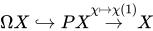
where
- is the based path space of the pointed space ; that is, equipped with the compact-open topology.
- is the fiber of over the base point of ; thus it is the loop space of .




The free path space of X, that is, , consists of all maps from I to X that do not necessarily begin at a base point, and the fibration given by, say, , is called the free path space fibration.


The path space fibration can be understood to be dual to the mapping cone.[clarification needed] The fiber of the based fibration is called the mapping fiber or, equivalently, the homotopy fiber.
Mapping path space
[edit]If is any map, then the mapping path space of is the pullback of the fibration along . (A mapping path space satisfies the universal property that is dual to that of a mapping cylinder, which is a push-out. Because of this, a mapping path space is also called a mapping cocylinder.[3])



Since a fibration pulls back to a fibration, if Y is based, one has the fibration
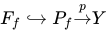
where and is the homotopy fiber, the pullback of the fibration along .
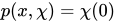


Note also is the composition

where the first map sends x to ; here denotes the constant path with value . Clearly, is a homotopy equivalence; thus, the above decomposition says that any map is a fibration up to homotopy equivalence.


If is a fibration to begin with, then the map is a fiber-homotopy equivalence and, consequently,[4] the fibers of over the path-component of the base point are homotopy equivalent to the homotopy fiber of .

Moore's path space
[edit]By definition, a path in a space X is a map from the unit interval I to X. Again by definition, the product of two paths such that is the path given by:


- .

This product, in general, fails to be associative on the nose: , as seen directly. One solution to this failure is to pass to homotopy classes: one has . Another solution is to work with paths of arbitrary lengths, leading to the notions of Moore's path space and Moore's path space fibration, described below.[5] (A more sophisticated solution is to rethink composition: work with an arbitrary family of compositions; see the introduction of Lurie's paper,[6] leading to the notion of an operad.)

![{\displaystyle [(\gamma \cdot \beta )\cdot \alpha ]=[\gamma \cdot (\beta \cdot \alpha )]}](https://wikimedia.org/api/rest_v1/media/math/render/svg/fd2c5733e6089ffd59809e3ec9c75b7c274a5e50)
Given a based space , we let
![{\displaystyle P'X=\{f\colon [0,r]\to X\mid r\geq 0,f(0)=*\}.}](https://wikimedia.org/api/rest_v1/media/math/render/svg/3824e1b4b78f7275f1df2b5a37b7d5833c777080)
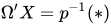
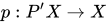
An element f of this set has a unique extension to the interval such that . Thus, the set can be identified as a subspace of . The resulting space is called the Moore path space of X, after John Coleman Moore, who introduced the concept. Then, just as before, there is a fibration, Moore's path space fibration:





where p sends each to and is the fiber. It turns out that and are homotopy equivalent.
![{\displaystyle f:[0,r]\to X}](https://wikimedia.org/api/rest_v1/media/math/render/svg/ff728af6f293e1ac0c5e346476aee3051bc94198)


Now, we define the product map

by: for and ,
![{\displaystyle f\colon [0,r]\to X}](https://wikimedia.org/api/rest_v1/media/math/render/svg/cac719591102b869a007eddd36aa755d17ef33db)
![{\displaystyle g\colon [0,s]\to X}](https://wikimedia.org/api/rest_v1/media/math/render/svg/71d1d94ea7a3be330d47f56d411d40d9ceea9a88)
- .

This product is manifestly associative. In particular, with μ restricted to Ω'X × Ω'X, we have that Ω'X is a topological monoid (in the category of all spaces). Moreover, this monoid Ω'X acts on P'X through the original μ. In fact, is an Ω'X-fibration.[7]
Notes
[edit]- ^ Throughout the article, spaces are objects of the category of "reasonable" spaces; e.g., the category of compactly generated weak Hausdorff spaces.
- ^ Davis & Kirk 2001, Theorem 6.15. 2.
- ^ Davis & Kirk 2001, § 6.8.
- ^ using the change of fiber
- ^ Whitehead 1978, Ch. III, § 2.
- ^ Lurie, Jacob (October 30, 2009). "Derived Algebraic Geometry VI: E[k]-Algebras" (PDF).
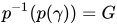
- ^ Let G = Ω'X and P = P'X. That G preserves the fibers is clear. To see, for each γ in P, the map is a weak equivalence, we can use the following lemma:
Lemma—Let p: D → B, q: E → B be fibrations over an unbased space B, f: D → E a map over B. If B is path-connected, then the following are equivalent:
- f is a weak equivalence.
- is a weak equivalence for some b in B.
- is a weak equivalence for every b in B.
We apply the lemma with where α is a path in P and I → X is t → the end-point of α(t). Since if γ is the constant path, the claim follows from the lemma. (In a nutshell, the lemma follows from the long exact homotopy sequence and the five lemma.)



References
[edit]- Davis, James F.; Kirk, Paul (2001). Lecture Notes in Algebraic Topology (PDF). Graduate Studies in Mathematics. Vol. 35. Providence, RI: American Mathematical Society. pp. xvi+367. doi:10.1090/gsm/035. ISBN 0-8218-2160-1. MR 1841974.
- May, J. Peter (1999). A Concise Course in Algebraic Topology (PDF). Chicago Lectures in Mathematics. Chicago, IL: University of Chicago Press. pp. x+243. ISBN 0-226-51182-0. MR 1702278.
- Whitehead, George W. (1978). Elements of homotopy theory. Graduate Texts in Mathematics. Vol. 61 (3rd ed.). New York-Berlin: Springer-Verlag. pp. xxi+744. ISBN 978-0-387-90336-1. MR 0516508.