
.svg/250px-Associativity_of_binary_operations_(without_question_marks).svg.png)


.svg/2000px-Associativity_of_binary_operations_(without_question_marks).svg.png)
Community hub
Recent from talks
Contribute something
Nothing was collected or created yet.
Associative property
View on Wikipedia | This article needs additional citations for verification. (June 2009) |
In mathematics, the associative property[1] is a property of some binary operations that rearranging the parentheses in an expression will not change the result. In propositional logic, associativity is a valid rule of replacement for expressions in logical proofs.
Key Information

.svg)




Within an expression containing two or more occurrences in a row of the same associative operator, the order in which the operations are performed does not matter as long as the sequence of the operands is not changed. That is (after rewriting the expression with parentheses and in infix notation if necessary), rearranging the parentheses in such an expression will not change its value. Consider the following equations:

Even though the parentheses were rearranged on each line, the values of the expressions were not altered. Since this holds true when performing addition and multiplication on any real numbers, it can be said that "addition and multiplication of real numbers are associative operations".
Associativity is not the same as commutativity, which addresses whether the order of two operands affects the result. For example, the order does not matter in the multiplication of real numbers, that is, a × b = b × a, so we say that the multiplication of real numbers is a commutative operation. However, operations such as function composition and matrix multiplication are associative, but not (generally) commutative.
Associative operations are abundant in mathematics; in fact, many algebraic structures (such as semigroups and categories) explicitly require their binary operations to be associative. However, many important and interesting operations are non-associative; some examples include subtraction, exponentiation, and the vector cross product. In contrast to the theoretical properties of real numbers, the addition of floating point numbers in computer science is not associative, and the choice of how to associate an expression can have a significant effect on rounding error.
Definition
[edit]
Formally, a binary operation on a set S is called associative if it satisfies the associative law:

- , for all in S.


Here, ∗ is used to replace the symbol of the operation, which may be any symbol, and even the absence of symbol (juxtaposition) as for multiplication.
- , for all in S.
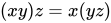
The associative law can also be expressed in functional notation thus:

Generalized associative law
[edit]
If a binary operation is associative, repeated application of the operation produces the same result regardless of how valid pairs of parentheses are inserted in the expression.[2] This is called the generalized associative law.
The number of possible bracketings is just the Catalan number, , for n operations on n+1 values. For instance, a product of 3 operations on 4 elements may be written (ignoring permutations of the arguments), in possible ways:


If the product operation is associative, the generalized associative law says that all these expressions will yield the same result. So unless the expression with omitted parentheses already has a different meaning (see below), the parentheses can be considered unnecessary and "the" product can be written unambiguously as

As the number of elements increases, the number of possible ways to insert parentheses grows quickly, but they remain unnecessary for disambiguation.
An example where this does not work is the logical biconditional ↔. It is associative; thus, A ↔ (B ↔ C) is equivalent to (A ↔ B) ↔ C, but A ↔ B ↔ C most commonly means (A ↔ B) and (B ↔ C), which is not equivalent.
Examples
[edit]
Some examples of associative operations include the following.
- The concatenation of the three strings
"hello"," ","world"can be computed by concatenating the first two strings (giving"hello ") and appending the third string ("world"), or by joining the second and third string (giving" world") and concatenating the first string ("hello") with the result. The two methods produce the same result; string concatenation is associative (but not commutative). - In arithmetic, addition and multiplication of real numbers are associative; i.e.,
Because of associativity, the grouping parentheses can be omitted without ambiguity. - The trivial operation x ∗ y = x (that is, the result is the first argument, no matter what the second argument is) is associative but not commutative. Likewise, the trivial operation (that is, the result is the second argument, no matter what the first argument is) is associative but not commutative.
- Addition and multiplication of complex numbers and quaternions are associative. Addition of octonions is also associative, but multiplication of octonions is non-associative.
- The greatest common divisor and least common multiple functions act associatively.
- Taking the intersection or the union of sets:
- If M is some set and S denotes the set of all functions from M to M, then the operation of function composition on S is associative:
- Slightly more generally, given four sets M, N, P and Q, with h : M → N, g : N → P, and f : P → Q, then as before. In short, composition of maps is always associative.
- In category theory, composition of morphisms is associative by definition. Associativity of functors and natural transformations follows from associativity of morphisms.
- Consider a set with three elements, A, B, and C. The following operation:
is associative. Thus, for example, A(BC) = (AB)C = A. This operation is not commutative.× A B C A A A A B A B C C A A A - Because matrices represent linear functions, and matrix multiplication represents function composition, one can immediately conclude that matrix multiplication is associative.[3]
- For real numbers (and for any totally ordered set), the minimum and maximum operation is associative:







Propositional logic
[edit]Rule of replacement
[edit]In standard truth-functional propositional logic, association,[4][5] or associativity[6] are two valid rules of replacement. The rules allow one to move parentheses in logical expressions in logical proofs. The rules (using logical connectives notation) are:
and
where "" is a metalogical symbol representing "can be replaced in a proof with".

Truth functional connectives
[edit]Associativity is a property of some logical connectives of truth-functional propositional logic. The following logical equivalences demonstrate that associativity is a property of particular connectives. The following (and their converses, since ↔ is commutative) are truth-functional tautologies.[citation needed]
- Associativity of disjunction
- Associativity of conjunction
- Associativity of equivalence



Joint denial is an example of a truth functional connective that is not associative.
Non-associative operation
[edit]A binary operation on a set S that does not satisfy the associative law is called non-associative. Symbolically,


For such an operation the order of evaluation does matter. For example:


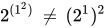
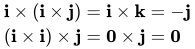
Also although addition is associative for finite sums, it is not associative inside infinite sums (series). For example, whereas


Some non-associative operations are fundamental in mathematics. They appear often as the multiplication in structures called non-associative algebras, which have also an addition and a scalar multiplication. Examples are the octonions and Lie algebras. In Lie algebras, the multiplication satisfies Jacobi identity instead of the associative law; this allows abstracting the algebraic nature of infinitesimal transformations.
Other examples are quasigroup, quasifield, non-associative ring, and commutative non-associative magmas.
Nonassociativity of floating-point calculation
[edit]In mathematics, addition and multiplication of real numbers are associative. By contrast, in computer science, addition and multiplication of floating point numbers are not associative, as different rounding errors may be introduced when dissimilar-sized values are joined in a different order.[7]
To illustrate this, consider a floating-point representation with a 4-bit significand:
Even though most computers compute with 24 or 53 bits of significand,[8] this is still an important source of rounding error, and approaches such as the Kahan summation algorithm are ways to minimize the errors. It can be especially problematic in parallel computing.[9][10]
Notation for non-associative operations
[edit]In general, parentheses must be used to indicate the order of evaluation if a non-associative operation appears more than once in an expression (unless the notation specifies the order in another way, like ). However, mathematicians agree on a particular order of evaluation for several common non-associative operations. This is simply a notational convention to avoid parentheses.

A left-associative operation is a non-associative operation that is conventionally evaluated from left to right, i.e.,
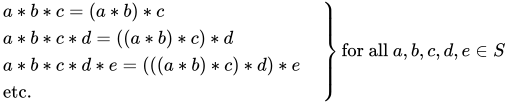
while a right-associative operation is conventionally evaluated from right to left:

Both left-associative and right-associative operations occur. Left-associative operations include the following:



This notation can be motivated by the currying isomorphism, which enables partial application.
Right-associative operations include the following:
- Exponentiation of real numbers in superscript notation
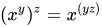
Exponentiation is commonly used with brackets or right-associatively because a repeated left-associative exponentiation operation is of little use. Repeated powers would mostly be rewritten with multiplication:
Formatted correctly, the superscript inherently behaves as a set of parentheses; e.g. in the expression the addition is performed before the exponentiation despite there being no explicit parentheses wrapped around it. Thus given an expression such as , the full exponent of the base is evaluated first. However, in some contexts, especially in handwriting, the difference between , and can be hard to see. In such a case, right-associativity is usually implied.
- Function definition
Using right-associative notation for these operations can be motivated by the Curry–Howard correspondence and by the currying isomorphism.





Non-associative operations for which no conventional evaluation order is defined include the following.
- Exponentiation of real numbers in infix notation[16]
- Knuth's up-arrow operators
- Taking the cross product of three vectors
- Taking the pairwise average of real numbers
- Taking the relative complement of sets
- .
(Compare material nonimplication in logic.)






History
[edit]William Rowan Hamilton seems to have coined the term "associative property"[17] around 1844, a time when he was contemplating the non-associative algebra of the octonions he had learned about from John T. Graves.[18]
Relationship with commutativity in certain special cases
[edit]In general, associative operations are not commutative. However, under certain special conditions, it may be the case that associativity implies commutativity. Associative operators defined on an interval of the real number line are commutative if they are continuous and injective in both arguments.[19] A consequence is that every continuous, associative operator on two real inputs that is strictly increasing in each of its inputs is commutative.[20]
See also
[edit]
- Light's associativity test
- Telescoping series, the use of addition associativity for cancelling terms in an infinite series
- A semigroup is a set with an associative binary operation.
- Commutativity and distributivity are two other frequently discussed properties of binary operations.
- Power associativity, alternativity, flexibility and N-ary associativity are weak forms of associativity.
- Moufang identities also provide a weak form of associativity.
References
[edit]- ^
Hungerford, Thomas W. (1974). Algebra (1st ed.). Springer. p. 24. ISBN 978-0387905181.
Definition 1.1 (i) a(bc) = (ab)c for all a, b, c in G.
- ^ Durbin, John R. (1992). Modern Algebra: an Introduction (3rd ed.). New York: Wiley. p. 78. ISBN 978-0-471-51001-7.
If are elements of a set with an associative operation, then the product is unambiguous; this is, the same element will be obtained regardless of how parentheses are inserted in the product.
- ^ "Matrix product associativity". Khan Academy. Retrieved 5 June 2016.
- ^ Moore, Brooke Noel; Parker, Richard (2017). Critical Thinking (12th ed.). New York: McGraw-Hill Education. p. 321. ISBN 9781259690877.
- ^ Copi, Irving M.; Cohen, Carl; McMahon, Kenneth (2014). Introduction to Logic (14th ed.). Essex: Pearson Education. p. 387. ISBN 9781292024820.
- ^ Hurley, Patrick J.; Watson, Lori (2016). A Concise Introduction to Logic (13th ed.). Boston: Cengage Learning. p. 427. ISBN 9781305958098.
- ^ Knuth, Donald, The Art of Computer Programming, Volume 3, section 4.2.2
- ^ IEEE Computer Society (29 August 2008). IEEE Standard for Floating-Point Arithmetic. doi:10.1109/IEEESTD.2008.4610935. ISBN 978-0-7381-5753-5. IEEE Std 754-2008.
- ^ Villa, Oreste; Chavarría-mir, Daniel; Gurumoorthi, Vidhya; Márquez, Andrés; Krishnamoorthy, Sriram, Effects of Floating-Point non-Associativity on Numerical Computations on Massively Multithreaded Systems (PDF), archived from the original (PDF) on 15 February 2013, retrieved 8 April 2014
- ^ Goldberg, David (March 1991). "What Every Computer Scientist Should Know About Floating-Point Arithmetic" (PDF). ACM Computing Surveys. 23 (1): 5–48. doi:10.1145/103162.103163. S2CID 222008826. Archived (PDF) from the original on 2022-05-19. Retrieved 20 January 2016.
- ^ George Mark Bergman "Order of arithmetic operations"
- ^ "The Order of Operations". Education Place.
- ^ "The Order of Operations", timestamp 5m40s. Khan Academy.
- ^ "Using Order of Operations and Exploring Properties" Archived 2022-07-16 at the Wayback Machine, section 9. Virginia Department of Education.
- ^ Bronstein, de:Taschenbuch der Mathematik, pages 115-120, chapter: 2.4.1.1, ISBN 978-3-8085-5673-3
- ^ Exponentiation Associativity and Standard Math Notation Codeplea. 23 August 2016. Retrieved 20 September 2016.
- ^ Hamilton, W.R. (1844–1850). "On quaternions or a new system of imaginaries in algebra". David R. Wilkins collection. Philosophical Magazine. Trinity College Dublin.
- ^ Baez, John C. (2002). "The Octonions" (PDF). Bulletin of the American Mathematical Society. 39 (2): 145–205. arXiv:math/0105155. doi:10.1090/S0273-0979-01-00934-X. ISSN 0273-0979. MR 1886087. S2CID 586512.
- ^ Aczél, J. (1966-01-01). Lectures on Functional Equations and Their Applications. Academic Press. p. 267. ISBN 978-0-08-095525-4. OL 46920179M.
- ^ Ling, Cho-Hsin (1 September 1964). "Representation of associative functions" (PDF). Publicationes Mathematicae. 12: 189–212.


Associative property
View on GrokipediaFundamentals
Formal Definition
In mathematics, a binary operation on a non-empty set is a function that assigns to each ordered pair of elements from a unique element in .[5] This contrasts with unary operations, which map a single element to another in the set, or n-ary operations for , which involve more than two inputs; the associative property specifically applies to binary operations by addressing how three elements interact under grouping.[5] The associative property holds for a binary operation on if, for all , [5] In the context of algebraic structures, a set equipped with such a binary operation forms a magma, and the magma is called a semigroup precisely when this condition is satisfied.[6] This property motivates the unambiguous extension of the operation to expressions involving multiple operands, as the result remains invariant under different parenthesizations, such as computing without specifying grouping.[5] For instance, familiar operations like addition and multiplication of real numbers satisfy associativity.[5]Generalized Associative Law
The generalized associative law extends the binary associative property to finite sequences of elements in an algebraic structure equipped with an associative binary operation, such as a semigroup. Specifically, for any elements in the structure where , the value obtained by iteratively applying the binary operation through any valid parenthesization of the sequence is independent of the choice of parenthesization.[7] This ensures that the n-ary extension of the operation, often denoted as or simply as the concatenated product , is well-defined without requiring explicit bracketing.[8] A proof of this law proceeds by induction on the number of operands . For the base cases, when , the expression is just with no operation; for , it is the binary operation itself; and for , it follows directly from the binary associative property .[9] Assuming the law holds for all sequences of length less than (where ), consider any parenthesization of . This splits the sequence into a left subproduct of the first elements (for some ) and a right subproduct of the remaining elements; by the induction hypothesis, each subproduct is unique regardless of internal bracketing. Associativity then equates combining these subproducts in either order, yielding the same overall result for all parenthesizations.[10] This law has significant implications for defining repeated applications of the operation without ambiguity. For instance, powers of an element, such as , can be computed via any iterative bracketing, as the result remains invariant under reassociation.[7] Similarly, it underpins the unambiguous evaluation of chains of operations in broader algebraic contexts, facilitating computations in semigroups and related structures.[8]Mathematical Examples
Arithmetic and Algebraic Operations
The associative property applies to the addition of real numbers, stating that for any real numbers , , and , .[11] This allows the grouping of addends to be changed without altering the sum. For verification, consider , , : and . Multiplication of real numbers also satisfies the associative property, where for any real numbers , , and , .[12] The product remains unchanged regardless of grouping. An example is , , : and . Matrix multiplication is associative for compatible square matrices, meaning that if , , and are matrices, then .[13] To verify with 2×2 matrices, let First, compute . Then . Now, . Finally, , confirming equality. Function composition is associative, such that for functions , , and , .[14] This means the result depends only on the order of functions, not their grouping. For example, let , , over the real numbers. Then , so . Similarly, , so , verifying the equality.Structures and Functions
In abstract algebra, the associative property serves as a foundational axiom for several key structures. A semigroup consists of a nonempty set together with a binary operation that satisfies associativity, i.e., for all .[15] This property ensures that the result of applying the operation multiple times is unambiguous, allowing for consistent definitions of longer products without dependence on parenthesization.[15] A monoid extends a semigroup by including an identity element such that for all , while preserving associativity.[15] Groups further require that every element has an inverse, but associativity remains essential for enabling the algebraic manipulations that characterize these structures, such as solving equations and defining subgroups.[15] Set theory provides concrete examples of associative operations through union and intersection. The union operation satisfies for any sets , , and , meaning the overall union of multiple sets is independent of how they are grouped.[16] Similarly, intersection is associative: .[16] These properties can be illustrated using Venn diagrams, where the shaded regions representing the union or intersection overlap in the same way regardless of bracketing, confirming that the resulting set encompasses identical elements. String concatenation exemplifies associativity in the context of sequences and formal languages. For strings over an alphabet, , where denotes appending without altering the order or content.[17] This forms a monoid with the empty string as the identity, facilitating efficient parsing and computation in algorithms that process concatenated data. In category theory, associativity governs the composition of morphisms. For morphisms , , and in a category, .[18] This axiom ensures that composite arrows between objects behave consistently, forming the basis for diagrammatic reasoning and functorial constructions across diverse mathematical domains.Logical Applications
Propositional Logic Overview
In propositional logic, the associative property applies to binary connectives such as conjunction (∧) and disjunction (∨), treating them as operations on truth values of propositions, where the grouping of operands does not alter the overall truth value. This property allows logical expressions involving multiple propositions to be evaluated equivalently regardless of parenthesization, facilitating the analysis of complex formulas. Similar to the mathematical definition of associativity for operations like addition, it ensures that the result remains unchanged under regrouping, enabling streamlined representations in logical reasoning.[19] Propositional formulas are structured as parse trees, with leaves representing atomic propositions (e.g., p, q, r) and internal nodes denoting connectives, ensuring a unique hierarchical representation for unambiguous evaluation. For associative connectives, this tree structure permits a flattened notation without parentheses, such as p ∧ q ∧ r, which is conventionally interpreted as (p ∧ q) ∧ r or p ∧ (q ∧ r) interchangeably due to the property's validity. This simplification aids in parsing and reduces notational complexity, as the unique readability of formulas guarantees a single interpretation under standard conventions.[20] The associativity of conjunction and disjunction can be verified through truth tables, which enumerate all possible truth value assignments to the propositions. For conjunction (∧), the binary truth table is as follows:| p | q | p ∧ q |
|---|---|---|
| T | T | T |
| T | F | F |
| F | T | F |
| F | F | F |
| p | q | p ∨ q |
|---|---|---|
| T | T | T |
| T | F | T |
| F | T | T |
| F | F | F |
Rules and Connectives
In propositional logic, the rule of replacement treats associativity as an equivalence rule, permitting the regrouping of subformulas connected by associative operators without altering the overall truth value. This rule applies specifically to connectives such as conjunction (∧) and disjunction (∨), allowing transformations like or .[22] Such replacements preserve logical equivalence and are integral to natural deduction systems, enabling flexible restructuring during proofs.[23] Truth-functional connectives in propositional logic are evaluated based on the truth values of their component propositions, and associativity holds for certain binary connectives that form semilattices or exhibit symmetric behavior under repeated application. The associative connectives include conjunction (∧), disjunction (∨), biconditional (↔), and exclusive disjunction (⊕). For ∧, the connective yields true only if both inputs are true; a partial truth table excerpt is:| p | q | p ∧ q |
|---|---|---|
| T | T | T |
| T | F | F |
| F | T | F |
| F | F | F |
| p | q | p ∨ q |
|---|---|---|
| T | T | T |
| T | F | T |
| F | T | T |
| F | F | F |
| p | q | p ↔ q |
|---|---|---|
| T | T | T |
| T | F | F |
| F | T | F |
| F | F | T |
| p | q | p ⊕ q |
|---|---|---|
| T | T | F |
| T | F | T |
| F | T | T |
| F | F | F |
| p | q | p → q |
|---|---|---|
| T | T | T |
| T | F | F |
| F | T | T |
| F | F | T |