Hubbry Logo
MoretonhampsteadMoretonhampsteadMain
Open search
Moretonhampstead
Community hub
Moretonhampstead
logo
8 pages, 0 posts
0 subscribers
Be the first to start a discussion here.
Moretonhampstead
Moretonhampstead
from Wikipedia

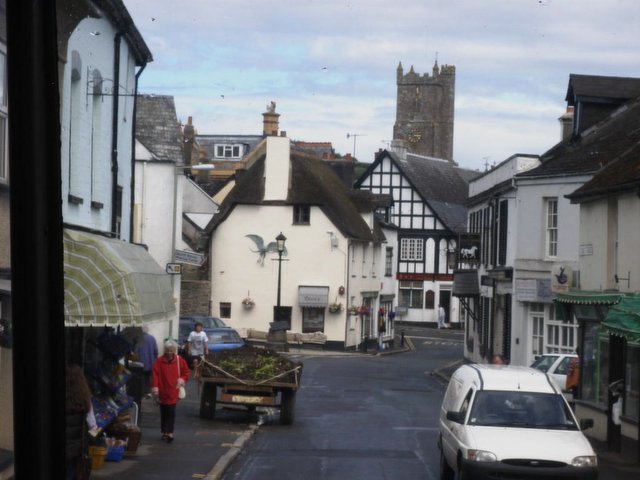
Moretonhampstead is a market town,[a] parish and ancient manor in Devon, situated on the north-eastern edge of Dartmoor, within the Dartmoor National Park. The parish now includes the hamlet Doccombe (/ˈdɒkəm/), and it is surrounded clockwise from the north by the parishes Drewsteignton, Dunsford, Bridford, Bovey Tracey, Lustleigh, North Bovey and Chagford.[4]

Key Information

According to the 2021 census, it had a population of 1,728, which was slightly more than the 1,703 recorded at the 2011 census.[5] The Moorland electoral ward, in which Moretonhampstead lies, had a population of 2,806 in 2011.[6] The parish church is dedicated to St. Andrew.[7] Along with a few other places in Devon, it has one of the longest place names in England, with 16 letters. Moretonhampstead is twinned with Betton in France.

Toponymy

[edit]

The Domesday Book of 1086 records the manor as MORTONE.[8] This part of the name derives from the Old English for a town or village in moorland,[9] referring to the town's situation on Dartmoor.

In 1493 the town was recorded as "Morton Hampstead" in the Calendar of Inquisitions Post Mortem,[10] with 'ham' and 'stede' both being Anglo-Saxon words for a home or enclosed area,[11][12][13] but seemingly unnecessary to the historical context of the settlement.[14]

The Oxford Names Companion (1991) speculates this may be a family name, or a nearby place.[15] However The Cambridge Dictionary of English Place-Names (2004) simply says the reason for the addition is unknown.[16]

The 'Hampstead' part of the name was not always used, with the Recovery Rolls from the Court of Common Pleas in 1692 noting it as "Moreton al. Moreton Hampstead",[10] indicating that both long and short forms may be used. Local noted antiquarian Cecil Torr states that the town continued to be known simply as Moreton to the majority of people prior to the arrival of the railway, which made the station Moretonhampstead in order to distinguish it from other towns called Moreton on the railways network,[17] with 45 other settlements called Moreton or Morton.[18]

History

[edit]

The central region of Devon was occupied by the Saxons sometime after 710. Over time, it was divided into a number of estates, and one of these divisions included all land within the boundaries of the rivers Teign and Bovey, with Moreton as its major settlement.

The present parish of over 6,000 acres (24 km2) is the remainder of an ancient royal estate. It remained a royal estate immediately after the Norman Conquest of 1066, as is recorded in the Domesday Book of 1086, where it is listed as the 45th of the 72 Devonshire holdings of King William the Conqueror.[19] The manor was held by grand serjeanty from the king by Richard de Burgh, 2nd Earl of Ulster (1259–1326) during the reign of King Edward I (1272–1307), for the annual yielding of one sparrow hawk.[20]

After that time it was the seat of Sir Philip de Courtenay (killed at Stirling 1314), second son of Sir Hugh de Courtenay (died 1292), feudal baron of Okehampton, by his wife Eleanor le Despenser (died 1328), sister of Hugh le Despenser, 1st Earl of Winchester, and younger brother of Hugh de Courtenay, 1st/9th Earl of Devon (1276–1340) of Tiverton Castle. When he died childless Moretonhampstead was inherited by his elder brother the Earl of Devon,[21] who gave Moretonhampstead to his third son Robert de Courtenay,[22] who made it his seat. Robert's grandson William de Courtenay (1377–1388) died childless,[22] and eventually the manor became the property of Sir Philip Courtenay (1340–1406) of Powderham,[21] 5th or 6th son of Hugh Courtenay, 2nd Earl of Devon (1303–1377). Thenceforth it descended with the Powderham estate and, in the time of Pole (died 1635), belonged to Francis Courtenay (1576–1638),[21] de jure 4th Earl of Devon.

Wool and (in later years) the manufacture of woollen cloth formed the basis of the town's economy for over 700 years. The economy was evidently healthy when Moretonhampstead established a water-powered fulling mill before the end of the 13th century.

In 1207 King John granted a weekly market and an annual five-day fair,[2] indicating that Moretonhampstead had developed into an important local community. The town grew steadily through the Middle Ages and remained prosperous until the end of the 17th century, when the wool industry began to decline. The town continued to be a local trading centre and a rest stop for travellers on the difficult routes across Dartmoor and from Exeter and Newton Abbot.

The population of the town in the 1841 census was 1,450 inhabitants.[23]

A series of fires in the 20th century destroyed many of Moretonhampstead's ancient buildings, but sufficient still remain to demonstrate the Saxon and medieval heritage, and its later industrial prosperity. Much of the town is a designated conservation area, with many listed buildings being of architectural and historic interest. The whole parish lies within Dartmoor National Park.

The sparrowhawk

[edit]

When King John granted the town its charter during the 13th century, the rent was set as one sparrowhawk per year. The bird has become something of a symbol for the town and is to be incorporated into works of public art under development by an artist in residence, Roger Dean.

Notable residents

[edit]

Places of interest

[edit]
The Church of St Andrew, Moretonhampstead

The Cross Tree

[edit]

The Cross Tree, immortalised by R. D. Blackmore in his 1882 novel Christowell, is now only represented by a cross minus its shaft, which is enclosed near the almshouses. This famous dancing tree, a fine old elm, cut and clipped in the form of a punch bowl (by which name it was also known), has long since disappeared, and in its place a beech tree has been planted. It was around the original tree that the village lads and lasses would dance and it recorded that French officers on parole from Dartmoor Prison at Princetown during the Napoleonic Wars, "did assemble around the Cross Tree with their Band".

Almshouses

[edit]

Standing behind the Cross Tree are the famous almshouses, built in solid granite. The date of 1637 on the outside is actually the date they were refurbished. Recent research has shown that the main core of these buildings are at least two hundred years older. Early in the 19th century the building was converted from two tenements into four and the facade was damaged. By 1938 they had fallen into disrepair. In 1940 they were purchased for the town and converted back into two tenements. In 1952 they were purchased by the National Trust.

St Andrew's Church

[edit]

The Grade I listed parish church, dedicated to St. Andrew, is at the eastern end of the town. Its imposing four-stage tower with pentagonal stair-turret was being built by 1418. The entire church is built of granite blocks although the body is roughcast. It has a two-storey porch, battlemented like the tower. Inside, the north and south aisles are separated from the nave by arcades of five bays, constructed of octagonal granite piers. All the windows are of standard Perpendicular design, and according to Pevsner there is "a singular absence of fitments of interest", due to the heavy restorations the church was subjected to in 1856 and in 1904–5. All the ledger stones were removed with the floor flagstones in the first restoration, but above the south door a wall memorial to Rev Francis Whiddon, MA (died 1656) who "was 32 years minister of this parish" survives. There is also a classical monument by Edward Bowring Stephens to a Captain John Newcombe (died 1855), and a tower screen of wood and glass of 1980.[28][29]

Tourism

[edit]

Moretonhampstead relies heavily on tourism, and has done so for a long time.[30][failed verification] Its position makes it a base to explore both Dartmoor and Devon. The central part of the town stands at an altitude of 700 feet (210 m) but a short stroll within the parish will elevate the walker to beyond 1,100 feet (340 m) and afford views of the surrounding area. Moretonhampstead has four pubs and three cafes. There is a wide selection of hotels, bed and breakfast, self-catering and camping accommodation.

Moretonhampstead has a good range of sporting facilities and the proximity of Dartmoor makes it popular with ramblers and cyclists, in particular for mountain biking.[31]

Events

[edit]

Moretonhampstead has an annual carnival, held in the fourth week in August which raises funds for local groups and associations. Since 2012 it has also held an annual flag festival: in 2017 it took place in mid-June. Other events include a fireworks night, annual pantomime, food and drink festival and music events spread throughout the year.[32]

Transport

[edit]

The town lies on the A382 road, connecting it to the trunk A38 and A30 roads.

Moretonhampstead railway station was opened by the Moretonhampstead and South Devon Railway on the south side of the town on 26 June 1866. It closed to passengers on 28 February 1959, although goods trains continued until 6 April 1964. After this the goods shed and engine shed continued to be used for many years by a commercial road haulage business.

Bus services are from the car park just west of the town centre and include services to Exeter (359/173) and Okehampton/Newton Abbot (178).

Sport and recreation

[edit]

Moretonhampstead has King George's Field, a memorial to King George V. This facility includes indoor courts for basketball etc., a gym and also conference rooms to rent. It has cricket fields a camping site, football facilities and a skate park.

See also

[edit]
  • Tozer, a family surname believed to have arisen in Moretonhampstead in the 15th century.

References

[edit]

Notes

[edit]
[edit]
Revisions and contributorsEdit on WikipediaRead on Wikipedia
from Grokipedia
Moretonhampstead is a and situated on the north-eastern edge of Dartmoor National Park in the district of , , serving as a key gateway to the surrounding moorland and a hub for and local services. With a population of 1,729 according to the 2021 census, the parish encompasses an area of 3,199 hectares and features undulating farmland bounded by ancient moorland landscapes, including field systems and hill forts such as those at Cranbrook and Wooston Castle. The town's strategic location at the junction of roads connecting to and to has historically supported its role as a commercial and transport center. The history of Moretonhampstead traces back to Saxon times, with the settlement known as "Moor-tun" by the and recorded as a royal manor in the of 1086, which noted three hides of land, 20 ploughs, and a tax value of £12. It achieved borough status in 1207 and received a market charter in 1335, fostering growth through the medieval wool trade, which included fulling mills and cloth production prominent by the late 15th century. The in 1348 severely impacted the population, reducing it to an estimated 450 by 1377, while later events like a major fire in 1845 destroyed much of the town center, leading to rebuilding in the . The arrival of in 1866 and in 1933 further modernized the area, shifting the economy from agriculture and wool toward small businesses and visitor-related activities. Today, Moretonhampstead remains a vibrant community with notable landmarks including the Grade I-listed St Andrew's Church, rebuilt in the with a tower from 1420, and the Grade I-listed Almshouses. The town supports a range of amenities such as shops, pubs, cafés, and annual events like the Christmas market, while its position within attracts hikers, cyclists, and nature enthusiasts exploring sites like nearby Mardon Down. Conservation efforts emphasize its heritage buildings and rural character, ensuring the preservation of this historic settlement.

Geography and environment

Location and boundaries

Moretonhampstead is situated on the north-eastern edge of in , , serving as a key access point for visitors entering the moor from the east. The town's central coordinates are approximately 50°39′35″N 3°46′00″W, with the built-up area lying at an of around 200–250 meters above , rising to higher moorland in the parish's southern extents. The covers 3,199 hectares (7,907 acres) and incorporates the southern of Doccombe, along with scattered farms and . Moretonhampstead lies roughly 14 miles west of and 30 miles northeast of Plymouth by road, while sharing boundaries with the adjacent es—and thus towns—of Chagford to the west and to the southeast. The parish boundaries are bordered clockwise from the north by Drewsteignton, Dunsford, Bridford, , Lustleigh, North Bovey, and Chagford, with the northern and eastern limits following hilly terrain and the southern and western edges abutting high moorland. Positioned in the upper Teign valley, Moretonhampstead functions as a primary gateway to , facilitating routes from nearby urban centers into the national park's interior.

Physical features and Dartmoor relation

Moretonhampstead lies within the Wray Valley in north-eastern , characterized by a narrow stream valley flanked by steep, rounded slopes and undulating hills that rise to surrounding . The area's is dominated by , typical of , which was intruded around 280-295 million years ago during the late to early Permian period and forms the underlying rock across much of the . This outcrops in nearby tors, such as those on Mardon Down to the north and Hound Tor to the south, providing dramatic elevated landscapes visible from the town and contributing to the rugged, boulder-strewn terrain. Streams like the Wray Brook flow through the valley, carving fast-running channels that support wet valley bottoms and add to the area's dynamic landform. The town and much of its parish are encompassed by National Park, designated in 1951 to protect its unique natural and cultural heritage, with the park covering 368 square miles of moorland, tors, and valleys. This inclusion fosters rich , including deciduous woodlands, species-rich hedgerows, and lowland meadows that host moorland species such as heather, bilberry, and tormentil, alongside rarer flora in sessile oak woodlands and blanket bogs. Hydrologically, the area is drained by tributaries of the River Teign, with the Wray Brook serving as a key stream that joins the River Bovey before reaching the Teign, facilitating water flow from the uplands. Nearby reservoirs, including Kennick, Tottiford, and Trenchford on Teign tributaries to the east, play a role in regional water management by storing upland runoff for public supply. Parts of the surrounding moorland hold (SAC) status under the EU , covering about 27% of the and prioritizing habitats like , heathland, and oak woodland for protection. Management efforts address challenges such as , which has contributed to unfavorable condition in many Sites of Special Scientific Interest (SSSIs) by altering cover, alongside impacts projected for 2025 including warmer temperatures, drier summers, and increased flood risks from wetter winters.

Climate and weather patterns

Moretonhampstead features a temperate (Köppen Cfb), characterized by mild temperatures and consistent precipitation throughout the year. Winters are mild with an average low of approximately 2°C, while summers remain cool, with an average high around 19°C. Annual rainfall averages about 917 mm, which is higher than in lowland areas of due to the town's elevation of roughly 240 meters on the northeastern edge of . The town's location on 's fringes creates distinct effects, including frequent mists and fogs, elevated wind speeds averaging 15-20 km/h year-round, and a heightened risk of , particularly in low-lying valleys during clear nights. from the nearby weather station, situated at higher elevation within , indicate trends in the 2020s of wetter winters, with the winter half-year (October-March) rainfall 6% above the 1991-2020 average, aligning with broader patterns of increased precipitation intensity. These climatic conditions significantly influence local life, shaping through challenges like waterlogged soils that delay planting and increase erosion risks, while supporting pasture-based farming suited to the mild, humid environment. , a key economic driver, peaks in summer due to more reliable mild but faces disruptions from sudden mists or storms; flood risks from events have risen, with records from 2023-2025 showing increased storm frequency leading to localized inundation along the River Teign. Historically, severe weather events have impacted the area, such as the Great Blizzard of 1891, which buried rail lines across under deep drifts, stranding trains including on the line and halting transport for days. In contrast, modern monitoring by the provides real-time data and forecasts, enabling better preparedness for such events through stations and regional models.

History

Toponymy and origins

The name Moretonhampstead derives from elements, with "Moreton" from "mōr-tūn," meaning "farmstead or settlement on the moor," reflecting its location on the northeastern edge of . This nomenclature likely originated around the eighth century, during Anglo-Saxon settlement patterns in the region, when the area was established as an early farmstead amid the surrounding moorland. The settlement was first recorded in historical documents as "Mortone" in the of 1086, where it appears as a royal manor with 28 households, underscoring its early administrative significance. Over time, the name evolved, with the suffix ""—from "hām-stede," meaning "homestead"—added later to distinguish it from other English places named Moreton. Historical records show variants such as "Morton " by 1493, and the full form "Moretonhampstead" became standardized in the 19th century, particularly following the opening of the Moretonhampstead railway station in 1866, which popularized the compound name. At 16 letters, Moretonhampstead holds the distinction of one of the longest one-word place names in , a feature that highlights its unique linguistic heritage tied to Anglo-Saxon naming conventions. In modern usage, the name is standardized on signage and official documents, though locals often shorten it to "Moreton," preserving a colloquial tradition rooted in its historical forms like "Mortone."

Early and medieval development

Evidence of prehistoric occupation in the vicinity of Moretonhampstead is evident from field systems known as reaves, which extended across into the parish, including visible examples at Butterdon with associated standing stones. Traces of early , a key activity on the nearby moors since prehistoric times, also influenced settlement patterns in the region. Additionally, the hillfort at Cranbrook Castle, dating from the Late to Early (eighth to fifth centuries BC), overlooks the town and suggests defensive occupation that shaped early human activity in the area. By the Saxon period, Moretonhampstead, known as "Moor-tun" or settlement in the moor, had been established by West Saxon settlers in the late seventh century, benefiting from its position on routes skirting . The settlement grew into a planned layout with a church by the tenth century. In the of 1086, it is recorded as a royal manor comprising three hides, supporting 20 ploughs, 28 households (including serfs, villeins, and bordars), 450 acres of arable land, and yielding £12 in tax, along with the third penny of hundred; a separate entry notes the nearby Wray manor with one hide, 18 men, and 150 acres. Medieval development accelerated with the grant of market rights in 1207 by King John, establishing weekly markets and an annual five-day fair, which positioned Moretonhampstead as a hub for the amid growing on surrounding lands. The manor, initially royal, passed to noble families like the de Mandevilles and Courtenays before being held by the Bishops of during the medieval period, supporting population expansion through agricultural and activities. St Andrew's Church, with origins possibly in a tenth-century structure on the current site, saw significant rebuilding in the fifteenth century, including a tower erected in 1420 funded by prosperity. The Black Death struck in 1348, reducing the local population by approximately one-third from an estimated 650 (with 400-450 in the town and 200-250 in outlying areas) to around 450 by 1377, as recorded in the poll taxes. Recovery in the 1400s was driven by the wool economy, sustained fairs, and the establishment of guilds such as the Guild of the Holy Cross, which funded almshouses between 1417 and 1428 for needy members.

Modern era and key events

During the , Moretonhampstead's economy flourished through the wool cloth industry, which had become the town's staple by the late and peaked in the 16th and 17th centuries. Local production focused on serge, a fine woollen fabric, supported by mills along the Wray Brook that processed and finished the cloth before export via nearby ports. This industry built on medieval foundations of and sheep rearing, funding expansions like the rebuilding of the church tower in the early . By the early , the began to decline as competition from mechanized production in and the drew investment and labor away from rural sites. mills gradually fell into disuse, shifting the local economy toward and small-scale , though the had reached approximately 1,000 by 1700 before stabilizing amid these changes. The 19th century brought both opportunities and setbacks. The arrival of the Moretonhampstead and South Devon Railway on 4 July 1866 enhanced trade by connecting the town to and broader markets, facilitating the transport of agricultural goods and livestock. However, major fires ravaged the timber-built town, including a devastating blaze on 4 1808 that originated at the Dolphin Inn and destroyed multiple properties, and another in 1926 that gutted over 20 houses and businesses in The Square despite efforts by local fire brigades. The 1841 recorded a of 1,450, reflecting modest growth amid these events. In the , the railway station closed to passengers on 2 1959 as part of broader British Railways cutbacks, ending a key transport link though freight continued until 1964. The designation of in 1951 positioned Moretonhampstead as a gateway town, spurring post-World War II growth through increased motoring, , and visitors drawn to the moorland landscapes. By the 2020s, initiatives addressed housing pressures, with local plans emphasizing affordable units to retain community viability while preserving the town's character, as seen in ongoing Authority projects. Recent challenges included the pandemic's effects on the local economy from 2020 to 2022, where and sectors—core to Moretonhampstead's income—faced severe disruptions, with over 90% of related businesses reporting impacts during lockdowns. Recovery efforts highlighted resilience through diversified experiences.

Notable residents and figures

James Jackson (1757–1806), born in Moretonhampstead to a family, emigrated to , at age 15, where he studied law, fought in the as a militia leader, and rose to prominence as a Democratic-Republican politician, serving as Georgia's governor from 1798 to 1801 and as a U.S. senator from 1799 to 1801 and 1802 to 1806. George Parker Bidder (1806–1878), a native of Moretonhampstead born to a stonemason, gained fame as the "Calculating Boy" for his extraordinary mental arithmetic abilities demonstrated from age six in public exhibitions across Britain and , later self-educating in engineering to become a leading who designed railways, bridges, and docks, including key contributions to the London system and the Chepstow Railway Bridge. Rev. Dr. James Fynes, also known as Fynes-Clinton (1695–1774), a kinsman of the Dukes of Newcastle through his mother Elizabeth Bertie, served as rector of Moretonhampstead from 1735 until his death, acquiring significant local estates such as Cross Tree House and acting as tutor to the Courtenay family, thereby influencing 18th-century ecclesiastical and landowning circles in the region. Reginald Engelbach (1888–1946), born in Moretonhampstead to a surgeon father, trained as an engineer before studying Egyptology at University College London; he assisted William Flinders Petrie on excavations from 1911, served as chief inspector of antiquities for Upper Egypt from 1924 to 1936, and contributed to the preservation and cataloging of Egyptian artifacts, earning honors such as membership in the French Institute of Oriental Archaeology. Matthew Towgood III (1727–1791), baptized in Moretonhampstead as the son of the prominent nonconformist minister Michaijah Towgood, became a Presbyterian minister at and later a banker in , associating with rational dissenters and maintaining ties to the family's dissenting tradition in . Although not a person, the holds cultural significance as the town's emblem, derived from King John's 1207 granting market rights in exchange for an annual rent of one , a tradition commemorated in local sculptures and motifs that symbolize Moretonhampstead's medieval heritage.

Demographics

The parish of Moretonhampstead recorded a population of 1,728 at the 2021 census, an increase of 25 people from the 1,703 residents counted in 2011, reflecting a modest annual growth rate of 0.15%. With an area of 32.01 km², this equates to a population density of approximately 54 persons per square kilometre. Historically, the population reached a peak of 2,037 in 1841, driven by the thriving local wool trade that had sustained the town's economy for centuries. Subsequent declines followed, with 1,858 residents in 1851 and a sharper drop to 1,468 by 1861, attributed to agricultural consolidation, the introduction of machinery, and broader shifts away from woollen manufacturing. By 1901, numbers had partially recovered to 1,541, indicating stabilization after the industrial transitions. In the early , the grew steadily from 1,536 in 2001, supported by the expansion of as a key economic driver following the wool industry's long-term decline. This shift helped reverse earlier depopulation trends in the rural region. However, faces challenges from an aging demographic—evidenced by a age of 48 and age distribution showing over 54% of residents aged 50 or older—and ongoing out-migration of younger people for employment opportunities elsewhere, partially offset by recent trends post-2020. These dynamics tie into the town's evolving , where remains a stabilizing force.

Ethnic and social composition

According to the 2021 Census, Moretonhampstead exhibits low ethnic diversity, with 97.8% of residents identifying as , including a predominant proportion of . Other groups include 1.4% mixed or multiple ethnicities, 0.2% Asian, 0.1% , 0.1% , and 0.2% other ethnic groups. This composition contrasts sharply with national figures, where only 81.7% identified as . Religious affiliation in Moretonhampstead reflects broader rural patterns, with 44.7% of residents reporting as their , 46.9% stating no , and 2.1% adhering to other faiths such as or unspecified others; Muslim, Hindu, Jewish, and Sikh populations are negligible. Social metrics underscore a stable, owner-occupied community, with approximately 73% of households in owned accommodation (49% outright and 24% with a ). The average household size stands at 2.2 persons, while deprivation levels are low, with 54.8% of households experiencing no deprivation across key dimensions like , , , and . However, an elevated elderly population—29.9% aged 65 and over—highlights dependency challenges in this rural setting. Community dynamics emphasize robust volunteerism, supported by networks like the Moretonhampstead Development Trust, which facilitates local services and environmental initiatives. A 2023 rural housing needs survey indicated high resident , particularly with cohesion, but identified persistent concerns over shortages amid rising costs.

Governance and administration

Local government structure

Moretonhampstead functions as a , with local governance provided by the Moretonhampstead Parish Council, comprising 11 elected councillors serving four-year terms. The council, as the lowest tier of , manages essential community services such as the maintenance of play areas and the parish cemetery, oversight of the Sentry building for local events, and the allocation of grants to support resident organizations and initiatives. The parish lies within the Moretonhampstead ward of District Council, which elects a single district councillor to represent the area—currently John Farrand-Rogers of the Liberal Democrats, elected in 2023. District Council addresses wider responsibilities, including planning permissions and environmental conservation, with particular attention to preserving the town's character adjacent to Dartmoor National Park. Moretonhampstead also falls under the Chudleigh & Teign Valley electoral division of , represented by Richard Keeling of the Liberal Democrats, who secured the seat in the 2025 election with 1,217 votes. The county council manages strategic services like highways, , and social care, coordinating with and levels on issues such as and community welfare. In recent years, the parish council has pursued a Neighbourhood Plan to shape sustainable local development, aligning with Authority policies on green energy targets and habitat protection through ongoing consultations. The council's annual precept, collected via , funds these efforts with a focus on community grants and collaboration with authorities on planning and conservation matters.

Twinning and international relations

Moretonhampstead is twinned with Betton, a commune in the department of , . The partnership originated as part of broader post-World War II initiatives to foster European reconciliation and cultural understanding through town twinning, a movement that began in the late 1940s. The Moretonhampstead-Betton link has endured for over 40 years, making the local Twinning Association one of the few remaining active groups of its kind in the region. Activities under the twinning arrangement emphasize people-to-people connections, including reciprocal visits, student exchanges, and joint cultural events that promote mutual appreciation of rural heritage and traditions. Notable examples include a 2022 hosting of 30 Betton residents in Moretonhampstead following a hiatus in exchanges, and a welcoming of 56 visitors from Betton in March of a recent year, organized with support from the parish council chair. A group trip from Moretonhampstead to Betton took place in September 2025, highlighting ongoing enthusiasm for the relationship. These efforts have evolved to address contemporary priorities like youth engagement and environmental sustainability in rural communities, with the town council providing administrative backing. In addition to the formal twinning, Moretonhampstead engages indirectly in through National Park's broader collaborations, such as the 2023 sister park agreement with in the United States, which focuses on shared conservation practices but does not extend to formal European park partnerships.

Economy and

Historical and modern economy

Moretonhampstead's economy in the medieval period was dominated by the , encompassing sheep rearing, wool processing, and cloth manufacture, which formed the backbone of local prosperity from the 13th century onward. The town received market rights in 1207 and a charter in 1335, establishing it as a key commercial center in the region, with records of a fulling mill and three corn mills by 1297 supporting textile production. The 1377 returns indicate 198 taxpayers in Moretonhampstead, surpassing nearby towns like Chagford (135) and underscoring the market's role in fueling through in and cloth. This wool-based economy persisted into the but began to decline in the 18th due to competition from larger northern mills and broader industrialization trends, with the last mill closing by 1776. By the early , employed only about one-third of the working population, supplemented by small-scale trades, while quarrying in the vicinity provided additional livelihoods, as noted in contemporary directories highlighting high-quality local stone. The arrival of the Moretonhampstead and South Devon Railway in facilitated trade in agricultural produce, nursery plants, and quarried materials, boosting connectivity and supporting farming and extractive industries through the late 19th and early 20th centuries. Following the railway's closure in 1964, the post-1950s era saw a shift toward a service-oriented , with emerging as a primary driver alongside . In recent years, has been a key sector in the area, employing 2,691 people as of 2023, while and retail continue to contribute to the local . in stood at about 1% as of November 2024. Challenges include seasonal fluctuations in tourism-dependent jobs, addressed in part by 2024 initiatives like the Green Impact Fund, which provides grants up to £49,999 for small businesses transitioning to low-carbon practices.

Tourism industry overview

Tourism forms a cornerstone of Moretonhampstead's , leveraging its position as a northern gateway to to draw visitors seeking outdoor pursuits and rural charm. The sector supports local businesses through a mix of day trips and overnight stays, with activities centered on and biking along nearby trails. Visitor numbers to Dartmoor dipped during the but have recovered, with 3.09 million visitors in 2023. Economically, tourism contributes significantly to the local , with -wide visitor spending reaching £226 million in 2023, providing spillover benefits to Moretonhampstead's hospitality and retail outlets. The Ranger App, launched by the end of 2024, enhances accessibility for visitors by providing trail information and planning tools. Infrastructure supports this influx through dedicated welcome centers and comprehensive signage directing tourists to key Dartmoor trails starting from the town. Accommodations comprise over 50 bed-and-breakfasts and two primary campsites, catering primarily to overnight guests interested in the area's natural and historical assets. Approximately 60% of visitors are day trippers originating from nearby , while the remainder opts for extended stays to immerse in the region's heritage. Post-2022, a push toward has emphasized reduction via promoted use and eco-friendly trail maintenance, aligning with -wide conservation goals.

Cultural events and festivals

Moretonhampstead hosts several annual cultural events that foster community spirit and attract visitors to the town on the edge of . The most prominent is the Moretonhampstead Carnival, an annual celebration held during the fourth week of , culminating in a colorful through the town on the evening. Originating as a winter event in the , it transitioned to a summer format in 1921 to raise funds for the local hospital, with activities including parades, music performances, and fundraising fairs. In 2025, the carnival marked its 100th anniversary with special exhibitions and community projects, such as songs composed by local schoolchildren. Organized by a dedicated volunteer committee, the event draws participants and spectators from across , contributing to the local economy through increased spending on accommodations and services. Another key gathering is the Moretonhampstead Flag Festival, held in , where residents create and display handmade fabric flags throughout the town, transforming streets into a vibrant outdoor gallery. Initiated around 2016 by local artists Veronica Gould and Andrea Foxwell to celebrate and unite the community, the festival encourages participation through workshops and includes guided walks across the to view the installations. Now managed by Green Hill Arts, it emphasizes themes of local identity and creativity, with flags often reflecting personal stories or Dartmoor's heritage. The town also features seasonal festivities like the and Lights Switch-On in late , held in the town center from 2:00 p.m. to 6:00 p.m., offering local crafts, food stalls, live music, and a before the 5:30 p.m. illumination of lights. Complementing these are regular nights, such as the monthly acoustic sessions at The White Horse on the last Monday of each month, which provide informal gatherings for performers and audiences of all ages. Additionally, the Moretonhampstead Community Folk Orchestra hosts term-time rehearsals and performances, promoting collaborative music-making among residents. These events, primarily coordinated by volunteer groups and local organizations like the Moretonhampstead Development Trust, play a vital role in sustaining community bonds and bolstering tourism by showcasing the town's cultural vibrancy.

Landmarks and attractions

Religious and historic sites

St Andrew's Church, located in the heart of Moretonhampstead, is a Grade I listed parish church in the Diocese of , recognized for its exceptional historical and architectural value. Built primarily in the in the Perpendicular style using local granite, the church features a prominent 90-foot tower constructed around 1418, which includes a medieval staircase turret at its southeast corner—a characteristic element of ecclesiastical architecture. The and aisles date to the late , with the structure standing on the site of an earlier medieval church possibly originating in the 12th or . The church underwent significant restorations in the mid-19th and early 20th centuries to preserve its fabric and adapt it for continued use. In 1856–57, the interior was re-pewed, and the original medieval was removed, with parts relocated to other sites such as St Andrew's Church in Whitchurch and . A new , designed by Walter E. Mills, was installed in 1904–05 during a broader restoration funded by Lord Hambleden that also raised the floor and added vestries. The church interior includes notable memorials, such as those commemorating local figures and war dead, alongside fine granite detailing in the pointed four-centered arch of the doorway. Historically, St Andrew's served as the manor church for Moretonhampstead, overseeing the spiritual and administrative needs of the , including the collection of medieval that supported its upkeep and the broader community. Records from the Tithe Commutation Act of 1836 document the conversion of these ancient payments into monetary equivalents, reflecting the church's enduring economic role in the locality. In contemporary times, beyond traditional worship, the church hosts community events, including concerts such as the Moreton Music Day in July 2025, fostering cultural engagement in the town. Moretonhampstead's religious landscape also reflects a strong 19th-century Nonconformist tradition, with surviving chapels illustrating the town's diverse spiritual heritage. The Wesleyan Methodist Chapel on Ford Street was erected in 1817, providing a venue for Methodist worship amid growing dissent from the established church. Similarly, the Baptist Chapel in Fore Street dates to 1790, with its building rebuilt in the 1850s to accommodate an expanding congregation of around 50 attendees by mid-century, underscoring the vitality of Baptist communities in rural . These sites, alongside the earlier foundations around 1720 by local Baptist leader Samuel Lightfoot, highlight the town's shift toward pluralistic religious practices during the era.

Architectural and natural features

Moretonhampstead features several notable secular architectural landmarks that reflect its historical development as a on the edge of . The almshouses on Cross Street, constructed in 1637 from local granite, were originally established to provide housing for eight poor residents of the parish. These Grade I listed buildings, possibly remodelling an earlier structure recorded as "new" in 1451 near a medieval , include a distinctive arcaded that enhances their architectural significance. Acquired by the in 1952 after local efforts prevented their demolition in , the almshouses continue to serve as while preserving their 17th-century character. Another prominent feature is the village cross on The Square in Cross Street, an ancient pedestal dating to the medieval period, now integrated with a substantial tree growing within its base. The site, originally marked by an tree known as the "Dancing Tree" or "Cross Tree," was used for medieval market activities and traditional dancing, with the tree's branches once pollarded and trained into a punchbowl shape. Over time, successive trees—including elms and later a copper —have been planted in the pedestal, symbolizing the town's enduring communal heritage. The town's natural surroundings contribute significantly to its appeal, offering panoramic views toward Haytor Rocks, a prominent tor approximately 3 miles to the south within National Park. These vistas are accessible via local lanes and paths, including connections to the nearby Templer Way, an 18-mile heritage trail tracing the historic granite tramway from Haytor to and providing opportunities for walks that highlight amid moorland scenery. Preservation efforts underscore Moretonhampstead's architectural integrity, with the conservation area encompassing seventy listed buildings, including thirty-one from the 15th to 17th centuries that exemplify the town's style. This focus on maintenance ensures the harmony between built heritage and the surrounding , distinct from the more ornate elements seen in nearby religious structures.

Museums and modern attractions

Moretonhampstead hosts several modern attractions that blend cultural, historical, and interactive experiences, appealing to visitors interested in local heritage and contemporary . The Moretonhampstead Motor , housed in a refurbished former bus depot, showcased a of over 135 vintage and classic vehicles, including British cars and motorcycles from the pre-1920s to the 1990s, along with related memorabilia that highlighted regional transport . Opened in June 2013 with around 60 exhibits, the museum expanded to emphasize design classics and drew enthusiasts for its personal storytelling approach to automotive evolution. However, it closed in November 2024, with its £1.5 million collection auctioned in May 2025. Green Hill Arts, established in 2011 in a converted building on the edge of , serves as one of Devon's prominent galleries, featuring works by respected South West artists such as and Susan Derges. The 56-square-meter exhibition space hosts rotating displays every six weeks, including biannual open exhibitions that showcase regional talent and themes inspired by landscapes. In addition to sales and a shop, the venue offers bookable workshops in its meeting room to engage visitors in creative activities. For 2025, it features the Winter Fair starting November 14, alongside ongoing exhibitions emphasizing local environmental motifs. Activity-based attractions include the Hawking Falconry Experience, previously located at Puddaven Farm in nearby North Bovey, which provided hands-on sessions with such as hawks, falcons, and owls, focusing on techniques and across 15,000 acres of terrain. These demonstrations highlighted the birds' natural behaviors, including high-speed dives exceeding 100 mph, and attracted families through educational flying sessions. The center, one of Britain's few private falconry facilities, ceased operations by 2025. Complementing these, self-guided walking tours around Moretonhampstead utilize mobile apps like and , which offer interactive maps and routes such as the 5-mile Moretonhampstead and North Bovey Circular, updated with user contributions through 2024 for enhanced navigation and elevation details. These digital tools enable independent exploration of local paths, integrating GPS tracking for safety and discovery of Dartmoor's trails.

Transport and connectivity

Road network

The A382 serves as the principal arterial route through Moretonhampstead, traversing the town center and linking in the southeast to the A30 near Whiddon Down in the northwest, providing essential connectivity across . This A-road facilitates regional travel, reflecting its role in supporting both local commuting and visitor access. Complementing the A382, the B3212 forms a key local route into Moretonhampstead from the west, originating from Postbridge and extending toward via the , with a along Betton Way connecting to the A382 north of . Within the town, the road infrastructure includes characteristic narrow lanes such as Ford Street, flanked by traditional granite cottages that exemplify the area's historic . Parking facilities, managed by the parish council, address visitor demand in this tourist hub, with identified needs for additional capacity to mitigate overflow during high season. Congestion poses ongoing challenges, particularly during peak tourist periods in summer when traffic volumes rise by around 10% above annual averages, straining the narrow rural lanes and town center. Efforts to manage flow include County Council's broader traffic regulation initiatives, though specific pilots like smart signage remain under exploration for gateways as of 2025. Historically, the road network's development accelerated in the late with the formation of the Moretonhampstead , which built 13 miles of improved roads from Cherrybrook on to Reedy Gate near Dunsford, enhancing market access and trade links to and beyond. These turnpike enhancements transformed local connectivity, laying the foundation for the current infrastructure.

Public transport services

Moretonhampstead's network relies heavily on bus services, providing essential links to nearby towns and cities in . The primary route to is served by South West's service 173, which operates several times daily from the Court Street Car Park, offering a direct journey of around 60 minutes to the city centre. This service runs Monday to Friday and on Saturdays, with frequencies typically every two hours during peak times, facilitating commuting and access to regional amenities. Complementing this, the Country Bus 178 connects Moretonhampstead to , departing from the Square and taking approximately 50 minutes for the 12-mile trip; it operates Monday to Saturday with about four journeys per direction, supported by funding to maintain rural connectivity. For local needs, Morecare operates a community minibus tailored for elderly and vulnerable residents, providing door-to-door transport for shopping, medical appointments, and social outings on a booked basis. Rail services are no longer available within Moretonhampstead, following the closure of the town's station in 1959. The Moretonhampstead and South Devon Railway, which once linked the town to via a 12-mile opened in 1866, ceased passenger operations on 2 March 1959 due to declining usage and was fully closed to goods traffic in 1964. The former trackbed has since been repurposed as the Templer Way, a scenic multi-use path for walking and that spans the length of the old line, promoting and sustainable travel within the local area. The nearest active railway station is , roughly 12 miles south, offering mainline connections to , Plymouth, and via Great Western Railway services. Alternative transport options enhance accessibility for non-drivers and eco-conscious travellers. Local taxi firms, such as Horseshoe Taxis and Capital Taxis, provide on-demand rides within and beyond the town, with fares typically starting at £2.40 per mile for short trips. Cycling enthusiasts can utilize nearby traffic-free routes like the Granite Way, an 11-mile rail trail from Okehampton to Lydford along the northern edge of Dartmoor National Park, accessible via connecting paths from Moretonhampstead for longer excursions. In line with Devon's sustainability goals, 2025 sees ongoing trials and expansions of electric bus initiatives across the county, including infrastructure upgrades like 48 new EV chargers to support zero-emission fleets on rural routes, potentially extending greener options to areas like Moretonhampstead in the future. Public transport usage in Moretonhampstead reflects the town's rural character, with bus services accounting for a notable portion of among residents without private vehicles, particularly the elderly and those accessing Exeter's facilities. Integration with broader schemes, such as Exeter's park-and-ride network—which allows seamless transfers from city-edge car parks to connecting buses—helps alleviate road congestion and encourages modal shift for visitors and locals alike.

Education and community

Schools and educational facilities

Moretonhampstead Primary School serves as the main for children aged 4 to 11 in the town. As a state-funded converter, it currently enrolls 124 pupils with a capacity of 175. The school was inspected by in February 2023. It emphasizes outdoor learning opportunities, utilizing spacious grounds and proximity to Dartmoor National Park for activities that connect pupils to the natural environment, including seasonal exploration and practical crafts. There is no secondary school located within Moretonhampstead, so pupils typically progress to nearby institutions such as South Dartmoor Community College in Ashburton or Teign School in . provides bus transport for eligible students living more than three miles from their designated . For , residents access courses at College in , supported by regular public bus services from Moretonhampstead, including routes operated by that take approximately 37 minutes. Additionally, the local hosts classes focused on through the Moretonhampstead History Society and hands-on crafts at the Green Hill Arts & Heritage Centre. In 2024, the school updated its Special Educational Needs and Disabilities (SEND) policy to enhance support for pupils requiring additional provision, with overall attendance rates reaching 95% for non-disadvantaged pupils.

Community services and recreation

Moretonhampstead Health Centre serves as the primary healthcare facility for the town and surrounding rural areas, providing services to approximately 3,100 patients (as of 2017) across a predominantly rural region covering about 220 square miles (570 km²) on the edge of . The centre offers routine appointments, clinics including services on weekdays, and out-of-hours care through , emphasizing accessible medical support in this isolated setting. The , managed by Libraries Unlimited, operates with a combination of staff and dedicated volunteers to support community access to books, large-print materials, and resources. Volunteers have played a key role in maintaining services, including during a 10-month period of building repairs when a pop-up library was hosted in the Hall. The library also hosts community activities, fostering social connections among residents. The Moretonhampstead Hall functions as a central venue for meetings, events, and gatherings, featuring two halls—one with a stage—and facilities like tables and a kitchen for hire. It hosts meetings, such as those scheduled for November 2025, and serves multiple nearby towns and villages. Recreational spaces in Moretonhampstead include the Orchard, established in 2016 through collaboration between local enthusiasts and , where over 30 trees provide a area for and harvesting. This orchard supports informal activities and environmental initiatives, with ongoing maintenance by volunteers. Youth engagement is facilitated by groups like The Yard Youth Club, which offers term-time sessions for ages 8-17 at a local venue, promoting social interaction through games and events. For seniors, programs such as Let's Get Connected provide online social activities for those aged 65 and over, aimed at reducing rural isolation. Additionally, the Club hosts cafés and social meetups for older residents, offering refreshments and support in a relaxed environment. These services and recreational opportunities are funded through a combination of District Council allocations, parish council grants—such as the biannual application process with deadlines in February and August 2025—and external sources like the UK Shared Prosperity Fund, benefiting the town's population of 1,728 residents as recorded in the 2021 census.

Sport and leisure

Sports facilities

Moretonhampstead's primary sports facilities are centered around the King Playing Fields, a memorial site dedicated to King that encompasses both outdoor pitches and the adjacent Moretonhampstead Sports and . The playing fields include football, , and rugby pitches, along with a and a riding arena, providing versatile outdoor spaces for various sports. Three all-weather courts with floodlighting are also situated on the fields, enabling year-round use despite the town's proximity to the variable weather of National Park. The Moretonhampstead Sports and Community Centre, constructed in 2005 through community efforts and managed by the Moreton Hampstead Sports and Community Centre Limited charity, features a large multi-purpose indoor hall suitable for activities such as , , and short mat . It includes a fully equipped fitness studio with cardio machines like cross trainers and machines, plus a dedicated free weights area, supporting strength and conditioning training. Additional amenities comprise meeting rooms, a , a bar, and a social room with a overlooking the playing fields, which can be hired for events. The King George's Field and Recreation Charity oversees the broader site, ensuring maintenance of these facilities as a public resource. A separate community-run outdoor swimming pool, the Moretonhampstead Community , offers a 25-meter solar-heated lane for public use from May to September, complementing the town's indoor and field-based options. While the parish council supports local enhancements, such as contributions to around the sports centre, no major upgrades were reported for 2025. These venues collectively serve as key built infrastructure for physical activity in the area, accommodating a range of recreational needs.

Outdoor activities and clubs

Moretonhampstead's location on the edge of fosters a vibrant culture of outdoor activities, with residents and visitors engaging in pursuits that leverage the area's rugged terrain, trails, and natural beauty. Local clubs and groups emphasize community involvement in sports like football, running, , and , often integrating these with the surrounding to promote physical and environmental appreciation. These organizations play a key role in fostering social connections and supporting the town's recreational ethos. Football is a cornerstone of local sports, exemplified by Moretonhampstead AFC, a non-league club competing in Division 4 of the WBW Solicitors . The club fields teams for various age groups and maintains an active presence in regional competitions, drawing on community support to host matches and training sessions. Complementing this, Moor Football provides structured opportunities for children and young adults aged 3-18 across , including weekly sessions and development programs that have led to players joining professional academies. Running clubs thrive amid Dartmoor's expansive trails, with serving as an informal group dedicated to off-road runs in open spaces, attracting members who enjoy the challenge of the moorland terrain. Local participants also join nearby events, such as the weekly 5km Parke Run, which starts close to Moretonhampstead and encourages inclusive participation for all abilities. Cycling enthusiasts utilize routes like the Templer Way, an 18-mile trail linking to that accommodates bikes and offers scenic landscapes; the Mid-Devon Club coordinates group rides along such paths, promoting safe and exploratory outings. Hiking societies, including the small, friendly Moretonhampstead Area group, organize regular walks that showcase local paths and moorland features, welcoming participants of varying experience levels to explore sites like the . In 2025, a new off-road path was completed linking Moretonhampstead directly to the Wray Valley Trail, offering an accessible, level route for walkers and cyclists. Pony trekking and horse riding are facilitated by the Moretonhampstead Riding Club, a family-oriented offering equestrian activities such as rides and events that highlight Dartmoor's equine heritage. These clubs often reference community facilities like the Moretonhampstead Sports and for indoor support during inclement weather. A highlight for cyclists is the annual Dartmoor Classic sportive, organized by the Mid-Devon Cycling Club, which took place on June 21-22, 2025, with routes ranging from 35 to 100 miles through challenging terrain, attracting hundreds of riders and emphasizing the region's cycling appeal. Many clubs extend their offerings to by providing guided walks and group excursions, such as those led by local or riding groups, which introduce visitors to hidden trails and boost the local economy through partnerships with accommodations and outfitters.

References

Add your contribution
Related Hubs
User Avatar
No comments yet.