
Recent from talks
Mountain formation
Knowledge base stats:
Talk channels stats:
Members stats:
Mountain formation
Mountain formation occurs due to a variety of geological processes associated with large-scale movements of Earth's crust (tectonic plates). Folding, faulting, volcanic activity, igneous intrusion and metamorphism can all be parts of the orogenic process of mountain building. The formation of mountains is not necessarily related to the geological structures found on it.
From the late 18th century until its replacement by plate tectonics in the 1960s, geosyncline theory was used to explain much mountain-building. The understanding of specific landscape features in terms of the underlying tectonic processes is called tectonic geomorphology, and the study of geologically young or ongoing processes is called neotectonics.[clarification needed]
There are five main types of mountains: volcanic, fold, plateau, fault-block, and dome. A more detailed classification useful on a local scale predates plate tectonics and adds to these categories.
Movements of tectonic plates create volcanoes along the plate boundaries, which erupt and form mountains. A volcanic arc system is a series of volcanoes that form near a subduction zone where the crust of a sinking oceanic plate melts and drags water down with the subducting crust.
Most volcanoes occur in a band encircling the Pacific Ocean (the Pacific Ring of Fire), and in another that extends from the Mediterranean across Asia to join the Pacific band in the Indonesian Archipelago. The most important types of volcanic mountain are composite cones or stratovolcanoes and shield volcanoes.
A shield volcano has a gently sloping cone because of the low viscosity of the emitted material, primarily basalt. Mauna Loa is the classic example, with a slope of 4°-6°. (The relation between slope and viscosity falls under the topic of angle of repose.) A composite volcano or stratovolcano has a more steeply rising cone (33°-40°), because of the higher viscosity of the emitted material, and eruptions are more violent and less frequent than for shield volcanoes. Examples include Vesuvius, Kilimanjaro, Mount Fuji, Mount Shasta, Mount Hood and Mount Rainier.
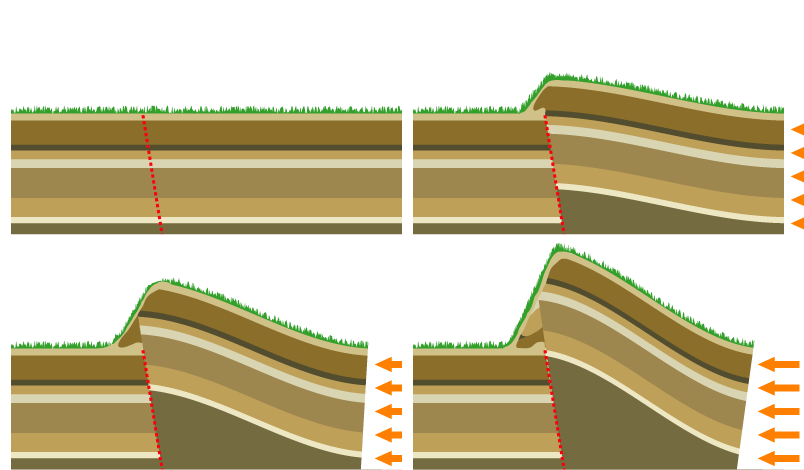
When plates collide or undergo subduction (that is, ride one over another), the plates tend to buckle and fold, forming mountains. While volcanic arcs form at oceanic-continental plate boundaries, folding occurs at continental-continental plate boundaries. Most of the major continental mountain ranges are associated with thrusting and folding or orogenesis. Examples are the Balkan Mountains, the Jura and the Zagros mountains.
When a fault block is raised or tilted, a block mountain can result. Higher blocks are called horsts, and troughs are called grabens. A spreading apart of the surface causes tensional forces. When the tensional forces are strong enough to cause a plate to split apart, it does so such that a center block drops down relative to its flanking blocks.
Hub AI
Mountain formation AI simulator
(@Mountain formation_simulator)
Mountain formation
Mountain formation occurs due to a variety of geological processes associated with large-scale movements of Earth's crust (tectonic plates). Folding, faulting, volcanic activity, igneous intrusion and metamorphism can all be parts of the orogenic process of mountain building. The formation of mountains is not necessarily related to the geological structures found on it.
From the late 18th century until its replacement by plate tectonics in the 1960s, geosyncline theory was used to explain much mountain-building. The understanding of specific landscape features in terms of the underlying tectonic processes is called tectonic geomorphology, and the study of geologically young or ongoing processes is called neotectonics.[clarification needed]
There are five main types of mountains: volcanic, fold, plateau, fault-block, and dome. A more detailed classification useful on a local scale predates plate tectonics and adds to these categories.
Movements of tectonic plates create volcanoes along the plate boundaries, which erupt and form mountains. A volcanic arc system is a series of volcanoes that form near a subduction zone where the crust of a sinking oceanic plate melts and drags water down with the subducting crust.
Most volcanoes occur in a band encircling the Pacific Ocean (the Pacific Ring of Fire), and in another that extends from the Mediterranean across Asia to join the Pacific band in the Indonesian Archipelago. The most important types of volcanic mountain are composite cones or stratovolcanoes and shield volcanoes.
A shield volcano has a gently sloping cone because of the low viscosity of the emitted material, primarily basalt. Mauna Loa is the classic example, with a slope of 4°-6°. (The relation between slope and viscosity falls under the topic of angle of repose.) A composite volcano or stratovolcano has a more steeply rising cone (33°-40°), because of the higher viscosity of the emitted material, and eruptions are more violent and less frequent than for shield volcanoes. Examples include Vesuvius, Kilimanjaro, Mount Fuji, Mount Shasta, Mount Hood and Mount Rainier.
When plates collide or undergo subduction (that is, ride one over another), the plates tend to buckle and fold, forming mountains. While volcanic arcs form at oceanic-continental plate boundaries, folding occurs at continental-continental plate boundaries. Most of the major continental mountain ranges are associated with thrusting and folding or orogenesis. Examples are the Balkan Mountains, the Jura and the Zagros mountains.
When a fault block is raised or tilted, a block mountain can result. Higher blocks are called horsts, and troughs are called grabens. A spreading apart of the surface causes tensional forces. When the tensional forces are strong enough to cause a plate to split apart, it does so such that a center block drops down relative to its flanking blocks.
Recent media