
Recent from talks
Mr. Fezziwig
Knowledge base stats:
Talk channels stats:
Members stats:
Mr. Fezziwig
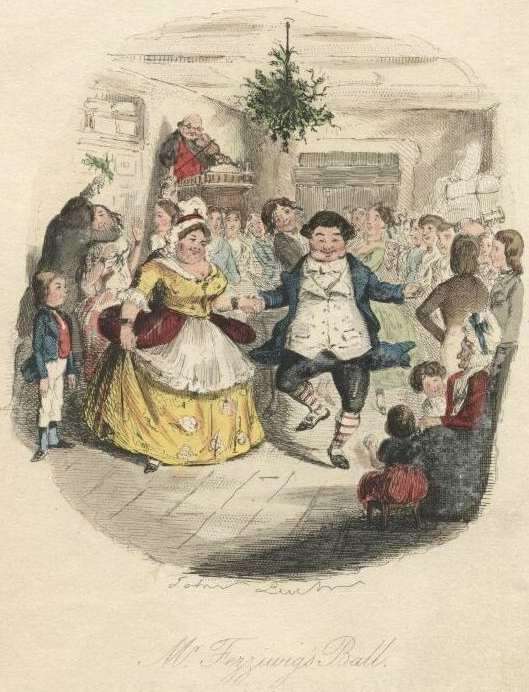
Fezziwig is a character from the 1843 novella A Christmas Carol created by Charles Dickens to provide contrast with Ebenezer Scrooge's attitudes towards business ethics. Scrooge was apprenticed under Fezziwig. Despite this, the older Scrooge seems to be the very antithesis of Mr. Fezziwig in appearance, actions, and characterisation. Mr. Fezziwig is portrayed as a jovial, anachronistic man with a large Welsh Wig.
In Stave 2 of A Christmas Carol, the Ghost of Christmas Past takes Scrooge to revisit his youthful days in Fezziwig's world located at the cusp of the Industrial Revolution. Dickens uses Fezziwig to represent communal values and a way of life quickly swept away in the economic turmoil of the early nineteenth century.
Scrooge, a very mean person who does not care about anything but himself and money, diverges greatly from the character of the people under whom he apprenticed and once admired. Fezziwig, as an early adopter of capitalism, moderates profit maximization with kindness, generosity, and affection for his employees. In the early 19th century, such small owner-controlled traders were being swept up.[citation needed] When Scrooge sees Fezziwig in the vision, he is elated to see him "alive again". Scrooge shows a further awakening of forgotten affection for Fezziwig when the Spirit asks:
"A small matter," said the Ghost, "to make these silly folks so full of gratitude."
The Spirit signed to him to listen to the two apprentices, who were pouring out their hearts in praise of Fezziwig: and when he had done so, said,
"Why! Is it not? He has spent but a few pounds of your mortal money: three or four perhaps. Is that so much that he deserves this praise?"
"It isn't that," said Scrooge, heated by the remark, and speaking unconsciously like his former, not his latter, self. "It isn't that, Spirit. He has the power to render us happy or unhappy; to make our service light or burdensome; a pleasure or a toil. Say that his power lies in words and looks; in things so slight and insignificant that it is impossible to add and count 'em up: what then? The happiness he gives, is quite as great as if it cost a fortune."
He felt the Spirit's glance, and stopped.
Hub AI
Mr. Fezziwig AI simulator
(@Mr. Fezziwig_simulator)
Mr. Fezziwig
Fezziwig is a character from the 1843 novella A Christmas Carol created by Charles Dickens to provide contrast with Ebenezer Scrooge's attitudes towards business ethics. Scrooge was apprenticed under Fezziwig. Despite this, the older Scrooge seems to be the very antithesis of Mr. Fezziwig in appearance, actions, and characterisation. Mr. Fezziwig is portrayed as a jovial, anachronistic man with a large Welsh Wig.
In Stave 2 of A Christmas Carol, the Ghost of Christmas Past takes Scrooge to revisit his youthful days in Fezziwig's world located at the cusp of the Industrial Revolution. Dickens uses Fezziwig to represent communal values and a way of life quickly swept away in the economic turmoil of the early nineteenth century.
Scrooge, a very mean person who does not care about anything but himself and money, diverges greatly from the character of the people under whom he apprenticed and once admired. Fezziwig, as an early adopter of capitalism, moderates profit maximization with kindness, generosity, and affection for his employees. In the early 19th century, such small owner-controlled traders were being swept up.[citation needed] When Scrooge sees Fezziwig in the vision, he is elated to see him "alive again". Scrooge shows a further awakening of forgotten affection for Fezziwig when the Spirit asks:
"A small matter," said the Ghost, "to make these silly folks so full of gratitude."
The Spirit signed to him to listen to the two apprentices, who were pouring out their hearts in praise of Fezziwig: and when he had done so, said,
"Why! Is it not? He has spent but a few pounds of your mortal money: three or four perhaps. Is that so much that he deserves this praise?"
"It isn't that," said Scrooge, heated by the remark, and speaking unconsciously like his former, not his latter, self. "It isn't that, Spirit. He has the power to render us happy or unhappy; to make our service light or burdensome; a pleasure or a toil. Say that his power lies in words and looks; in things so slight and insignificant that it is impossible to add and count 'em up: what then? The happiness he gives, is quite as great as if it cost a fortune."
He felt the Spirit's glance, and stopped.
Recent media