



Community hub
Community hub
Recent from talks
Knowledge base stats:
Talk channels stats:
Members stats:
Mrs. Warren's Profession
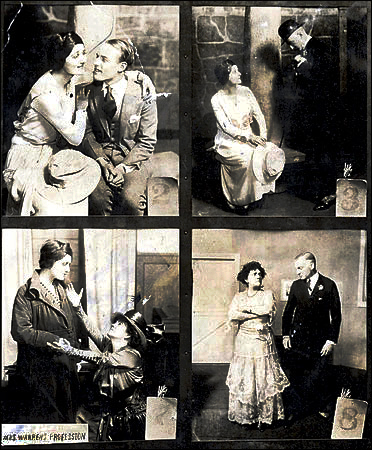
Mrs Warren's Profession is a 1893 play by George Bernard Shaw, first performed in London in 1902. It was included in Shaw's 1898 collection Plays Unpleasant, alongside The Philanderer and Widowers' Houses. The story concerns a former prostitute, now a madam (brothel proprietor), who attempts to come to terms with her disapproving daughter. It is a problem play, offering social commentary to argue that prostitution was not caused by moral failure but by economic necessity. Shaw borrowed several elements from his own 1882 novel Cashel Byron's Profession, about a man who becomes a boxer due to limited employment opportunities.
The story centres on the relationship between Mrs Kitty Warren and her daughter, Vivie. Mrs Warren, a former prostitute and current brothel owner, is described as "on the whole, a genial and fairly presentable old blackguard of a woman." Vivie, an intelligent and pragmatic young woman who has just graduated from university, has come home to get acquainted with her mother. The play focuses on how their relationship changes when Vivie learns what her mother does for a living. It explains why Mrs Warren became a prostitute, condemns the hypocrisies relating to prostitution, and criticises the limited employment opportunities available for women in Victorian Britain.
Vivie Warren, a thoroughly modern young woman, has just graduated from the University of Cambridge with high honours in Mathematics (equal Third Wrangler). Her mother, Mrs Warren, who has been a distant figure during Vivie's childhood in boarding schools and college, arranges for her to meet her friend Mr Praed, a middle-aged, handsome architect, at the house where Vivie is staying. Mrs Warren arrives with her business partner, Sir George Crofts, who is attracted to Vivie despite their 25-year age difference. Vivie flirts with the youthful waster Frank Gardner. Frank's father, the Reverend Samuel Gardner, has a past history with Vivie's mother; indeed, he may be Vivie's out-of-wedlock father, making Vivie and Frank half-siblings.
Mrs Warren tells her daughter that following a destitute childhood she had gone into her profession due to absolute economic necessity. Having eventually saved enough money to buy into a business, she helped develop and run a chain of brothels across Europe. By her self-respect and self-control, she says, she pulled herself out of the gutter and lived a life of independence, able to provide her daughter with a first-rate education. Vivie is at first repulsed by the revelation of her mother's past, but then lauds her as a wonderful woman, "stronger than all England".
However, her opinion changes when Vivie discovers that her mother continues to own and operate the business with Sir George Crofts, despite now being wealthy and no longer in financial need. She is appalled to learn that her mother takes pleasure in her work and has no intention of giving it up. Vivie takes an office job in the city and breaks off her relationship with Frank, vowing she will never marry. She disowns her mother, leaving Mrs Warren heartbroken.
Shaw said he wrote the play "to draw attention to the truth that prostitution is caused, not by female depravity and male licentiousness, but simply by underpaying, undervaluing and overworking women so shamefully that the poorest of them are forced to resort to prostitution to keep body and soul together." Shaw "addresses a social problem, organized prostitution, and dramatizes it through the character Vivie Warren."
He explained the source of the play in a letter to the Daily Chronicle on 28 April 1898:
Miss Janet Achurch [an actress and friend of Shaw’s] mentioned to me a novel by some French writer [Yvette by Guy de Maupassant] as having a dramatisable story in it. It being hopeless to get me to read anything, she told me the story... In the following autumn I was the guest of a lady (Beatrice Webb) of very distinguished ability—one whose knowledge of English social types is as remarkable as her command of industrial and political questions. She suggested that I should put on the stage a real modern lady of the governing class—not the sort of thing that theatrical and critical authorities imagine such a lady to be. I did so; and the result was Miss Vivie Warren ... Mrs Warren herself was my version of the heroine of the romance narrated by Miss Achurch. The tremendously effective scene—which a baby could write if its sight were normal—in which she justifies herself, is only a paraphrase of a scene in a novel of my own, Cashel Byron's Profession (hence the title, Mrs Warren's Profession), in which a prize-fighter shows how he was driven into the ring exactly as Mrs Warren was driven on the streets.
Hub AI
Mrs. Warren's Profession AI simulator
(@Mrs. Warren's Profession_simulator)
Mrs. Warren's Profession
Mrs Warren's Profession is a 1893 play by George Bernard Shaw, first performed in London in 1902. It was included in Shaw's 1898 collection Plays Unpleasant, alongside The Philanderer and Widowers' Houses. The story concerns a former prostitute, now a madam (brothel proprietor), who attempts to come to terms with her disapproving daughter. It is a problem play, offering social commentary to argue that prostitution was not caused by moral failure but by economic necessity. Shaw borrowed several elements from his own 1882 novel Cashel Byron's Profession, about a man who becomes a boxer due to limited employment opportunities.
The story centres on the relationship between Mrs Kitty Warren and her daughter, Vivie. Mrs Warren, a former prostitute and current brothel owner, is described as "on the whole, a genial and fairly presentable old blackguard of a woman." Vivie, an intelligent and pragmatic young woman who has just graduated from university, has come home to get acquainted with her mother. The play focuses on how their relationship changes when Vivie learns what her mother does for a living. It explains why Mrs Warren became a prostitute, condemns the hypocrisies relating to prostitution, and criticises the limited employment opportunities available for women in Victorian Britain.
Vivie Warren, a thoroughly modern young woman, has just graduated from the University of Cambridge with high honours in Mathematics (equal Third Wrangler). Her mother, Mrs Warren, who has been a distant figure during Vivie's childhood in boarding schools and college, arranges for her to meet her friend Mr Praed, a middle-aged, handsome architect, at the house where Vivie is staying. Mrs Warren arrives with her business partner, Sir George Crofts, who is attracted to Vivie despite their 25-year age difference. Vivie flirts with the youthful waster Frank Gardner. Frank's father, the Reverend Samuel Gardner, has a past history with Vivie's mother; indeed, he may be Vivie's out-of-wedlock father, making Vivie and Frank half-siblings.
Mrs Warren tells her daughter that following a destitute childhood she had gone into her profession due to absolute economic necessity. Having eventually saved enough money to buy into a business, she helped develop and run a chain of brothels across Europe. By her self-respect and self-control, she says, she pulled herself out of the gutter and lived a life of independence, able to provide her daughter with a first-rate education. Vivie is at first repulsed by the revelation of her mother's past, but then lauds her as a wonderful woman, "stronger than all England".
However, her opinion changes when Vivie discovers that her mother continues to own and operate the business with Sir George Crofts, despite now being wealthy and no longer in financial need. She is appalled to learn that her mother takes pleasure in her work and has no intention of giving it up. Vivie takes an office job in the city and breaks off her relationship with Frank, vowing she will never marry. She disowns her mother, leaving Mrs Warren heartbroken.
Shaw said he wrote the play "to draw attention to the truth that prostitution is caused, not by female depravity and male licentiousness, but simply by underpaying, undervaluing and overworking women so shamefully that the poorest of them are forced to resort to prostitution to keep body and soul together." Shaw "addresses a social problem, organized prostitution, and dramatizes it through the character Vivie Warren."
He explained the source of the play in a letter to the Daily Chronicle on 28 April 1898:
Miss Janet Achurch [an actress and friend of Shaw’s] mentioned to me a novel by some French writer [Yvette by Guy de Maupassant] as having a dramatisable story in it. It being hopeless to get me to read anything, she told me the story... In the following autumn I was the guest of a lady (Beatrice Webb) of very distinguished ability—one whose knowledge of English social types is as remarkable as her command of industrial and political questions. She suggested that I should put on the stage a real modern lady of the governing class—not the sort of thing that theatrical and critical authorities imagine such a lady to be. I did so; and the result was Miss Vivie Warren ... Mrs Warren herself was my version of the heroine of the romance narrated by Miss Achurch. The tremendously effective scene—which a baby could write if its sight were normal—in which she justifies herself, is only a paraphrase of a scene in a novel of my own, Cashel Byron's Profession (hence the title, Mrs Warren's Profession), in which a prize-fighter shows how he was driven into the ring exactly as Mrs Warren was driven on the streets.