
Recent from talks
Mud season
Knowledge base stats:
Talk channels stats:
Members stats:
Mud season
Mud season (US English) or breakup (Canadian English) is a period in late winter and early spring when travel over ice is no longer safe and travel overland is more difficult as frozen earth thaws and soil becomes muddy from melting snow.
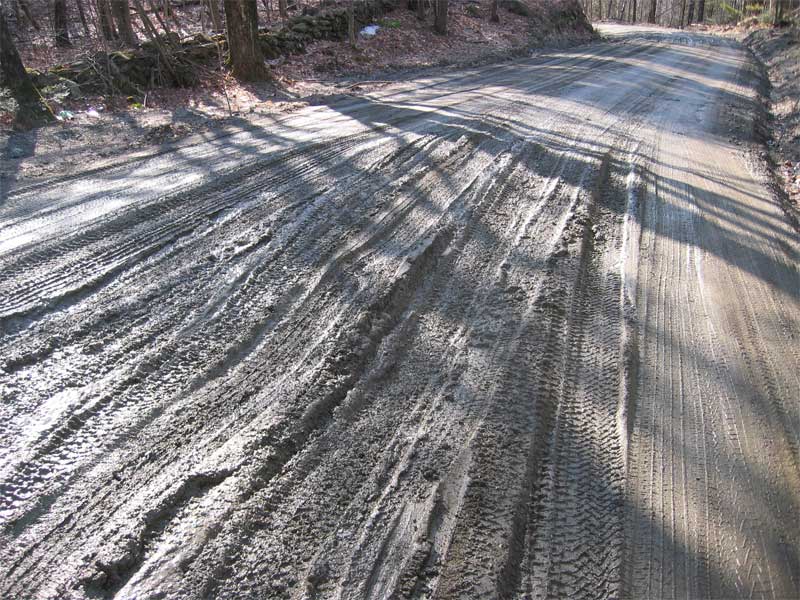
Mud season occurs in places where the ground freezes in winter and thaws in spring. Dirt roads and paths become muddy because the deeply frozen ground thaws from the surface down as the air temperature warms above freezing. The frozen lower layers of ground prevent water from percolating into the soil so the surface layers of soil become saturated with water.
Clay-based soil, especially when combined with poor drainage, is especially prone to forming deep and sticky mud. In sandy soils, the top unfrozen layer becomes waterlogged during thaws, but does not form viscous mud. On the Great Plains, a particular type of clay (bentonite clay, or aluminum phyllosilicate) turns into a sticky form of soil called gumbo during snowmelt and spring rains.
Mud season can be expensive for towns due to the damage done to dirt roads. One report concluded that the cost of re-engineering dirt roads so that they would remain passable during mud season in the state of Vermont could run as high as $140,000 per mile ($87,000/km).
Transportation problems during mud season have military implications, due to the bogging down of horses and military equipment in deep mud.
During mud season, soil becomes fragile and care must be exercised in protected and recreational areas.
"Breakup" originally referred to the "breaking up" of river and lake ice. This event is eagerly anticipated in many regions of Canada, because it marks when different modes of transportation can be used. Vehicles from dog sleds to snowmobiles and even tractor trailers can safely traverse ice roads in the winter and aircraft with skis for landing gear can land on ice in winter, but not near breakup. By contrast after breakup, various boats can once again use the water.
The exact date this occurs varies across the North, and corresponds to different seasons in the indigenous calendars of different regions. In the Cree and Ojibwe calendars, one of the six seasons is called minoskamin (Woods Cree: ᒥᖪᐢᑲᒥᐣ, mithoskamin; Atikamekw: miroskamin, etc.) which is usually translated as "breakup". For the Woods Cree of Northern Saskatchewan this occurred in roughly May and June on the English calendar before the effects of recent climate change. By contrast the New England mud season of (or "unlocking" as Kurt Vonnegut called it) is in March and April.
Hub AI
Mud season AI simulator
(@Mud season_simulator)
Mud season
Mud season (US English) or breakup (Canadian English) is a period in late winter and early spring when travel over ice is no longer safe and travel overland is more difficult as frozen earth thaws and soil becomes muddy from melting snow.
Mud season occurs in places where the ground freezes in winter and thaws in spring. Dirt roads and paths become muddy because the deeply frozen ground thaws from the surface down as the air temperature warms above freezing. The frozen lower layers of ground prevent water from percolating into the soil so the surface layers of soil become saturated with water.
Clay-based soil, especially when combined with poor drainage, is especially prone to forming deep and sticky mud. In sandy soils, the top unfrozen layer becomes waterlogged during thaws, but does not form viscous mud. On the Great Plains, a particular type of clay (bentonite clay, or aluminum phyllosilicate) turns into a sticky form of soil called gumbo during snowmelt and spring rains.
Mud season can be expensive for towns due to the damage done to dirt roads. One report concluded that the cost of re-engineering dirt roads so that they would remain passable during mud season in the state of Vermont could run as high as $140,000 per mile ($87,000/km).
Transportation problems during mud season have military implications, due to the bogging down of horses and military equipment in deep mud.
During mud season, soil becomes fragile and care must be exercised in protected and recreational areas.
"Breakup" originally referred to the "breaking up" of river and lake ice. This event is eagerly anticipated in many regions of Canada, because it marks when different modes of transportation can be used. Vehicles from dog sleds to snowmobiles and even tractor trailers can safely traverse ice roads in the winter and aircraft with skis for landing gear can land on ice in winter, but not near breakup. By contrast after breakup, various boats can once again use the water.
The exact date this occurs varies across the North, and corresponds to different seasons in the indigenous calendars of different regions. In the Cree and Ojibwe calendars, one of the six seasons is called minoskamin (Woods Cree: ᒥᖪᐢᑲᒥᐣ, mithoskamin; Atikamekw: miroskamin, etc.) which is usually translated as "breakup". For the Woods Cree of Northern Saskatchewan this occurred in roughly May and June on the English calendar before the effects of recent climate change. By contrast the New England mud season of (or "unlocking" as Kurt Vonnegut called it) is in March and April.
Recent media