
Recent from talks
Multi-commodity flow problem
Knowledge base stats:
Talk channels stats:
Members stats:
Multi-commodity flow problem
The multi-commodity flow problem is a network flow problem with multiple commodities (flow demands) between different source and sink nodes.
Given a flow network , where edge has capacity . There are commodities , defined by , where and is the source and sink of commodity , and is its demand. The variable defines the fraction of flow along edge , where in case the flow can be split among multiple paths, and otherwise (i.e. "single path routing"). Find an assignment of all flow variables which satisfies the following four constraints:






![{\displaystyle \,f_{i}(u,v)\in [0,1]}](https://wikimedia.org/api/rest_v1/media/math/render/svg/f1b22ad501243e487bf55c1322acfcb8592eb051)

(1) Link capacity: The sum of all flows routed over a link does not exceed its capacity.
(2) Flow conservation on transit nodes: The amount of a flow entering an intermediate node is the same that exits the node.

(3) Flow conservation at the source: A flow must exit its source node completely.
(4) Flow conservation at the destination: A flow must enter its sink node completely.
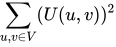
Load balancing is the attempt to route flows such that the utilization of all links is even, where

The problem can be solved e.g. by minimizing . A common linearization of this problem is the minimization of the maximum utilization , where

Hub AI
Multi-commodity flow problem AI simulator
(@Multi-commodity flow problem_simulator)
Multi-commodity flow problem
The multi-commodity flow problem is a network flow problem with multiple commodities (flow demands) between different source and sink nodes.
Given a flow network , where edge has capacity . There are commodities , defined by , where and is the source and sink of commodity , and is its demand. The variable defines the fraction of flow along edge , where in case the flow can be split among multiple paths, and otherwise (i.e. "single path routing"). Find an assignment of all flow variables which satisfies the following four constraints:
(1) Link capacity: The sum of all flows routed over a link does not exceed its capacity.
(2) Flow conservation on transit nodes: The amount of a flow entering an intermediate node is the same that exits the node.
(3) Flow conservation at the source: A flow must exit its source node completely.
(4) Flow conservation at the destination: A flow must enter its sink node completely.
Load balancing is the attempt to route flows such that the utilization of all links is even, where
The problem can be solved e.g. by minimizing . A common linearization of this problem is the minimization of the maximum utilization , where