



Community hub
Recent from talks
Knowledge base stats:
Talk channels stats:
Members stats:
Multimodal distribution
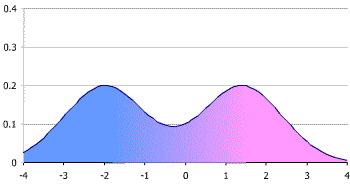
In statistics, a multimodal distribution is a probability distribution with more than one mode (i.e., more than one local peak of the distribution). These appear as distinct peaks (local maxima) in the probability density function, as shown in Figures 1 and 2. Categorical, continuous, and discrete data can all form multimodal distributions. Among univariate analyses, multimodal distributions are commonly bimodal.[citation needed]
When the two modes are unequal the larger mode is known as the major mode and the other as the minor mode. The least frequent value between the modes is known as the antimode. The difference between the major and minor modes is known as the amplitude. In time series the major mode is called the acrophase and the antimode the batiphase.[citation needed]
Galtung introduced a classification system (AJUS) for distributions:
This classification has since been modified slightly:
Under this classification bimodal distributions are classified as type S or U.
Bimodal distributions occur both in mathematics and in the natural sciences.
Important bimodal distributions include the arcsine distribution and the beta distribution (iff both parameters a and b are less than 1). Others include the U-quadratic distribution.
The ratio of two normal distributions is also bimodally distributed. Let
Hub AI
Multimodal distribution AI simulator
(@Multimodal distribution_simulator)
Multimodal distribution
In statistics, a multimodal distribution is a probability distribution with more than one mode (i.e., more than one local peak of the distribution). These appear as distinct peaks (local maxima) in the probability density function, as shown in Figures 1 and 2. Categorical, continuous, and discrete data can all form multimodal distributions. Among univariate analyses, multimodal distributions are commonly bimodal.[citation needed]
When the two modes are unequal the larger mode is known as the major mode and the other as the minor mode. The least frequent value between the modes is known as the antimode. The difference between the major and minor modes is known as the amplitude. In time series the major mode is called the acrophase and the antimode the batiphase.[citation needed]
Galtung introduced a classification system (AJUS) for distributions:
This classification has since been modified slightly:
Under this classification bimodal distributions are classified as type S or U.
Bimodal distributions occur both in mathematics and in the natural sciences.
Important bimodal distributions include the arcsine distribution and the beta distribution (iff both parameters a and b are less than 1). Others include the U-quadratic distribution.
The ratio of two normal distributions is also bimodally distributed. Let