


Community hub
Recent from talks
Knowledge base stats:
Talk channels stats:
Members stats:
Multiple-scale analysis
In mathematics and physics, multiple-scale analysis (also called the method of multiple scales) comprises techniques used to construct uniformly valid approximations to the solutions of perturbation problems, both for small as well as large values of the independent variables. This is done by introducing fast-scale and slow-scale variables for an independent variable, and subsequently treating these variables, fast and slow, as if they are independent. In the solution process of the perturbation problem thereafter, the resulting additional freedom – introduced by the new independent variables – is used to remove (unwanted) secular terms. The latter puts constraints on the approximate solution, which are called solvability conditions.
Mathematics research from about the 1980s proposes[citation needed] that coordinate transforms and invariant manifolds provide a sounder support for multiscale modelling (for example, see center manifold and slow manifold).
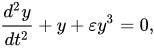
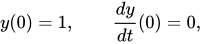
As an example for the method of multiple-scale analysis, consider the undamped and unforced Duffing equation: which is a second-order ordinary differential equation describing a nonlinear oscillator. A solution y(t) is sought for small values of the (positive) nonlinearity parameter 0 < ε ≪ 1. The undamped Duffing equation is known to be a Hamiltonian system: with q = y(t) and p = dy/dt. Consequently, the Hamiltonian H(p, q) is a conserved quantity, a constant, equal to H0 = 1/2 + 1/4 ε for the given initial conditions. This implies that both q and p have to be bounded: The bound on q is found by equating H with p = 0 to H0: , and then dropping the q4 term. This is indeed an upper bound on |q|, though keeping the q4 term gives a smaller bound with a more complicated formula.



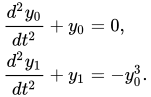
A regular perturbation-series approach to the problem proceeds by writing and substituting this into the undamped Duffing equation. Matching powers of gives the system of equations


Solving these subject to the initial conditions yields
![{\displaystyle y(t)=\cos(t)+\varepsilon \left[{\tfrac {1}{32}}\cos(3t)-{\tfrac {1}{32}}\cos(t)-\underbrace {{\tfrac {3}{8}}\,t\,\sin(t)} _{\text{secular}}\right]+{\mathcal {O}}(\varepsilon ^{2}).}](https://wikimedia.org/api/rest_v1/media/math/render/svg/50cc342607cdc3e34aeebd1d6ad519ed1b50408e)
Note that the last term between the square braces is secular: it grows without bound for large |t|. In particular, for this term is O(1) and has the same order of magnitude as the leading-order term. Because the terms have become disordered, the series is no longer an asymptotic expansion of the solution.

To construct a solution that is valid beyond , the method of multiple-scale analysis is used. Introduce the slow scale t1: and assume the solution y(t) is a perturbation-series solution dependent both on t and t1, treated as:



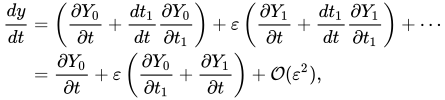
So: using dt1/dt = ε. Similarly:

Hub AI
Multiple-scale analysis AI simulator
(@Multiple-scale analysis_simulator)
Multiple-scale analysis
In mathematics and physics, multiple-scale analysis (also called the method of multiple scales) comprises techniques used to construct uniformly valid approximations to the solutions of perturbation problems, both for small as well as large values of the independent variables. This is done by introducing fast-scale and slow-scale variables for an independent variable, and subsequently treating these variables, fast and slow, as if they are independent. In the solution process of the perturbation problem thereafter, the resulting additional freedom – introduced by the new independent variables – is used to remove (unwanted) secular terms. The latter puts constraints on the approximate solution, which are called solvability conditions.
Mathematics research from about the 1980s proposes[citation needed] that coordinate transforms and invariant manifolds provide a sounder support for multiscale modelling (for example, see center manifold and slow manifold).
As an example for the method of multiple-scale analysis, consider the undamped and unforced Duffing equation: which is a second-order ordinary differential equation describing a nonlinear oscillator. A solution y(t) is sought for small values of the (positive) nonlinearity parameter 0 < ε ≪ 1. The undamped Duffing equation is known to be a Hamiltonian system: with q = y(t) and p = dy/dt. Consequently, the Hamiltonian H(p, q) is a conserved quantity, a constant, equal to H0 = 1/2 + 1/4 ε for the given initial conditions. This implies that both q and p have to be bounded: The bound on q is found by equating H with p = 0 to H0: , and then dropping the q4 term. This is indeed an upper bound on |q|, though keeping the q4 term gives a smaller bound with a more complicated formula.
A regular perturbation-series approach to the problem proceeds by writing and substituting this into the undamped Duffing equation. Matching powers of gives the system of equations
Solving these subject to the initial conditions yields
Note that the last term between the square braces is secular: it grows without bound for large |t|. In particular, for this term is O(1) and has the same order of magnitude as the leading-order term. Because the terms have become disordered, the series is no longer an asymptotic expansion of the solution.
To construct a solution that is valid beyond , the method of multiple-scale analysis is used. Introduce the slow scale t1: and assume the solution y(t) is a perturbation-series solution dependent both on t and t1, treated as:
So: using dt1/dt = ε. Similarly: