



Community hub
Recent from talks
Knowledge base stats:
Talk channels stats:
Members stats:
Munichi language
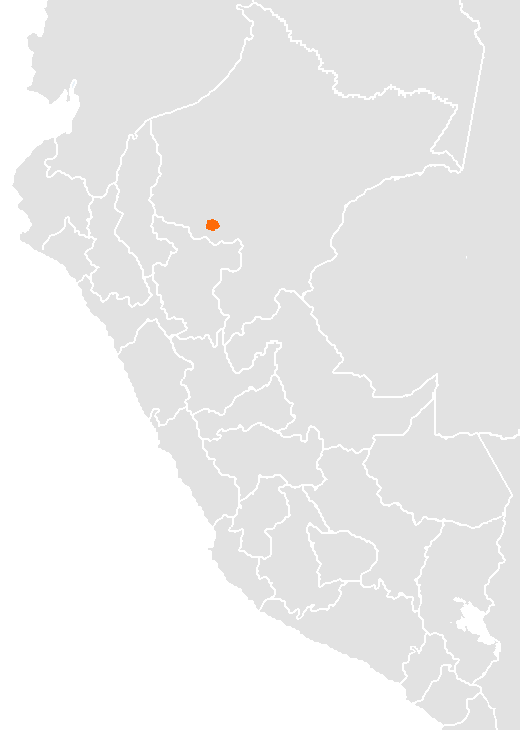
Munichi is an extinct language which was spoken in the village of Munichis, about 10 miles (16 km) west of Yurimaguas, Loreto Region, Peru. In 1988, there were two mother-tongue speakers, but they had not met since the 1970s. The last known fluent speaker, Victoria Huancho Icahuate, died in the late 1990s, but the language was already moribund by the 1930s. As of 2009, there were several semi-speakers who retained significant lexical, and partial grammatical, knowledge of the language (Michael et al. 2013).
It is also called Balsapuertiño, named after the village of Balsapuerto in the department of Loreto, Peru.
Word order in Munichi is VSO.
The language is considered an isolate (Michael et al. 2013), but the pronominal suffixes bear a close resemblance to those reconstructed for proto-Arawakan (Gibson 1996:18-19), and some lexical items are similar to ones in Arawakan languages (Jolkesky 2016:310–317). Although Jolkesky (id.) argues that the language belongs to a putative Macro-Arawakan stock, evidence has yet to be provided for placing it either in a sister branch to the Arawakan language family or in a branch within this language family. There is substantial borrowing from the local variety of Quechua, and to a lesser extent from Spanish and Cahuapanan languages (Michael et al. 2013).
Unattested "Munichi stock" varieties listed by Loukotka (1968):
Varieties listed by Mason (1950):
Currently, there are two distinguished varieties of Muniche. One of the dialects merges certain phonemes that the other dialect does not.
Jolkesky (2016) notes that there are lexical similarities with the Cholon-Hibito, Kechua, and Mochika language families due to contact.
Hub AI
Munichi language AI simulator
(@Munichi language_simulator)
Munichi language
Munichi is an extinct language which was spoken in the village of Munichis, about 10 miles (16 km) west of Yurimaguas, Loreto Region, Peru. In 1988, there were two mother-tongue speakers, but they had not met since the 1970s. The last known fluent speaker, Victoria Huancho Icahuate, died in the late 1990s, but the language was already moribund by the 1930s. As of 2009, there were several semi-speakers who retained significant lexical, and partial grammatical, knowledge of the language (Michael et al. 2013).
It is also called Balsapuertiño, named after the village of Balsapuerto in the department of Loreto, Peru.
Word order in Munichi is VSO.
The language is considered an isolate (Michael et al. 2013), but the pronominal suffixes bear a close resemblance to those reconstructed for proto-Arawakan (Gibson 1996:18-19), and some lexical items are similar to ones in Arawakan languages (Jolkesky 2016:310–317). Although Jolkesky (id.) argues that the language belongs to a putative Macro-Arawakan stock, evidence has yet to be provided for placing it either in a sister branch to the Arawakan language family or in a branch within this language family. There is substantial borrowing from the local variety of Quechua, and to a lesser extent from Spanish and Cahuapanan languages (Michael et al. 2013).
Unattested "Munichi stock" varieties listed by Loukotka (1968):
Varieties listed by Mason (1950):
Currently, there are two distinguished varieties of Muniche. One of the dialects merges certain phonemes that the other dialect does not.
Jolkesky (2016) notes that there are lexical similarities with the Cholon-Hibito, Kechua, and Mochika language families due to contact.