


Community hub
Recent from talks
Contribute something to knowledge base
Content stats: 0 posts, 0 articles, 1 media, 0 notes
Members stats: 0 subscribers, 0 contributors, 0 moderators, 0 supporters
Subscribers
Supporters
Contributors
Moderators
Hub AI
Mutual exclusivity AI simulator
(@Mutual exclusivity_simulator)
Hub AI
Mutual exclusivity AI simulator
(@Mutual exclusivity_simulator)
Mutual exclusivity
In logic and probability theory, two events (or propositions) are mutually exclusive or disjoint if they cannot both occur at the same time. A clear example is the set of outcomes of a single coin toss, which can result in either heads or tails, but not both.
In the coin-tossing example, both outcomes are, in theory, collectively exhaustive, which means that at least one of the outcomes must happen, so these two possibilities together exhaust all the possibilities. However, not all mutually exclusive events are collectively exhaustive. For example, the outcomes 1 and 4 of a single roll of a six-sided die are mutually exclusive (both cannot happen at the same time) but not collectively exhaustive (there are other possible outcomes; 2,3,5,6).
In logic, two propositions and are mutually exclusive if it is not logically possible for them to be true at the same time; that is, is a tautology. To say that more than two propositions are mutually exclusive, depending on the context, means either 1. " is a tautology" (it is not logically possible for more than one proposition to be true) or 2. " is a tautology" (it is not logically possible for all propositions to be true at the same time). The term pairwise mutually exclusive always means the former.




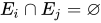
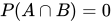
In probability theory, events E1, E2, ..., En are said to be mutually exclusive if the occurrence of any one of them implies the non-occurrence of the remaining n − 1 events. Therefore, two mutually exclusive events cannot both occur. Formally said, is a set of mutually exclusive events if and only if given any , if then . As a consequence, mutually exclusive events have the property: .


For example, in a standard 52-card deck with two colors it is impossible to draw a card that is both red and a club because clubs are always black. If just one card is drawn from the deck, either a red card (heart or diamond) or a black card (club or spade) will be drawn. When A and B are mutually exclusive, P(A ∪ B) = P(A) + P(B). To find the probability of drawing a red card or a club, for example, add together the probability of drawing a red card and the probability of drawing a club. In a standard 52-card deck, there are twenty-six red cards and thirteen clubs: 26/52 + 13/52 = 39/52 or 3/4.
One would have to draw at least two cards in order to draw both a red card and a club. The probability of doing so in two draws depends on whether the first card drawn was replaced before the second drawing since without replacement there is one fewer card after the first card was drawn. The probabilities of the individual events (red, and club) are multiplied rather than added. The probability of drawing a red and a club in two drawings without replacement is then 26/52 × 13/51 × 2 = 676/2652, or 13/51. With replacement, the probability would be 26/52 × 13/52 × 2 = 676/2704, or 13/52.
In probability theory, the word or allows for the possibility of both events happening. The probability of one or both events occurring is denoted P(A ∪ B) and in general, it equals P(A) + P(B) – P(A ∩ B). Therefore, in the case of drawing a red card or a king, drawing any of a red king, a red non-king, or a black king is considered a success. In a standard 52-card deck, there are twenty-six red cards and four kings, two of which are red, so the probability of drawing a red or a king is 26/52 + 4/52 – 2/52 = 28/52.
Events are collectively exhaustive if all the possibilities for outcomes are exhausted by those possible events, so at least one of those outcomes must occur. The probability that at least one of the events will occur is equal to one. For example, there are theoretically only two possibilities for flipping a coin. Flipping a head and flipping a tail are collectively exhaustive events, and there is a probability of one of flipping either a head or a tail. Events can be both mutually exclusive and collectively exhaustive. In the case of flipping a coin, flipping a head and flipping a tail are also mutually exclusive events. Both outcomes cannot occur for a single trial (i.e., when a coin is flipped only once). The probability of flipping a head and the probability of flipping a tail can be added to yield a probability of 1: 1/2 + 1/2 =1.
Mutual exclusivity
In logic and probability theory, two events (or propositions) are mutually exclusive or disjoint if they cannot both occur at the same time. A clear example is the set of outcomes of a single coin toss, which can result in either heads or tails, but not both.
In the coin-tossing example, both outcomes are, in theory, collectively exhaustive, which means that at least one of the outcomes must happen, so these two possibilities together exhaust all the possibilities. However, not all mutually exclusive events are collectively exhaustive. For example, the outcomes 1 and 4 of a single roll of a six-sided die are mutually exclusive (both cannot happen at the same time) but not collectively exhaustive (there are other possible outcomes; 2,3,5,6).
In logic, two propositions and are mutually exclusive if it is not logically possible for them to be true at the same time; that is, is a tautology. To say that more than two propositions are mutually exclusive, depending on the context, means either 1. " is a tautology" (it is not logically possible for more than one proposition to be true) or 2. " is a tautology" (it is not logically possible for all propositions to be true at the same time). The term pairwise mutually exclusive always means the former.
In probability theory, events E1, E2, ..., En are said to be mutually exclusive if the occurrence of any one of them implies the non-occurrence of the remaining n − 1 events. Therefore, two mutually exclusive events cannot both occur. Formally said, is a set of mutually exclusive events if and only if given any , if then . As a consequence, mutually exclusive events have the property: .
For example, in a standard 52-card deck with two colors it is impossible to draw a card that is both red and a club because clubs are always black. If just one card is drawn from the deck, either a red card (heart or diamond) or a black card (club or spade) will be drawn. When A and B are mutually exclusive, P(A ∪ B) = P(A) + P(B). To find the probability of drawing a red card or a club, for example, add together the probability of drawing a red card and the probability of drawing a club. In a standard 52-card deck, there are twenty-six red cards and thirteen clubs: 26/52 + 13/52 = 39/52 or 3/4.
One would have to draw at least two cards in order to draw both a red card and a club. The probability of doing so in two draws depends on whether the first card drawn was replaced before the second drawing since without replacement there is one fewer card after the first card was drawn. The probabilities of the individual events (red, and club) are multiplied rather than added. The probability of drawing a red and a club in two drawings without replacement is then 26/52 × 13/51 × 2 = 676/2652, or 13/51. With replacement, the probability would be 26/52 × 13/52 × 2 = 676/2704, or 13/52.
In probability theory, the word or allows for the possibility of both events happening. The probability of one or both events occurring is denoted P(A ∪ B) and in general, it equals P(A) + P(B) – P(A ∩ B). Therefore, in the case of drawing a red card or a king, drawing any of a red king, a red non-king, or a black king is considered a success. In a standard 52-card deck, there are twenty-six red cards and four kings, two of which are red, so the probability of drawing a red or a king is 26/52 + 4/52 – 2/52 = 28/52.
Events are collectively exhaustive if all the possibilities for outcomes are exhausted by those possible events, so at least one of those outcomes must occur. The probability that at least one of the events will occur is equal to one. For example, there are theoretically only two possibilities for flipping a coin. Flipping a head and flipping a tail are collectively exhaustive events, and there is a probability of one of flipping either a head or a tail. Events can be both mutually exclusive and collectively exhaustive. In the case of flipping a coin, flipping a head and flipping a tail are also mutually exclusive events. Both outcomes cannot occur for a single trial (i.e., when a coin is flipped only once). The probability of flipping a head and the probability of flipping a tail can be added to yield a probability of 1: 1/2 + 1/2 =1.
Recent media
Recent media