Hubbry Logo
Muzzle energyMuzzle energyMain
Open search
Muzzle energy
Community hub
Muzzle energy
logo
8 pages, 0 posts
0 subscribers
Be the first to start a discussion here.
Muzzle energy
Muzzle energy
from Wikipedia
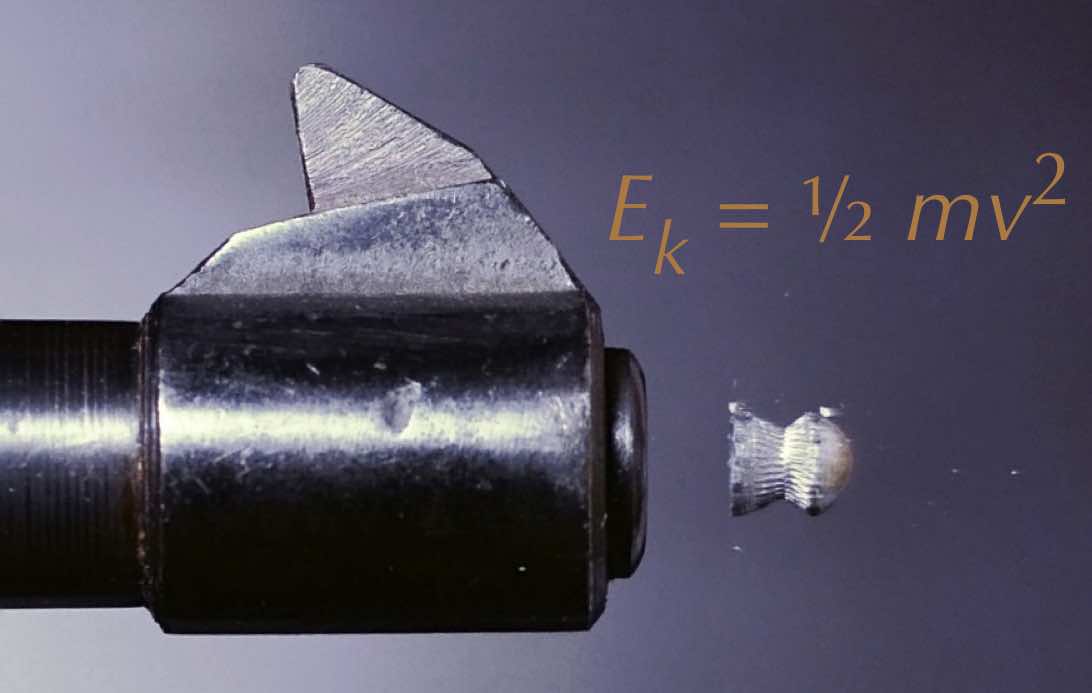
Pellet exiting muzzle, with formula for energy overlaid.

Muzzle energy is the kinetic energy of a bullet as it is expelled from the muzzle of a firearm. Without consideration of factors such as aerodynamics and gravity for the sake of comparison, muzzle energy is used as a rough indication of the destructive potential of a given firearm or cartridge. The heavier the bullet and especially the faster it moves, the higher its muzzle energy and the more damage it will do.

Kinetic energy

[edit]

The general formula for the kinetic energy is where v is the velocity of the bullet and m is the mass of the bullet.

Although both mass and velocity contribute to the muzzle energy, the muzzle energy is proportional to the mass while proportional to the square of the velocity. The velocity of the bullet is a more important determinant of muzzle energy. For a constant velocity, if the mass is doubled, the energy is doubled; however, for a constant mass, if the velocity is doubled, the muzzle energy increases four times. In the SI system the above Ek will be in unit joules if the mass, m, is in kilograms, and the speed, v, is in metres per second.[1]

Typical muzzle energies of common firearms and cartridges

[edit]

Muzzle energy is dependent upon the factors previously listed, and velocity is highly variable depending upon the length of the barrel a projectile is fired from.[2] Also the muzzle energy is only an upper limit for how much energy is transmitted to the target, and the effects of a ballistic trauma depend on several other factors as well. There is wide variation in commercial ammunition. A 180 gr (12 g) bullet fired from .357 Magnum handgun can achieve a muzzle energy of 580 ft⋅lbf (790 J). A 110 gr (7.1 g) bullet fired from the same gun might only achieve 400 ft⋅lbf (540 J) of muzzle energy, depending upon the manufacturer of the cartridge. Some .45 Colt +P ammunition can produce 1,200 ft⋅lbf (1,600 J) of muzzle energy.[citation needed]

[edit]

Many parts of the world use muzzle energy to classify guns into categories that require different categories of licence. In general guns that have the potential to be more dangerous have tighter controls, while those of minimal energy, such as small air pistols or air rifles, require little more than user registration, or in some countries have no restrictions at all. Overview of gun laws by nation indicates the various approaches taken. Firearms regulation in the United Kingdom is a complicated example, but is demarked by muzzle energy as well as barrel length and ammunition diameter.

Some jurisdictions also stipulate minimum muzzle energies for safe hunting. For example, in Denmark rifle ammunition used for hunting the largest types of game there such as red deer must have a kinetic energy E100 (i.e.: at 100 m (110 yd) range) of at least 2,700 J (2,000 ft⋅lbf) and a bullet mass of at least 9 g (140 gr) or alternatively an E100 of at least 2,000 J (1,500 ft⋅lbf) and a bullet mass of at least 10 g (150 gr).[3] Namibia specifies three levels of minimum muzzle energy for hunting depending on the size of the game, 1,350 J (1,000 ft⋅lbf) for game such as springbok, 2,700 J (2,000 ft⋅lbf) for game such as hartebeest, and 5,400 J (4,000 ft⋅lbf) for Big Five game, together with a minimum caliber of 7 mm (0.28 in).[4]

In Germany, airsoft guns with a muzzle energy of no more than 0.5 J (0.37 ft⋅lbf) are exempt from the gun law,[5] while air guns with a muzzle energy of no more than 7.5 J (5.5 ft⋅lbf) may be acquired without a firearms license.[6]

Mainland China uses a varied concept of "muzzle ratio kinetic energy" (Chinese: 枪口比动能), which is the quotient (ratio) of the muzzle energy divided by the bore cross sectional area, to distinguish genuine guns from "imitation" replicas like toy guns. The Ministry of Public Security unilaterally introduced the concept in 2008 leading up to the Beijing Olympic Games, dictating that anything over 1.8 J/cm2 to be defined as real firearms. This caused many existing toy gun products on the Chinese market (particularly airsoft) to become illegal overnight, as almost all airsoft guns shooting a standard 0.20 g (3.1 gr) 6 mm (0.24 in) pellet have a muzzle velocity over 76 m/s (250 ft/s), which translates to more than 0.58 J (0.43 ft⋅lbf) of muzzle energy, or 2.0536 J/cm2 of "ratio energy". For comparison a standard baseball changeup thrown at 34 m/s (110 ft/s) has 1.951 J/cm2 of "ratio energy" which also exceeds the 1.8 J/cm2 of a real firearm while a fastball can reach over 3.5 J/cm2 or nearly double the level of a real firearm. The subsequent crackdowns by local law enforcement led to many seizures, arrests and prosecutions of individual owners for "trafficking and possession of illegal weapons" over the years for weapons that were previously permitted.

See also

[edit]

Resources

[edit]
  • Edward F. Obert, Thermodynamics, McGraw-Hill Book Co., 1948.
  • Mc Graw-Hill encyclopedia of Science and Technology, volume ebe-eye and ice-lev, 9th Edition, Mc Graw-Hill, 2002.

References

[edit]
Revisions and contributorsEdit on WikipediaRead on Wikipedia
from Grokipedia
Muzzle energy is the of a or at the moment it exits the muzzle of a , representing the imparted by the expanding gases during the phase. It is calculated using the Ek=12mv2E_k = \frac{1}{2} m v^2, where mm denotes the projectile's and vv its muzzle , with velocity squared emphasizing its outsized influence on the result. Expressed typically in foot-pounds (ft-lb) for American contexts or joules (J) in metric systems, this value quantifies a cartridge's initial ballistic potential and aids in comparing effectiveness across calibers. Higher muzzle energies, often exceeding 1,000 ft-lb for rifle rounds like the , indicate greater capacity for penetration and tissue disruption, though real-world also depend on factors such as design and target medium. As a standardized metric derived from Newtonian , muzzle energy facilitates empirical evaluation of power without direct testing, but it overlooks post-muzzle retention influenced by drag and does not fully predict wounding efficacy, prompting ballistic experts to pair it with metrics like .

Fundamentals

Definition and Physical Principles

Muzzle energy is defined as the kinetic energy possessed by a projectile at the instant it exits the barrel of a firearm, representing the culmination of internal ballistic processes. This measure quantifies the projectile's capacity to perform work upon impact, primarily derived from the acceleration imparted by expanding propellant gases. The physical principle underlying muzzle energy stems from the conservation of energy within the firearm's chamber and barrel. Chemical energy from the propellant's combustion rapidly converts into thermal and pressure energy, which propels the projectile, converting a portion into translational kinetic energy while losses occur as heat, friction, and unburned propellant. Muzzle energy is thus expressed by the Newtonian kinetic energy formula: where EkE_k is the kinetic energy, mm is the projectile mass, and vv is the muzzle velocity—the speed at which the projectile leaves the barrel. This formula assumes non-relativistic speeds typical in ballistics, with vv measured in meters per second and mm in kilograms yielding EkE_k in joules. In practice, muzzle energy ignores post-muzzle factors like air resistance or , focusing solely on the barrel-exit state; it serves as a baseline for comparing cartridge performance, though actual terminal effects depend on subsequent energy transfer. Empirical measurements confirm that higher charges and optimized barrel lengths maximize this by enhancing vv, subject to limits and ratios often below 30% due to thermodynamic inefficiencies.

Historical Context in Ballistics

The systematic study of projectile motion in firearms, foundational to muzzle energy calculations, originated in the 18th century with Benjamin Robins' empirical measurements of muzzle velocity. In 1742, Robins utilized a ballistic pendulum device to quantify the speeds of musket balls exiting smoothbore firearms, achieving velocities around 300-400 m/s for typical loads of the era; this marked the first accurate, reproducible data on interior ballistics, enabling retrospective computation of kinetic energy via Ek=12mv2E_k = \frac{1}{2} m v^2 once mass was known. Prior efforts, such as Galileo's 1638 parabolic trajectory derivations, focused on exterior ballistics without velocity quantification at the muzzle. Robins' work shifted emphasis to causal factors like propellant burn and barrel friction, though explicit energy tabulations awaited 19th-century physics formalizations of kinetic energy from vis viva debates. The saw interior evolve through pressure instrumentation, correlating chemical energy to . Devices like the Noble-Abel crusher gauge, introduced circa 1860, measured peak chamber pressures in foot-tons, revealing how black powder combustion inefficiencies limited muzzle energies to under 1,000 ft-lbs for musket-era loads. adoption in the 1850s (e.g., in Enfield rifles) and initial smokeless powders by 1884 increased velocities by 50-100%, pushing energies toward 2,000 ft-lbs in early metallic cartridges; German engineers explicitly applied E=12mv2E = \frac{1}{2} m v^2 to cartridge optimization, prioritizing velocity's quadratic effect over mass. These developments underscored muzzle energy's role in predicting range and penetration, distinct from models. By the early , muzzle energy standardized as a performance benchmark amid cartridge proliferation, such as the 1906 .30-06 achieving ~2,900 ft-lbs. Military labs, using piezoelectric transducers from the , refined models to within 1% of observed velocities, linking mass ratios (e.g., 0.95 charge-to-projectile) to energies exceeding 3 km/s in theoretical limits. This metric informed terminal effects assumptions from the late 1800s onward, positing energy dump as key to wounding, though empirical wound data later challenged simplistic transfers.

Calculation and Measurement

Formulas and Derivations

Muzzle energy is the possessed by a immediately upon exiting the barrel, calculated using the classical formula for translational : Ek=12mv2E_k = \frac{1}{2} m v^2, where mm is the and vv is the . This expression derives from the work-energy theorem, which states that the net work done on the equals its change in . Starting from rest (v0=0v_0 = 0), the generates gases that exert a force FF along the barrel length LL, yielding work W=0LFdxW = \int_0^L F \, dx. Since F=maF = m a and a=dvdt=vdvdxa = \frac{dv}{dt} = v \frac{dv}{dx}, substitution gives W=m0vvdv=12mv2W = m \int_0^v v \, dv = \frac{1}{2} m v^2, assuming constant or average force profiles and neglecting relativistic effects, which are minimal for typical velocities below 1 km/s. In ballistics practice, imperial units predominate, with projectile weight ww in grains (1 grain ≈ 0.0648 grams) and velocity in feet per second. The mass m=wgm = \frac{w}{g}, where g32.174g \approx 32.174 ft/s² is gravitational acceleration, leads to the adapted formula E=wv2450240E = \frac{w v^2}{450240} in foot-pounds (ft-lbf), incorporating the conversion factor from the doubled velocity term and unit scaling (450240 ≈ 2 × 7000 grains/lb × 32.174 g). Equivalent SI formulations use joules with mass in kilograms and velocity in meters per second, Ek=12mv2E_k = \frac{1}{2} m v^2, directly without additional constants. Derivations often idealize the process by excluding barrel friction, engraving forces, and propellant inefficiency, which can reduce realized energy by 20-40% compared to theoretical chemical energy release; empirical validation via chronographs confirms the formula's utility for comparative assessments.

Units and Practical Computation

Muzzle energy is quantified in foot-pound-force (ft·lbf) within imperial systems prevalent in U.S. ballistics, representing the kinetic energy imparted to a one-pound mass accelerated one foot per second squared through one foot. The SI unit is the joule (J), with 1 ft·lbf equivalent to approximately 1.3558 J, facilitating international comparisons in firearms performance data. Practical computation in imperial units employs the formula E=w×v2450,437E = \frac{w \times v^2}{450{,}437} ft·lbf, where ww is bullet weight in grains and vv is muzzle velocity in feet per second (fps). This divisor arises from converting grain weight to slugs (mass unit: pounds divided by 32.174 ft/s²) via w/7000w / 7000 for pounds, then applying E=12mv2E = \frac{1}{2} m v^2, yielding the constant 2×32.174×7000450,4362 \times 32.174 \times 7000 \approx 450{,}436. Velocity is measured via chronograph, typically 10-20 feet from the muzzle to approximate exit speed, with weight sourced from manufacturer specifications or precise scales. In SI units, the formula simplifies to E=12mv2E = \frac{1}{2} m v^2 J, requiring mass mm in kilograms (convert grains via 11 grain =6.479891×105= 6.479891 \times 10^{-5} kg) and velocity in meters per second (fps ×0.3048\times 0.3048). For efficiency, imperial results convert directly: multiply ft·lbf by 1.3558. Software or online calculators often integrate these steps, but manual verification ensures accuracy against measurement variability, such as chronograph error margins of ±1-5 fps. Example: A 168-grain .308 Winchester bullet at 2,650 fps yields E168×2,6502450,437=2,616E \approx \frac{168 \times 2{,}650^2}{450{,}437} = 2{,}616 ft·lbf (3{,}548 J), aligning with published load data.

Experimental Methods

Muzzle energy is experimentally determined by measuring the projectile's and , then computing the via Ek=12mv2E_k = \frac{1}{2} m v^2. Projectile is obtained using a precision scale, such as a digital balance with accuracy to 0.1 grains (approximately 6.5 mg), ensuring consistency across test rounds from the same lot. The primary method for muzzle velocity measurement in modern testing employs chronographs, which calculate as the distance between sensors divided by the transit time of the . Optical chronographs, widely used in firearms laboratories, feature two or more light screens with photodiodes that detect the shadow or ionization trail of the passing , typically spaced 2 to 4 feet apart; setups are positioned 5 to 15 feet downrange to minimize muzzle blast interference. Acoustic chronographs detect supersonic shock waves via , deriving from the time-of-arrival differences of pressure signatures, with reported accuracies exceeding 1% under controlled conditions. Doppler radar chronographs, such as those used in advanced testing, track the projectile's directly via reflections without fixed baselines, offering continuous velocity profiling and suitability for high-speed or oblique-angle measurements; these are common in and precision rifle applications for their resistance to environmental factors like lighting. For validation, laboratories often conduct multiple firings—typically 10 to 20 rounds—and compute averages with standard deviations to quantify variability, controlling variables like barrel and consistency. Historical and alternative methods include the ballistic pendulum, where the embeds in a suspended heavy block, and the maximum height of swing is used to calculate initial velocity through conservation of momentum followed by energy equivalence, though this yields lower precision due to inelastic collisions and is largely superseded for direct muzzle measurements. In specialized setups, such as pressure trace systems integrated with velocity radars, interior ballistics data correlates peak chamber pressure to exit velocity for predictive modeling, but direct chronographic measurement remains the standard for empirical muzzle energy validation.

Factors Affecting Muzzle Energy

Projectile and Propellant Characteristics

The primary characteristic influencing muzzle energy is its , which enters linearly into the equation Ek=12mv2E_k = \frac{1}{2} m v^2, such that equivalent muzzle velocities yield higher for heavier projectiles. Heavier es generally require optimized loads to maintain competitive velocities, as under fixed diminishes inversely with , often resulting in muzzle energies that vary modestly across weights in standardized cartridges. Secondary factors include diameter, which affects gas sealing and initial buildup, and or , which influence bore and engraving resistance, though these exert smaller effects on final compared to . Propellant characteristics dominate the energy available for projectile acceleration, with smokeless powders classified by burn rate to match firearm geometry: faster-burning variants ensure complete combustion in short-barreled handguns, maximizing pressure duration and velocity, while slower-burning types sustain push in rifle barrels for higher energies. Double-base propellants, incorporating nitroglycerin alongside nitrocellulose, deliver greater energy density than single-base types due to the additive's higher calorific value, enabling elevated muzzle velocities at comparable charge weights. Increasing charge mass elevates peak chamber pressure—typically capped at 50,000-65,000 psi for small arms per industry standards—and prolongs acceleration, directly boosting muzzle velocity and thus energy, subject to safe pressure limits.

Firearm Design Elements

Barrel length is a primary element influencing muzzle energy, as it determines the duration the gases accelerate the . Longer barrels permit more complete of the and extended , typically increasing by approximately 20 to 50 feet per second (fps) per inch of added length, though this varies by cartridge and ; for cartridges achieving 2000-2500 fps, the increment is often around 10 fps per inch. However, excessive length beyond the point of full powder introduces frictional drag, potentially reducing velocity gains or causing net losses. Chamber design, including volume and material strength, directly governs peak , which correlates with achievable and thus energy. chambers are engineered for higher pressures (50,000 to 70,000 psi) compared to handguns (around 40,000 psi), enabling greater propellant efficiency and velocity without exceeding structural limits. Smaller chamber volumes can concentrate pressure for faster pressure rise, but must balance against risks; maximum pressures are constrained by the firearm's action strength. Rifling configuration, particularly twist rate, exerts a secondary effect on velocity through frictional resistance during engraving and spin-up. Faster twist rates (e.g., 1:8 versus 1:12) impart greater to the , resulting in minor velocity reductions of about 1 to 5 fps per equivalent twist change, as the engages the grooves more aggressively. Slower twists minimize this drag but may compromise stability, indirectly affecting effective energy transfer downrange. Bore diameter and also play roles, as tighter bores increase gas pressure on the base for higher , while smoother finishes reduce drag losses. These elements collectively optimize , with empirical testing via pressure transducers and chronographs confirming their impacts on muzzle energy output.

Applications in Practice

Hunting and Terminal Performance

In hunting applications, muzzle energy serves as a proxy for the kinetic energy available to the projectile upon impact, influencing the potential for tissue disruption, hydrostatic shock, and rapid incapacitation of game animals. Higher muzzle energies generally correlate with greater capacity for bullet expansion and penetration, which are critical for creating lethal wound channels in vital organs such as the heart and lungs. However, terminal performance depends not solely on energy but on the interplay with bullet construction, velocity retention, and impact dynamics; for instance, bullets designed for controlled expansion transfer energy more efficiently within the target while achieving 12-18 inches of penetration in ballistic gelatin analogs for large game. Regulatory and ethical guidelines often specify minimum muzzle energies to ensure humane harvests, with 1,000 foot-pounds (ft-lbs) commonly recommended for medium game like deer to achieve sufficient impact energy for reliable kills within 200-300 yards. For larger species such as elk, thresholds rise to 1,500 ft-lbs to account for tougher hides, denser muscle, and greater skeletal mass, maintaining velocities above 1,800-2,000 feet per second (fps) for reliable mushrooming of soft-point or polymer-tipped bullets. These figures derive from field observations and ballistic modeling, where insufficient energy risks shallow wounds or failure to reach vitals, prolonging suffering; empirical hunter reports indicate that cartridges delivering under these minima, like .243 Winchester at extended ranges, yield higher wounding rates despite adequate shot placement. Terminal ballistics studies emphasize that muzzle energy's predictive value diminishes beyond the muzzle, as drag reduces it quadratically with velocity loss, shifting emphasis to and design for momentum transfer over pure dump. In big game like or , where penetration through bone is paramount, energies exceeding 2,000 ft-lbs pair with heavy-for-caliber bullets (e.g., 300-grain .30-06 loads) to balance expansion with 24+ inches of gel penetration, avoiding over-fragmentation that fragments superficially. Critiques from ballistic experts highlight that while thresholds provide practical baselines, real-world efficacy hinges on empirical factors like angle of impact and animal , with low-energy precise shots (e.g., 100 ft-lbs to the spine) proving lethal more reliably than high-energy marginal hits.

Military, Law Enforcement, and Self-Defense Uses

In military applications, muzzle energy serves as a fundamental metric for evaluating ammunition effectiveness, particularly for long-range engagement, penetration of barriers or , and on personnel or light vehicles. For instance, the cartridge, standard for rifles like the M4 and M16, typically delivers around 1,300 foot-pounds (1,766 joules) of muzzle energy from a 20-inch barrel, enabling high-velocity yawing and fragmentation upon impact to maximize wounding potential while conserving soldier carry weight. In contrast, the used in AK-pattern rifles provides approximately 1,500 foot-pounds (2,034 joules), prioritizing greater penetration and energy retention at intermediate ranges over flatter trajectories. Higher muzzle energies in rifle calibers like (about 2,600 foot-pounds or 3,525 joules) support and roles, where sustained and defeat of cover are critical, though trade-offs include increased recoil and ammunition weight. Law enforcement agencies assess muzzle energy in conjunction with standardized ballistic gel tests emphasizing 12-18 inches of penetration and controlled expansion to balance incapacitation against risks like overpenetration in urban environments. The FBI's protocol, developed post-1986 , prioritizes performance through layered simulants (, , walls) rather than raw energy, but handgun loads meeting these criteria often exhibit 350-450 foot-pounds (475-610 joules), as in 9mm jacketed hollow points. Empirical analyses of shootings indicate that while higher energy correlates with potential tissue disruption, one-shot incapacitation rates vary little across service calibers (e.g., 9mm at 34% vs. at 39%), underscoring that energy alone does not predict without proper bullet design and placement. For , civilians select firearms and loads aiming for sufficient muzzle energy to ensure reliable expansion and vital organ disruption in close-range encounters, typically favoring compact handguns with 300-500 foot-pounds (407-678 joules) to minimize while achieving FBI-like penetration standards. Common choices include 9mm Parabellum (e.g., 115-grain at ~350 foot-pounds), which offers capacity advantages over higher-energy (~400 foot-pounds), with ballistic tests showing comparable gel performance when using modern hollow points. Defensive data from over 1,800 incidents reveal marginal differences in threat neutralization by energy, with success hinging more on multiple hits to the or head than initial kinetic output, though inadequate energy (below ~250 foot-pounds) risks insufficient wounding in subcompact carry guns.
ApplicationCommon CaliberTypical Muzzle Energy (ft-lbs / J)Key Considerations
Military (Rifle)1,300 / 1,766Fragmentation, lightweight logistics
Military (Rifle)2,600 / 3,525Penetration,
Law Enforcement (Handgun)9mm Luger350-450 / 475-610Expansion, reduced overpenetration
Self-Defense (Handgun)~400 / 542Wound cavity size, controllability

Metrics Comparisons and Debates

Versus Momentum and Other Ballistic Measures

Muzzle energy quantifies the imparted to a upon exiting the barrel, calculated as E=12mv2E = \frac{1}{2} m v^2, where mm is the and vv is , representing the total mechanical work potential available for transfer to a target. In contrast, linear , p=mvp = m v, measures the projectile's impetus or resistance to deceleration, directly conserved in the impulse where bullet equals the firearm's rearward momentum divided by the mass ratio. This distinction arises because energy scales quadratically with , amplifying the apparent potency of high-velocity, lower-mass projectiles (e.g., a 10% velocity increase yields approximately 21% more energy but only 10% more momentum), whereas momentum scales linearly, favoring heavier, slower projectiles for sustained penetration. In , proponents of argue it better predicts in or for non-expanding or minimally deforming projectiles, as deceleration depends on the force required to alter the projectile's path, governed by F=Δp/ΔtF = \Delta p / \Delta t. Empirical tests with rigid penetrators, such as in or FMJ bullets, show penetration correlating more closely with than , since dissipation involves complex factors like drag and deformation not captured by initial 12mv2\frac{1}{2} m v^2. Conversely, is favored for assessing potential or temporary in high-velocity rounds (>2,000 fps), where rapid dump can cause remote neural disruption, though this effect diminishes below ~1,200 fps in calibers, rendering a less reliable proxy for incapacitation. FBI ballistic studies emphasize penetration (12-18 inches in 10% ) over raw or for reliable stopping, as inadequate leads to shallow wounds despite high initial . Beyond these, other ballistic measures address limitations of both and by incorporating geometry or target interaction. Sectional density (SD = length / cross-sectional area, or equivalently mass normalized by diameter squared) enhances 's predictive value for penetration in dense media like or hide, with higher SD correlating to deeper travel in tests independent of . The Taylor Knock-Out (TKO) formula, TKO=mvd27000\text{TKO} = \frac{m \cdot v}{d^2 \cdot 7000} (with mm in pounds, vv in fps, dd in inches), proxies per unit frontal area for estimating knockdown on large , outperforming pure in empirical data by accounting for leverage against vital disruption rather than total work. Critics note that no single muzzle-derived metric fully captures terminal performance, as expansion, yaw, and fragmentation—evident in chronographed velocities and recovered —dominate outcomes, with simulations showing high- varmint rounds fragmenting prematurely while -heavy big-bore loads achieve consistent vitals access.
MeasureFormulaStrengthsLimitations
Muzzle Energy12mv2\frac{1}{2} m v^2Captures velocity-squared damage potential; useful for in riflesOvervalues fragile high-speed projectiles; ignores shape/deformation
mvm vPredicts penetration and ; linear with massUnderweights energy dissipation in expanding bullets; poor for shock effects
m/(π(d/2)2)m / (\pi (d/2)^2)Enhances penetration forecasts in mediaStatic; neglects or expansion dynamics
Taylor Knock-Outmvd2k\frac{m v}{d^2 \cdot k} (k=constant)Balances with area for game impactEmpirical fit for large animals; less validated for small game or humans

Relation to Stopping Power and Empirical Evidence

While muzzle energy quantifies a projectile's initial kinetic output and is theoretically linked to potential tissue disruption via energy transfer, empirical assessments of —the ability to incapacitate a threat through rapid physiological failure—reveal weak and inconsistent correlations. Real-world incapacitation primarily arises from hits or severe hemorrhage disrupting vital functions, rather than uniform energy deposition, as demonstrated in analyses of over 1,800 shooting incidents where factors like shot placement and path outweighed muzzle energy differences among calibers. Federal Bureau of Investigation protocols for handgun ammunition selection emphasize 12-18 inches of penetration in 10% ballistic gelatin, with reliable expansion to 1.5 times original diameter, over muzzle energy metrics, based on forensic reviews of officer-involved shootings such as the 1986 Miami incident where shallow penetration compromised effectiveness despite sufficient energy. This led to the FBI's 2015 reversion to 9mm Parabellum as the standard duty round, which delivers approximately 350-400 foot-pounds of muzzle energy—lower than .40 S&W (450-500 foot-pounds) or .45 ACP (400-450 foot-pounds)—yet achieves superior terminal performance through modern jacketed hollow-point designs optimizing wound channel formation. Compilations of "one-shot stop" data, such as those by Evan Marshall and Ed Sanow aggregating percentages from street shootings (e.g., claiming 94% for vs. 34% for ), have been critiqued for , small unverified samples, and omission of variables like entry wound location and attacker , rendering energy-based extrapolations unreliable. Peer-reviewed reviews highlight that such datasets fail to isolate causal effects, with hydrostatic shock from high-energy transfers rarely contributing to handgun stops due to insufficient (typically under 1,200 fps) for significant temporary in tissue. Terminal ballistics gel tests and correlations further underscore that effective stopping relies on permanent cavity volume from deformation and yaw, not initial muzzle energy, as over-rapid deceleration fragments projectiles prematurely, reducing penetration and vital organ reach. In contexts, high-muzzle-energy rounds (e.g., 5.56x45mm at ~1,300 foot-pounds) often require multiple hits for stops, prioritizing fragmentation over energy alone, while data shows minimum energy thresholds (e.g., 1,000 foot-pounds for deer) succeed only with proper expansion to maximize hydrodynamic pressure spikes.

Limitations and Criticisms

Predictive Shortcomings

Muzzle energy, calculated as Ek=12mv2E_k = \frac{1}{2} m v^2, quantifies a projectile's at the firearm's muzzle but exhibits significant predictive shortcomings for , as it neglects the multifaceted dynamics of bullet-tissue interaction post-impact. This metric assumes a direct proportionality between initial energy and wounding potential, yet actual tissue disruption hinges on , permanent cavity formation via bullet deformation or fragmentation, and the limited role of temporary at typical handgun velocities below 2,000 ft/s. Dr. Martin Fackler, a pioneering wound ballistics researcher, critiqued energy-based models as irrelevant or incomplete for forecasting damage, emphasizing that only the physical volume of destroyed tissue—primarily from penetration and expansion—determines incapacitation, not total energy availability. Empirical protocols, such as the FBI's handgun wounding standards developed in the 1980s following the 1986 Miami shootout, prioritize consistent penetration of 12 to 18 inches in 10% over muzzle energy, as inadequate depth fails to reach vital organs despite high initial kinetic output, while excessive penetration risks minimal energy deposition. In these guidelines, temporary —often overstated in energy-centric theories—contributes negligibly to wounds, rendering muzzle energy a poor proxy for , which correlates more strongly with reliable expansion (increasing permanent cavity diameter) and shot placement targeting the or major vasculature. Analysis of real-world shootings, including data, reveals no robust statistical correlation between muzzle energy and one-shot incapacitation rates, with factors like construction and entry angle overriding raw energy figures. Further limitations arise in variable real-world scenarios, where muzzle energy disregards aerodynamic drag-induced loss over distance, reducing impact unpredictably, and fails to account for inconsistent transfer in diverse targets (e.g., clothed humans versus simulants). High-muzzle- rounds may yaw or fragment to maximize tissue damage, but handgun projectiles often underperform relative to their due to yaw instability or failure to expand, as evidenced by comparative tests showing low- .45 ACP loads outperforming higher- 9mm variants in vital disruption when expansion occurs. Methodological critiques of purported -stopping power correlations, such as those in early studies, highlight selection biases and overlook that only the fraction of energy retained within the target contributes to wounding, often far below muzzle values.

Common Misconceptions and Empirical Counterexamples

A prevalent misconception holds that muzzle energy serves as the primary or sole predictor of a projectile's capacity to deliver effective , such as incapacitation in or humane dispatch in , irrespective of construction, , or impact dynamics. This view overprioritizes velocity-squared contributions in the formula while undervaluing factors like and wound channel formation, which determine actual tissue disruption. For instance, big-game hunter John Taylor, drawing from extensive African experience, deemed muzzle energy "misleading" for its bias toward high-velocity loads that often fail to penetrate deeply enough against or hide. Empirical counterexamples from hunting illustrate this limitation: the , delivering approximately 2,000 foot-pounds of muzzle energy with a 95-grain at 3,100 feet per second, proves adequate for deer-sized but marginal for larger animals like due to insufficient for reliable penetration beyond 150 yards, whereas the , generating about 1,650 foot-pounds with a heavier 190-grain at 1,980 feet per second, yields superior close-range performance on bigger quarry through better and reduced fragmentation risk. Similarly, high-energy varmint-oriented bullets, such as those in loads exceeding 1,200 foot-pounds, frequently fragment prematurely on medium , resulting in shallow wounds and prolonged suffering, as documented in field reports of inadequate expansion control. Another common error posits that high muzzle energy imparts a "knockdown" or backward effect on targets, akin to cinematic portrayals, implying direct energy transfer equates to immediate . In reality, conservation of momentum precludes such outcomes, as the impulse on the shooter exceeds any forward force on the target; ballistic studies confirm that even high-energy rounds rarely displace subjects more than a few inches, with incapacitation stemming instead from hits or blood loss rather than kinetic shock. In handgun contexts for or , the belief persists that cartridges with greater muzzle energy, such as .45 ACP (typically 400–500 foot-pounds from 230-grain loads), inherently outperform lower-energy options like 9mm Luger (350–450 foot-pounds from 124-grain +P loads) in terminal effectiveness. However, protocol tests in 10% reveal that modern jacketed hollow-point 9mm ammunition achieves comparable 12–18-inch penetration and expansion diameters (0.55–0.65 inches) to , often with larger permanent wound channels when factoring bullet mass retention, while enabling higher shot capacity and reduced recoil for faster follow-ups—prompting the FBI's 2014 shift to 9mm for these practical advantages over energy alone. These findings underscore that bullet design and shooter proficiency eclipse raw muzzle energy in empirical outcomes.

Minimum Energy Standards for Hunting

Minimum energy standards for hunting, expressed in foot-pounds (ft-lbs) of muzzle kinetic energy, aim to ensure projectiles deliver sufficient force for ethical, rapid kills by promoting adequate penetration, tissue disruption, and vital organ damage, thereby minimizing wounded animals and suffering. These thresholds vary by jurisdiction, game species, and weapon type, with conventional centerfire rifles often regulated via minimum calibers (e.g., .24 for deer in many U.S. states) that correlate to energies exceeding 1,000 ft-lbs rather than explicit energy mandates. Non-traditional firearms like air rifles face stricter energy requirements to compensate for lower velocities and potential expansion limitations. In the United States, state-specific regulations frequently target air guns and pneumatic weapons for big game. mandates that air rifles used for deer must fire .40 caliber or larger bullets generating at least 400 ft-lbs of muzzle energy to qualify as legal. requires air rifles or similar devices for deer to achieve a minimum of 800 feet per second or equivalent energy of 215 ft-lbs, though this lower threshold applies to configurations emphasizing lighter projectiles. stipulates cartridge rifles for certain hunting must produce at least 1,200 ft-lbs of muzzle energy. These rules reflect empirical assessments of , where insufficient energy risks shallow wounds and escape of game. Beyond legal minima, organizations and ballistic experts advocate higher benchmarks for reliable performance on medium to large . A common guideline for whitetail deer is 1,000 ft-lbs at the muzzle, ensuring bullets maintain for expansion and penetration out to 200-300 yards; loads falling below this, such as some .22 centerfires (around 1,300 ft-lbs for but variable), may suffice at close range but risk failure on angled shots. For or similar larger species, recommendations rise to 1,500 ft-lbs or more, accounting for thicker hides, bones, and greater mass requiring deeper channels. These figures derive from field data on rather than theoretical models alone, with underpowered cartridges linked to higher crippling rates in harvest statistics. Internationally, standards emphasize caliber and energy proxies for dangerous game; for instance, some African nations require .375 H&H or equivalent (yielding 4,000+ ft-lbs) for safari hunts to guarantee against charges. Compliance often involves pre-hunt inspections or affidavits verifying load data, underscoring causal links between energy deficits and hunter safety risks. While debates persist on energy's primacy over design, regulations prioritize verifiable metrics to enforce .

Firearm Classification and International Variations

In various jurisdictions, muzzle energy serves as a criterion for classifying pneumatic weapons, such as air rifles and air pistols, distinguishing them from unregulated devices or treating them as firearms subject to licensing and restrictions. This approach aims to regulate devices capable of causing significant injury based on their kinetic output rather than solely on propellant type. Thresholds are typically specified in joules (J) or foot-pounds of energy (ft-lb), with exceedance triggering firearm status, background checks, or prohibitions on possession without permits. For conventional powder-actuated firearms, classification more commonly relies on factors like barrel length, firing mechanism, and semi-automatic capability, though exceptionally high muzzle energies—such as exceeding 10,000 J—may independently qualify weapons as prohibited in certain contexts, as seen in Canadian regulations for large-bore or sniper systems. International variations reflect differing assessments of risk and public safety priorities, often calibrated to .177 or .22 caliber projectiles. In the United States, federal classification under the Bureau of Alcohol, Tobacco, Firearms and Explosives (ATF) primarily hinges on the use of fixed ammunition with explosive propellants, rendering most airguns exempt from firearm status regardless of energy output unless they mimic regulated designs; state laws may impose additional thresholds for hunting or concealed carry. By contrast, European and Commonwealth nations frequently employ energy-based delineations for airguns to bridge gaps between toys and lethal devices. The following table summarizes key thresholds for air rifle classification in select countries, above which the device is typically deemed a requiring a or facing heightened (values approximate standard adult air rifles; thresholds are often lower):
CountryThreshold for Air RiflesNotes on Classification Above Threshold
>5.7 J (for .177 cal at <500 fps)Regulated as non-restricted ; low-energy variants exempt from licensing.
United Kingdom>16.2 J (12 ft-lb)Requires Firearm Certificate (Section 1); sub-12 ft-lb models license-free for adults over 18.
>7.5 J (6 ft-lb)Permit required; below threshold treated as non-firearm for acquisition.
>20 J prohibited entirely with airguns; above threshold demands authorization.
>10 J (varies by intent) required for all airguns, but low-energy models (< certain limit) face fewer restrictions.
These thresholds are periodically reviewed based on injury data and forensic evidence, with higher limits in some nations accommodating sporting use while lower ones prioritize child safety. Discrepancies arise from national ballistic testing standards, such as those from the Commission Internationale Permanente (C.I.P.), which certify safe energy outputs but influence legal interpretations indirectly. In export controls like the U.S. , muzzle energies exceeding 5 MJ denote heavy ordnance rather than small arms, highlighting a tiered global framework.

References

Add your contribution
Related Hubs
User Avatar
No comments yet.