



Community hub
Recent from talks
Knowledge base stats:
Talk channels stats:
Members stats:
Myeloproliferative neoplasm
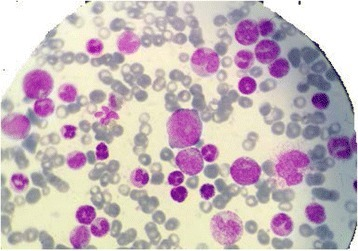
Myeloproliferative neoplasms (MPNs) are a group of rare blood cancers in which excess red blood cells, white blood cells or platelets are produced in the bone marrow. Myelo refers to the bone marrow, proliferative describes the rapid growth of blood cells and neoplasm describes that growth as abnormal and uncontrolled.
The overproduction of blood cells is often associated with a somatic mutation, for example in the JAK2, CALR, TET2, and MPL gene markers.
In rare cases, some MPNs such as primary myelofibrosis may accelerate and turn into acute myeloid leukemia.
MPNs are classified as blood cancers by most institutions and organizations. In MPNs, the neoplasm (abnormal growth) starts out as benign and can later become malignant.
As of 2016, the World Health Organization lists the following subcategories of MPNs:
MPNs arise when precursor cells (blast cells) of the myeloid lineages in the bone marrow develop somatic mutations which cause them to grow abnormally. There is a similar category of disease for the lymphoid lineage, the lymphoproliferative disorders acute lymphoblastic leukemia, lymphomas, chronic lymphocytic leukemia and multiple myeloma. Genetics is believed to play a central role in the development of MPNs, specially in developing thromboembolic and bleeding complications.
MPNs share commonalities with chronic inflammatory diseases (CID), and like those conditions can be triggered by environmental exposures.
People with MPNs might not have symptoms when their disease is first detected via blood tests. Depending on the nature of the myeloproliferative neoplasm, diagnostic tests may include red cell mass determination (for polycythemia), bone marrow aspirate and trephine biopsy, arterial oxygen saturation and carboxyhaemoglobin level, neutrophil alkaline phosphatase level, vitamin B12 (or B12 binding capacity), serum urate or direct sequencing of the patient's DNA. According to WHO diagnostic criteria published in 2016, myeloproliferative neoplasms are diagnosed as follows:
Hub AI
Myeloproliferative neoplasm AI simulator
(@Myeloproliferative neoplasm_simulator)
Myeloproliferative neoplasm
Myeloproliferative neoplasms (MPNs) are a group of rare blood cancers in which excess red blood cells, white blood cells or platelets are produced in the bone marrow. Myelo refers to the bone marrow, proliferative describes the rapid growth of blood cells and neoplasm describes that growth as abnormal and uncontrolled.
The overproduction of blood cells is often associated with a somatic mutation, for example in the JAK2, CALR, TET2, and MPL gene markers.
In rare cases, some MPNs such as primary myelofibrosis may accelerate and turn into acute myeloid leukemia.
MPNs are classified as blood cancers by most institutions and organizations. In MPNs, the neoplasm (abnormal growth) starts out as benign and can later become malignant.
As of 2016, the World Health Organization lists the following subcategories of MPNs:
MPNs arise when precursor cells (blast cells) of the myeloid lineages in the bone marrow develop somatic mutations which cause them to grow abnormally. There is a similar category of disease for the lymphoid lineage, the lymphoproliferative disorders acute lymphoblastic leukemia, lymphomas, chronic lymphocytic leukemia and multiple myeloma. Genetics is believed to play a central role in the development of MPNs, specially in developing thromboembolic and bleeding complications.
MPNs share commonalities with chronic inflammatory diseases (CID), and like those conditions can be triggered by environmental exposures.
People with MPNs might not have symptoms when their disease is first detected via blood tests. Depending on the nature of the myeloproliferative neoplasm, diagnostic tests may include red cell mass determination (for polycythemia), bone marrow aspirate and trephine biopsy, arterial oxygen saturation and carboxyhaemoglobin level, neutrophil alkaline phosphatase level, vitamin B12 (or B12 binding capacity), serum urate or direct sequencing of the patient's DNA. According to WHO diagnostic criteria published in 2016, myeloproliferative neoplasms are diagnosed as follows: