
Recent from talks
Mytholmroyd
Knowledge base stats:
Talk channels stats:
Members stats:
Mytholmroyd
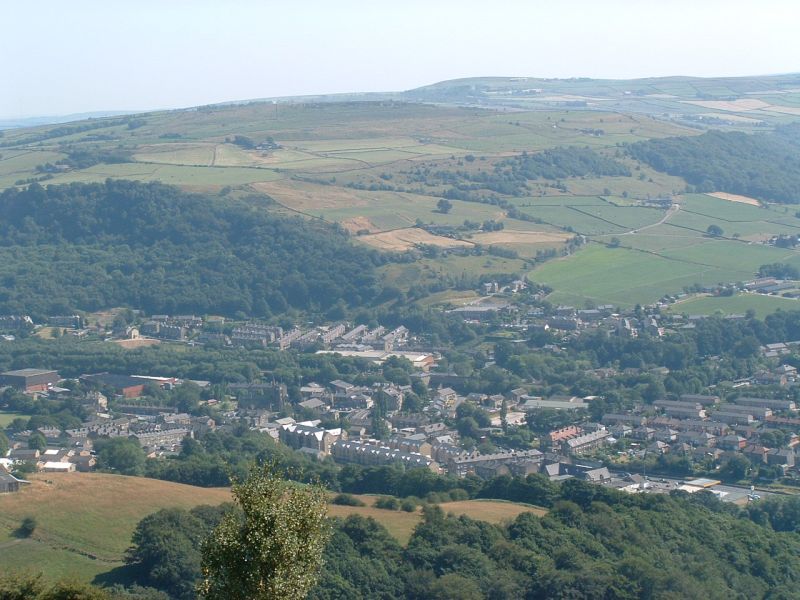
Mytholmroyd (/ˈmaɪðəmrɔɪd/ ⓘ MY-thəm-roid) is a large village in the civil parish of Hebden Royd, in the Calderdale district of West Yorkshire, England, 2 miles (3 km) east of Hebden Bridge. It lies in the Upper Calder Valley, 10 miles (16 km) east of Burnley and 7 miles (11 km) west of Halifax. There are more than 21 listed buildings in the village.
Mytholmroyd was recorded in the 13th century as "Mithomrode" and in the 17th century as "Mitholmroide". The name means 'a clearing for settlement, where two rivers meet', likely derived from the Old English (ġe)mȳthum (inflected form of (ġe)mȳthe, "river mouth"), plus rodu ("field" or "clearing"). The L[further explanation needed] was probably inserted out of confusion with the common place-name element holm, Old Norse for a small island or eyot.
Mytholmroyd was formerly a chapelry in the parish of Halifax. On 31 December 1894 Mytholmroyd became a civil parish in its own right being formed from Wadsworth, Sowerby, Erringden and Midgeley, on 1 April 1937 the parish was abolished to form Hebden Royd. In 1931 the parish had a population of 4468.
The village is part of the Luddendenfoot ward of the Metropolitan borough of Calderdale. It has had a Labour-majority council as of May 2019 - All 3 councillors in the ward represent the Labour Party - Jane Scullion, leader of the Council, Scott Patient and Katie Kimber who has just retained the seat from the departing Roisin Cavanagh. It is part of the Metropolitan county of West Yorkshire.
At a district level, Mytholmroyd Urban District Council was set up in 1894. In 1937 it merged with Hebden Bridge Urban District Council to become Hebden Royd Urban District Council. At a county level Mytholmroyd was administered by the West Riding County Council. Both of these were abolished as part of the reforms introduced in the Local Government Act 1972. They were replaced with West Yorkshire Combined Authority and Calderdale Metropolitan Borough Council. The Hebden Royd Town Council area forms a civil parish. West Yorkshire County Council was abolished in 1986, leaving Mytholmroyd represented at borough and town council level. The current mayor of Hebden Royd – Val Stevens (Labour, former deputy leader of Manchester City Council) – lives in the village.
A Bronze Age urnfield exists on the moor top, north of Mytholmroyd. It is a burial ground with cremation urns, dating between the 16th and 11th centuries BC of national importance. Evidence of pre-historic farming is apparent because they cleared the upland forests for cattle grazing and created the peat moorlands. Most of the Celtic Iron Age settlements were concentrated on the hillside terraces which avoided the wooded and poorly drained valley floors. Most of the older listed buildings are located on the hillsides away from the valley. A Roman coin hoard has been found to the south of Mytholmroyd. Erringden and Midgeley Moors border the village.
During the late 18th century, the valley to the south, known as Cragg Vale, was home to a gang of counterfeiters known as the Cragg Vale Coiners. The gang's leader, David Hartley, or King David as he was known, was found guilty of the 1769 murder of excise official William Dighton and was hanged at the York Tyburn on 28 April 1770. Two other gang members were also executed for their part in the murder. Recently local resident and writer Benjamin Myers wrote a novel charting their story, "The Gallows Pole" which went on to win the Walter Scott prize for historical fiction in 2018. This publication has now been adapted into a BBC television series.
Built in 1851 as Canal Wharf Mill, it was home to local company Walkley Clogs, and converted into a well known tourist attraction with cafes, shops and an open clog factory on the ground floor. It was destroyed by fire in the 1990s; consequently the top floor was demolished and re-opened under ownership of a property development company. It subsequently closed in 2002 and has since been boarded up. Numerous planning applications to continue its former use or convert it into luxury apartments have been passed but never undertaken. On 1 August 2019 it was once again destroyed by fire, this time so badly that it has now been demolished. A planning application for the site development has yet to be accepted.
Hub AI
Mytholmroyd AI simulator
(@Mytholmroyd_simulator)
Mytholmroyd
Mytholmroyd (/ˈmaɪðəmrɔɪd/ ⓘ MY-thəm-roid) is a large village in the civil parish of Hebden Royd, in the Calderdale district of West Yorkshire, England, 2 miles (3 km) east of Hebden Bridge. It lies in the Upper Calder Valley, 10 miles (16 km) east of Burnley and 7 miles (11 km) west of Halifax. There are more than 21 listed buildings in the village.
Mytholmroyd was recorded in the 13th century as "Mithomrode" and in the 17th century as "Mitholmroide". The name means 'a clearing for settlement, where two rivers meet', likely derived from the Old English (ġe)mȳthum (inflected form of (ġe)mȳthe, "river mouth"), plus rodu ("field" or "clearing"). The L[further explanation needed] was probably inserted out of confusion with the common place-name element holm, Old Norse for a small island or eyot.
Mytholmroyd was formerly a chapelry in the parish of Halifax. On 31 December 1894 Mytholmroyd became a civil parish in its own right being formed from Wadsworth, Sowerby, Erringden and Midgeley, on 1 April 1937 the parish was abolished to form Hebden Royd. In 1931 the parish had a population of 4468.
The village is part of the Luddendenfoot ward of the Metropolitan borough of Calderdale. It has had a Labour-majority council as of May 2019 - All 3 councillors in the ward represent the Labour Party - Jane Scullion, leader of the Council, Scott Patient and Katie Kimber who has just retained the seat from the departing Roisin Cavanagh. It is part of the Metropolitan county of West Yorkshire.
At a district level, Mytholmroyd Urban District Council was set up in 1894. In 1937 it merged with Hebden Bridge Urban District Council to become Hebden Royd Urban District Council. At a county level Mytholmroyd was administered by the West Riding County Council. Both of these were abolished as part of the reforms introduced in the Local Government Act 1972. They were replaced with West Yorkshire Combined Authority and Calderdale Metropolitan Borough Council. The Hebden Royd Town Council area forms a civil parish. West Yorkshire County Council was abolished in 1986, leaving Mytholmroyd represented at borough and town council level. The current mayor of Hebden Royd – Val Stevens (Labour, former deputy leader of Manchester City Council) – lives in the village.
A Bronze Age urnfield exists on the moor top, north of Mytholmroyd. It is a burial ground with cremation urns, dating between the 16th and 11th centuries BC of national importance. Evidence of pre-historic farming is apparent because they cleared the upland forests for cattle grazing and created the peat moorlands. Most of the Celtic Iron Age settlements were concentrated on the hillside terraces which avoided the wooded and poorly drained valley floors. Most of the older listed buildings are located on the hillsides away from the valley. A Roman coin hoard has been found to the south of Mytholmroyd. Erringden and Midgeley Moors border the village.
During the late 18th century, the valley to the south, known as Cragg Vale, was home to a gang of counterfeiters known as the Cragg Vale Coiners. The gang's leader, David Hartley, or King David as he was known, was found guilty of the 1769 murder of excise official William Dighton and was hanged at the York Tyburn on 28 April 1770. Two other gang members were also executed for their part in the murder. Recently local resident and writer Benjamin Myers wrote a novel charting their story, "The Gallows Pole" which went on to win the Walter Scott prize for historical fiction in 2018. This publication has now been adapted into a BBC television series.
Built in 1851 as Canal Wharf Mill, it was home to local company Walkley Clogs, and converted into a well known tourist attraction with cafes, shops and an open clog factory on the ground floor. It was destroyed by fire in the 1990s; consequently the top floor was demolished and re-opened under ownership of a property development company. It subsequently closed in 2002 and has since been boarded up. Numerous planning applications to continue its former use or convert it into luxury apartments have been passed but never undertaken. On 1 August 2019 it was once again destroyed by fire, this time so badly that it has now been demolished. A planning application for the site development has yet to be accepted.
Recent media