



Community hub
Recent from talks
Contribute something to knowledge base
Content stats: 0 posts, 0 articles, 1 media, 0 notes
Members stats: 0 subscribers, 0 contributors, 0 moderators, 0 supporters
Subscribers
Supporters
Contributors
Moderators
Hub AI
Myxococcus xanthus AI simulator
(@Myxococcus xanthus_simulator)
Hub AI
Myxococcus xanthus AI simulator
(@Myxococcus xanthus_simulator)
Myxococcus xanthus
Myxococcus xanthus is a gram-negative, bacillus (or rod-shaped) species of myxobacteria that is typically found in the top-most layer of soil. These bacteria lack flagella; rather, they use pili for motility. M. xanthus is well-known for its predatory behavior on other microorganisms. These bacteria source carbon from lipids rather than sugars. They exhibit various forms of self-organizing behavior in response to environmental cues. Under normal conditions with abundant food, they exist as predatory, saprophytic single-species biofilm called a swarm, highlighting the importance of intercellular communication for these bacteria. Under starvation conditions, they undergo a multicellular development cycle.
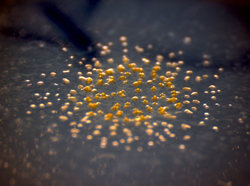
M. xanthus appear as gram-negative rods without flagella. These rods have an average length of 7 microns and width of 0.5 microns. It utilizes type IV pilus (T4P) to move in a "gliding" manner, crawling along a surface. As a colony or swarm, M. xanthus appear as a thin layer of ripples, often moving toward prey. In its spore form, the bacterium becomes a sphere with a thick outer membrane. This spore is yellow-orange, giving M. xanthus its name (xanthós, Ancient Greek meaning "golden").
M. xanthus is typically found in the top most layer of soil, preying as a "pack" on other microorganisms like bacteria or fungi. It is a neutralophile, growing best between a pH of 7.2-8.2. The bacteria are mesophiles, growing best within the temperature range of 34-36 °C. Like other Myxococcus bacteria, it is an obligate aerobe, meaning it requires oxygen for aerobic respiration to maintain cellular functions.
M. xanthus is a chemoorganoheterotroph. It obtains energy from oxidation-reduction reactions and obtains both electrons and carbon from organic molecules. These bacteria do produce and consume glycogen, a branched glucose polymer, but cannot fully convert glucose to pyruvate though the Embden-Meyerhof-Parnas pathway. The flux through the pathway is incomplete, even though homologs of each enzyme are present in the genome. Because of this reason, M. xanthus cannot rely on sugars for growth. It is hypothesized that the incomplete glycolytic pathway produces substrates needed for lipid metabolism.
M. xanthus relies on lipid metabolism to source carbon. The bacteria demonstrate a diverse set of lipid reactions, especially in lipid anabolism. They produce ether lipids, which are commonly associated with eukaryotes rather than prokaryotes. In these reactions, phospholipids are broken down into the polar head group, glycerol, and the two fatty acids. The fatty acids are degraded through β-oxidation at the carboxyl end of the fatty acid. M. xanthus expresses a wide variety of fatty acids. Cells contain at least 18 different fatty acids, compared to the 3 to 5 fatty acids seen in most Proteobacteria. Redundancy in the fatty acid elongation enzymes and desaturase enzymes may contribute to this diversity of fatty acids.
M. xanthus salvages purines and pyrimidines from its prey to produce nucleic acids. Amino acids are treated similarly, with the majority undergoing further catalysis for use in other pathways as needed.
The evolution of M. xanthus unique ability to collectively gather and assemble into a stalk-like structure, termed a fruiting body, can largely be attributed to two mechanisms of gene transfer such as lateral gene transfer (LGT) and vertical gene transfer. For myxobacteria, LGT suggests acquisition of genes comes from other species of bacteria and is supported with the fact that the trait of M. xanthus' fruiting body is not possible without genes from other bacterial sources. LGT has shown to be responsible for the expansion of the genome by at least 1.4 Mb. Very little is known about the evolutionary mechanisms present in M. xanthus. However, it has been discovered that it can establish a generalist predator relationship with different prey, among which is Escherichia coli. In this predator-prey relationship, a parallel evolution of both species is observed through genomic and phenotypic modifications, producing in subsequent generations a better adaptation of one of the species that is counteracted by the evolution of the other, following a co-evolutionary model known as the Red Queen hypothesis. However, the evolutionary mechanisms present in M. xanthus that produce this parallel evolution are still unknown.
In 2003, two scientists, Velicer and Yu, deleted certain parts of the M. xanthus genome. This deletion made cells unable to swarm effectively on soft agar. Isolated colonies were cloned and allowed to evolve. After a period of 64 weeks, two of the evolving populations had started to swarm outward almost as effectively as normal wild-type colonies. However, the patterns of the swarm were very different from those of the wild-type bacteria. This suggested that the cells had developed a new way of moving, and Velicer and Yu confirmed this by showing that the new populations had not regained the ability to make pili. This study addressed questions about the evolution of cooperation between individual cells that had plagued scientists for years.
Myxococcus xanthus
Myxococcus xanthus is a gram-negative, bacillus (or rod-shaped) species of myxobacteria that is typically found in the top-most layer of soil. These bacteria lack flagella; rather, they use pili for motility. M. xanthus is well-known for its predatory behavior on other microorganisms. These bacteria source carbon from lipids rather than sugars. They exhibit various forms of self-organizing behavior in response to environmental cues. Under normal conditions with abundant food, they exist as predatory, saprophytic single-species biofilm called a swarm, highlighting the importance of intercellular communication for these bacteria. Under starvation conditions, they undergo a multicellular development cycle.
M. xanthus appear as gram-negative rods without flagella. These rods have an average length of 7 microns and width of 0.5 microns. It utilizes type IV pilus (T4P) to move in a "gliding" manner, crawling along a surface. As a colony or swarm, M. xanthus appear as a thin layer of ripples, often moving toward prey. In its spore form, the bacterium becomes a sphere with a thick outer membrane. This spore is yellow-orange, giving M. xanthus its name (xanthós, Ancient Greek meaning "golden").
M. xanthus is typically found in the top most layer of soil, preying as a "pack" on other microorganisms like bacteria or fungi. It is a neutralophile, growing best between a pH of 7.2-8.2. The bacteria are mesophiles, growing best within the temperature range of 34-36 °C. Like other Myxococcus bacteria, it is an obligate aerobe, meaning it requires oxygen for aerobic respiration to maintain cellular functions.
M. xanthus is a chemoorganoheterotroph. It obtains energy from oxidation-reduction reactions and obtains both electrons and carbon from organic molecules. These bacteria do produce and consume glycogen, a branched glucose polymer, but cannot fully convert glucose to pyruvate though the Embden-Meyerhof-Parnas pathway. The flux through the pathway is incomplete, even though homologs of each enzyme are present in the genome. Because of this reason, M. xanthus cannot rely on sugars for growth. It is hypothesized that the incomplete glycolytic pathway produces substrates needed for lipid metabolism.
M. xanthus relies on lipid metabolism to source carbon. The bacteria demonstrate a diverse set of lipid reactions, especially in lipid anabolism. They produce ether lipids, which are commonly associated with eukaryotes rather than prokaryotes. In these reactions, phospholipids are broken down into the polar head group, glycerol, and the two fatty acids. The fatty acids are degraded through β-oxidation at the carboxyl end of the fatty acid. M. xanthus expresses a wide variety of fatty acids. Cells contain at least 18 different fatty acids, compared to the 3 to 5 fatty acids seen in most Proteobacteria. Redundancy in the fatty acid elongation enzymes and desaturase enzymes may contribute to this diversity of fatty acids.
M. xanthus salvages purines and pyrimidines from its prey to produce nucleic acids. Amino acids are treated similarly, with the majority undergoing further catalysis for use in other pathways as needed.
The evolution of M. xanthus unique ability to collectively gather and assemble into a stalk-like structure, termed a fruiting body, can largely be attributed to two mechanisms of gene transfer such as lateral gene transfer (LGT) and vertical gene transfer. For myxobacteria, LGT suggests acquisition of genes comes from other species of bacteria and is supported with the fact that the trait of M. xanthus' fruiting body is not possible without genes from other bacterial sources. LGT has shown to be responsible for the expansion of the genome by at least 1.4 Mb. Very little is known about the evolutionary mechanisms present in M. xanthus. However, it has been discovered that it can establish a generalist predator relationship with different prey, among which is Escherichia coli. In this predator-prey relationship, a parallel evolution of both species is observed through genomic and phenotypic modifications, producing in subsequent generations a better adaptation of one of the species that is counteracted by the evolution of the other, following a co-evolutionary model known as the Red Queen hypothesis. However, the evolutionary mechanisms present in M. xanthus that produce this parallel evolution are still unknown.
In 2003, two scientists, Velicer and Yu, deleted certain parts of the M. xanthus genome. This deletion made cells unable to swarm effectively on soft agar. Isolated colonies were cloned and allowed to evolve. After a period of 64 weeks, two of the evolving populations had started to swarm outward almost as effectively as normal wild-type colonies. However, the patterns of the swarm were very different from those of the wild-type bacteria. This suggested that the cells had developed a new way of moving, and Velicer and Yu confirmed this by showing that the new populations had not regained the ability to make pili. This study addressed questions about the evolution of cooperation between individual cells that had plagued scientists for years.
Recent media
Recent media