



Community hub
Recent from talks
Knowledge base stats:
Talk channels stats:
Members stats:
NA62 experiment
The NA62 experiment (known as P-326 at the stage of the proposal) is a fixed-target particle physics experiment in the North Area of the SPS accelerator at CERN. The experiment was approved in February 2007. Data taking began in 2015, and the experiment is expected to become the first in the world to probe the decays of the charged kaon with probabilities down to 10−12. The experiment's spokesperson is Giuseppe Ruggiero (since October 2022; the former spokespersons were Cristina Lazzeroni 2019–2022 and Augusto Ceccucci before 2019). The collaboration involves 308 participants from 33 institutions and 16 countries around the world.
The experiment is designed to conduct precision tests of the Standard Model by studying rare decays of charged kaons. The principal goal, for which the design has been optimized, is the measurement of the rate of the ultra-rare decay K+ → π+ + ν + ν with a precision of 10%, by detecting about 100 decay candidates with low background. This will lead to the determination of the CKM matrix element |Vtd| with a precision better than 10%. This element relates very accurately to the likelihood that top quarks decay to down quarks. The Particle Data Group's 2008 Review of Particle Physics lists |Vtd| = 0.00874+0.00026
−0.00037. A broad program of studies of kaon physics is run in parallel including studies of other rare decays, searches for forbidden decays, and for new exotic particles not predicted by the standard model (for example Dark Photons).
In order to achieve the desired precision, the NA62 experiment requires a certain level of signal sensitivity and background rejection. Namely, high-resolution timing (to support a high-rate environment), kinematic rejection (involving the cutting on the square of the missing mass of the observed charged particle from the decay with respect to the incident kaon vector), particle identification (especially distinguishing between pions and muons), hermetic vetoing of photons out to large angles, and redundancy of information.
Due to these necessities, the NA62 experiment has constructed a detector which is approximately 270 m in length. The components of the experiment are explained briefly below, for full details see.
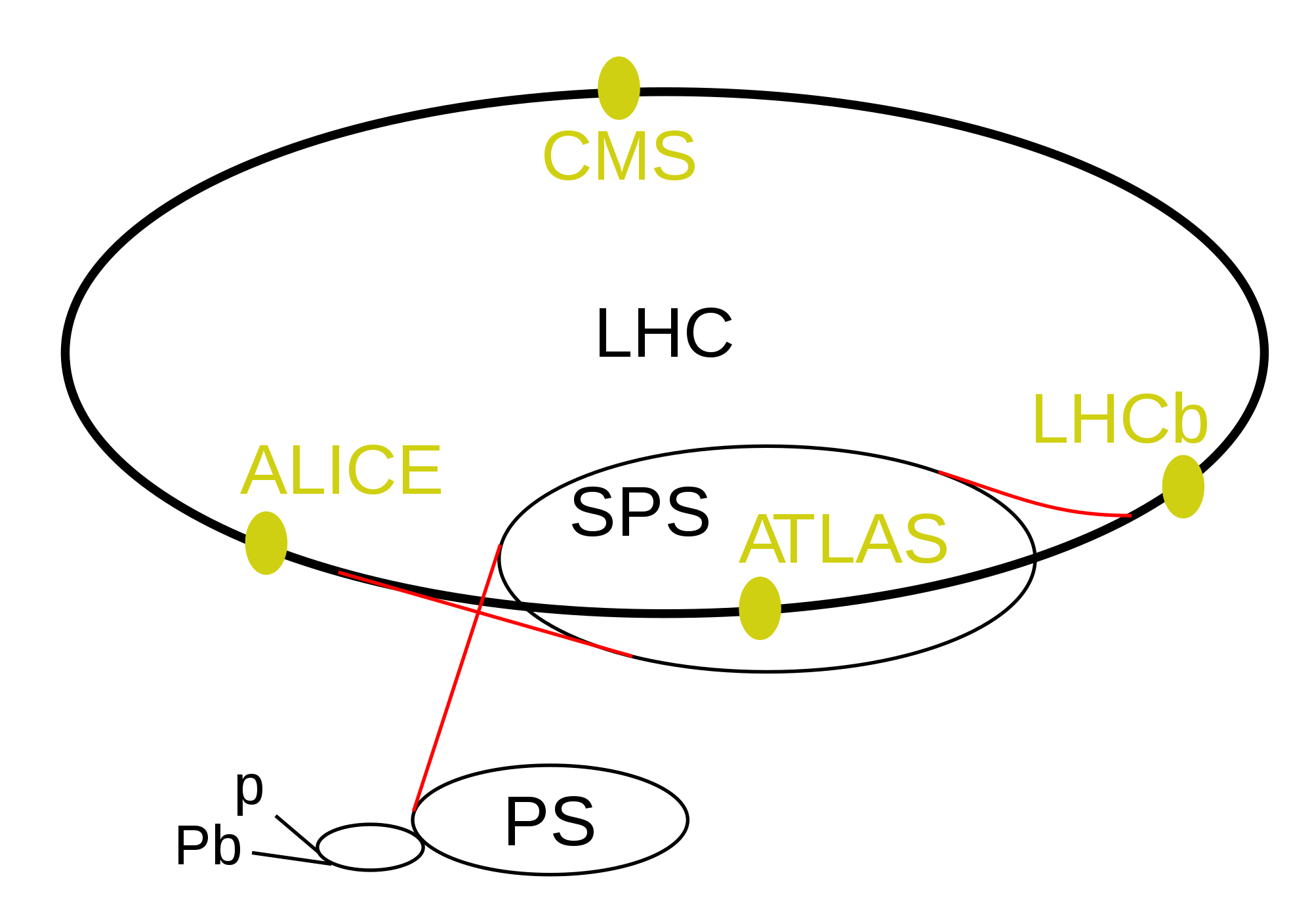
The foundation of the NA62 experiment is observing the decays of kaons. A primary beam of protons from the SPS is delivered to a target at which a secondary hadron beam is produced which contains the kaons.
The Primary Beam, called P42, is used for the production of the beam. The 400 GeV/c SPS proton beam is split into three branches and strikes three targets (T2, T4, and T6). This produces beams of secondary particles which are directed through the underground target tunnel (TCC2). At the exit of T4, the beam of transmitted protons passes through apertures in two vertically-motorized beam-dump/collimator modules, TAX 1 and TAX 2 for P42, in which holes of different apertures define the angular acceptance of the beam and hence allow the flux of protons to be selected over a wide range. In order to protect the components of the apparatus, a computer surveillance program allows the currents in the principle magnets along the P42 beam line to be monitored and to close TAX2 in case of error.

A secondary beam line, K12HIKA+, is the kaon beam line. The target/beam tunnel, TCC8, and the cavern, ECN3, where the detectors of the NA62 experiment have been installed, have a combined length of 270m. The T10 target (located 15m from the beginning of TCC8) is used to produce the final secondary hadron beam (K12). This K12 beam-line has a length of 102m, ending at the exit of the final collimator which marks the beginning of the decay fiducial region and points to the NA62 detectors (notably the liquid krypton electro-magnetic calorimeter, LKr).
The K12 beam has an instantaneous rate of about 600 MHz and is composed primarily of pions (70%) and protons (23%) with only 6% being kaons. Approximately 10% of the kaons decay in the fiducial decay volume, corresponding to a rate of 4 MHz of kaon decays in the fiducial region.
Hub AI
NA62 experiment AI simulator
(@NA62 experiment_simulator)
NA62 experiment
The NA62 experiment (known as P-326 at the stage of the proposal) is a fixed-target particle physics experiment in the North Area of the SPS accelerator at CERN. The experiment was approved in February 2007. Data taking began in 2015, and the experiment is expected to become the first in the world to probe the decays of the charged kaon with probabilities down to 10−12. The experiment's spokesperson is Giuseppe Ruggiero (since October 2022; the former spokespersons were Cristina Lazzeroni 2019–2022 and Augusto Ceccucci before 2019). The collaboration involves 308 participants from 33 institutions and 16 countries around the world.
The experiment is designed to conduct precision tests of the Standard Model by studying rare decays of charged kaons. The principal goal, for which the design has been optimized, is the measurement of the rate of the ultra-rare decay K+ → π+ + ν + ν with a precision of 10%, by detecting about 100 decay candidates with low background. This will lead to the determination of the CKM matrix element |Vtd| with a precision better than 10%. This element relates very accurately to the likelihood that top quarks decay to down quarks. The Particle Data Group's 2008 Review of Particle Physics lists |Vtd| = 0.00874+0.00026
−0.00037. A broad program of studies of kaon physics is run in parallel including studies of other rare decays, searches for forbidden decays, and for new exotic particles not predicted by the standard model (for example Dark Photons).
In order to achieve the desired precision, the NA62 experiment requires a certain level of signal sensitivity and background rejection. Namely, high-resolution timing (to support a high-rate environment), kinematic rejection (involving the cutting on the square of the missing mass of the observed charged particle from the decay with respect to the incident kaon vector), particle identification (especially distinguishing between pions and muons), hermetic vetoing of photons out to large angles, and redundancy of information.
Due to these necessities, the NA62 experiment has constructed a detector which is approximately 270 m in length. The components of the experiment are explained briefly below, for full details see.
The foundation of the NA62 experiment is observing the decays of kaons. A primary beam of protons from the SPS is delivered to a target at which a secondary hadron beam is produced which contains the kaons.
The Primary Beam, called P42, is used for the production of the beam. The 400 GeV/c SPS proton beam is split into three branches and strikes three targets (T2, T4, and T6). This produces beams of secondary particles which are directed through the underground target tunnel (TCC2). At the exit of T4, the beam of transmitted protons passes through apertures in two vertically-motorized beam-dump/collimator modules, TAX 1 and TAX 2 for P42, in which holes of different apertures define the angular acceptance of the beam and hence allow the flux of protons to be selected over a wide range. In order to protect the components of the apparatus, a computer surveillance program allows the currents in the principle magnets along the P42 beam line to be monitored and to close TAX2 in case of error.
A secondary beam line, K12HIKA+, is the kaon beam line. The target/beam tunnel, TCC8, and the cavern, ECN3, where the detectors of the NA62 experiment have been installed, have a combined length of 270m. The T10 target (located 15m from the beginning of TCC8) is used to produce the final secondary hadron beam (K12). This K12 beam-line has a length of 102m, ending at the exit of the final collimator which marks the beginning of the decay fiducial region and points to the NA62 detectors (notably the liquid krypton electro-magnetic calorimeter, LKr).
The K12 beam has an instantaneous rate of about 600 MHz and is composed primarily of pions (70%) and protons (23%) with only 6% being kaons. Approximately 10% of the kaons decay in the fiducial decay volume, corresponding to a rate of 4 MHz of kaon decays in the fiducial region.