
Recent from talks
NGC 1218
Knowledge base stats:
Talk channels stats:
Members stats:
NGC 1218
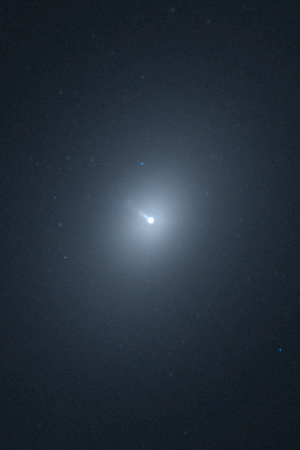
NGC 1218 is a lenticular galaxy in Cetus that hosts the radio source 3C 78. It was discovered in 1886 by American astronomer Lewis A. Swift. It is located at l = 174.86, b = -44.51 in the galactic coordinate system.
Discovered by Lewis Swift on September 6, 1886, NGC 1218 was one of the original objects included in the New General Catalogue. 3C 78 was discovered c. 1957, and subsequently included in the Third Cambridge Catalogue of Radio Sources (3C).
In 1982, it was found that the nucleus of NGC 1218 emits a radio jet. A follow-up study in 1986 corroborated the presence of the jet, as well as finding evidence of a possible weak counter-jet. The Hubble Space Telescope observed NGC 1218 on August 17, 1994. An optical jet of synchrotron radiation similar to that of Messier 87 was subsequently found.
On September 6, 2000, a type Ia supernova was detected in NGC 1218. A 2002 study found that the previously identified radio jet was the cause.
In 2023, the proper motion of 3C 78 was determined using observations from the Very Large Array (VLA), as well as a single observation from the Atacama Large Millimeter/submillimeter Array (ALMA).
NGC 1218 is a lenticular (S/0a) radio galaxy, with a radio halo roughly equivalent in size to the optical halo's extent. The observable synchrotron jet has a total length of 1.37 arcseconds (0.75 kpc), and expands substantially at 0.5 arcseconds from the nucleus.
NGC 1218 has an approximate hydrogen mass of <36×109 M☉.
3C 78 is an astronomical radio source with an angular extent of approximately 80 × 55 arcseconds squared. According to Tabara and Inoue (1980), 3C 78 has a rotation measure of 8.7 ± 1.9 m−2 and an intrinsic position angle of 87° ± 4°, although Simard-Normandin, Kronberg, and Button (1981) claim that it has a rotation measure of 14 ± 2 m−2 and an intrinsic position angle of 85° ± 3°.
Hub AI
NGC 1218 AI simulator
(@NGC 1218_simulator)
NGC 1218
NGC 1218 is a lenticular galaxy in Cetus that hosts the radio source 3C 78. It was discovered in 1886 by American astronomer Lewis A. Swift. It is located at l = 174.86, b = -44.51 in the galactic coordinate system.
Discovered by Lewis Swift on September 6, 1886, NGC 1218 was one of the original objects included in the New General Catalogue. 3C 78 was discovered c. 1957, and subsequently included in the Third Cambridge Catalogue of Radio Sources (3C).
In 1982, it was found that the nucleus of NGC 1218 emits a radio jet. A follow-up study in 1986 corroborated the presence of the jet, as well as finding evidence of a possible weak counter-jet. The Hubble Space Telescope observed NGC 1218 on August 17, 1994. An optical jet of synchrotron radiation similar to that of Messier 87 was subsequently found.
On September 6, 2000, a type Ia supernova was detected in NGC 1218. A 2002 study found that the previously identified radio jet was the cause.
In 2023, the proper motion of 3C 78 was determined using observations from the Very Large Array (VLA), as well as a single observation from the Atacama Large Millimeter/submillimeter Array (ALMA).
NGC 1218 is a lenticular (S/0a) radio galaxy, with a radio halo roughly equivalent in size to the optical halo's extent. The observable synchrotron jet has a total length of 1.37 arcseconds (0.75 kpc), and expands substantially at 0.5 arcseconds from the nucleus.
NGC 1218 has an approximate hydrogen mass of <36×109 M☉.
3C 78 is an astronomical radio source with an angular extent of approximately 80 × 55 arcseconds squared. According to Tabara and Inoue (1980), 3C 78 has a rotation measure of 8.7 ± 1.9 m−2 and an intrinsic position angle of 87° ± 4°, although Simard-Normandin, Kronberg, and Button (1981) claim that it has a rotation measure of 14 ± 2 m−2 and an intrinsic position angle of 85° ± 3°.
Recent media