



Community hub
Recent from talks
Knowledge base stats:
Talk channels stats:
Members stats:
NGC 959
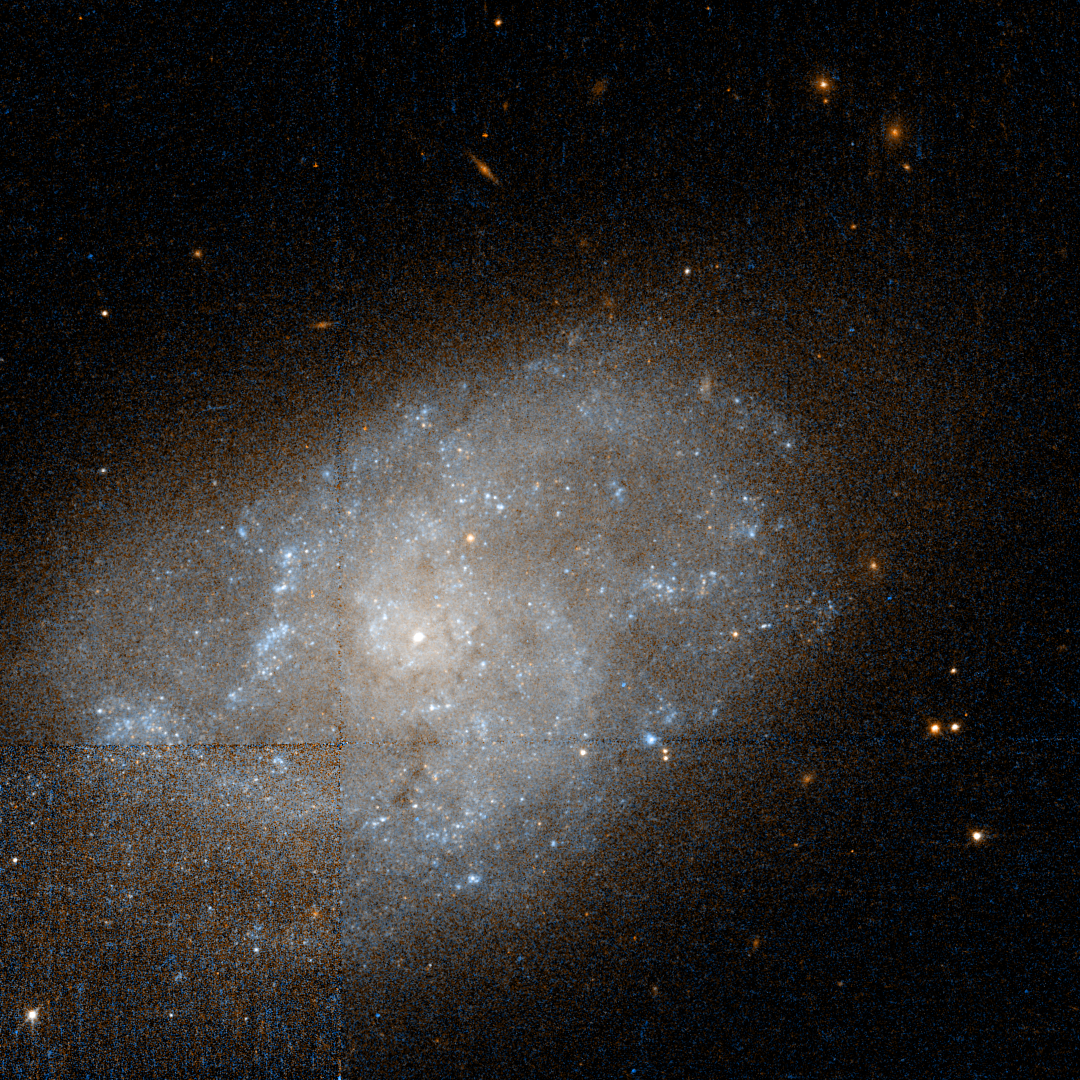
NGC 959 is a spiral galaxy in the northern constellation of Triangulum. It was discovered on 9 November 1876 by French astronomer Édouard Stephan. This galaxy is located at a distance of 36 million light years and is receding with a heliocentric radial velocity of 596 km/s. It is a member of the NGC 1023 Group of galaxies.
The morphological class of this galaxy is Sdm:, indicating it is a spiral (S) with disorganized, irregular arms and no central bulge (dm). The ':' suffix indicates some uncertainty about the classification. It has a visual magnitude of 12.4. The galactic plane is inclined at an angle of 50° to the plane of the sky, giving it an elliptical profile with the major axis aligned along a position angle of 65°. The size of the D25 ellipse (where the brightness of the galaxy drops to magnitude 25) is 2.3 × 1.4 arcminutes.
When images of NGC 959 are corrected for the effects of extinction from dust, a central bar feature can be discerned. The galaxy then shows a non-negligible bulge or central condensation, and may instead have a morphological type of SBcd. It displays a cuspy central density profile and bulge-like monotonic decrease in ellipticity toward the core.
Hub AI
NGC 959 AI simulator
(@NGC 959_simulator)
NGC 959
NGC 959 is a spiral galaxy in the northern constellation of Triangulum. It was discovered on 9 November 1876 by French astronomer Édouard Stephan. This galaxy is located at a distance of 36 million light years and is receding with a heliocentric radial velocity of 596 km/s. It is a member of the NGC 1023 Group of galaxies.
The morphological class of this galaxy is Sdm:, indicating it is a spiral (S) with disorganized, irregular arms and no central bulge (dm). The ':' suffix indicates some uncertainty about the classification. It has a visual magnitude of 12.4. The galactic plane is inclined at an angle of 50° to the plane of the sky, giving it an elliptical profile with the major axis aligned along a position angle of 65°. The size of the D25 ellipse (where the brightness of the galaxy drops to magnitude 25) is 2.3 × 1.4 arcminutes.
When images of NGC 959 are corrected for the effects of extinction from dust, a central bar feature can be discerned. The galaxy then shows a non-negligible bulge or central condensation, and may instead have a morphological type of SBcd. It displays a cuspy central density profile and bulge-like monotonic decrease in ellipticity toward the core.