Hubbry Logo
NIR Class 4000NIR Class 4000Main
Open search
NIR Class 4000
Community hub
NIR Class 4000
logo
8 pages, 0 posts
0 subscribers
Be the first to start a discussion here.
NIR Class 4000
NIR Class 4000
from Wikipedia

Northern Ireland Railways
Class 4000 "C4K"
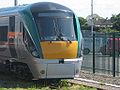
Class 4000 DMU 4012 at Coleraine railway station, 2021
Interior view of car 4513 of set 4013
In service29 September 2011–present
ManufacturerCAF
Family nameCxK
ReplacedClass 450 and Class 80
Entered service2011–2012
Number built20 sets (81 cars in total, 40 DM cars, 41 intermediates)
Formation
  • 13 3-car sets
  • 7 6-car sets
Fleet numbers
  • 4001-4013 (3-car)
  • 4014-4020 (6-car)
Capacity
  • 216 seated (3-car)
  • 442 seated (6-car)
OperatorsNI Railways
Specifications
Maximum speed90 mph (145 km/h)
Prime mover(s)MTU 6H 1800 R84[1] (one per car)
Engine typeInline-6 turbo-diesel[2]
Displacement12.8 L (780 cu in) per engine[2]
Power output390 kW (520 hp) per engine[2]
Transmission
  • ZF Ecomat-Rail 6 speed
  • ZF Reversing final drive
Safety system(s)AWS, TPWS
Track gauge1,600 mm (5 ft 3 in)
Passengers board train 4002, waiting at a platform at Holywood railway station.
NIR C4k no. 4002 at Holywood station.

The Class 4000 is a type of diesel multiple unit (DMU) in service with Northern Ireland Railways.

The fleet was procured due to the recognition of the essential role railways play in economic growth and the need to replace outdated rolling stock, particularly Class 80 and Class 450 trains. After receiving funding from the Northern Ireland Assembly and issuing a tender, NI Railways awarded the contract to CAF, which already had a successful track record with the Class 3000 units. The Class 4000 trains entered service in 2011, with significant internal differences from the C3K fleet, such as increased seating capacity and improved fuel economy. The trains have replaced the remaining Class 80 and Class 450 trains, increasing capacity and allowing longer trains to operate. In 2018, 21 additional vehicles were ordered to further extend train lengths. Despite some reported technical issues, testing for six-car formations started in 2021.[citation needed]

History

[edit]

The fleet covers 20 DMUs procured by NI Railways. None of the Northern Irish rail network is electrified, and diesel multiple units have been used since nationalisation in the 1950s.

Prior to 2000, the NIR rolling stock consisted of a mixture of diesel multiple unit types that had entered service between 15 and 25 years previously. The main type was the Class 80, based on the Mark 2b bodyshell, 22 3-car and 4-car units built in two batches between 1973 and 1979. Additional capacity was provided with the Class 450, nine 3-car units that entered service in 1985 based on the Mark 3 bodyshell. Chronic underinvestment in the railway meant that by the millennium these were the newest domestic trains. By 2000 it was estimated that the network required investment of £183 million to bring it up to basic safety standards.[3]

New trains

[edit]

Recognising that the railways serve an important role in the growth of the local economy, the devolved Northern Ireland Assembly granted funding for improvements in December 2000 following the report of the Railways Task Force.[4] Included was £80 million for rolling stock, the largest order in the history of NIR. The result was the Class 3000 DMU from CAF in Spain, 23 three-car units used to replace the increasingly outdated Class 80. They entered service between 2004 and 2005. This was a like-for-like replacement meaning that older rolling stock had to be retained, and NIR could not introduce the service enhancements it desired.[citation needed]

"New Trains Two"

[edit]

The expanding economy led to increasing pressure to improve the rail network, with recommendations made in a debate in the Northern Ireland Assembly in May 2007.[5] Among these was the purchase of rolling stock to replace the remaining Class 80 and Class 450 trains. Translink instituted the "New Trains 2010" (later renamed "New Trains Two") proposal for new trains,[6] and decided that it needed to improve its service frequency to go with the associated infrastructure improvements, which would mean expanding the fleet. The proposal was that up to 20 trains would be purchased, which would replace the Class 450 and 80 units and expand the fleet by up to seven trains. The go-ahead was given on the publication of the draft budget of the Department for Regional Development, which allocated £137 million over three years to Translink, including for 20 trains.[7]

Translink issued the invitation to tender (ITT) in June 2008. Three firm offers were received: Bombardier Transportation offered the Class 172 Turbostar being built for operation on the British network; Hyundai Rotem a variant of the 22000 Class ICR purchased by Iarnród Éireann (ruled out because of NIR's desire to have units with 13 and 23 spaced doors); and CAF a variant of the Class 3000 units.[8] The similarity with the existing sets led to CAF winning the bid in March 2009.[9] The first train was delivered in March 2011 and after testing it entered service in September 2011.[10][11]

In the summer of 2021, testing began on increased six-car sets using extra intermediate carriages.

Extended train 4017 being checked by engineers at Portadown station whilst on test.
Extended train no. 4017.

Timetable

[edit]

The timetable for the introduction was released at the same time as the ITT:[12][13][10]

  • June 2008 – Invitation to Tender
  • Wednesday 25 March 2009 – Contracts signed
  • June 2010 – Construction of first train begins
  • Monday 14 March 2011 – Delivery of first train
  • Thursday 29 September 2011 – First train enters passenger service
  • Tuesday 3 July 2012 – Final train arrives in Belfast
  • Wednesday 19 September 2012 – Final train entered service
  • Thursday 6 December 2018 – Order signed with CAF for an additional 21 Class 4000 carriages[14]

Specification

[edit]

Although the trains are externally similar to the C3K fleet, internally they have significant differences. Each three-car train has a seating capacity of 212,[10] with fewer table bays and extra standing room.[8] They have one toilet compared to the C3K's two.[10] They have a new traction system, with an MTU 390kW engine providing power to both the traction motors and auxiliary generators. With a train being four tonnes lighter than a C3K unit, fuel economy is improved.[8]

Usage

[edit]
Class 4000 departing Magheramorne

The trains have replaced the 13 remaining trains of Class 80 and Class 450. The capacity increase provided has allowed NIR to operate longer trains. Of the seven extra sets, NIR has earmarked five for running in six-car formations, with the other two planned to improve service frequency on the Derry-Londonderry Line once renovation work has been completed and a new crossing loop laid.[8] The option was taken up in December 2018, when 21 additional vehicles were ordered from CAF at a cost of £50 million.[15] The 21 additional vehicles will be used to lengthen seven of the twenty Class 4000 units to six-cars long[16] to provide a train that the conductor can walk through fully, this means only 1 conductor is required. The first three-car set was extended in November 2021, with all six expected to be complete by July 2022.[17]

Sets numbered 4002, 4007, 4009 and 4012 have been refurbished to get replaced carpets, new seating and USB charging points at tables.

Technical problems

[edit]

It has been reported[citation needed] on several websites that at least one train has been taken out of service on several occasions with major engine failure and has been re-engined.

Testing is now underway as of September 2021. All walk-through sets are now in service, since Summer 2022.

Fleet details

[edit]
Class Operator No. Built Year built Cars per Set Unit nos. In service Notes
Class 4000 NI Railways 20 2010–2021 3 4001–4013 13
6 4014–4020 7 New carriages entered service in September 2021[18]

References

[edit]
[edit]
Revisions and contributorsEdit on WikipediaRead on Wikipedia
from Grokipedia
The NIR Class 4000 is a fleet of modern diesel multiple units (DMUs) operated by , a division of Translink, designed to provide efficient services across . These three-car sets, manufactured by Spanish firm , were introduced to replace aging Class 450 and Class 80 DMUs, enhancing passenger comfort, capacity, and accessibility while supporting increased ridership on key routes. Ordered in 2009 as part of a fleet modernization program, the initial batch of 20 units entered service progressively from September 2011, with all operational by summer 2012. Each unit features a contemporary interior with energy-efficient , a , and compliance with Technical Specifications for Interoperability (TSI) Persons with Reduced Mobility (PRM) standards, including priority seating, signage, and color-contrasted handrails. Accommodating 212 passengers per set—comprising 179 fixed seats and 33 tip-up seats—along with one and space for up to eight bicycles, the Class 4000 prioritizes versatility for daily commuters and leisure travelers. To meet growing demand, Translink placed an additional order in for 21 intermediate cars from CAF, funded by £50 million from the Department for Infrastructure, which were delivered and integrated by autumn 2022. These additions enable the formation of six-car trains during peak hours, boosting overall capacity by 1,600 seats and facilitating more frequent services. Since their introduction, the Class 4000 fleet has undergone refurbishments since 2022, including conversions to six-car sets and recent interior updates on select units in 2025 such as USB charging points, ensuring reliability and alignment with environmental goals, such as meeting emissions limits under relevant regulations. As of November 2025, these DMUs form the backbone of NIR's non-electrified network, serving major lines like to Derry and to while contributing to Translink's broader strategy for sustainable rail growth.

Background and Procurement

Initial Funding and Tender

Progress on fleet modernization accelerated following the restoration of devolved government in 2007, when the Department for Regional Development announced a £137 million investment over three years (2008/09 to 2010/11) for rail projects, including the of new diesel multiple units (DMUs). In June 2008, Translink, NIR's parent company, issued an for up to 20 three-car DMUs to enhance capacity and reliability across the network, with bids solicited from major manufacturers including Bombardier and CAF. The tender process culminated in March 2009 with the award of the to (CAF) of , valued at £105 million for the supply of 20 three-car sets, along with a separate 15-year agreement, representing a total investment of approximately £114 million.

Contract Award and Delivery Timeline

The contract was signed on 25 March 2009 by Translink, the Department for Regional Development, and CAF for the design, manufacture, and delivery of the 20 three-car Class 4000 DMUs, with production at CAF's facilities in . The design was evolved from the earlier Class 3000 sets for compatibility with NIR's infrastructure. The delivery timeline commenced with the arrival of the first unit at docks on 14 March 2011, following initial manufacturing and quality checks in . Subsequent units followed progressively, allowing for incremental testing and preparation at NIR facilities; the final unit was delivered in July 2012, with all 20 sets operational by September 2012. To address growing passenger demand and enable longer train formations, NIR exercised an option in the original contract and placed a order in December 2018 for 21 additional intermediate vehicles from CAF, valued at £50 million and funded by the Department for Infrastructure. These vehicles, produced at the same Spanish facility, allow seven of the existing sets to be extended to six cars each, enhancing capacity on key routes while the remaining 13 sets operate as three-car units. Deliveries began in March 2021 with the first three vehicles arriving in ; all 21 were in place by summer 2022, entering service progressively from autumn 2022.

Design and Technical Specifications

Mechanical and Propulsion Systems

The NIR Class 4000 is a (DMU) built on the Irish broad gauge of 5 ft 3 in (1,600 mm). Each car is equipped with an MTU 6H 1800 R84 inline-6 turbo-diesel engine rated at 390 kW, enabling a total power output of 1,170 kW for a standard three-car set. These engines drive ZF Ecomat-Rail 6-speed hydraulic transmissions with ZF reversing final drive, which provide smooth power delivery to the wheels and support a maximum operating speed of 90 mph (145 km/h). The propulsion system incorporates an integrated traction raft that combines the , transmission, and auxiliary power generation, contributing to overall durability and reduced maintenance needs. Fuel efficiency represents a significant advancement over predecessor classes, with approximately 20% improved economy attributed to the optimized design and lighter overall vehicle weight of five tonnes less per unit. An onboard ECO-Meter further aids drivers in achieving economical operation by monitoring and promoting efficient acceleration and braking patterns. The system complies with Stage IIIA emissions standards, ensuring environmental performance alongside mechanical reliability.

Passenger Facilities and Capacity

The NIR Class 4000 trains feature a standard class-only interior layout optimized for passenger comfort and efficient use of space, with all configurations consisting of three-car sets that can be coupled to form longer trains. Each three-car set provides seating for 212 passengers, comprising 179 fixed seats arranged in a mix of airline-style and table bays, along with 33 tip-up seats to enhance flexibility for luggage, bicycles, or needs. With deliveries starting in 2021 and full integration by autumn 2022, seven three-car units were lengthened to six-car formations using 21 additional intermediate carriages, expanding to approximately 440 passengers per set and adding around 1,600 seats overall to the NIR fleet for improved handling of . Accessibility is a core aspect of the design, with each three-car set including one fully wheelchair-accessible compliant with Technical Specifications for Interoperability relating to Persons with Reduced Mobility (TSI PRM). Dedicated spaces accommodate two wheelchairs alongside companion seats, supplemented by features such as and embossed signage, high-contrast handrails, visual and audible passenger information systems, and 'Call for Aid' devices for assistance. Step-free access is supported via an on-board ramp stored within the train, enabling easier boarding at stations despite the lack of full low-floor construction. Comfort amenities include full air-conditioning, energy-efficient LED saloon lighting, carpeted floors, tinted laminated windows, overhead luggage racks, and litter bins throughout the cars. The layout promotes ease of movement with uncluttered vestibule entrances, priority seating areas offering extra legroom near doors, and multi-purpose zones suitable for families with pushchairs or cyclists (with space for up to eight bicycles). In six-car configurations, a walk-through design across the full length enhances passenger circulation and standing room during busy periods. Subsequent refurbishments have incorporated passenger power sockets at seats to support modern device charging needs.

Introduction to Service

First Deployments and Testing

The first Class 4000 arrived at docks on 14 March 2011, marking the start of pre-service testing on the Railways (NIR) network. Testing included high-speed runs, fault-free operation trials, performance evaluations, and route-proving trials to ensure compatibility with NIR . Following successful testing, the units began entering passenger service in September 2011, with the first unit inaugurating operations on 29 September. Initial deployments focused on key intercity and commuter services, replacing older while undergoing final integration. The introduction proceeded in a phased manner through , with progressive rollout across the network to allow for operational familiarization; the full fleet of 20 three-car sets became operational by September . Concurrently, NIR implemented dedicated driver training programs, certifying personnel under adapted rail standards to account for the unique 5 ft 3 in (1,600 mm) gauge and operational requirements of the NIR system.

Integration into Timetables

The Class 4000 diesel multiple units were initially introduced into passenger service on high-demand routes, including the to and to lines, starting in late 2011. This deployment marked the beginning of their integration into Northern Ireland Railways' (NIR) daily schedules, replacing older on these corridors to improve service quality and punctuality. The arrival of the Class 4000 enabled significant timetable enhancements, allowing for more frequent services across key routes due to their enhanced performance characteristics, such as superior acceleration and operational reliability compared to predecessor units. For instance, the units' design facilitated quicker journey times and better adherence to schedules, supporting NIR's goal of increasing overall network capacity without requiring additional infrastructure investments. By 2013, the Class 4000 achieved full integration into NIR's timetable across the entire network, coinciding with a major service expansion announced in a new working timetable effective January 6. This included doubling frequencies to hourly on the to via corridor, extending hourly services on the to line, and introducing peak-hour extra trains on commuter lines such as those serving greater and surrounding suburbs. These changes capitalized on the fleet's availability to meet rising passenger demand, which had grown by over 70% in the preceding decade. Following the completion of extensions to six-car formations in autumn 2022, timetable adjustments were made to accommodate the increased capacity of these longer sets, particularly on longer-distance routes like to Derry/Londonderry. This allowed for higher volumes during peak periods while maintaining schedule efficiency. The capacity boost from these configurations, which added around 1,400 additional seats network-wide, complemented existing facilities without necessitating widespread service disruptions.

Operational History and Usage

Replacement of Older Fleet

The introduction of the NIR Class 4000 diesel multiple units played a pivotal role in modernizing the fleet by directly replacing the aging Class 80 and Class 450 units, which had been in service since the and , respectively. The remaining Class 80 units and all nine Class 450 units were progressively withdrawn between 2011 and 2017 as the new trains entered service, enabling NIR to retire the legacy diesel multiple units that had become increasingly unreliable and inefficient for contemporary demands. The withdrawal process commenced with the Class 80 units, the last of which ceased passenger operations in September 2011, though a few remained in use for non-passenger duties such as sandite application until their final disposal in 2017. The Class 450 units, known as the "Castle Class," followed suit, with the entire fleet of nine three-car sets retired by 2012 after the delivery of sufficient Class 4000 replacements to cover their routes. This marked the complete phase-out of 1970s-era diesel multiple units from NIR's mainline operations, ending reliance on the original fleet inherited from earlier eras. The transition significantly enhanced fleet capacity, expanding from the previous fleet to the 60 cars provided by the initial batch of 20 three-car Class 4000 sets, which supported longer train formations and improved overall on key suburban and regional lines. Environmentally, the Class 4000 units delivered reduced emissions compared to their predecessors, thanks to more efficient QSK19 engines and adherence to updated regulatory standards, contributing to lower operational impacts on air quality.

Performance and Route Applications

The NIR Class 4000 diesel multiple units serve as the backbone for commuter services within the urban area, handling high-frequency operations on lines such as those to Bangor and , while also supporting intercity routes including the to Derry~Londonderry line. These units, with their maximum speed capability of up to 90 mph on permitted sections, facilitate efficient passenger throughput across the network's 213 route miles. Since their full introduction post-2013, the Class 4000 fleet has achieved high reliability, bolstered by design features like the driver assist system that optimizes and braking for reduced fuel consumption and extended operational range without frequent refueling. This efficiency has been critical in maintaining service punctuality amid growing passenger numbers, which reached 13.8 million journeys in 2023/24, a 5.4% increase year-over-year. Adaptations for varying demands include flexible formations to meet seasonal peaks, such as augmented services on the Causeway Coast line during summer months from 2023 to 2025, where additional capacity supports tourism-related traffic to and surrounding areas. As of 2025, the fleet includes full deployment of seven six-car sets on peak commuter and routes, providing approximately 1,600 extra daily seats and enhancing overall network resilience.

Challenges and Modifications

Refurbishments and Expansions

In December 2018, Translink ordered 21 additional diesel multiple-unit cars from CAF under the New Trains Two initiative at a cost of £50 million, with the aim of extending seven existing three-car Class 4000 sets to six-car formations to boost network capacity by approximately 1,600 seats. The new vehicles were delivered during 2021, enabling testing of the coupled configurations that year and achieving full certification by 2022, after which the extended sets entered passenger service by summer 2022. As part of this expansion, seven donor Class 4000 units were refurbished in 2022 to integrate with the new carriages, incorporating updated interiors such as new seating arrangements and USB charging points at tables for enhanced passenger comfort. Specific units including 4002, 4007, 4009, and 4012 received these modernizations. Translink aligns these enhancements with broader fleet strategies to support growing ridership and sustainability goals.

Current Fleet Status

Configuration Details

The NIR Class 4000 fleet originated with 20 three-car diesel multiple units numbered 4001 to 4020, delivered between 2011 and 2012 to replace older . In 2018, Translink exercised an option in the original to order 21 additional intermediate cars from CAF, which were delivered starting in 2021 to extend seven units for increased capacity on busy routes. These additions resulted in a total of 81 vehicles across the fleet as of 2025. The current configurations include 13 unmodified three-car sets (units 4001 to 4013) and 7 extended six-car sets (units 4014 to 4020), with the longer formations deployed on high-demand services such as the to Derry route. Each three-car set provides seating for 212 passengers, while the six-car sets offer approximately 440 seated passengers, enhancing peak-hour operations. The vehicle types consist of driving motor cars at each end—typically a Driving Motor Composite (DMC) with first-class and standard accommodation at one end and a Driving Motor Standard (DMS) at the other—flanked by Trailer Standard (TS) intermediate cars in the three-car formation. The added intermediates for the six-car sets are primarily TS vehicles inserted between the original cars during refurbishment. All units carry the standard NIR corporate livery of blue bodysides with red doors and accents, though the seven refurbished six-car sets received minor updates to doors and interiors for improved accessibility during their 2021 extensions.

Ongoing Operations

As of 2025, the NIR Class 4000 fleet is fully integrated into daily operations across the Northern Ireland Railways network, serving key routes including those to Derry~Londonderry, , Bangor, , and . The original 20 three-car sets, introduced between 2011 and 2012, continue to operate alongside seven six-car walkthrough formations created in 2022 by combining 21 newly delivered carriages with refurbished existing units, providing an additional 1,600 seats to meet peak demand. These longer configurations are deployed on high-traffic services, enhancing capacity on busy corridors such as the Belfast to line, where refurbished sets have demonstrated reliable performance throughout 2025. Maintenance for the Class 4000 units is conducted at the dedicated Depot in , a £28 million facility opened in 2012 specifically for this fleet, handling routine servicing, fuelling, and engineering tasks. The original contract with manufacturer CAF included upkeep for 15 years from 2009, ensuring high availability without reported major disruptions. While specific overhaul intervals are not publicly detailed, standard practices align with periodic inspections to maintain operational standards. No major retirements are planned for the Class 4000 fleet, which remains a cornerstone of NIR's modern operations, with a projected service life extending into the 2040s based on typical rail asset lifespans for similar units. Future enhancements may include explorations of sustainable technologies, such as potential adaptations, in line with broader rail decarbonization goals targeting reduced diesel reliance by 2040.

References

Add your contribution
Related Hubs
User Avatar
No comments yet.