


Community hub
Recent from talks
Contribute something
Nothing was collected or created yet.
Diesel multiple unit
View on Wikipedia


| Multiple unit trains |
|---|
| Subtypes |
| Technology |
| By country |

A diesel multiple unit or DMU is a multiple-unit train powered by on-board diesel engines. A DMU requires no separate locomotive, as the engines are incorporated into one or more of the carriages. When additional carriages are coupled on, their controls are connected through and a single driver can control every engine in the train. This also allows the driver to drive from a cab at either end, simplifying reversing. Diesel-powered single-unit railcars are generally regarded as DMUs for most operations, at least with smaller trains.
Advantages
[edit]The first diesel railcars appeared in the 1930s and DMUs became popular immediately post-war. They offered several cost-saving advantages at a time when railway operations were short of funds.
- Greater convenience of operation. They could go from parked and stabled to running a train in little time, unlike a steam locomotive that needed to be prepared hours in advance, then disposed afterwards. They could also run trains intermittently through the working day without needing to tend their fire or boiler even when idle.
- Reduced crew. They could be driven by a single driver, without a fireman.
- Simpler station layouts. They did not need a locomotive to 'run round' the train at a terminus station, merely for the driver to change ends. This made them quicker to operate in a busy station. It also permitted small stations to be simplified from a loop to a simple dead-end, also saving on signalling costs and the need to employ a signaller. This simplicity could be enough to keep small branch lines in viable operation, rather than being closed.
- Greater flexibility. As each carriage or pair of carriages was powered, more carriages could be added to a longer train and there was no need to swap in a more powerful locomotive.
Design
[edit]The diesel engine may be located above the frame in an engine bay or under the floor. Driving controls can be at both ends, on one end, or in a separate car.
Types by transmission
[edit]DMUs may also be classified by the method of transmitting motive power to their wheels: diesel–mechanical DMMU, diesel–hydraulic DHMU, or diesel–electric DEMU.
Diesel–mechanical
[edit]In a diesel–mechanical multiple unit (DMMU), the rotating energy of the engine is transmitted via a gearbox and driveshaft directly to the wheels of the train, like a car. The transmissions can be shifted manually by the driver, as in the great majority of first-generation British Rail DMUs, but in most applications, gears are changed automatically.
Diesel–hydraulic
[edit]
In a diesel–hydraulic multiple unit (DHMU), a hydraulic torque converter, a type of fluid coupling, acts as the transmission medium for the motive power of the diesel engine to turn the wheels. Some units feature a hybrid mix of hydraulic and mechanical transmissions, usually reverting to the latter at higher operating speeds as this decreases engine RPM and noise.
Diesel-hydraulic locomotive transmissions can be hard to distinguish from diesel-mechanical, where both have multiple mechanical ratios and a single torque converter. This is especially true for lower powers (<500 hp) such as DMUs. Some railways, such as British Rail in the 1960s, retreated from using hydraulic transmissions from main line locomotives, yet had no difficulty with large DMU fleets based on torque converters.
Diesel–electric
[edit]
In a diesel–electric multiple unit (DEMU), a diesel engine drives an electrical generator or an alternator which produces electrical energy. The generated current is then fed to electric traction motors on the wheels or bogies in the same way as a conventional diesel–electric locomotive.[1]
On some DEMUs, such as the Bombardier Voyager, each car is entirely self-contained and has its own engine, generator and electric motors.[1] In other designs, such as the British Rail Class 207 or the Stadler GTW and Stadler FLIRT DMU,[2] some cars within the consist may be entirely unpowered or only feature electric motors, obtaining electric current from other cars in the consist which have a generator and engine.
With diesel–electric transmission, some DMU can be no other than an EMU without pantograph or contact shoes (for use on the former British Rail Southern Region), which "is substituted" by one or more on-board diesel generators; this kind of DEMU can be potentially upgraded to electro-diesel multiple unit (EDMU), becoming a bi-mode multiple units train (BMU), just adding one or two pantographs or contact shoes (with opportune converters,[clarification needed] if necessary) and related modifications on the electric system.[citation needed]
Around the world
[edit]Europe
[edit]Belgium
[edit]NMBS/SNCB uses its NMBS/SNCB Class 41 DMUs on the few remaining unelectrified lines. As electrification progresses, the DMUs become less and less important.
Croatia
[edit]
Diesel multiple units cover large number of passenger lines in Croatia which are operated by the national passenger service operator HŽ Putnički Prijevoz. On Croatian Railways, DMUs have important role since they cover local, regional and distant lines all across the country. The country's two largest towns, Zagreb and Split, are connected with an inter-city service that is provided by DMU tilting trains "RegioSwinger" (Croatian series 7123) since 2004. Those trains may also cover other lines in the country depending on need and availability.
Luxury DMU series 7021, built in France, started to operate for Yugoslav Railways in 1972 and after 1991 still remained in service of Croatian Railways until 2005. Units 7121 and 7122 (which came as a replacement for 7221 units), together with the newest series 7022 and 7023 built in 2010s Croatia, cover many of the country's local and regional services on unelectrified or partly electrified lines.
Czech Republic
[edit]

Diesel multiple units also cover large number of passenger lines in the Czech Republic which are operated by the national operator České dráhy. They have important role since they cover local, regional and distant lines all across the country. Those trains may also cover other lines in the country depending on need and availability too.
Also, the DMUs were manufactured for foreign carriers. The tables of cars and units are divided into vehicles operated until 1987, when the ČSD used the series designations proposed by Vojtěch Kryšpín, and vehicles created after this date, which no longer have Kryšpín's designations (with some exceptions). In addition, these new cars are the new vehicles are already different in both countries.
Estonia
[edit]Elron has since 2015 a Stadler FLIRT fleet, with 20 trains DEMU version.
Germany
[edit]Germany has employed DMUs for both commuter and express services for many decades. The SVT 877 Fliegender Hamburger DMU, introduced in 1933, made the run from Berlin to Hamburg in an astonishing 138 minutes, and its derivative SVT 137 broke the land speed record in 1936. After World War 2, the VT 11.5 DMU was the flagship of the glamorous Trans Europ Express.
Since 1968, DB has designated DMUs with class numbers beginning in 6. While DB and regional transport authorities generally prefer electric power for commuter rail, many local and rural lines remain un-electrified, and DMUs are invaluable in providing services to those areas. DMUs in service as of 2021 include the Adtranz Class 612 tilting train ("Regio Swinger"), the Alstom Coradia LINT (Classes 620–623, 640 and 648), the Siemens Desiro (Class 642) and the Bombardier Talent (Class 643/644). From 2001 to 2016 there was even a DMU version of DB's high-speed Intercity Express, the Class 605 ICE TD.
Greece
[edit]Ireland
[edit]
In the Republic of Ireland the Córas Iompair Éireann (CIÉ), which controlled the republic's railways between 1945 and 1986, introduced DMUs in the mid-1950s and they were the first diesel trains on many main lines.[3]
Italy
[edit]
Diesel Multiple Unit were introduced in Italy around the 1930s when Fiat produced the first unit of the ATR 100 series, a fixed-composition train that was innovative for the time, equipped with two diesel-powered extreme traction units with a trailered intermediate unit. They are still used today.
Romania
[edit]
DMUs are used mostly on shorter or less frequently travelled routes in remote areas. The national railway company CFR still uses, along with other DMU models, Class 77 and 78 DMUs, locally built by Malaxa between the 1930s and 50s and refurbished in the 70s. The main DMU in use is the Class 96 Siemens Desiro aka Săgeata Albastră (The Blue Arrow). Private operators also largely use DMU units, mainly purchased from various French and German operators.
Slovakia
[edit],_SK-ZSSK_813_044-5_(M%C3%A1ria),_SzG3-2.jpg)
In the present, several types of DMUs operate in Slovakia. Was the most common type in Slovakia is a Class 812 ZSSK based on the ČD Class 810. These are used almost exclusively for hauling passenger trains on non-electrified regional lines and these trains often excel in low travel speeds. In the past, however, in Slovakia there were a number of express trains driven by motor coaches, which often overcame heavier trains driven by steam locomotives at cruising speed, and classic sets. A typical example can be, for example, the Slovenská strela motor express train led on the Bratislava-Prague route by a motor car of the same name, or the Tatran express from Bratislava to Košice. Representatives of high-speed motor wagons were, for example, motor wagons of the M262 or M286 series, which, however, lost their application in high-speed wagons due to the gradual electrification of main lines and were, like the current wagons currently used for passenger trains.
United Kingdom
[edit]


The first significant use of DMUs in the United Kingdom was by the Great Western Railway, which introduced its small but successful series of diesel–mechanical GWR railcars in 1934. The London & North Eastern Railway[4] and London, Midland & Scottish Railway also experimented with DMUs in the 1930s, the LMS both on its own system, and on that of its Northern Irish subsidiary, but development was curtailed by World War II.
After nationalisation, British Railways (BR) revived the concept in the early 1950s. At that time there was an urgent need to move away from expensive steam traction which led to many experimental designs using diesel propulsion and multiple units. The early DMUs proved successful, and under BR's 1955 Modernisation Plan the building of a large fleet was authorised. These BR "First Generation" DMUs were built between 1956 and 1963.
BR required that contracts for the design and manufacture of new locomotives and rolling stock be split between numerous private firms as well as BR's own workshops, while different BR Regions laid down different specifications. The result was a multitude of different types, one of which was:
- 'Intercity' units, which were more substantially constructed, and shared many features with contemporary hauled coaching stock. They were built for express services on important secondary routes on the Scottish, North Eastern and Western regions.[citation needed]
In 1960, British Railways introduced its Blue Pullman high-speed DEMUs.[5] These were few in number and relatively short-lived,[5] but they paved the way for the very successful InterCity 125 or High Speed Train (HST) units, which were built between 1975 and 1982 to take over most principal express services on non-electrified routes.[6][7] These 125 mph (201 km/h) trains run with a streamlined power car at each end and (typically) seven to nine intermediate trailer cars.[8][9] Although originally classified as DEMUs, the trailer cars are very similar to loco-hauled stock, and the power cars were later reclassified as locomotives under Class 43.[8][9] HSTs started being replaced in 2017, but as of October 2022 some are still in use.[10][11]
By the early 1980s, many of the surviving First Generation units were reaching the end of their design life, leading to spiralling maintenance costs, poor reliability and a poor public image for the railway. A stopgap solution was to convert some services back to locomotive haulage, as spare locomotives and hauled coaching stock were available, but this also increased operating costs. Commencing in the mid '80s, British Rail embarked upon its so called "Sprinterisation" programme, to replace most of the first generation DMUs and many locomotive-hauled trains with three new families of DMU:
- Class 140–144 Pacer railbuses, ultra-low-cost diesel–mechanical units (later converted to hydraulic) utilising four-wheeled chassis and lightweight bus bodywork, designed for provincial branch line and stopping services.
- Sprinter a family of diesel–hydraulic DMUs. These fall into three sub-groups; Class 150 Sprinters (for branch line/commuter service), Class 153 / 155 / 156 Super Sprinters (for longer cross country services), and Class 158 / 159 Express units (for secondary express services);
- Networker diesel–hydraulic units, of Class 165 Network Turbo (standard commuter version) and Class 166 Network Express (for longer distance commuter services). These took over the remaining non-electric commuter services into London.[citation needed]
Following the impact of the privatisation of British Rail in the late 1990s, several other DMU families have been introduced:[citation needed]
- Class 168 Clubman and Class 170/171/172 Bombardier Turbostar, a development of the earlier Networkers. These are built by Adtranz and later Bombardier at Derby Litchurch Lane Works and are the most numerous and widespread of the post-privatisation designs. Purchased by Anglia Railways, Central Trains, Chiltern Railways, London Midland, London Overground Rail Operations, Midland Mainline and ScotRail. All are diesel-hydraulic except for the Class 172, which is diesel-mechanical.
- Class 175 Alstom Coradia diesel-hydraulic multiple units were designed by Alstom as a rival to the 170 Turbostar, but bought only by First North Western
- Class 180 Adelante diesel-hydraulic multiple units were an Alstom design for express services built only for First Great Western
- Class 185 Siemens Desiro, built by Siemens introduced in 2006 by First TransPennine Express
- Class 195/196/197 CAF Civity, built by CAF for Arriva Rail North, West Midlands Trains and Transport for Wales
- Class 220/221/222 Voyagers/Meridian diesel-electric multiple units built by Bombardier in Bruges for Hull Trains, Midland Mainline and Virgin CrossCountry
In 2018, the first bi and tri-mode electro-diesel multiple units were introduced:
- Class 800/802s are being built by Hitachi for Great Western Railway, Hull Trains, London North Eastern Railway and TransPennine Express[12]
- Class 755 Stadler FLIRT are to be operated by Abellio Greater Anglia[13]
- Class 769s are being converted by Brush Traction from Class 319s for Arriva Rail North, Great Western Railway and KeolisAmey Wales[14]
- Class 230s were converted by Vivarail from London Underground D78 Stock[15] for West Midland Trains[16] and Transport for Wales.[17] After the collapse of Vivarail in 2022, the West Midlands units were withdrawn from service.[18]
North America
[edit]Canada
[edit]
Canada generally follows similar buffer strength requirements to the US,[19] but new services are evaluated on a case-by-case basis. As a result, several types of lightweight DMUs have been used:
- O-Train Line 2 in Ottawa, Ontario uses European-standard Alstom Coradia LINT (previously Bombardier Talent) DMUs on conventional railway tracks under a specific safety agreement with Transport Canada.[citation needed]
- Via Rail operates Budd Rail Diesel Cars on its Sudbury – White River train.
- Réseau Charlevoix (Le Massif) operates a shuttle in the Charlevoix region, Québec, using ex-Deutsche Bahn DB Class 628 units.
- Canadian National operates the small custom-built Kaoham Shuttle between Lillooet, and D'Arcy via Seton Portage, 213 km (132 mi) northeast of Vancouver, in a partnership with the Seton Lake Indian Band.[20]
- Union Pearson Express uses Nippon Sharyo DMU trains for express service between Union Station and Pearson Airport.
Costa Rica
[edit]
Costa Rica has purchased several Apolo 2400 series DMU railcars from the former narrow gauge operator in Spain, which are run in commuter service.[21]
Mexico
[edit]42 X'Trapolis Tsíimin K'áak train sets have been ordered for Tren Maya, 10 of which are DMU and 32 are EDMU.[22]
United States
[edit]
A type of diesel multiple units in the U.S. was the Budd Rail Diesel Car (RDC). The RDC was a single passenger car with two diesel engines and two sets of controls.[23]
In the United States, DMU systems must be FRA-compliant to be permitted on freight rail corridors. The Federal Railway Administration has mandated higher coupling strength requirements than European regulators, effectively prohibiting the use of lighter weight European-style inter-city rail DMUs on U.S. main line railways without timesharing with freight operations or special waivers from the FRA. This has greatly restricted the development of DMUs within the U.S. as no other country requires the much heavier FRA compliant vehicles, and no export market for them exists.[24]

Operations using FRA-compliant vehicles:
- Since February 2009, TriMet is using FRA-compliant Colorado Railcar DMUs for its rush-hour WES Commuter Rail service, a suburb-to-suburb line between Beaverton and Wilsonville, Oregon. The opening of the line was delayed from fall 2008 to early 2009 due to delays in getting the vehicles. TriMet also has four refurbished former Alaska RR and Trinity Railway Express RDCs as backup trainsets for when one or more Colorado Railcar DMUs is out of service.[citation needed]
- Sonoma–Marin Area Rail Transit, also referred to as SMART, operates Nippon Sharyo DMUs (the same as those in Toronto) on its route between Larkspur and Santa Rosa, California. Service commenced in 2017.
Operations using non FRA-compliant vehicles:
- Capital Metro uses Stadler GTW cars to operate Capital MetroRail, a commuter rail line serving the Greater Austin, Texas area.
- In Denton County, Texas, DCTA also uses Stadler GTW cars to operate its A-train service. DCTA has secured from the FRA the first-ever alternative vehicle technology waiver to use these cars on active freight corridors.[25]

- TEXRail in Tarrant County, Texas is a commuter rail line operated by Trinity Metro which uses Stadler FLIRT DMUs. The vehicles are FRA Alternate Compliant.[26] The line has 9 stops with termini at DFW Airport and T&P Station.[27]
- NJ Transit operates the River Line from Camden, NJ to Trenton, NJ, every 15 minutes during peak hours and every 30 minutes at other times. It uses modified Stadler GTW trains of one or two cars. The line is classified as light rail because it utilizes imported European made DMUs that do not meet FRA crash guidelines. The cars may not operate with the freight rail service that shares the line, so evening operating hours are restricted to Saturday nights. This line currently carries over 7,500 passengers on a typical weekday, exceeding expectations.
- NCTD operates the Sprinter line using Desiro Classic DMUs built by Siemens. Opened March 2008, The line operates every half-hour daily, except limitations in the morning and at night on Saturday, Sunday and on holidays. The line runs from Oceanside, CA, where transfer is possible with Coaster commuter rail service to San Diego, to Escondido, CA. Like the NJT River Line, it is classified as light rail due to the use of European made DMUs, but does not run at a more typical light rail frequency.
- The eBART expansion of the Bay Area Rapid Transit system implements Stadler GTW diesel multiple unit train service from Pittsburg/Bay Point station east along the Highway 4 corridor to the town of Antioch. Future expansions in this direction could also connect the eBART service to Oakley, Brentwood, Byron, and beyond to Tracy and Stockton. The DMU system was chosen as a less-expensive alternative to the existing third-rail BART design.[28] Service began on 25 May 2018.[29]
- Arrow utilizes Stadler FLIRT trainsets along its service route in Redlands, California.
Proposed operations:
- The Los Angeles County Metropolitan Transportation Authority approved an allocation of $250,000 for a feasibility study of DMUs for "future transportation options for the region" on 5 July 2006 (Ara Najarian, Metro Board Member).[30]
- Chicago's commuter rail line, Metra, is studying the use of DMUs on its newly proposed lines (STAR line, SES). They claim these DMUs will have better acceleration, be more fuel efficient, and seat more customers than the current diesel locomotive and double decker rail cars that are currently in use.[31]
- Seattle area – The Central Puget Sound's regional transit agency Sound Transit, along with the Puget Sound Regional Council evaluated the feasibility of both DMU and diesel locomotive technology for operation in the Eastside BNSF Corridor in response to a state legislative request. The Eastside BNSF corridor runs from the City of Snohomish in the north to Renton in the south of the metro area. Sound Transit has no plans to operate passenger rail service in the eastside BNSF corridor, but has committed limited funds to provide capital improvements in the event another public or private operator proposes to operate the service.[32]
- Anchorage Mat-Su area – As part of a joint U.S. Forest Service (USFS) and ARRC Chugach Forest Whistle Stop project, a self-propelled rail car was purchased and delivered spring 2009. The diesel multiple unit (DMU) may be available for flexible demonstration service during winter months.[33]
- The Long Island Rail Road, the busiest commuter railroad in the United States, is exploring the possibility of operating DMUs on some of its lesser traveled routes in non-electrified territory (on the Montauk, Greenport, Port Jefferson, and Oyster Bay branches), where operation of its current fleet of C3 bilevel railcars pulled by DE30AC/DM30AC locomotives is uneconomical and inefficient.
- A proposal to use DMUs on Boston's Fairmount Line was initially approved, but was canceled in 2016.[34]
- NJ Transit's Passaic–Bergen–Hudson Transit Project is studying the re-introduction passenger service on a portion of the New York, Susquehanna and Western Railway (NYSW) right-of-way in Passiac, Bergen and Hudson counties using newly built, FRA-compliant diesel multiple units.[35]
- Dallas Area Rapid Transit is rebuilding the Cotton Belt Rail Line as the Silver Line, which will utilize Stadler FLIRT units.
Asia/Australasia
[edit]Australia
[edit]
DMUs were first introduced to Australia in the late mid-20th century for use on quiet branch lines that could not justify a locomotive hauled service. Today, DMUs are widely used throughout Australia's southern states:
- Adelaide Metro use 3000 class DMUs on their suburban network.
- NSW TrainLink use Xplorer DMUs on services from Sydney to Canberra (ACT), Griffith, Broken Hill, Armidale and Moree. Endeavour DMUs are used on services to Bathurst, Moss Vale and Goulburn on the Southern Highlands Line, Kiama to Bomaderry and on the Hunter Line. Hunter railcar DMUs are also used on the Hunter Line.
- Victoria's V/Line uses Sprinter and V/Locity DMUs on all medium distance services.
- Western Australia's Transwa operates the Prospector, AvonLink and Australind on medium and long distance country services.
In Queensland, heritage DMUs are used on the Savannahlander and Gulflander tourist trains.
Bangladesh
[edit]
Chinese manufactured (CNR Tangshan) DEMU was introduced in Bangladesh from 25 May 2013. DEMU is the country's first-ever commuter train service starting its journey on the Chittagong–Faujdarhat line. These DEMUs also operate on the Chittagong Circular Railway and on the Bangladesh Railway's service between Dhaka and Narayanganj.[36] However, these trains faced reliability issues soon after the final delivery in 2015, with all 20 trains becoming inoperable past 2018.[37] In 2020, technicians from Bangladesh Railway were able to repair one of the inoperative trains to working condition. However, the proposed project to repair the rest of the trains were deemed to be too expensive in the long run.[38] By January 2025, after 10 years of service, Bangladesh Railway announced its intention to sell the DEMU trains as scrap.[37]
Cambodia
[edit]
Mexican manufacturer Ferrovias Del Bajio supplied in 2019, three DSUs (Diesel Single Unit) to Royal Railway in Cambodia for their airport shuttle service from Phnom Penh international airport to the city central station. The other two units were assigned to long-distance services from the central station to Sihanoukville and to Poipet. Royal Railways Cambodia have now acquired eleven carriages DMU from Japan. Model: " Kiha 183 heavy snow ". (キハ183系オホーツク・大雪) Speed: 110 km/h (max) Type: 特急 (Limited Express) Started: 1986 ............ End of Service in Japan 17 March 2023
China
[edit]
The Dongfeng DMU was first Chinese diesel multiple unit produced by Qingdao Sifang in 1958.
The China Railway NZJ was China's first double-decker diesel multiple unit is an ideal medium- and short-distance rail transport vehicle. It was independently developed and manufactured by Tangshan Works in 1998 and put into operation between Nanchang and Jiujiang in June of that year.[39]
The China Railway NYJ1 was China's first hydraulic transmission diesel multiple unit class was developed by Qingdao Sifang at the end of 1998 and put into operation between Nanchang and Jiujiang and Nanchang and Ganzhou in February 1999.[39]
The China Railway NZJ1 "New Dawn" was higher-speed double-decker diesel multiple unit was jointly developed by Qishuyan Works and Nanjing Puzhen Works in August 1999, and put into commercial operation on the Shanghai-Nanjing Railway in October of that year.[39]
The China Railway NDJ3 "Great Wall", previously labeled the "Harmony Great Wall" is the only higher-speed diesel multiple unit that is still operating in China. It was first designed to be used for passenger transport in the 2008 Olympics, and has become a mature technology platform with export orders to Nigeria despite initial flaws related to overheating of electrical cables in the power car.
.jpg)
On 14 January 2014, CRRC Changchun Railway Vehicles announced that hybrid electric multiple units were put into production. At the end of 2014, the first batch of hybrid EMUs, one train each with battery-catenary power supply (EEMU) and catenary power supply-internal combustion engine (DEMU), rolled off the assembly line in Changchun. From 2016 to 2020, the vehicles were tested in Hohhot and Beijing Academy of Railway Sciences.
In September 2022, the first CJ-5 train used by the Xi'an-Huxian Railway arrived in Xi'an. The No. 0506 train, which uses an internal combustion engine and a battery hybrid, was used as a vehicle during the initial operation of the Xi'an-Huxian Railway. During the operation period, it will be temporarily managed by Xi'an Metro.
India
[edit]_DHMU_at_Ammuguda.jpg)
DMUs (particularly DEMUs) are widely used in India. DEMUs in India are used in both the eight-coach format and the four-coach format. These trains replaced many (up to 10 car) trains with a WDM-2 or WDM-3A locomotive in the middle. These old trains had the loco controls duplicated in the Driving Trailer coach and all the actuation information reaching the locomotive through thin communication lines. This was called 'push-pull train'. The longest running such push-pull service operated between Diva – Bhiwandi Road and Vasai Road and was recently converted into an MEMU train service in 2018.
India's first and largest DMU shed at Jalandhar, Punjab, holds more than 90 units placed in service all over Punjab. The DMU services in India have had various different classes. They can be classified as
- First generation DMU:
- Rated power was 700 HP and had either three or six coaches.
- Transmission was Voith-hydraulic.
- Max speed 100 km/h.
- Made at first at ICF and then at RCF.
- Second generation DMU:

- Rated power is 1400 HP and have eight coaches.
- Max speed is 105 km/h.
- Transmission is DC electric.
- Made at ICF and RCF.
- Third generation DMU:
.jpg)
- Rated power is 1,600 HP and have ten coaches.
- Max speed is 110 km/h.
- Transmission is AC electric.
- Made at ICF.
Indonesia
[edit]
State-owned company PT.INKA builds several type of DMU, some of which operate in urban and suburban areas.
Japan
[edit]
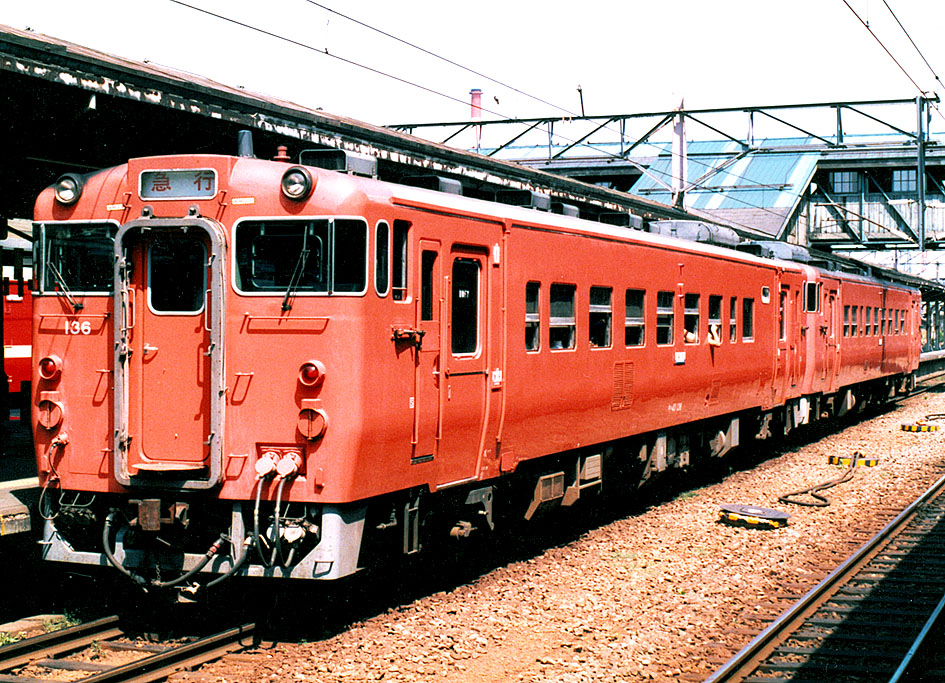
In Japan, where gasoline-driven railbuses (on small private lines) and railmotors (Kihani 5000 of the national railways) had been built since the 1920s, the first two streamlined DMUs came in service in 1937, class Kiha 43000 (キハ43000系).[40]
The service of several hundreds (in sum even thousands) of diesel railcars and DMUs started in 1950s following the improvement of fuel supply that was critical during World War II.[41]
Kenya
[edit]In 2021, Kenya acquired DMUs from France to operate in the Nairobi Metropolitan Area. These trains connect the city with settlements outside Nairobi, Jomo Kenyatta International Airport and the Nairobi Terminus.
Malaysia
[edit]The Keretapi Tanah Melayu (KTM) has a total of 13 DMU KTM Class 61 ordered from CRRC for the West Coast Line and are assembled locally at CRRCs Batu Gajah factory from 2016 to 2020. The first scheduled service is expected from 1 September along the Gemas-Johor Bahru route, replacing old non-automotive stock.[42]
Philippines
[edit]The Philippine National Railways (PNR) was one of the first adopters of diesel multiple unit trains in Asia. Initially built as gasoline-powered railmotors, the locally assembled Manila Railroad RMC class of 1929 was the first to be powered by diesel traction. Some units were also converted to streamliner units by 1932 for first-class services on the South Main Line between Manila and Legazpi, Albay.[43] Since then, generations of DMUs were used chiefly for short-distance commuter services by the PNR in the island of Luzon.[44][45]
Even without active inter-city rail services in the present-day, DMUs are still used on the PNR Metro Commuter Line in Metro Manila and the Bicol Commuter service in the Bicol Region.[46] Three generations of DMUs are in use: second-hand DMUs handed over by JR East such as the KiHa 35, 52 and 59 series originally built in the 1960s and acquired in the early 2010s,[47][48] the Rotem DMUs of 2009 built by Korean manufacturer Hyundai Rotem,[49] and the 8000 and 8100 classes built by Indonesian firm PT INKA.[50][51]
From 2022 onwards, the PNR will purchase standard gauge DMUs for its upcoming inter-city rail network in Luzon and Mindanao. This is compared to the 3 ft 6 in gauge of the rolling stock that is currently in active service. This move should allow access to better technology and increase line speeds.
South Korea
[edit]

Korail used to operates many DMUs. The DHC (Diesel Hydraulic Car), which made its debut for the 1988 Seoul Olympics, was able to reach speeds up to 150 km/h (93 mph) and served Saemaul-ho trains. These train have retired on 2008.[citation needed]
Sri Lanka
[edit]DMUs were first introduced to Sri Lanka in 1940. The aim of this was connecting minor railway stations and stops on the main line where most express trains don't have a halt.[52]
Taiwan
[edit]The DMUs are now usually used on the Taiwan Railway Administration Hualien–Taitung Line, North-Link Line, South-Link Line. DMUs in Taiwan are classified as Class DR.
- Class DR2700 – built by Tokyu Car Corporation in 1966; was the fastest train on the West Coast line
- Class DR2800 – built by Tokyu Car Corporation in 1982 and 1984[citation needed]
- Class DR2900
- Class DR3000
- Class DR3100
Thailand
[edit]
The State Railway of Thailand ASR class is a diesel multiple unit operated by the State Railway of Thailand. Built by British Rail Engineering Limited at Derby Litchurch Lane Works in England, it is based on the British Rail Class 158. Twenty carriages were built in 1990/91. All were painted in the same Regional Railways livery as the Class 158s.
- Numbers 2501 – 2512 (with cockpit) 12 Unit
- Numbers 2113 – 2120 (no cockpit) 8 Unit
Manufacturers
[edit]DMU manufacturers include:
- Alstom
- AnsaldoBreda, Italy
- BEML, India
- BHEL, India
- Bombardier Transportation of Montreal, Canada
- British Rail Engineering Limited, United Kingdom (1962–1980s)
- British Railways, United Kingdom (1950s–1962)
- Budd Company of United States
- CAF
- Colorado Railcar, US (Rader Railcar 1988–1997, Colorado Railcar 1997–2008, US Railcar[53] 2009–present)
- CRRC, China
- DMZ, Russia
- EIKON International
- Electroputere VFU, Romania
- Ferrovias Del Bajio S.A. de C.V., Mexico
- Ganz-MÁVAG, Hungary
- Hyundai Rotem of Seoul, South Korea
- INKA, Indonesia
- Integral Coach Factory, Chennai, India
- Luganskteplovoz, Ukraine
- Materfer, Argentina
- Metrovagonmash, Russia
- Niigata Transys of Tokyo, Japan
- Nippon Sharyo/Sumitomo, Japan
- Pojazdy Szynowe Pesa Bydgoszcz
- RVR, Latvia
- Siemens Mobility DMU
- Stadler Rail of Bussnang, Switzerland
- Torzhoksky car-building factory, Russia
- TÜVASAŞ of Adapazarı, Turkey
See also
[edit]
References
[edit]- ^ a b "Cutting noise and smoothing the ride". Railway Gazette International. 1 August 2000. Archived from the original on 4 June 2012. Retrieved 20 January 2011.
In the Voyager application, every car has a Cummins underfloor engine and alternator supplying power to a pair of body-mounted traction motors. Each drives one inner axle through a cardan shaft and axle-mounted final drive gearbox.
- ^ Stadler Flirt DMU/DEMU example: Elron Elektriraudtee Classes 2200, 2300 and 2400, TEXRail Stadler FLIRT
- ^ Holland, Julian (January 2013). An A-Z of Famous Express Trains: An Illustrated Trip Down Memory Lane. David & Charles. ISBN 9781446302958.[permanent dead link]
- ^ "LNER Encyclopedia: The LNER Armstrong-Whitworth Diesel–Electric Railcars". Retrieved 19 June 2016.
- ^ a b Heaps, Chris (1988). "End of the Blue Pullmans". BR Diary: 1968–1977. London: Ian Allan. pp. 66–67. ISBN 978-0-7110-1611-8.
- ^ "1976: New train speeds into service". London: BBC News. 4 October 1976. Retrieved 15 February 2011.
- ^ "New opportunities for the railways: the privatisation of British Rail" (PDF). Railway Archive. p. 8. Archived (PDF) from the original on 23 October 2007. Retrieved 15 February 2011.
- ^ a b "Class 253 High Speed Train". Railblue.co.uk. Archived from the original on 15 July 2011. Retrieved 15 February 2011.
- ^ a b "Class 254 High Speed Train". Railblue.co.uk. Archived from the original on 15 July 2011. Retrieved 15 February 2011.
- ^ "Great Western Railway calls time on long-distance HSTs". railmagazine.com. Retrieved 8 October 2022.
- ^ "Final batch of refurbed Inter7City trains handed over to ScotRail". RailAdvent. 13 March 2021. Retrieved 8 October 2022.
- ^ GWR unveils Hitachi iep trainset Archived 25 April 2018 at the Wayback Machine Railway Gazette International 30 June 2016
- ^ Stadler and Bombardier to supply trains for Abellio East Anglia franchise Railway Gazette International 10 August 2016
- ^ GWR to lease Class 769 Flex trimode trainsets Archived 27 July 2018 at the Wayback Machine Railway Gazette International 20 April 2018
- ^ "'They don't make trains like this anymore'". railtechnologymagazine.com. Retrieved 18 July 2019.
- ^ "West Midlands Trains puts first Class 230 D Train in service". Railway Technology. 23 April 2019. Retrieved 18 July 2019.
- ^ Hughes, Owen (10 September 2018). "New North Wales trains will be slower than Arriva ones BUT journey times will fall". northwales. Retrieved 18 July 2019.
- ^ Dobell, Malcolm (19 December 2023). "Class 150 units back on the Marston Vale line". Rail Engineer. Retrieved 11 August 2024.
- ^ Such as the Railroad Safety Appliance Act of 1893.
- ^ ""Kaoham Shuttle" page, Seton Lake Indian Band website (Tsalalh.net)". Archived from the original on 28 July 2014.
- ^ "Six Commuter Trains Purchased: Travel Easier in San Jose Costa Rica – Costa Rica Star News". 16 June 2012. Retrieved 19 June 2016.
- ^ Fender, Keith (5 September 2023). "Passenger equipment from Britain, US heads to Mexico". Trains. Retrieved 24 November 2023.
- ^ Franz, Justin; Vondrak, Otto M. "RDC Update". Railfan & Railroad (September 2020).
- ^ "Diesel Multiple Unit Assessment" (PDF). sccrtc.org. September 2010. Retrieved 26 June 2023.
- ^ Lewis, Bj (5 June 2012). "DCTA gets go-ahead to use Stadler cars". Denton Record-Chronicle. Archived from the original on 9 June 2012. Retrieved 6 June 2012.
- ^ "TEX Rail commuter line opens". Railway Gazette. 10 January 2019. Archived from the original on 2 April 2019. Retrieved 1 April 2019.
- ^ "TEXRail Map". Trinity Metro. Retrieved 1 April 2019.
- ^ "BART moves forward with $1 billion in extension projects – bart.gov". Retrieved 19 June 2016.
- ^ "BART to Antioch: East Contra Costa BART Extension". Retrieved 27 March 2019.
- ^ "July 2006 Metro to Fund Implementation Study on a Regional Connector Through Glendale and Burbank". ebb.metro.net. Retrieved 1 February 2017.[permanent dead link]
- ^ "Coming Soon page". Retrieved 19 June 2016.
- ^ "BNSF Eastside Commuter Rail Feasibility Study". Archived from the original on 11 February 2010. Retrieved 21 January 2010.
- ^ "Alaska Railroad – Alaskan Tours & Vacations – Train Packages" (PDF). Archived from the original (PDF) on 6 March 2012. Retrieved 19 June 2016.
- ^ Pattison-Gordon, Jule (10 February 2016). "Fairmount line setback: No DMUs says MBTA". Bay State Banner. Retrieved 20 November 2019.
- ^ "Passaic Bergen Hudson Transit Project". Projects & Reports. NJ Transit. Retrieved 26 February 2021.
- ^ "DEMU trains begin debut run in Ctg". Bdnews24.com. Retrieved 26 May 2013.
- ^ a b Somoy National Desk. "Railway to sell Tk 650cr worth of DEMU trains as scrap". Somoy News. Retrieved 28 January 2025.
- ^ "Another wasteful railway project". The Daily Star. 20 October 2022. Retrieved 28 January 2025.
- ^ a b c "铁道馆_中国科普博览". www.kepu.net.cn. Retrieved 24 April 2025.
- ^ "キハ43000の資料 – しるねこの微妙な生活/浮気心あれば水心!?". Archived from the original on 25 June 2016. Retrieved 19 June 2016.
- ^ "The Railway Museum in Saitama". Archived from the original on 13 September 2016. Retrieved 19 June 2016.
- ^ "New CRRC DMU on test in Malaysia". 16 May 2019.
- ^ Report of the General Manager for the Year Ended December 31, 1938. Reports of the General Manager (Report). Manila Railroad Company. 17 March 1939.
- ^ Motive Power and Rolling Stock. Report of Survey of the Manila Railroad Company and the Preliminary Survey of Railroads for Mindanao (Report). De Leuw, Cather and Company; Manila Railroad Company. July 1952. Retrieved 13 April 2021.
- ^ "Corporate Profile". Philippine National Railways. Archived from the original on 10 April 2021. Retrieved 10 April 2021.
- ^ Peadon, Brad. "April 2020". Philippine National Railways Rolling Stock Update. 3. Philippine Railways Historical Society.
- ^ 寺本光照 (2014). 国鉄・JR関西圏近郊電車発達史 大阪駅140年の歴史とアーバンネットワークの成立ち. キャンブックス (in Japanese). JTBパブリッシング. p. 73. ISBN 978-4-533-09794-2.
- ^ "フィリピン国鉄 KIHA59「KOGANE」が営業運転に復帰" [Philippine National Railways KIHA59 "KOGANE" returns to commercial operation]. Japan Railfan Magazine Online (in Japanese). Japan: Koyusha Co., Ltd. 10 December 2019. Archived from the original on 10 December 2019. Retrieved 10 December 2019.
- ^ "Railway Systems-Project Record View". hyundai-rotem.co.kr. Archived from the original on 21 April 2021. Retrieved 25 December 2018.
- ^ "Two more PNR trainsets arrive in PH". ph.news.yahoo.com. Retrieved 12 February 2020.
- ^ "PNR unveils 2 brand new diesel multiple unit trains bought from Indonesia". Manila Standard. Archived from the original on 12 December 2023. Retrieved 3 February 2020.
- ^ https://apps.who.int/iris/rest/bitstreams/1081775/retrieve [dead link]
- ^ "US Railcar". usrailcar.com.
| Authority control databases: National |
|---|


Diesel multiple unit
View on GrokipediaDefinition and history
Definition and characteristics
A diesel multiple unit (DMU) is a self-propelled rail vehicle powered by one or more onboard diesel engines integrated into the carriages, enabling operation without a separate locomotive.[7][8] These units are designed as standardized trainsets where multiple carriages can be coupled to function as a single train, with power distributed to one or more axles per powered car.[2] DMUs are typically lighter and shorter than traditional locomotive-hauled trains, making them suitable for regional, suburban, or branch line passenger services.[9] Common configurations include 2-car or 3-car sets, often with high- or low-floor designs to accommodate varying platform heights and passenger accessibility needs.[7] They feature semi-permanently coupled vehicles for flexibility on lower-demand routes, with seating capacities ranging from approximately 90 to 144 passengers per unit depending on the model.[7][9] Unlike diesel locomotives, which pull unpowered coaches from a dedicated leading or trailing position, DMUs incorporate propulsion engines directly into the powered end cars, allowing for distributed power and more efficient short-haul operations.[2] In contrast to electric multiple units (EMUs), which draw power from overhead lines or third rails, DMUs rely solely on onboard diesel fuel, eliminating the need for electrification infrastructure.[10] DMUs support multiple working capability, enabling several units to be coupled and controlled from a single cab for extended train formations.[2] Typical top speeds range from 75 to 125 km/h (47 to 78 mph) for regional services, with acceleration and deceleration rates optimized for frequent stops on suburban or branch lines.[7][9]Historical development
The origins of diesel multiple units (DMUs) trace back to the early 20th century, with initial experiments in self-propelled railcars emerging as economical alternatives to steam locomotives on branch lines and rural routes. In the United Kingdom, the Great Western Railway (GWR) pioneered diesel railcars in the 1930s, introducing the first unit in 1933 equipped with an AEC diesel engine and mechanical transmission, followed by a series of 38 diesel-powered vehicles built between 1934 and 1942 that demonstrated reliable performance on secondary services.[11] In the United States, early diesel railcars appeared in the 1930s, such as the 1933 Texas and Pacific Silver Slipper, a gasoline-electric demonstrator that influenced later designs, though widespread adoption was limited until postwar years.[12] The Budd Rail Diesel Car (RDC), introduced in 1949 by the Budd Company, marked a significant milestone as the first standardized diesel multiple unit in North America, featuring lightweight stainless steel construction and diesel-mechanical power for efficient operation on low-density passenger routes. Between 1949 and 1962, 398 RDCs were produced, serving railroads across the continent and setting a template for self-propelled passenger vehicles that reduced crew requirements compared to locomotive-hauled trains.[13] Post-World War II dieselization accelerated DMU development, particularly in the 1950s amid global rail network modernizations to replace aging steam fleets. In the UK, British Railways' 1955 Modernisation Plan prioritized DMUs for cost-effective local services, leading to the introduction of production units like the Metro-Cammell Class 101 in 1956, which became one of the most numerous first-generation designs with over 550 vehicles built by 1959.[14][15] This era saw a boom in Europe and North America, where DMUs addressed labor shortages and fuel efficiency needs during economic recovery. During the 1960s and 1970s, European manufacturers emphasized hydraulic transmissions in DMU designs for smoother power delivery and compact integration, as seen in German and British models that favored this system for railcars due to its reliability on varied terrains. By the 1980s and 1990s, a shift toward diesel-electric transmissions gained prominence, offering improved efficiency and flexibility for higher-speed operations, particularly in upgraded networks.[16] In Western Europe, DMU usage declined from the 1970s onward as extensive electrification programs converted main lines to electric multiple units, reducing the need for diesel on high-traffic routes and leading to the phasing out of many first-generation fleets by the 1990s. However, DMUs experienced resurgence after 2000 in developing countries, where non-electrified lines proliferated; for instance, modern units were adopted in regions like the Middle East and South Asia for rapid infrastructure expansion on secondary networks.[17][18] Globally, DMUs initially spread in Europe and North America during the mid-20th century before expanding to Asia from the mid-20th century, with early examples such as Japan's KiHa series introduced in the 1950s, supporting growing suburban and regional services on unelectrified tracks.[19][20][21]Advantages and disadvantages
Advantages
Diesel multiple units (DMUs) offer significant economic benefits over traditional locomotive-hauled trains, primarily due to their integrated design that combines propulsion and passenger accommodation in self-propelled vehicles. This eliminates the need for separate locomotives, reducing capital costs for acquisition and infrastructure modifications, while lowering maintenance expenses through simpler mechanical systems and fewer components requiring upkeep. For instance, combined fuel and maintenance costs for DMUs can be approximately 35% lower than for comparable locomotive-hauled consists in regional service.[22] Additionally, DMUs typically require reduced staffing, often operating with a single driver, which cuts labor expenses compared to the two-person crews common on locomotive-hauled trains. Faster turnaround times at terminals are achieved by simply switching the driver between cab ends, avoiding the need to reposition locomotives. Operationally, DMUs provide enhanced efficiency, particularly for stop-start services on regional routes. Their distributed power systems enable quicker acceleration, with power-to-weight ratios that surpass those of locomotive-hauled trains, allowing for shorter dwell times at stations and improved schedule adherence. Multiple working capability facilitates the formation of variable-length trains by coupling units electronically, enabling operators to adjust consists dynamically to match demand without complex shunting. This makes DMUs especially suitable for low-density routes, where full locomotives would be uneconomical due to underutilized capacity and higher fuel demands; for example, fuel consumption for DMUs averages 0.33 gallons per vehicle-mile, compared to 2.23 gallons per train-mile for locomotive-hauled equivalents.[18] The flexibility of DMUs extends to simpler coupling and uncoupling procedures, supporting short turns and efficient reconfiguration at endpoints, which is ideal for branch lines and rural services. Operators can run single units for light loads or combine them seamlessly, enhancing adaptability to fluctuating passenger volumes without dedicated yard facilities. From an environmental and safety perspective, DMUs generally produce lower emissions per passenger-kilometer than older steam or locomotive-diesel setups, thanks to improved fuel efficiency—approximately 5-10% better energy use per vehicle compared to equivalent locomotive-hauled trains—and the ability to incorporate biodiesel or advanced engines.[23] Modern hybrid variants further enhance this with 20-30% additional fuel savings and reduced emissions.[24] The cab-forward design at both ends enhances driver visibility, reducing collision risks by providing unobstructed forward and rearward views during operations. Overall, these advantages translate to operating cost savings of approximately 5-10% in regional service operations relative to locomotive-hauled trains.[25]Disadvantages
Diesel multiple units (DMUs) generally exhibit lower total power output compared to locomotive-hauled trains, which restricts their operational suitability for steep gradients or high-speed mainlines. Individual DMU engines typically range from 130 to 560 kW, whereas locomotives often exceed 560 kW, resulting in reduced tractive effort and acceleration on demanding terrains.[23] This power disparity often results in DMUs being operated in 2-4 car formations for optimal performance on regional routes. The distributed placement of engines across multiple cars in DMUs introduces significant maintenance challenges, increasing overall complexity and repair durations compared to centralized locomotive systems. Servicing requires access to numerous engine compartments, often necessitating specialized facilities that can cost tens of millions to establish or upgrade, such as the estimated $54.6 million for a dedicated DMU maintenance site.[25] Additionally, the design can lead to higher downtime if multiple units require simultaneous servicing. On-board diesel engines contribute to elevated interior noise and vibration levels, diminishing passenger comfort particularly on extended journeys. Vibration measurements on DMUs, such as the Swedish Kustpilen Y2 model, reveal indices exceeding 3.0 on suboptimal tracks, leading to difficulties for two-thirds of passengers in sedentary tasks like reading and writing.[26] These effects stem from engine-induced oscillations in the 1-10 Hz range, amplified at seats and tables, which surpass general perception thresholds of 65 VdB and approach annoyance levels of 75 VdB.[27][26] Retrofitting older DMUs to comply with modern emissions standards presents substantial technical hurdles, including power derating and structural modifications. For instance, converting diesel engines to hydrogen compatibility reduces output from 600 kW to 400 kW due to altered compression ratios and injection systems, with retrofit costs ranging from €8,000 to €12,000 per engine.[28] In harsh environments, such upgrades exacerbate wear, contributing to shorter operational lifespans as components like high-pressure tanks face accelerated degradation.[28] Increasing regulatory pressure for zero-emission transitions, such as EU and US standards as of 2025, may further limit the viability of pure diesel DMUs. Economically, DMUs incur higher per-unit costs owing to low-volume production runs, which limit economies of scale in manufacturing. Industry reports highlight the challenges of high-mix, low-volume rail production, driving up unit prices relative to mass-produced alternatives.[29] Furthermore, their design is less scalable for very high-capacity urban services, often resulting in underutilization on low-ridership routes, while capital investments for fleets and infrastructure can exceed $300 million.[25]Design and technology
Core design principles
Diesel multiple units (DMUs) feature a modular structural layout centered on powered end cars, or power cars, equipped with driver's cabs to facilitate operation from either direction. These end cars house the primary propulsion systems, while intermediate cars can be either powered to distribute motive power or configured as unpowered trailers to extend train length without adding engines. This arrangement allows for scalable formations, from single cars to multi-unit consists, optimizing operational flexibility on branch lines and regional routes. Construction methods emphasize lightness and durability, often utilizing monocoque designs where the body shell integrates the underframe, sides, and roof into a single welded structure, or traditional underframe approaches with stressed-skin panels to resist bending forces while reducing overall mass.[30][18] Engine integration forms a cornerstone of DMU design, with on-board diesel engines—typically rated at 200-600 kW per car—mounted under the floor or at the vehicle ends to preserve interior space for passengers. This underfloor placement positions the engine within the underframe alongside key components like the drive line, minimizing protrusion into the passenger area and enabling a low center of gravity for stability. Fuel tanks are incorporated directly into the chassis for balance and protection, often with capacities supporting 500-1000 km ranges. Cooling systems use radiators and fans integrated into the underbody to dissipate waste heat and maintain optimal engine temperatures during extended runs, while heating systems utilize engine waste heat for passenger comfort.[31][32][33] Passenger accommodations in DMUs are tailored to service type, with commuter variants prioritizing high-density seating arrangements—often 2+2 across with minimal aisles—to maximize capacity on urban routes, accommodating up to 80-100 passengers per car. Regional DMUs, by contrast, blend fixed seating with open areas for standing, providing 50-70 seats per car to suit mixed loads on longer intercity trips. Since the 1990s, accessibility has been enhanced through low-floor designs that lower the car floor to near-platform height, incorporating features like wide doors, deployable ramps, and dedicated wheelchair spaces to comply with standards such as the Americans with Disabilities Act.[7][34] Safety and control systems ensure reliable multi-car operation, with automatic train control (ATC) integrated to monitor speed, signal adherence, and automatic braking in response to trackside signals or obstacles. Multiple unit control (MUC) synchronizes throttle, engine starting, and propulsion across cars via electrical and pneumatic jumpers, allowing a single driver to manage the entire consist seamlessly. Braking combines pneumatic systems for immediate, fail-safe stopping using compressed air actuators on each axle, supplemented by dynamic braking that converts kinetic energy back to electrical power for dissipation or regeneration, reducing mechanical wear and heat buildup.[35][36] Materials selection focuses on lightweight alloys to balance strength and efficiency, employing high-tensile steel for underframes and aluminum panels for bodywork to curb tare weights to 35-50 tonnes per car. This approach yields power-to-weight ratios of 5-10 kW/tonne, enabling responsive acceleration up to 0.5 m/s² on gradients and curves without excessive fuel use.[37]Transmission types overview
The transmission system in a diesel multiple unit (DMU) serves to convert the rotational power generated by the onboard diesel engine into traction force at the wheels, enabling efficient propulsion while managing key factors such as power efficiency, torque multiplication for acceleration, and operational control complexity.[38] This conversion is essential for adapting the engine's output to varying load and speed demands in passenger service, where smooth starts, stops, and cruising are prioritized over heavy freight hauling.[39] DMU transmissions are classified primarily by their method of energy transfer from the engine to the wheels: diesel-mechanical, which uses direct gearing; diesel-hydraulic, employing fluid torque converters; or diesel-electric, involving electrical generation and motor drive.[40] The selection of a transmission type depends on route characteristics like gradient and frequency of stops, as well as economic considerations including initial cost and long-term maintenance requirements.[38] In general, mechanical transmissions suit simpler, low-power DMUs due to their straightforward design and minimal components, offering ease of integration in compact underfloor layouts.[39] Hydraulic systems provide smoother power delivery and better low-speed torque for medium-distance routes with frequent acceleration, while electric transmissions excel in versatility for higher-performance applications, allowing precise control and multi-unit operation.[40] These differences influence overall vehicle dynamics, with mechanical types emphasizing simplicity and hydraulics and electrics favoring adaptability.[38] Historically, early DMUs in the mid-20th century predominantly featured mechanical transmissions for their reliability in basic designs, evolving toward hydraulic systems in the 1950s for improved torque handling, particularly in European railcars.[16] By the late 20th century, electric transmissions gained prominence in modern DMUs for enhanced reliability and efficiency, reflecting a broader industry trend toward electrical systems in self-propelled rail vehicles.[40] Transmission efficiency typically ranges from 70% to 90% across types, with mechanical systems achieving the highest due to direct power transfer and minimal losses, while hydraulic and electric incur greater slippage or conversion inefficiencies.[41] This impacts acceleration performance, where DMUs commonly achieve 0.5 to 1 m/s² under typical operating conditions, varying by power output and transmission response.[42]Diesel-mechanical transmission
A diesel-mechanical transmission in a diesel multiple unit (DMU) directly links the diesel engine to the wheels via a clutch, gearbox, and final drive system, typically using cardan shafts to transmit power to the bogie axles. This setup often employs an epicyclic gearbox with multiple gear ratios—such as four-speed configurations—for efficient power delivery across varying speeds, sometimes incorporating a fluid flywheel as an automatic clutch and a freewheel to prevent reverse rotation. The design ensures straightforward mechanical power transfer without intermediate fluid or electrical conversion.[39][43] The primary advantages of diesel-mechanical transmissions lie in their simplicity and low weight, which reduce overall vehicle mass and manufacturing costs, making them particularly cost-effective for short-route and lightweight operations. They achieve high efficiency, often around 95% in power transmission, surpassing the approximately 85% typical of hydraulic or electric alternatives due to minimal energy losses in direct drive modes. This efficiency supports optimized engine loading, especially with multi-speed setups like 16 ratios in advanced designs.[44] Diesel-mechanical transmissions have been applied in early lightweight DMUs and continue in some modern regional railcars suited to rural or branch line services. Notable examples include the United Kingdom's British Rail Class 121 "Bubble Cars" from the 1960s, which used a single-car configuration with two 150 hp engines and an R14 epicyclic gearbox for flexible, low-capacity operations. More contemporary implementations appear in units like the Danish State Railways' IC3, a three-car articulated DMU with mechanical transmissions providing strong acceleration for intercity and regional routes.[45][44] Key limitations include interruptions in power delivery during gear shifts, which can affect smooth acceleration compared to fluid-based systems. These transmissions are generally unsuitable for high-power outputs exceeding 300 kW, as the direct mechanical linkage subjects gears and shafts to excessive torque stress under heavy loads. Additionally, they offer limited regenerative braking capabilities, relying more on traditional friction brakes.[44] Maintenance for diesel-mechanical systems benefits from fewer complex components than hydraulic or electric variants, lowering long-term costs in simple setups. However, in multi-car formations, precise synchronization of multiple engines and gearboxes is essential to ensure even torque distribution and prevent drivetrain vibrations or uneven wear.[44]Diesel-hydraulic transmission
In diesel-hydraulic transmissions for diesel multiple units (DMUs), power from the diesel engine is transferred to the wheels via a hydraulic system that utilizes torque converters and fluid couplings to drive a gearbox, enabling smooth and efficient propulsion without direct mechanical linkage. The core mechanism involves a centrifugal pump or impeller, rotated by the engine, which circulates hydraulic fluid (typically oil) to impart kinetic energy to a turbine connected to the input shaft of the gearbox; as the turbine accelerates, fluid impingement decreases, allowing variable torque multiplication during startup and low speeds. Prominent systems include those developed by Voith, which integrate hydrodynamic torque converters with multi-stage designs for optimized power delivery in rail applications.[16][46] Key features of these transmissions include seamless acceleration without gear clashes, as the fluid coupling allows slip between engine and transmission components, providing progressive torque buildup ideal for urban routes with frequent stops and starts. They offer hydrodynamic efficiency curves that peak at 75-85% under optimal operating conditions, balancing power transfer with minimal energy loss through fluid dynamics, though efficiency drops at extreme speeds or loads. This design excels in mid-range torque delivery, making it suitable for lighter railcars on secondary lines.[16][47][40] Diesel-hydraulic transmissions gained prominence in Europe during the 1950s to 1980s, particularly in Germany, where they powered efficient DMUs for regional services on lighter infrastructure. A representative example is the German Federal Railway's VT 08 series, introduced in the early 1950s, which used Maybach engines paired with hydraulic transmissions for reliable operation at speeds up to 140 km/h on non-electrified lines. While less common in the UK, similar systems influenced designs like certain prototype DMUs, though adoption favored mechanical variants; their use persists in exported models to Asia, such as Voith-equipped units in Southeast Asian networks for cost-effective rural connectivity.[16][48][49] Despite these strengths, limitations include potential fluid leaks from seals under vibration and pressure, which can reduce lubrication and lead to component wear, as well as heat buildup in the torque converter during prolonged operation, necessitating robust cooling systems. These transmissions are generally heavier than mechanical alternatives due to the added fluid reservoirs and housings, contributing to higher axle loads on tracks. Their decline in modern applications stems from stricter emissions regulations favoring electrified or hybrid systems, though retrofits remain viable for legacy fleets.[50][51] Engineering specifics involve multi-stage torque converters, where multiple impeller-turbine sets provide variable gear ratios—typically 4:1 to 6:1 in the first stage—allowing adaptation to engine speed without manual shifting, often integrated with automatic planetary gearboxes for seamless progression through four to six speeds. Voith's DIWA and RailPack systems exemplify this, combining hydrodynamic elements with electronic controls for precise ratio adjustments in DMUs.[52]Diesel-electric transmission
In diesel-electric transmission systems for diesel multiple units (DMUs), the diesel engine drives a generator or alternator to produce electrical power, which is then supplied to traction motors mounted on the bogie axles to propel the train. This setup allows for distributed power across multiple cars without requiring a separate locomotive. Variants include DC-DC systems, where a DC generator powers DC traction motors via resistance control; AC-DC systems, where an AC alternator's output is rectified to DC for DC motors; and modern AC-DC-AC systems, where AC alternator output is rectified to DC and then inverted to three-phase AC for AC traction motors, offering superior performance in contemporary designs.[38][53] Key features of diesel-electric transmission include precise speed and torque control through electronic systems, enabling smooth acceleration and adherence to varying track conditions. These systems achieve high transmission efficiency, typically 85-90%, due to the direct conversion and minimal mechanical losses compared to other types, while modern units incorporate regenerative braking, where traction motors act as generators during deceleration to recover energy and reduce wear on friction brakes. This capability enhances overall energy utilization, particularly in stop-start suburban operations.[38] Diesel-electric transmissions have become dominant in DMUs introduced after the 1990s, providing flexibility for services on non-electrified lines, including those shared with freight traffic due to their compatibility with standard rail infrastructure and ability to handle varied loads. Representative examples include the UK's Bombardier Class 220 Voyager, a four-car high-speed unit introduced in 2001 for intercity routes, and India's Diesel Electric Multiple Unit (DEMU) series, such as the 1400 HP models used for suburban and regional passenger services since the early 2000s.[55][56] Despite these advantages, diesel-electric systems incur higher initial costs and greater complexity from the electrical components, leading to elevated manufacturing and installation expenses relative to mechanical alternatives. Electrical faults, such as traction motor flashovers or generator failures, can immobilize entire units, requiring specialized diagnostics and repairs that disrupt service.[57][58] Advancements in this transmission type include the adoption of insulated gate bipolar transistor (IGBT)-based inverters for AC drives, which enable finer control, reduced switching losses, and improved reliability in variable-speed operations. By the 2020s, hybrid integrations combining diesel-electric systems with onboard batteries have emerged, allowing energy storage for regenerative braking and short battery-only runs to cut emissions; examples include the UK's Stadler Class 756 FLIRT hybrid DMUs, introduced in 2024 for regional services in Wales.[59][60][61]Global usage
European usage
Diesel multiple units (DMUs) are extensively deployed across Europe, particularly on non-electrified rural and regional lines where they provide efficient, self-propelled passenger services without the need for separate locomotives. In the United Kingdom, the fleet is one of the largest in the region, with approximately 1,500 units (as of 2023) serving local and rural routes, exemplified by the Class 150 Sprinter and Class 156 Super Sprinter, which operate at speeds up to 75 mph (120 km/h) on networks like those managed by Northern Rail. These units have been integral to maintaining connectivity in areas not yet electrified, supporting daily commuter and inter-urban travel. Germany features a robust DMU presence with around 800 units (as of 2023) focused on regional express services, including the Stadler Regio-Shuttle RS1, which runs at 120 km/h on lines such as those in Bavaria and Saxony, emphasizing short-distance, high-frequency operations. In Belgium, the SNCB's I11 units, introduced in the 2000s, handle local services on non-electrified branches at speeds around 120 km/h, enhancing accessibility in Wallonia and Flanders. Croatia employs tilting DMUs like the HŽ Series 6112 for intercity routes through hilly terrain, achieving up to 160 km/h to connect Zagreb with coastal areas. The Czech Republic utilizes the Škoda RegioPanter for cross-border regional services, operating at 160 km/h on lines linking Prague to neighboring countries like Poland and Germany, promoting seamless European integration. Estonia has modernized its DR1 series railcars, including the DRZ1 variant, for domestic routes at 120 km/h, addressing the legacy of Soviet-era equipment with upgrades for reliability. Greece maintains limited DMU operations, primarily on island networks like those served by converted units on Rhodes and Crete, focusing on tourist and local shuttles at lower speeds of 80-100 km/h. In Ireland, the 22K class Civity DMUs from CAF provide intercity services at 160 km/h on routes from Dublin to Cork and Galway, replacing older locomotives for improved efficiency. Italy deploys regional ETB (Elettrenord Tilting Train) units and similar DMUs for suburban and inter-regional lines at 130-160 km/h, such as those operated by Trenitalia in the north. Romania has converted ex-Soviet railcars, like the 92 series, for secondary lines at 100 km/h, adapting them for modern passenger needs amid infrastructure challenges. Slovakia's ZSSK operates classes such as 670 and 672 DMUs for regional services at 120 km/h, connecting Bratislava to rural areas and supporting cross-border links with Austria and Hungary. Recent trends in Europe include the gradual phasing out of older diesel units in favor of low-emission hybrid and battery-assisted DMUs by 2025, driven by EU environmental directives, with examples like the RegioJet's battery-electric-diesel multiple units ordered from Škoda Group in September 2025 for services in the Czech Republic. The European Union is advancing standardization efforts through initiatives like TSI (Technical Specifications for Interoperability) to enhance cross-border DMU operations, targeting interoperability for units operating at 100-160 km/h. Hydraulic transmissions remain a legacy preference in Germany for their torque efficiency in regional starts and stops.[62]North American usage
In North America, diesel multiple units (DMUs) have seen limited adoption compared to Europe, largely due to the predominance of freight rail networks that prioritize heavy-haul operations over passenger services, leading to a focus on commuter, regional, and tourist applications where DMUs provide efficient, self-propelled alternatives to locomotive-hauled trains.[18] Historical use peaked in the mid-20th century with models like the Budd Rail Diesel Car (RDC), but declined through the 1970s amid reduced domestic manufacturing and public investment in rail; a modest resurgence began in the late 1990s with demonstrations of European and Asian designs.[18] By the 2020s, DMUs represent a small fraction of passenger rail fleets, emphasizing lightweight yet regulation-compliant vehicles for shorter routes. Regulatory factors significantly constrain DMU deployment, particularly in the United States, where the Federal Railroad Administration (FRA) enforces crashworthiness standards under 49 CFR Part 238 to protect occupants in collisions with heavy freight equipment.[63] These require structures capable of withstanding 800,000 pounds of compressive end load, 300,000 pounds at cab corner posts, and anti-climbing mechanisms rated at 100,000 pounds, often necessitating heavier steel construction that increases costs and limits speeds compared to lighter international designs.[64] In Canada and Mexico, similar safety rules apply, though with variations; there is increasing advocacy for bi-modal (diesel-electric) DMUs to enable shared use of electrified and non-electrified tracks, enhancing versatility in mixed infrastructure.[65] In the United States, notable implementations include the Sonoma-Marin Area Rail Transit (SMART) in California, which launched commuter service in 2017 using 14 Nippon Sharyo DMUs configured in two- or three-car sets powered by 760-horsepower Cummins QSK19-R engines compliant with EPA Tier 4 emissions standards.[66] These units accommodate 180 to 237 seated passengers each, with space for bicycles and wheelchairs, and operate at speeds up to 79 mph (127 km/h) along a 71-mile route from Larkspur to Windsor, integrating with heavy-rail corridors while adhering to FRA rules.[67] Demonstrations, such as Colorado Railcar DMUs tested on Amtrak California routes like the Fullerton-Irvine line in the early 2000s, highlighted potential for regional services but faced hurdles in scaling due to regulatory adaptations.[68] Canada's usage centers on remote and regional lines, with Ontario Northland Railway operating over 100 self-propelled railcars, including Hawker Siddeley RTC-85SP/D units derived from Budd RDC designs, for passenger and mixed services in northern Ontario since the 1970s.[69] Via Rail Canada continues to deploy Budd RDCs—early DMUs with 270-horsepower engines—as the last mainline examples in North America on routes like the Sudbury-White River line, valued for their reliability in low-density areas.[70] In Mexico, DMUs support tourist operations, exemplified by the Tren Maya line's four Alstom X'trapolis four-car sets introduced in 2023, each seating 230 passengers and using ultra-low-sulfur diesel for 900 km of scenic Yucatán Peninsula routes at speeds up to 130 km/h.[71] Central American examples include Costa Rica, where the Instituto Costarricense de Ferrocarriles (Incofer) introduced eight CRRC DMUs in 2019 for commuter services around San José, each 38 meters long and carrying up to 372 passengers to replace aging Spanish-built units on urban lines.[72] Post-2010 trends indicate a revival driven by urban rail expansions and emissions regulations, with challenges persisting in integrating DMUs with freight-heavy infrastructure, including compatibility with Class 1 tracks, signaling for single-unit shunting, and maintenance training, while operational speeds rarely exceed 130 km/h to ensure safety.[18]Asian and Oceanian usage
In Asia and Oceania, diesel multiple units (DMUs) have seen rapid adoption on non-electrified routes, particularly in developing infrastructure networks where cost-effective, self-propelled trains address diverse passenger and freight needs in rural and regional areas. This proliferation supports economic growth in populous regions, with DMUs offering flexibility for mixed traffic operations amid ongoing electrification efforts. In Australia, Queensland Rail's Diesel Tilt Train, introduced in 2003, exemplifies high-speed regional service on the 1,067 mm gauge network, achieving operational speeds up to 160 km/h on the Brisbane to Cairns route while incorporating tilting technology for curved tracks.[73] Bangladesh Railways has incorporated locally assembled and imported DEMUs, such as the 20 units from CNR Tangshan since 2013, to enhance commuter services on metre-gauge lines. Country-specific deployments highlight tailored applications across the region. In Cambodia, Royal Railway operates Japanese-sourced KiHa 183 series DMUs, acquired in 2024, which serve both passenger and limited freight-hybrid roles on routes like Phnom Penh to Sihanoukville, supporting tourism and logistics in under-electrified areas.[74] China employs regional DMUs like CRRC's double-deck variants for suburban services, complementing its vast high-speed electric network, with over 168 CRH6-series configurations produced by 2023 for commuter operations at speeds up to 200 km/h.[75] India's Indian Railways maintains a massive DEMU fleet exceeding 1,000 units as of 2023, primarily diesel-electric types operating at 100 km/h for short-haul passenger services across non-electrified sections, with multiple units allowing up to four rakes in formation. In Indonesia, Kereta Api Indonesia (KAI) utilizes economy-class KRDI DMUs built by PT INKA, capable of 100 km/h, for intercity and regional routes on Java's network.[76] Japan's JR Group relies on the KiHa series, such as the KiHa 100 and KiHa 110 introduced in 1990, for rural non-electrified lines, emphasizing lightweight construction and diesel-mechanical propulsion for efficient local services. Malaysia's Keretapi Tanah Melayu (KTM) deploys Class 61 DMUs since 2015 for intercity operations on non-electrified west coast lines, offering air-conditioned comfort at speeds up to 120 km/h.[77] In the Philippines, Philippine National Railways (PNR) has tested hybrid diesel-electric units like the 2019 prototype, combining diesel engines with battery storage for 80 km/h operations on Metro Manila lines, aiming to reduce emissions.[78] South Korea's Korail operates legacy DMUs like the 9500 series, though phasing out diesel passenger units by 2029 in favor of electrification.[79] Sri Lanka Railways uses ex-Indian DEMUs from Integral Coach Factory, including six 13-car sets delivered since 2018, for coastal and intercity routes at 100-120 km/h.[80] Taiwan Railways incorporates diesel variants in its DR series, such as the DR3100, for regional services on non-electrified branches.[81] Thailand's State Railway (SRT) employs refurbished KiHa 40 DMUs from Japan on the Red Line and northeastern routes, with 20 units tested in 2025 for feeder services at 100 km/h.[81] Regional trends indicate DMUs are increasingly displaced by electrification in urban corridors, such as Malaysia's KTM Komuter expansions and Thailand's Red Line EMU integrations, prioritizing higher capacity and lower emissions.[82] By 2025, hybrid diesel-electric configurations are gaining traction to meet emission standards, with prototypes in the Philippines and market forecasts showing hybrid DMU growth at a 5-7% CAGR amid global rail decarbonization.[83] Typical operational speeds range from 80 to 140 km/h to balance efficiency and infrastructure constraints.Usage in other regions
In Africa, diesel multiple units (DMUs) are employed primarily for commuter and regional services, with a strong emphasis on durability to withstand rough tracks and challenging terrain. Kenya Railways operates a fleet of second-hand DMUs, acquired from Spain, on the Nairobi Commuter Rail network, providing capacity for up to 1,200 passengers per unit and integrating with the Standard Gauge Railway (SGR) for sidings and short-haul operations.[84][85] In Madagascar, Madarail maintains a small fleet including one DMU as part of its 11 diesel locomotives and passenger coaches, supporting limited freight-passenger mixed services on aging infrastructure.[86] South Africa's Passenger Rail Agency of South Africa (PRASA) has pursued limited conversions of existing rolling stock into DMUs to enable rural rail solutions, addressing underutilized lines with diesel-powered flexibility.[87] In Latin America, DMU deployments focus on regional connectivity, often featuring air-conditioned sets for extended journeys in varied climates. Argentina's Trenes Argentinos operates CNR-built DMUs on the Belgrano Sur line for suburban and regional routes, while a 2019 contract with CRRC delivered 50 additional DMUs to enhance medium-distance services with improved passenger comfort, including climate control for long-haul operations.[88] In Brazil, Vale S.A. utilizes DMUs for tourist excursions on the Estrada de Ferro Vitória a Minas, such as the Ouro Preto–Mariana route, where air-conditioned units facilitate scenic, long-distance travel amid mining corridors.[89] Beyond major continents, DMU adoption remains minimal but includes demonstration projects tailored to specific needs. In the Middle East, the United Arab Emirates' Etihad Rail awarded a contract in 2023 for 21 CRRC-manufactured high-speed DMUs, with deliveries commencing in 2025 and passenger services expected to begin in 2026, marking the nation's first mainline passenger fleet capable of 200 km/h operations across desert terrain, with designs incorporating dust-proofing for arid conditions.[90][91] In the Pacific islands, ferrobus-style railbuses—compact DMU variants—see rare use on isolated networks, such as short-haul services in Fiji and Papua New Guinea, prioritizing low-maintenance operations over extensive fleets.[92] Regional trends highlight aid-driven imports from China and India, enabling small-scale modernizations; for instance, most African and Latin American operators maintain fleets under 100 units per country, often sourced via development financing to upgrade legacy systems.[93] Adaptations for harsh environments, such as enhanced dust-proofing and robust suspensions, are common to handle sandy or tropical conditions, as seen in UAE and African deployments.[94] Challenges include political instability disrupting maintenance schedules and the need to integrate DMUs with colonial-era tracks, which often feature narrow gauges and inconsistent alignments, limiting scalability in countries like Madagascar and Argentina.[95]Manufacturers and production
Major manufacturers
Alstom, headquartered in France, has emerged as a leading producer of diesel multiple units (DMUs) following its 2021 acquisition of Bombardier Transportation. The company's Coradia family, including the LINT and Regional variants, emphasizes modular designs that allow flexible configurations for regional and commuter routes, enabling customization of interior layouts and power systems while maintaining high standards of energy efficiency and passenger comfort. Alstom's focus on sustainability integrates hybrid and low-emission options into its DMU offerings, supporting transitions toward greener rail operations across Europe.[96] Siemens Mobility, based in Germany, specializes in the Desiro platform, a versatile DMU family deployed widely in Europe for regional services, with models like the Desiro Classic featuring diesel-hydraulic or diesel-electric propulsion for speeds up to 160 km/h.[97] Known for its innovative bogie designs and digital integration, such as predictive maintenance systems, Siemens has supplied Desiro units to operators in countries including the UK, Hungary, and Germany, enhancing network reliability on non-electrified lines.[98] Spain's Construcciones y Auxiliar de Ferrocarriles (CAF) offers the Civity platform, a modular DMU designed for adaptability in length and capacity, serving markets in the UK, Australia, and Spain with features like low-floor access and ergonomic seating.[99] CAF's emphasis on lightweight materials and advanced aerodynamics contributes to fuel efficiency, making Civity units suitable for both urban and rural deployments. Poland's PESA Bydgoszcz SA has gained prominence through its export-oriented production, delivering DMUs like the RegioFox and Link series to international operators in the Czech Republic, Romania, and Ghana, focusing on cost-competitive designs with modern interiors and compliance with European standards.[100] PESA's growth in exports underscores its role in providing affordable, reliable units for emerging rail networks.[101] In North America, the Budd Company's Rail Diesel Cars (RDCs) represent a historical milestone, with 398 units produced between 1949 and 1962, pioneering self-propelled stainless-steel DMUs that influenced global designs for lightweight, efficient passenger services.[13] For contemporary production, Japan's Nippon Sharyo manufactures FRA-compliant DMUs tailored for U.S. markets, including the two-car sets for California's Sonoma-Marin Area Rail Transit (SMART), emphasizing safety features and compatibility with American infrastructure.[102] South Korea's Hyundai Rotem contributes through its DMU exports and domestic models, such as those supplied to the Philippines' Philippine National Railways, incorporating advanced diesel engines for tropical climates and high reliability.[103] China's CRRC Corporation Limited dominates Asian production with its extensive DMU lineup, including diesel-electric models for domestic high-density routes and exports to the UAE, leveraging economies of scale for cost-effective mass production that has enabled rapid fleet expansions.[104] CRRC's facilities produce thousands of units annually, focusing on standardized components to reduce lifecycle costs while meeting international emission standards.[105] In India, the Integral Coach Factory (ICF) under Indian Railways manufactures diesel-electric multiple units (DEMUs) like the 1600 HP AC-AC series, with over 67 trainsets built for non-electrified networks, prioritizing local sourcing and rugged designs for diverse terrains.[106] BEML Limited collaborates with ICF on rail vehicle production, including contributions to high-speed prototypes that incorporate DMU elements, supporting India's push for indigenous manufacturing. Japan's Hitachi Rail produces KiHa-series DMUs, such as the KiHa 100 and 110, for JR East and other operators, known for their compact, efficient layouts suited to rural and regional lines with speeds up to 130 km/h. Hitachi's expertise in hybrid systems enhances these units' environmental performance, with exports like the RHN series to Cambodia demonstrating adaptability to international specifications.[107] These manufacturers prioritize export markets, with Alstom and CRRC leading in global deliveries through customizable platforms that address varying regulatory and operational needs.[108] Europe accounts for approximately 70% of global DMU production, driven by established firms like Alstom and Siemens, while Asia's share has risen to over 20% by 2025, fueled by CRRC's scale and India's local initiatives.[109]Production trends and innovations
In recent years, the production of diesel multiple units (DMUs) has shifted toward modular assembly techniques, enabling greater customization and efficiency in manufacturing by allowing components like power packs and interiors to be standardized yet interchangeable across models.[110] This approach has been particularly beneficial in adapting existing DMUs for hybrid configurations, reducing assembly time and costs while facilitating retrofits. Global supply chains for DMU components faced significant disruptions in the early 2020s due to geopolitical events and the COVID-19 pandemic, prompting a resurgence in local production initiatives, such as India's emphasis on domestic manufacturing under the Make in India program to bolster self-reliance in rail vehicle assembly.[111] Key innovations in DMU production include the integration of hybrid diesel-battery electric multiple unit (DMU-BEMU) systems, where existing diesel units are converted to operate in zero-emission modes for urban or non-electrified routes. For instance, the UK's HybridFLEX program retrofitted a Class 168 DMU with battery-hybrid power packs, allowing seamless switching between diesel and battery propulsion to eliminate emissions in sensitive areas.[110] Additionally, digital twins—virtual replicas of physical DMUs—have been employed in design and testing phases to simulate performance, optimize energy use, and accelerate prototyping without extensive physical builds.[112] The adoption of lightweight composite materials in car bodies and underframes has achieved weight reductions of 15-20%, improving fuel efficiency and extending range on diesel powertrains.[113] Recent developments reflect a push toward sustainability amid regulatory pressures. In the European Union, green mandates under the European Green Deal and the 4th Railway Package are accelerating the phase-out of pure-diesel operations, with studies estimating that hydrogen and battery-powered multiple units could replace up to 30% of diesel fleets on non-electrified lines by 2030.[114] China has initiated pilot projects for hydrogen fuel cell DMUs, such as the CRRC hydrogen-powered urban train, to test extended-range zero-emission capabilities on suburban routes.[115] In Australia, battery-hybrid developments aim to reduce diesel dependency in remote networks by 2025.[111] Market forecasts indicate a contraction in the global DMU sector, with the market valued at approximately USD 1.1 billion in 2025 and projected to decline at a compound annual growth rate (CAGR) of -9.1% through 2033, driven by widespread electrification in developed regions.[116] In Europe and North America, pure-diesel DMU production is waning as operators prioritize battery and hydrogen alternatives to meet emission targets, potentially halving new diesel unit deployments. Conversely, the Asia-Pacific region is expected to account for a significant share of new DMU units due to expanding rural and intercity networks where electrification lags. Emerging markets in Africa also contribute to global demand.[117] Challenges in DMU production persist, particularly supply chain vulnerabilities for rare-earth elements used in electric transmission motors and hybrid batteries, which have caused delays and cost escalates in regions reliant on imports from China.[118] Standardization efforts, led by the International Union of Railways (UIC) through technical specifications for interoperability (TSI), aim to harmonize DMU designs across borders, but varying national regulations continue to hinder modular production scalability.[111]References
- https://commons.wikimedia.org/wiki/File:Texas_and_Pacific_Silver_Slipper_at_Budd_factory_1933.jpg
- https://www.[mdpi](/page/MDPI).com/1996-1073/13/4/963