


Community hub
Recent from talks
Contribute something
Nothing was collected or created yet.


Nucleotide-binding oligomerization domain-containing protein 1 (NOD1) is a protein receptor that in humans is encoded by the NOD1 gene.[5][6] It recognizes bacterial molecules and stimulates an immune reaction.[7]
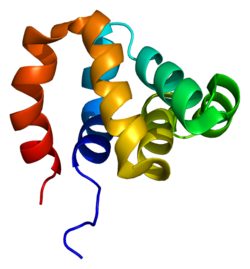
NOD1 protein contains a caspase recruitment domain (CARD). NOD1 is a member of NOD-like receptor protein family and is a close relative of NOD2. NOD1 is an intracellular pattern recognition receptor, which is similar in structure to resistant proteins of plants, and mediates innate and acquired immunity by recognizing molecules containing D-glutamyl-meso-diaminopimelic acid (iE-DAP) moiety, including bacterial peptidoglycan. Nod1 interacts with RIPK2 through the CARDs of both molecules (See the structure of the NOD1 CARD in the right panel). Stimulation of NOD1 by iE-DAP containing molecules results in activation of the transcription factor NF-κB.
References
[edit]- ^ a b c GRCh38: Ensembl release 89: ENSG00000106100 – Ensembl, May 2017
- ^ a b c GRCm38: Ensembl release 89: ENSMUSG00000038058 – Ensembl, May 2017
- ^ "Human PubMed Reference:". National Center for Biotechnology Information, U.S. National Library of Medicine.
- ^ "Mouse PubMed Reference:". National Center for Biotechnology Information, U.S. National Library of Medicine.
- ^ Bertin J, Nir WJ, Fischer CM, Tayber OV, Errada PR, Grant JR, Keilty JJ, Gosselin ML, Robison KE, Wong GH, Glucksmann MA, DiStefano PS (May 1999). "Human CARD4 protein is a novel CED-4/Apaf-1 cell death family member that activates NF-kappaB". The Journal of Biological Chemistry. 274 (19): 12955–8. doi:10.1074/jbc.274.19.12955. PMID 10224040.
- ^ Inohara N, Koseki T, del Peso L, Hu Y, Yee C, Chen S, Carrio R, Merino J, Liu D, Ni J, Núñez G (May 1999). "Nod1, an Apaf-1-like activator of caspase-9 and nuclear factor-kappaB". The Journal of Biological Chemistry. 274 (21): 14560–7. doi:10.1074/jbc.274.21.14560. PMID 10329646.
- ^ Mahla RS, Reddy MC, Prasad DV, Kumar H (September 2013). "Sweeten PAMPs: Role of Sugar Complexed PAMPs in Innate Immunity and Vaccine Biology". Frontiers in Immunology. 4: 248. doi:10.3389/fimmu.2013.00248. PMC 3759294. PMID 24032031.
Further reading
[edit]- Martinon F, Tschopp J (August 2005). "NLRs join TLRs as innate sensors of pathogens". Trends in Immunology. 26 (8): 447–54. doi:10.1016/j.it.2005.06.004. PMID 15967716.
- Strober W, Murray PJ, Kitani A, Watanabe T (January 2006). "Signalling pathways and molecular interactions of NOD1 and NOD2". Nature Reviews. Immunology. 6 (1): 9–20. doi:10.1038/nri1747. PMID 16493424. S2CID 33505741.
- Inohara N, Koseki T, Lin J, del Peso L, Lucas PC, Chen FF, Ogura Y, Núñez G (September 2000). "An induced proximity model for NF-kappa B activation in the Nod1/RICK and RIP signaling pathways". The Journal of Biological Chemistry. 275 (36): 27823–31. doi:10.1074/jbc.M003415200. PMID 10880512.
- Inohara N, Ogura Y, Chen FF, Muto A, Nuñez G (January 2001). "Human Nod1 confers responsiveness to bacterial lipopolysaccharides". The Journal of Biological Chemistry. 276 (4): 2551–4. doi:10.1074/jbc.M009728200. PMID 11058605.
- Chu ZL, Pio F, Xie Z, Welsh K, Krajewska M, Krajewski S, Godzik A, Reed JC (March 2001). "A novel enhancer of the Apaf1 apoptosome involved in cytochrome c-dependent caspase activation and apoptosis". The Journal of Biological Chemistry. 276 (12): 9239–45. doi:10.1074/jbc.M006309200. PMID 11113115.
- Yoo NJ, Park WS, Kim SY, Reed JC, Son SG, Lee JY, Lee SH (December 2002). "Nod1, a CARD protein, enhances pro-interleukin-1beta processing through the interaction with pro-caspase-1". Biochemical and Biophysical Research Communications. 299 (4): 652–8. doi:10.1016/S0006-291X(02)02714-6. PMID 12459189.
- Matsuda A, Suzuki Y, Honda G, Muramatsu S, Matsuzaki O, Nagano Y, Doi T, Shimotohno K, Harada T, Nishida E, Hayashi H, Sugano S (May 2003). "Large-scale identification and characterization of human genes that activate NF-kappaB and MAPK signaling pathways". Oncogene. 22 (21): 3307–18. doi:10.1038/sj.onc.1206406. PMID 12761501. S2CID 38880905.
- Stehlik C, Hayashi H, Pio F, Godzik A, Reed JC (August 2003). "CARD6 is a modulator of NF-kappa B activation by Nod1- and Cardiak-mediated pathways". The Journal of Biological Chemistry. 278 (34): 31941–9. doi:10.1074/jbc.M300009200. PMID 12775719.
- Girardin SE, Boneca IG, Carneiro LA, Antignac A, Jéhanno M, Viala J, Tedin K, Taha MK, Labigne A, Zähringer U, Coyle AJ, DiStefano PS, Bertin J, Sansonetti PJ, Philpott DJ (June 2003). "Nod1 detects a unique muropeptide from gram-negative bacterial peptidoglycan". Science. 300 (5625): 1584–7. Bibcode:2003Sci...300.1584G. doi:10.1126/science.1084677. PMID 12791997. S2CID 1320864.
- Hisamatsu T, Suzuki M, Podolsky DK (August 2003). "Interferon-gamma augments CARD4/NOD1 gene and protein expression through interferon regulatory factor-1 in intestinal epithelial cells". The Journal of Biological Chemistry. 278 (35): 32962–8. doi:10.1074/jbc.M304355200. PMID 12813035.
- Girardin SE, Travassos LH, Hervé M, Blanot D, Boneca IG, Philpott DJ, Sansonetti PJ, Mengin-Lecreulx D (October 2003). "Peptidoglycan molecular requirements allowing detection by Nod1 and Nod2". The Journal of Biological Chemistry. 278 (43): 41702–8. doi:10.1074/jbc.M307198200. PMID 12871942.
- Kim JG, Lee SJ, Kagnoff MF (March 2004). "Nod1 is an essential signal transducer in intestinal epithelial cells infected with bacteria that avoid recognition by toll-like receptors". Infection and Immunity. 72 (3): 1487–95. doi:10.1128/IAI.72.3.1487-1495.2004. PMC 356064. PMID 14977954.
- Damiano JS, Oliveira V, Welsh K, Reed JC (July 2004). "Heterotypic interactions among NACHT domains: implications for regulation of innate immune responses". The Biochemical Journal. 381 (Pt 1): 213–9. doi:10.1042/BJ20031506. PMC 1133779. PMID 15107016.
External links
[edit]- NOD1 human gene location in the UCSC Genome Browser.
- NOD1 human gene details in the UCSC Genome Browser.
PDB gallery | |
|---|---|
|


 | This article on a gene on human chromosome 7 is a stub. You can help Wikipedia by adding missing information. |