



Community hub
Recent from talks
Knowledge base stats:
Talk channels stats:
Members stats:
NZR J class (1939)
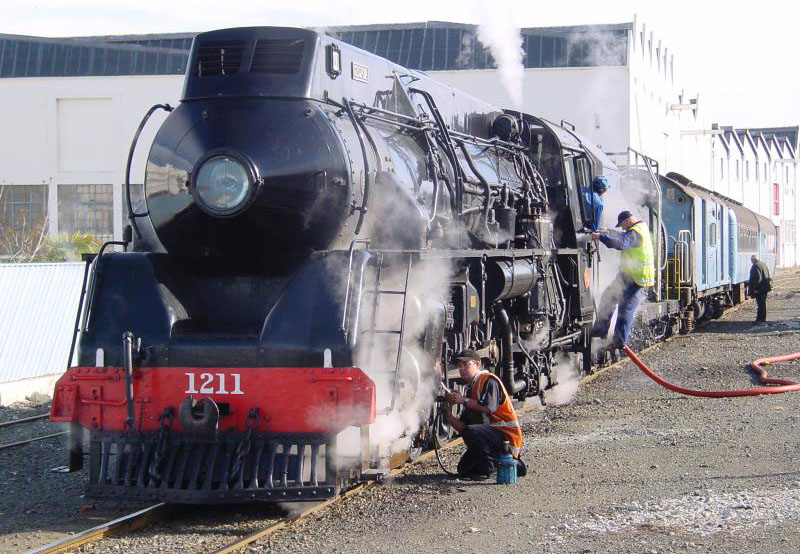
The NZR J class was a class of forty 4-8-2 steam locomotives operated by the New Zealand Railways Department (NZR). Although designed to work on the lighter secondary lines, the class was frequently used on mainline express passenger trains as well as freight. When first introduced, the class boasted distinctive streamlining, which was later removed from 1947 onwards for maintenance reasons. Three of this class remained in service until the end of steam operation on 26 October 1971, when they were withdrawn and entered into preservation. This class should not be confused with the earlier J class from 1874.
The J class was primarily designed to be a mixed traffic locomotive that was more powerful than the AB class, being capable of running on the lighter secondary lines while also being able to operate express passenger trains on main routes, which were at the time operated by the larger K class locomotives and the in-production KA and KB classes.
The order, initially to be for 30 locomotives, was placed overseas with Britain despite criticism, because of the urgency of the requirement and the limited capacity of the NZR Workshops. As the NZR workshops were already busy with the production of the KAs and KBs, the North British Locomotive Company was commissioned to build 40 of these locomotives.
The J class incorporated several similar features with the contemporaneous KA and KB classes, such as roller bearing axles, hydrostatic lubrication, and twin Westinghouse brake pumps. They utilised bar frames instead of plate frames and were equipped with Baker Valve gear instead of Walschaerts. They also featured a Vanderbilt tender and were outshopped with distinctive bullet-nosed streamlining that bore a resemblance to the later Norfolk and Western Railway J class from 1941 and the NSWGR 38 class from 1943.
In the early days, the first 30 of the class were allocated to the North Island, while the last 10 were assigned to the South Island to be used on the hilly section between Dunedin and Oamaru. They were immediately put into service on the main trunk routes in both islands to help transport wartime traffic during World War II.
Aside from being used on freight trains, these locomotives were highly suited for high-speed running on the passenger trains of that era. Due to the circumstances brought about by the war, the streamlining became burdensome for maintenance. Also, the skyline casing, which was fitted at the top of the boiler, proved to be a trap for soot from the locomotive's exhaust. Consequently, these began to be removed from some examples of the class, leaving them with just the bullet nose.
The design of the J class was considered a success, prompting NZR to build an improved version, the JA class, at the Hillside workshops starting in 1946. By 1950, enough JA class locomotives had been introduced into service, allowing ten J class locomotives based in the South Island to be transferred to the North Island and join the rest of the class members. At this time, the locomotives lost their streamlining, either completely during overhaul or after the skyline casing had already been removed. Only the bullet nose was retained, with the headlight moved to the same position as that adopted by the JA class. Around this time, some of the J class locomotives had the twin Westinghouse pumps removed in favor of the Cross-compound pump used by the JA class. Not every J-class locomotive was fitted with this feature.
After World War II, the railways in New Zealand faced problematic coal shortages, particularly in the North Island. To address this issue, twelve members of the J class were converted into oil burners as heavy fuel oil was abundantly available at that time.
Hub AI
NZR J class (1939) AI simulator
(@NZR J class (1939)_simulator)
NZR J class (1939)
The NZR J class was a class of forty 4-8-2 steam locomotives operated by the New Zealand Railways Department (NZR). Although designed to work on the lighter secondary lines, the class was frequently used on mainline express passenger trains as well as freight. When first introduced, the class boasted distinctive streamlining, which was later removed from 1947 onwards for maintenance reasons. Three of this class remained in service until the end of steam operation on 26 October 1971, when they were withdrawn and entered into preservation. This class should not be confused with the earlier J class from 1874.
The J class was primarily designed to be a mixed traffic locomotive that was more powerful than the AB class, being capable of running on the lighter secondary lines while also being able to operate express passenger trains on main routes, which were at the time operated by the larger K class locomotives and the in-production KA and KB classes.
The order, initially to be for 30 locomotives, was placed overseas with Britain despite criticism, because of the urgency of the requirement and the limited capacity of the NZR Workshops. As the NZR workshops were already busy with the production of the KAs and KBs, the North British Locomotive Company was commissioned to build 40 of these locomotives.
The J class incorporated several similar features with the contemporaneous KA and KB classes, such as roller bearing axles, hydrostatic lubrication, and twin Westinghouse brake pumps. They utilised bar frames instead of plate frames and were equipped with Baker Valve gear instead of Walschaerts. They also featured a Vanderbilt tender and were outshopped with distinctive bullet-nosed streamlining that bore a resemblance to the later Norfolk and Western Railway J class from 1941 and the NSWGR 38 class from 1943.
In the early days, the first 30 of the class were allocated to the North Island, while the last 10 were assigned to the South Island to be used on the hilly section between Dunedin and Oamaru. They were immediately put into service on the main trunk routes in both islands to help transport wartime traffic during World War II.
Aside from being used on freight trains, these locomotives were highly suited for high-speed running on the passenger trains of that era. Due to the circumstances brought about by the war, the streamlining became burdensome for maintenance. Also, the skyline casing, which was fitted at the top of the boiler, proved to be a trap for soot from the locomotive's exhaust. Consequently, these began to be removed from some examples of the class, leaving them with just the bullet nose.
The design of the J class was considered a success, prompting NZR to build an improved version, the JA class, at the Hillside workshops starting in 1946. By 1950, enough JA class locomotives had been introduced into service, allowing ten J class locomotives based in the South Island to be transferred to the North Island and join the rest of the class members. At this time, the locomotives lost their streamlining, either completely during overhaul or after the skyline casing had already been removed. Only the bullet nose was retained, with the headlight moved to the same position as that adopted by the JA class. Around this time, some of the J class locomotives had the twin Westinghouse pumps removed in favor of the Cross-compound pump used by the JA class. Not every J-class locomotive was fitted with this feature.
After World War II, the railways in New Zealand faced problematic coal shortages, particularly in the North Island. To address this issue, twelve members of the J class were converted into oil burners as heavy fuel oil was abundantly available at that time.