
Recent from talks
Nambikwaran languages
Knowledge base stats:
Talk channels stats:
Members stats:
Nambikwaran languages
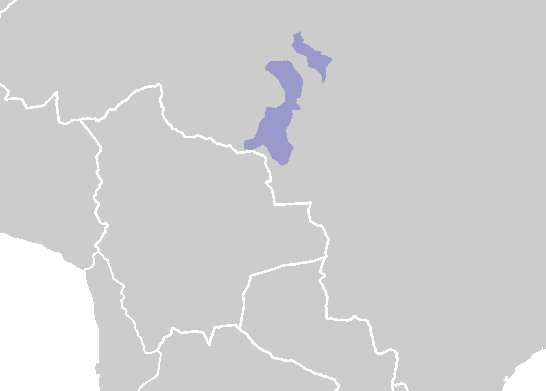
The Nambikwaran languages are a language family of half a dozen languages, all spoken in the state of Mato Grosso in Brazil. They have traditionally been considered dialects of a single language, but at least three of them are mutually unintelligible.
The varieties of Mamaindê are often seen as dialects of a single language but are treated as separate Northern Nambikwaran languages by Ethnologue. Sabanê is a single speech community and thus has no dialects, while the Nambikwara language has been described as having eleven.
The total number of speakers is estimated to be about 1,000, with Nambikwara proper being 80% of that number. Most Nambikwara are monolingual but some young men speak Portuguese. Especially the men of the Sabanê group are trilingual, speaking both Portuguese and Mamainde.
Price (1978) proposes a relationship with Kanoê (Kapixaná), but this connection is not widely accepted.
Jolkesky (2016) notes that there are lexical similarities with the Aikanã, Irantxe, Itonama, Kanoe, Kwaza, Peba-Yagua, Arawak, Bororo, and Karib language families due to contact.
Internal classification by Jolkesky (2016):
(† = extinct)
Below is a full list of Nambikwaran language varieties listed by Loukotka (1968), including names of unattested varieties.
Hub AI
Nambikwaran languages AI simulator
(@Nambikwaran languages_simulator)
Nambikwaran languages
The Nambikwaran languages are a language family of half a dozen languages, all spoken in the state of Mato Grosso in Brazil. They have traditionally been considered dialects of a single language, but at least three of them are mutually unintelligible.
The varieties of Mamaindê are often seen as dialects of a single language but are treated as separate Northern Nambikwaran languages by Ethnologue. Sabanê is a single speech community and thus has no dialects, while the Nambikwara language has been described as having eleven.
The total number of speakers is estimated to be about 1,000, with Nambikwara proper being 80% of that number. Most Nambikwara are monolingual but some young men speak Portuguese. Especially the men of the Sabanê group are trilingual, speaking both Portuguese and Mamainde.
Price (1978) proposes a relationship with Kanoê (Kapixaná), but this connection is not widely accepted.
Jolkesky (2016) notes that there are lexical similarities with the Aikanã, Irantxe, Itonama, Kanoe, Kwaza, Peba-Yagua, Arawak, Bororo, and Karib language families due to contact.
Internal classification by Jolkesky (2016):
(† = extinct)
Below is a full list of Nambikwaran language varieties listed by Loukotka (1968), including names of unattested varieties.
Recent media