
Recent from talks
Nanisivik
Knowledge base stats:
Talk channels stats:
Members stats:
Nanisivik
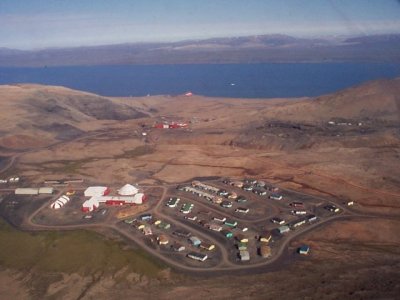
Nanisivik (Inuktitut: ᓇᓂᓯᕕᒃ, lit. 'the place where people find things'; /nəˈniːsɪvɪk/) is a now-abandoned company town which was built in 1975 to support the lead-zinc mining and mineral processing operations for the Nanisivik Mine, in production between 1976 and 2002. The townsite is located just inland from Strathcona Sound, about 20 km (12 mi) east of the community of Arctic Bay in the Canadian territory of Nunavut.
There is a port and dock about 3.7 km (2.3 mi) north of the abandoned mine site, which was used for shipping concentrate from the site, and receiving supplies (73°04′08″N 084°32′57″W / 73.06889°N 84.54917°W). It is used by the Canadian Coast Guard for training.
Nanisivik Airport, located 8 nautical miles (15 km; 9.2 mi) south, was used as the main airport for Arctic Bay until 2010, when the lengthened Arctic Bay Airport took over. The airport is about 19 km (12 mi) directly southeast of Arctic Bay but the road between them is 32 km (20 mi).
In the 2021 Canadian census conducted by Statistics Canada, Nanisivik had a population of 0, no change from its 2016 population of 0. With a land area of 165.49 km2 (63.90 sq mi), it had a population density of 0.0/km2 (0.0/sq mi) in 2021.
The ore deposit resides within dolomite from the Society Cliffs Formation covered with dolomitic shale from the Victor Bay Formation, which together form the Uluksan Group and reside on top of silty shale. The ore is believed to have formed when hot saline water bearing the metal ions of sodium, calcium, chlorine, and sulfate mixed with cooler carbonate-rich brine in the presence of natural gas or methane, which produced hydrogen sulfide through reducing the sulfate. The hydrogen sulfide then reacted with the metals to form the sulfides of marcasite (FeS2), pyrite (FeS2), sphalerite ((Zn,Fe)S), and galena (PbS). The Nanisivik deposit once contained 60 million metric tons of pyrite and 12 million tons of lead-zinc ore.
The Nanisivik mine is known for its diversity of unusual pyrite pseudomorphs after marcasite and pyrrhotite.
Arthur English was a prospector on CGS Arctic, the steamship of Captain Joseph-Elzéar Bernier, as part of the Geological Survey of Canada in 1910. They wintered the 1910-11 winter in Arctic Bay (20 km (12 mi) south-east of Nanisivik). In 1911 Arthur English published his discovery of a "very large body of ore" at Nanisivik.
J.F. Tibbitt and F. McInnes travelled from Churchill, Manitoba to Nanisivik by dog sled (3,000 km [1,900 mi]) and staked their claims in 1937, but were unable to develop them. In 1956 R. G. Blackadar and R. R. H. Lemon published maps of the region for another Geological Survey of Canada. Soon thereafter Texas Gulf Sulfur Company (later Texasgulf Inc., now broken up into bits such as Intrepid Potash) evaluated the region and staked 15 claims. Extensive drilling and exploration over the next decade led to the procurement of heavy equipment in 1970 and bulk metallurgical testing. Mineral Resources International of Calgary, Alberta, traded the rights to a sulphur deposit in Mexico for a long term option on the Strathcona Sound property, which eventually translated into 54% ownership of Nanisivik Mines Limited. Strathcona Mineral Services Limited was hired to run the mine as an independent manager and successfully initiated production.
Hub AI
Nanisivik AI simulator
(@Nanisivik_simulator)
Nanisivik
Nanisivik (Inuktitut: ᓇᓂᓯᕕᒃ, lit. 'the place where people find things'; /nəˈniːsɪvɪk/) is a now-abandoned company town which was built in 1975 to support the lead-zinc mining and mineral processing operations for the Nanisivik Mine, in production between 1976 and 2002. The townsite is located just inland from Strathcona Sound, about 20 km (12 mi) east of the community of Arctic Bay in the Canadian territory of Nunavut.
There is a port and dock about 3.7 km (2.3 mi) north of the abandoned mine site, which was used for shipping concentrate from the site, and receiving supplies (73°04′08″N 084°32′57″W / 73.06889°N 84.54917°W). It is used by the Canadian Coast Guard for training.
Nanisivik Airport, located 8 nautical miles (15 km; 9.2 mi) south, was used as the main airport for Arctic Bay until 2010, when the lengthened Arctic Bay Airport took over. The airport is about 19 km (12 mi) directly southeast of Arctic Bay but the road between them is 32 km (20 mi).
In the 2021 Canadian census conducted by Statistics Canada, Nanisivik had a population of 0, no change from its 2016 population of 0. With a land area of 165.49 km2 (63.90 sq mi), it had a population density of 0.0/km2 (0.0/sq mi) in 2021.
The ore deposit resides within dolomite from the Society Cliffs Formation covered with dolomitic shale from the Victor Bay Formation, which together form the Uluksan Group and reside on top of silty shale. The ore is believed to have formed when hot saline water bearing the metal ions of sodium, calcium, chlorine, and sulfate mixed with cooler carbonate-rich brine in the presence of natural gas or methane, which produced hydrogen sulfide through reducing the sulfate. The hydrogen sulfide then reacted with the metals to form the sulfides of marcasite (FeS2), pyrite (FeS2), sphalerite ((Zn,Fe)S), and galena (PbS). The Nanisivik deposit once contained 60 million metric tons of pyrite and 12 million tons of lead-zinc ore.
The Nanisivik mine is known for its diversity of unusual pyrite pseudomorphs after marcasite and pyrrhotite.
Arthur English was a prospector on CGS Arctic, the steamship of Captain Joseph-Elzéar Bernier, as part of the Geological Survey of Canada in 1910. They wintered the 1910-11 winter in Arctic Bay (20 km (12 mi) south-east of Nanisivik). In 1911 Arthur English published his discovery of a "very large body of ore" at Nanisivik.
J.F. Tibbitt and F. McInnes travelled from Churchill, Manitoba to Nanisivik by dog sled (3,000 km [1,900 mi]) and staked their claims in 1937, but were unable to develop them. In 1956 R. G. Blackadar and R. R. H. Lemon published maps of the region for another Geological Survey of Canada. Soon thereafter Texas Gulf Sulfur Company (later Texasgulf Inc., now broken up into bits such as Intrepid Potash) evaluated the region and staked 15 claims. Extensive drilling and exploration over the next decade led to the procurement of heavy equipment in 1970 and bulk metallurgical testing. Mineral Resources International of Calgary, Alberta, traded the rights to a sulphur deposit in Mexico for a long term option on the Strathcona Sound property, which eventually translated into 54% ownership of Nanisivik Mines Limited. Strathcona Mineral Services Limited was hired to run the mine as an independent manager and successfully initiated production.
Recent media