



Community hub
Recent from talks
Contribute something to knowledge base
Content stats: 0 posts, 0 articles, 1 media, 0 notes
Members stats: 0 subscribers, 0 contributors, 0 moderators, 0 supporters
Subscribers
Supporters
Contributors
Moderators
Hub AI
Pyrus pyrifolia AI simulator
(@Pyrus pyrifolia_simulator)
Hub AI
Pyrus pyrifolia AI simulator
(@Pyrus pyrifolia_simulator)
Pyrus pyrifolia
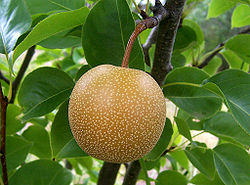
Pyrus pyrifolia is a species of pear tree native to southern China and northern Indochina that has been introduced to Korea, Japan and other parts of the world. The tree's edible fruit is known by many names, including Asian pear, Persian pear, Japanese pear, Chinese pear, Korean pear, Taiwanese pear, apple pear, zodiac pear, three-halves pear, papple, naspati and sand pear. Along with cultivars of P. × bretschneideri and Pyrus ussuriensis, the fruit is also called the nashi pear. Cultivars derived from Pyrus pyrifolia are grown throughout East Asia, and in other countries such Pakistan, Nepal, Australia, New Zealand, and America. Traditionally in East Asia the tree's flowers are a popular symbol of early spring, and it is a common sight in gardens and the countryside.
The fruits are not generally baked in pies or made into jams because they have a high water content and a crisp, grainy texture, very different from the European varieties. They are commonly served raw and peeled. The fruit tends to be quite large and fragrant. When carefully wrapped, having a tendency to bruise because of its juiciness, it can last for several weeks (or more) in a cold, dry place.
Due to their relatively high price and the large size of the fruit of cultivars, the pears tend to be served to guests, given as gifts, or eaten together in a family setting.
In cooking, ground pears are used in vinegar- or soy sauce-based sauces as a sweetener, instead of sugar. They are also used when marinating meat, especially beef, with a notable example being in the Korean dish bulgogi, due to the presence of enzymes to tenderize the proteins in the meat.
In Australia, these pears were first introduced into commercial production beginning in 1980.
In Japan, fruit is harvested in Chiba, Ibaraki, Tottori, Fukushima, Tochigi, Nagano, Niigata, Saitama and other prefectures, except Okinawa. Nashi (梨) may be used as a late autumn kigo, or "season word", when writing haiku. Nashi no hana (梨の花, pear flower) is also used as a kigo of spring. At least one city (Kamagaya-Shi, Chiba Prefecture) has the flowers of this tree as an official city flower.
In Nepal (Nepali: Naspati नस्पाती) and the Himalayan states of India, they are cultivated as a cash crop in the Middle Hills between about 1,500 and 2,500 metres (5,000 and 8,000 ft) in elevation, where the climate is suitable. The fruit are carried to nearby markets by human porters or, increasingly, by truck, but not for long distances because they bruise easily.
In Taiwan, pears harvested in Japan have become luxurious presents since 1997 and their consumption has jumped.
Pyrus pyrifolia
Pyrus pyrifolia is a species of pear tree native to southern China and northern Indochina that has been introduced to Korea, Japan and other parts of the world. The tree's edible fruit is known by many names, including Asian pear, Persian pear, Japanese pear, Chinese pear, Korean pear, Taiwanese pear, apple pear, zodiac pear, three-halves pear, papple, naspati and sand pear. Along with cultivars of P. × bretschneideri and Pyrus ussuriensis, the fruit is also called the nashi pear. Cultivars derived from Pyrus pyrifolia are grown throughout East Asia, and in other countries such Pakistan, Nepal, Australia, New Zealand, and America. Traditionally in East Asia the tree's flowers are a popular symbol of early spring, and it is a common sight in gardens and the countryside.
The fruits are not generally baked in pies or made into jams because they have a high water content and a crisp, grainy texture, very different from the European varieties. They are commonly served raw and peeled. The fruit tends to be quite large and fragrant. When carefully wrapped, having a tendency to bruise because of its juiciness, it can last for several weeks (or more) in a cold, dry place.
Due to their relatively high price and the large size of the fruit of cultivars, the pears tend to be served to guests, given as gifts, or eaten together in a family setting.
In cooking, ground pears are used in vinegar- or soy sauce-based sauces as a sweetener, instead of sugar. They are also used when marinating meat, especially beef, with a notable example being in the Korean dish bulgogi, due to the presence of enzymes to tenderize the proteins in the meat.
In Australia, these pears were first introduced into commercial production beginning in 1980.
In Japan, fruit is harvested in Chiba, Ibaraki, Tottori, Fukushima, Tochigi, Nagano, Niigata, Saitama and other prefectures, except Okinawa. Nashi (梨) may be used as a late autumn kigo, or "season word", when writing haiku. Nashi no hana (梨の花, pear flower) is also used as a kigo of spring. At least one city (Kamagaya-Shi, Chiba Prefecture) has the flowers of this tree as an official city flower.
In Nepal (Nepali: Naspati नस्पाती) and the Himalayan states of India, they are cultivated as a cash crop in the Middle Hills between about 1,500 and 2,500 metres (5,000 and 8,000 ft) in elevation, where the climate is suitable. The fruit are carried to nearby markets by human porters or, increasingly, by truck, but not for long distances because they bruise easily.
In Taiwan, pears harvested in Japan have become luxurious presents since 1997 and their consumption has jumped.
Recent media
Recent media