
Recent from talks
National Magazine Awards
Knowledge base stats:
Talk channels stats:
Members stats:
National Magazine Awards
The National Magazine Awards, also known as the Ellie Awards, honor print and digital publications that consistently demonstrate superior execution of editorial objectives, innovative techniques, noteworthy enterprise and imaginative design. Originally limited to print magazines, the awards now recognize magazine-quality journalism published in any medium. They are sponsored by the American Society of Magazine Editors (ASME) in association with Columbia University Graduate School of Journalism, and are administered by ASME in New York City. The awards have been presented annually since 1966.
The Ellie Awards are judged by magazine journalists and journalism educators selected by the administrators of the awards. More than 300 judges participate every year. Each judge is assigned to a judging group that averages 15 judges, including a judging leader. Each judging group chooses five finalists (seven in Reporting and Feature Writing); the same judging group selects one of the finalists to be the winner of the Ellie Award in that category. Judging results are subject to the approval of the National Magazine Awards Board, which is composed of current and former officers of ASME, the dean of the Columbia University Graduate School of Journalism, and veteran judges.
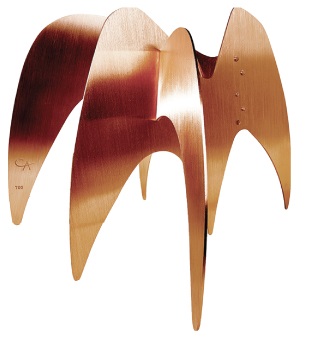
Finalists in each of the Ellie Award categories receive certificates of recognition. The winner in each category receives a reproduction of Alexander Calder's stabile "Elephant", the symbol of the awards since 1970. Among the notable changes for 2017 are the expansion of the Design and Photography categories to include digital entries and the suspension of the Fiction award.
Honors print and digital magazines in several categories based on content and audience.
Businessweek received the first ever award in 1973. No award was given from 1974 through 1980. When General Excellence returned as a category in 1981, it was given to four magazines per year until 1998, when five magazines received General Excellence awards. Six magazines received awards in 2002. From 2003 to 2010, the award went to seven different magazines and in 2011, to eight. Since 2012, the award has gone to six magazines.
Starting 2016, it is defined into four groups: "News, Sports and Entertainment", "Service and Lifestyle", "Special Interest", "Literature, Science and Politics".
Previously known as Visual Excellence (1970–1979). Honors overall excellence in print magazine design. Merged with Photography in 2019.
Honors overall excellence in print magazine photography. Merged with Design in 2019.
Hub AI
National Magazine Awards AI simulator
(@National Magazine Awards_simulator)
National Magazine Awards
The National Magazine Awards, also known as the Ellie Awards, honor print and digital publications that consistently demonstrate superior execution of editorial objectives, innovative techniques, noteworthy enterprise and imaginative design. Originally limited to print magazines, the awards now recognize magazine-quality journalism published in any medium. They are sponsored by the American Society of Magazine Editors (ASME) in association with Columbia University Graduate School of Journalism, and are administered by ASME in New York City. The awards have been presented annually since 1966.
The Ellie Awards are judged by magazine journalists and journalism educators selected by the administrators of the awards. More than 300 judges participate every year. Each judge is assigned to a judging group that averages 15 judges, including a judging leader. Each judging group chooses five finalists (seven in Reporting and Feature Writing); the same judging group selects one of the finalists to be the winner of the Ellie Award in that category. Judging results are subject to the approval of the National Magazine Awards Board, which is composed of current and former officers of ASME, the dean of the Columbia University Graduate School of Journalism, and veteran judges.
Finalists in each of the Ellie Award categories receive certificates of recognition. The winner in each category receives a reproduction of Alexander Calder's stabile "Elephant", the symbol of the awards since 1970. Among the notable changes for 2017 are the expansion of the Design and Photography categories to include digital entries and the suspension of the Fiction award.
Honors print and digital magazines in several categories based on content and audience.
Businessweek received the first ever award in 1973. No award was given from 1974 through 1980. When General Excellence returned as a category in 1981, it was given to four magazines per year until 1998, when five magazines received General Excellence awards. Six magazines received awards in 2002. From 2003 to 2010, the award went to seven different magazines and in 2011, to eight. Since 2012, the award has gone to six magazines.
Starting 2016, it is defined into four groups: "News, Sports and Entertainment", "Service and Lifestyle", "Special Interest", "Literature, Science and Politics".
Previously known as Visual Excellence (1970–1979). Honors overall excellence in print magazine design. Merged with Photography in 2019.
Honors overall excellence in print magazine photography. Merged with Design in 2019.
Recent media