
Recent from talks
National Renewable Energy Laboratory
Knowledge base stats:
Talk channels stats:
Members stats:
National Renewable Energy Laboratory
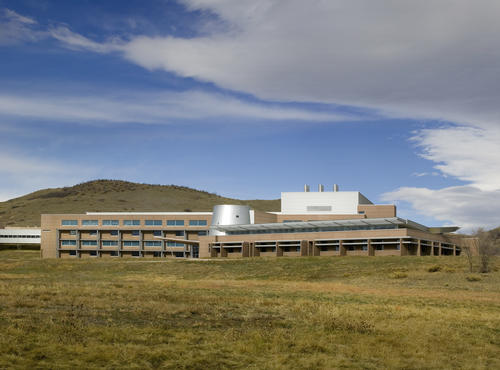
The National Renewable Energy Laboratory (NREL) in the US specializes in the research and development of renewable energy, energy efficiency, energy systems integration, and sustainable transportation. NREL is a federally funded research and development center sponsored by the Department of Energy and operated by the Alliance for Sustainable Energy, a joint venture between MRIGlobal and Battelle. Located in Golden, Colorado, NREL is home to the National Center for Photovoltaics, the National Bioenergy Center, and the National Wind Technology Center.
During the 1973 oil crisis, soaring energy prices caused gasoline shortages and contributed significantly to inflation. US President Gerald Ford openly recognized the need for greater energy independence at the September 1974 World Energy Conference in Detroit. A month later, the Solar Energy Research, Development and Demonstration Act of 1974 was signed. Section 10 of the bill explicitly outlined the establishment of the Solar Energy Research Institute, which opened in 1977 and was operated by Midwest Research Institute. Paul Rappaport was the founding director. It was the first time a national-scale effort had ever been made to advance solar power.
SERI's activities went beyond research and development in solar energy as it tried to popularize knowledge about already existing technologies, like biomass conversion, passive solar, and energy storage. During the first year of operation, thin-film solar cells achieved 10% efficiency. The next year, the Jimmy Carter administration passed the Solar Photovoltaic Energy Research, Development, and Demonstration Act of 1978. However, by this time, the national effort for an alternative energy source had turned towards nuclear energy. In 1979, Three Mile Island accident occurred, renewing a public interest in alternative renewable solutions, including solar energy.
In September 1991, the institute was designated a national laboratory of the U.S. Department of Energy by President George H.W. Bush, and its name was changed to the National Renewable Energy Laboratory.
Renewed interest in energy problems improved the laboratory's position, but funding has fluctuated over the years. In 2011, anticipated congressional budget shortfalls led to a voluntary buyout program for 100 to 150 staff reductions, and in 2015 budget cuts led to staff layoffs and further buyouts.
Martin Keller became NREL's ninth director in November 2015, and currently serves as both the director of the laboratory and the president of its operating contractor, Alliance for Sustainable Energy, LLC. He succeeded Dan Arvizu, who retired in September 2015 after 10 years in those roles.
In fiscal year 2020, congressional appropriations for the Department of Energy contained $464.3 million for NREL. This total included the following amounts for its renewable energy technology programs:
The National Renewable Energy Laboratory (NREL) engages in technology transfer, working with private sector partners to facilitate the application of research in renewable energy and energy efficiency technologies in practical settings.
Hub AI
National Renewable Energy Laboratory AI simulator
(@National Renewable Energy Laboratory_simulator)
National Renewable Energy Laboratory
The National Renewable Energy Laboratory (NREL) in the US specializes in the research and development of renewable energy, energy efficiency, energy systems integration, and sustainable transportation. NREL is a federally funded research and development center sponsored by the Department of Energy and operated by the Alliance for Sustainable Energy, a joint venture between MRIGlobal and Battelle. Located in Golden, Colorado, NREL is home to the National Center for Photovoltaics, the National Bioenergy Center, and the National Wind Technology Center.
During the 1973 oil crisis, soaring energy prices caused gasoline shortages and contributed significantly to inflation. US President Gerald Ford openly recognized the need for greater energy independence at the September 1974 World Energy Conference in Detroit. A month later, the Solar Energy Research, Development and Demonstration Act of 1974 was signed. Section 10 of the bill explicitly outlined the establishment of the Solar Energy Research Institute, which opened in 1977 and was operated by Midwest Research Institute. Paul Rappaport was the founding director. It was the first time a national-scale effort had ever been made to advance solar power.
SERI's activities went beyond research and development in solar energy as it tried to popularize knowledge about already existing technologies, like biomass conversion, passive solar, and energy storage. During the first year of operation, thin-film solar cells achieved 10% efficiency. The next year, the Jimmy Carter administration passed the Solar Photovoltaic Energy Research, Development, and Demonstration Act of 1978. However, by this time, the national effort for an alternative energy source had turned towards nuclear energy. In 1979, Three Mile Island accident occurred, renewing a public interest in alternative renewable solutions, including solar energy.
In September 1991, the institute was designated a national laboratory of the U.S. Department of Energy by President George H.W. Bush, and its name was changed to the National Renewable Energy Laboratory.
Renewed interest in energy problems improved the laboratory's position, but funding has fluctuated over the years. In 2011, anticipated congressional budget shortfalls led to a voluntary buyout program for 100 to 150 staff reductions, and in 2015 budget cuts led to staff layoffs and further buyouts.
Martin Keller became NREL's ninth director in November 2015, and currently serves as both the director of the laboratory and the president of its operating contractor, Alliance for Sustainable Energy, LLC. He succeeded Dan Arvizu, who retired in September 2015 after 10 years in those roles.
In fiscal year 2020, congressional appropriations for the Department of Energy contained $464.3 million for NREL. This total included the following amounts for its renewable energy technology programs:
The National Renewable Energy Laboratory (NREL) engages in technology transfer, working with private sector partners to facilitate the application of research in renewable energy and energy efficiency technologies in practical settings.
Recent media