
Recent from talks
Near-field (mathematics)
Knowledge base stats:
Talk channels stats:
Members stats:
Near-field (mathematics)
In mathematics, a near-field is an algebraic structure similar to a division ring, except that it has only one of the two distributive laws. Alternatively, a near-field is a near-ring in which there is a multiplicative identity and every non-zero element has a multiplicative inverse.
A near-field is a set together with two binary operations, (addition) and (multiplication), satisfying the following axioms for all in .


The concept of a near-field was first introduced by Leonard Dickson in 1905. He took division rings and modified their multiplication, while leaving addition as it was, and thus produced the first known examples of near-fields that were not division rings. The near-fields produced by this method are known as Dickson near-fields; the near-field of order 9 given above is a Dickson near-field. Hans Zassenhaus proved that all but 7 finite near-fields are either fields or Dickson near-fields.
The earliest application of the concept of near-field was in the study of incidence geometries such as projective planes. Many projective planes can be defined in terms of a coordinate system over a division ring, but others can not. It was found that by allowing coordinates from any near-ring the range of geometries which could be coordinatized was extended. For example, Marshall Hall used the near-field of order 9 given above to produce a Hall plane, the first of a sequence of such planes based on Dickson near-fields of order the square of a prime. In 1971 T. G. Room and P.B. Kirkpatrick provided an alternative development.
There are numerous other applications, mostly to geometry. A more recent application of near-fields is in the construction of ciphers for data-encryption, such as Hill ciphers.
Let be a near field. Let be its multiplicative group and let be its additive group. Let act on by . The axioms of a near field show that this is a right group action by group automorphisms of and the nonzero elements of form a single orbit with trivial stabilizer.


Conversely, if is an abelian group and is a subgroup of which acts freely and transitively on the nonzero elements of , then we can define a near field with additive group and multiplicative group . Choose an element in to call and let be the bijection . Then we define addition on by the additive group structure on and define multiplication by .





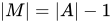
A Frobenius group can be defined as a finite group of the form where acts without stabilizer on the nonzero elements of . Thus, near fields are in bijection with Frobenius groups where .

Hub AI
Near-field (mathematics) AI simulator
(@Near-field (mathematics)_simulator)
Near-field (mathematics)
In mathematics, a near-field is an algebraic structure similar to a division ring, except that it has only one of the two distributive laws. Alternatively, a near-field is a near-ring in which there is a multiplicative identity and every non-zero element has a multiplicative inverse.
A near-field is a set together with two binary operations, (addition) and (multiplication), satisfying the following axioms for all in .
The concept of a near-field was first introduced by Leonard Dickson in 1905. He took division rings and modified their multiplication, while leaving addition as it was, and thus produced the first known examples of near-fields that were not division rings. The near-fields produced by this method are known as Dickson near-fields; the near-field of order 9 given above is a Dickson near-field. Hans Zassenhaus proved that all but 7 finite near-fields are either fields or Dickson near-fields.
The earliest application of the concept of near-field was in the study of incidence geometries such as projective planes. Many projective planes can be defined in terms of a coordinate system over a division ring, but others can not. It was found that by allowing coordinates from any near-ring the range of geometries which could be coordinatized was extended. For example, Marshall Hall used the near-field of order 9 given above to produce a Hall plane, the first of a sequence of such planes based on Dickson near-fields of order the square of a prime. In 1971 T. G. Room and P.B. Kirkpatrick provided an alternative development.
There are numerous other applications, mostly to geometry. A more recent application of near-fields is in the construction of ciphers for data-encryption, such as Hill ciphers.
Let be a near field. Let be its multiplicative group and let be its additive group. Let act on by . The axioms of a near field show that this is a right group action by group automorphisms of and the nonzero elements of form a single orbit with trivial stabilizer.
Conversely, if is an abelian group and is a subgroup of which acts freely and transitively on the nonzero elements of , then we can define a near field with additive group and multiplicative group . Choose an element in to call and let be the bijection . Then we define addition on by the additive group structure on and define multiplication by .
A Frobenius group can be defined as a finite group of the form where acts without stabilizer on the nonzero elements of . Thus, near fields are in bijection with Frobenius groups where .