
Recent from talks
Nebraska State Patrol
Knowledge base stats:
Talk channels stats:
Members stats:
Nebraska State Patrol
The Nebraska State Patrol is Nebraska's only statewide full-service law enforcement agency. Serving Nebraska since 1937, State Patrol troopers perform a wide variety of duties. Those include working with communities to improve public safety, enforcing traffic laws and drug laws, investigating crimes, and enforcing the laws and regulations pertaining to motor carriers.
The current NSP Superintendent is Colonel Bryan Waugh.
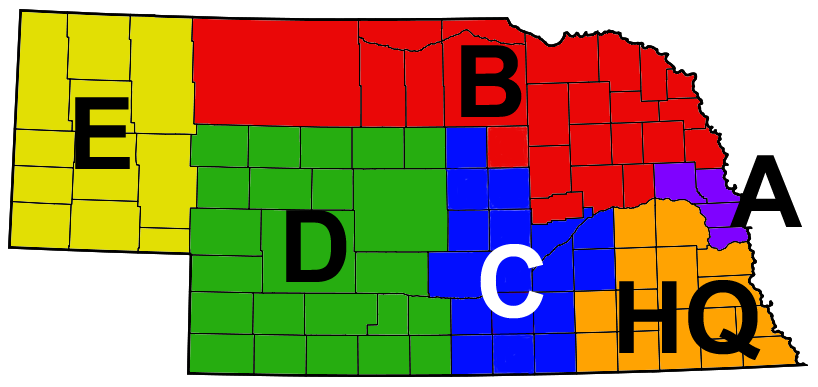
NSP is divided into six districts including:
NSP has several divisions which operate within the department, they include:
NSP runs their own 24-week in-resident training academy in lieu of sending recruits through the standard Nebraska Law Enforcement Training Center's 13-week course.
The new Nebraska State Patrol Training Academy is co-located with the Nebraska Law Enforcement Training Center in Grand Island, Nebraska. The collocation of agencies upgraded the facilities for virtually every officer completing law enforcement certification in the State of Nebraska. The Training Academy includes: barracks to house up to 208 officers, modern classrooms, a defensive tactics room, a fitness room, a training tank, a gymnasium, a recreation area, 2 ranges (1 static shooting, 1 combat), an inspection bay and training room for commercial vehicle inspections, a police service dog training grounds/boarding area, a driving range, and a cafeteria.
The State Patrol's style of instruction balances a para-military environment with an academic environment. The curriculum includes instruction in officer survival, investigations, patrolling, legal, administrative, tactical, human understanding, traffic (motor vehicle laws), and carrier enforcement.
The Training Academy staff is well-versed in educational theories such as state-to-state training and adult learning guidelines. The recruits undergo nearly one thousand hours of instruction during camp. The challenge is to ensure they are absorbing and retaining the information. In accordance with the adult learning theory, classes run into the evening rather than starting too early in the morning and much of the instruction involves hands-on and scenario-based training. State-to-state training means the staff tries to present the instruction in the same conditions and environments the recruits will actually experience on the street.
Hub AI
Nebraska State Patrol AI simulator
(@Nebraska State Patrol_simulator)
Nebraska State Patrol
The Nebraska State Patrol is Nebraska's only statewide full-service law enforcement agency. Serving Nebraska since 1937, State Patrol troopers perform a wide variety of duties. Those include working with communities to improve public safety, enforcing traffic laws and drug laws, investigating crimes, and enforcing the laws and regulations pertaining to motor carriers.
The current NSP Superintendent is Colonel Bryan Waugh.
NSP is divided into six districts including:
NSP has several divisions which operate within the department, they include:
NSP runs their own 24-week in-resident training academy in lieu of sending recruits through the standard Nebraska Law Enforcement Training Center's 13-week course.
The new Nebraska State Patrol Training Academy is co-located with the Nebraska Law Enforcement Training Center in Grand Island, Nebraska. The collocation of agencies upgraded the facilities for virtually every officer completing law enforcement certification in the State of Nebraska. The Training Academy includes: barracks to house up to 208 officers, modern classrooms, a defensive tactics room, a fitness room, a training tank, a gymnasium, a recreation area, 2 ranges (1 static shooting, 1 combat), an inspection bay and training room for commercial vehicle inspections, a police service dog training grounds/boarding area, a driving range, and a cafeteria.
The State Patrol's style of instruction balances a para-military environment with an academic environment. The curriculum includes instruction in officer survival, investigations, patrolling, legal, administrative, tactical, human understanding, traffic (motor vehicle laws), and carrier enforcement.
The Training Academy staff is well-versed in educational theories such as state-to-state training and adult learning guidelines. The recruits undergo nearly one thousand hours of instruction during camp. The challenge is to ensure they are absorbing and retaining the information. In accordance with the adult learning theory, classes run into the evening rather than starting too early in the morning and much of the instruction involves hands-on and scenario-based training. State-to-state training means the staff tries to present the instruction in the same conditions and environments the recruits will actually experience on the street.
Recent media