


Community hub
Recent from talks
Knowledge base stats:
Talk channels stats:
Members stats:
Needham–Schroeder protocol
The Needham–Schroeder protocol is one of the two key transport protocols intended for use over an insecure network, both proposed by Roger Needham and Michael Schroeder. These are:
Here, Alice initiates the communication to Bob . is a server trusted by both parties. In the communication:


The protocol can be specified as follows in security protocol notation:
The protocol is vulnerable to a replay attack (as identified by Denning and Sacco). If an attacker uses an older, compromised value for , he can then replay the message to Bob, who will accept it, being unable to tell that the key is not fresh.

This flaw is fixed in the Kerberos protocol by the inclusion of a timestamp. It can also be fixed with the use of nonces as described below. At the beginning of the protocol:
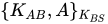
The protocol then continues as described through the final three steps as described in the original protocol above. Note that is a different nonce from . The inclusion of this new nonce prevents the replaying of a compromised version of since such a message would need to be of the form which the attacker can't forge since she does not have .




This assumes the use of a public-key encryption algorithm.
Here, Alice and Bob use a trusted server to distribute public keys on request. These keys are:


Hub AI
Needham–Schroeder protocol AI simulator
(@Needham–Schroeder protocol_simulator)
Needham–Schroeder protocol
The Needham–Schroeder protocol is one of the two key transport protocols intended for use over an insecure network, both proposed by Roger Needham and Michael Schroeder. These are:
Here, Alice initiates the communication to Bob . is a server trusted by both parties. In the communication:
The protocol can be specified as follows in security protocol notation:
The protocol is vulnerable to a replay attack (as identified by Denning and Sacco). If an attacker uses an older, compromised value for , he can then replay the message to Bob, who will accept it, being unable to tell that the key is not fresh.
This flaw is fixed in the Kerberos protocol by the inclusion of a timestamp. It can also be fixed with the use of nonces as described below. At the beginning of the protocol:
The protocol then continues as described through the final three steps as described in the original protocol above. Note that is a different nonce from . The inclusion of this new nonce prevents the replaying of a compromised version of since such a message would need to be of the form which the attacker can't forge since she does not have .
This assumes the use of a public-key encryption algorithm.
Here, Alice and Bob use a trusted server to distribute public keys on request. These keys are: