



Community hub
Recent from talks
Contribute something to knowledge base
Content stats: 0 posts, 0 articles, 1 media, 0 notes
Members stats: 0 subscribers, 0 contributors, 0 moderators, 0 supporters
Subscribers
Supporters
Contributors
Moderators
Hub AI
Loop of Henle AI simulator
(@Loop of Henle_simulator)
Hub AI
Loop of Henle AI simulator
(@Loop of Henle_simulator)
Loop of Henle
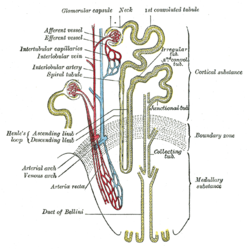
In the kidney, the loop of Henle (English: /ˈhɛnli/) (or Henle's loop, Henle loop, nephron loop or its Latin counterpart ansa nephroni) is the portion of a nephron that leads from the proximal convoluted tubule to the distal convoluted tubule. Named after its discoverer, the German anatomist Friedrich Gustav Jakob Henle, the loop of Henle's main function is to create a concentration gradient in the medulla of the kidney.
By means of a countercurrent multiplier system, which uses electrolyte pumps, the loop of Henle creates an area of high urea concentration deep in the medulla, near the papillary duct in the collecting duct system. Water present in the filtrate in the papillary duct flows through aquaporin channels out of the duct, moving passively down its concentration gradient. This process reabsorbs water and creates a concentrated urine for excretion.
The loop of Henle can be divided into four parts:
The tissue type of the loop is simple squamous epithelium. The "thick" and "thin" terminology does not refer to the size of the lumen, but to the size of the epithelial cells. The loop is also sometimes called the nephron loop.[citation needed]
The loop of Henle is supplied by blood in a series of straight capillaries descending from the cortical efferent arterioles. These capillaries (called the vasa recta; recta is from the Latin for "straight") also have a countercurrent multiplier mechanism that prevents washout of solutes from the medulla, thereby maintaining the medullary concentration. As water is osmotically driven from the descending limb into the interstitium, it readily enters the capillaries. The low bloodflow through the vasa recta allows time for osmotic equilibration, and can be altered by changing the resistance of the vessels' efferent arterioles.[citation needed]
As well, blood in the vasa recta still has large proteins and ions which were not filtered through the glomerulus. This provides an oncotic pressure for ions to enter the vasa recta from the interstitium.[citation needed]
The main function of the loop of Henle is to absorb water and sodium chloride from the filtride which preserving water and produces highly concentrated urine.[citation needed]
The descending loop of Henle receives isotonic (300 mOsm/L) fluid from the proximal convoluted tubule (PCT). The fluid is isotonic because as ions are reabsorbed by the gradient time system, water is also reabsorbed maintaining the osmolarity of the fluid in the PCT. Substances reabsorbed in the PCT include urea, water, potassium, sodium, chloride, glucose, amino acids, lactate, phosphate, and bicarbonate. Since water is also reabsorbed the volume of fluid in the loop of Henle is less than the PCT, approximately one-third of the original volume.
Loop of Henle
In the kidney, the loop of Henle (English: /ˈhɛnli/) (or Henle's loop, Henle loop, nephron loop or its Latin counterpart ansa nephroni) is the portion of a nephron that leads from the proximal convoluted tubule to the distal convoluted tubule. Named after its discoverer, the German anatomist Friedrich Gustav Jakob Henle, the loop of Henle's main function is to create a concentration gradient in the medulla of the kidney.
By means of a countercurrent multiplier system, which uses electrolyte pumps, the loop of Henle creates an area of high urea concentration deep in the medulla, near the papillary duct in the collecting duct system. Water present in the filtrate in the papillary duct flows through aquaporin channels out of the duct, moving passively down its concentration gradient. This process reabsorbs water and creates a concentrated urine for excretion.
The loop of Henle can be divided into four parts:
The tissue type of the loop is simple squamous epithelium. The "thick" and "thin" terminology does not refer to the size of the lumen, but to the size of the epithelial cells. The loop is also sometimes called the nephron loop.[citation needed]
The loop of Henle is supplied by blood in a series of straight capillaries descending from the cortical efferent arterioles. These capillaries (called the vasa recta; recta is from the Latin for "straight") also have a countercurrent multiplier mechanism that prevents washout of solutes from the medulla, thereby maintaining the medullary concentration. As water is osmotically driven from the descending limb into the interstitium, it readily enters the capillaries. The low bloodflow through the vasa recta allows time for osmotic equilibration, and can be altered by changing the resistance of the vessels' efferent arterioles.[citation needed]
As well, blood in the vasa recta still has large proteins and ions which were not filtered through the glomerulus. This provides an oncotic pressure for ions to enter the vasa recta from the interstitium.[citation needed]
The main function of the loop of Henle is to absorb water and sodium chloride from the filtride which preserving water and produces highly concentrated urine.[citation needed]
The descending loop of Henle receives isotonic (300 mOsm/L) fluid from the proximal convoluted tubule (PCT). The fluid is isotonic because as ions are reabsorbed by the gradient time system, water is also reabsorbed maintaining the osmolarity of the fluid in the PCT. Substances reabsorbed in the PCT include urea, water, potassium, sodium, chloride, glucose, amino acids, lactate, phosphate, and bicarbonate. Since water is also reabsorbed the volume of fluid in the loop of Henle is less than the PCT, approximately one-third of the original volume.
Recent media
Recent media