Hubbry Logo
KidneyKidneyMain
Open search
Kidney
Community hub
Kidney
logo
8 pages, 0 posts
0 subscribers
Be the first to start a discussion here.
Contribute something
Kidney
Kidney
from Wikipedia

Kidneys
The kidneys lie in the retroperitoneal space behind the abdomen, and act to filter blood to create urine
Location of kidneys with associated organs (adrenal glands and bladder)
Details
SystemUrinary system and endocrine system
ArteryRenal artery
VeinRenal vein
NerveRenal plexus
Identifiers
Latinren
Greekνεφρός (nephros)
MeSHD007668
TA98A08.1.01.001
TA23358
FMA7203
Anatomical terminology

In humans, the kidneys are two reddish-brown bean-shaped blood-filtering organs[1] that are a multilobar, multipapillary form of mammalian kidneys, usually without signs of external lobulation.[2][3] They are located on the left and right in the retroperitoneal space, and in adult humans are about 12 centimetres (4+12 inches) in length.[4][5] They receive blood from the paired renal arteries; blood exits into the paired renal veins. Each kidney is attached to a ureter, a tube that carries excreted urine to the bladder.

The kidney participates in the control of the volume of various body fluids, fluid osmolality, acid-base balance, various electrolyte concentrations, and removal of toxins. Filtration occurs in the glomerulus: one-fifth of the blood volume that enters the kidneys is filtered. Examples of substances reabsorbed are solute-free water, sodium, bicarbonate, glucose, and amino acids. Examples of substances secreted are hydrogen, ammonium, potassium and uric acid. The nephron is the structural and functional unit of the kidney. Each adult human kidney contains around 1 million nephrons, while a mouse kidney contains only about 12,500 nephrons. The kidneys also carry out functions independent of the nephrons. For example, they convert a precursor of vitamin D to its active form, calcitriol; and synthesize the hormones erythropoietin and renin.

Chronic kidney disease (CKD) has been recognized as a leading public health problem worldwide. The global estimated prevalence of CKD is 13.4%, and patients with kidney failure needing renal replacement therapy are estimated between 5 and 7 million.[6] Procedures used in the management of kidney disease include chemical and microscopic examination of the urine (urinalysis), measurement of kidney function by calculating the estimated glomerular filtration rate (eGFR) using the serum creatinine; and kidney biopsy and CT scan to evaluate for abnormal anatomy. Dialysis and kidney transplantation are used to treat kidney failure; one (or both sequentially) of these are almost always used when renal function drops below 15%. Nephrectomy is frequently used to cure renal cell carcinoma.

Renal physiology is the study of kidney function. Nephrology is the medical specialty which addresses diseases of kidney function: these include CKD, nephritic and nephrotic syndromes, acute kidney injury, and pyelonephritis. Urology addresses diseases of kidney (and urinary tract) anatomy: these include cancer, renal cysts, kidney stones and ureteral stones, and urinary tract obstruction.[7]

The word "renal" is an adjective meaning "relating to the kidneys", and its roots are French or late Latin. Whereas according to some opinions, "renal" should be replaced with "kidney" in scientific writings such as "kidney artery", other experts have advocated preserving the use of "renal" as appropriate including in "renal artery".[8]

Structure

[edit]
Image showing the human trunk with positions of the organs. The kidneys are at the vertebral level of T12 to L3.

In humans, the kidneys are located high in the abdominal cavity, one on each side of the spine, and lie in a retroperitoneal position at a slightly oblique angle.[9] The asymmetry within the abdominal cavity, caused by the position of the liver, typically results in the right kidney being slightly lower and smaller than the left, and being placed slightly more to the middle than the left kidney.[10][11][12] The left kidney is approximately at the vertebral level T12 to L3,[13] and the right is slightly lower. The right kidney sits just below the diaphragm and posterior to the liver. The left kidney sits below the diaphragm and posterior to the spleen. On top of each kidney is an adrenal gland. The upper parts of the kidneys are partially protected by the 11th and 12th ribs. Each kidney, with its adrenal gland is surrounded by two layers of fat: the perirenal fat present between renal fascia and renal capsule and pararenal fat superior to the renal fascia.

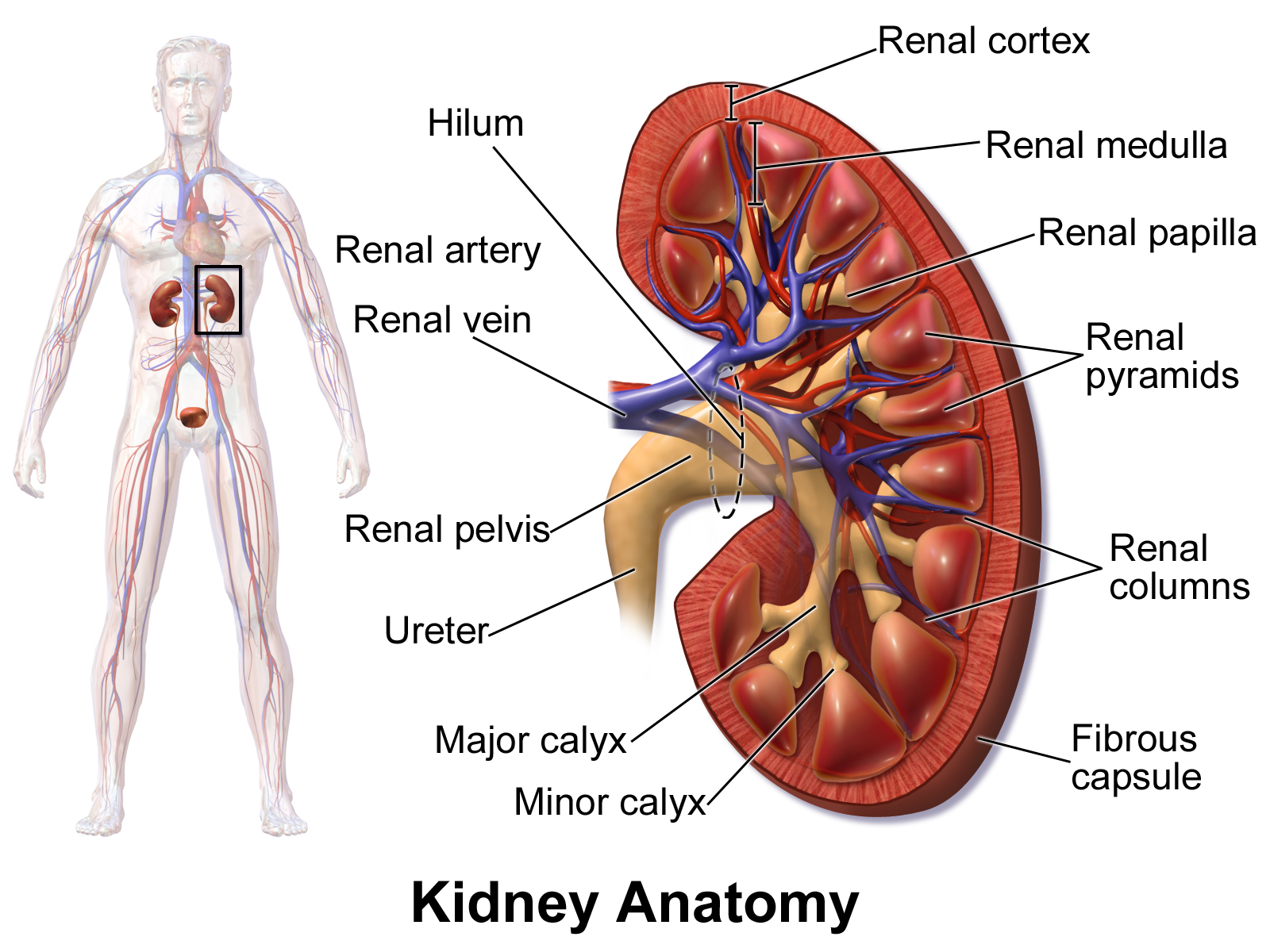
The human kidney is a bean-shaped structure with a convex and a concave border.[14] A recessed area on the concave border is the renal hilum, where the renal artery enters the kidney and the renal vein and ureter leave. The kidney is surrounded by tough fibrous tissue, the renal capsule, which is itself surrounded by perirenal fat, renal fascia, and pararenal fat. The anterior (front) surface of these tissues is the peritoneum, while the posterior (rear) surface is the transversalis fascia.

The superior pole of the right kidney is adjacent to the liver. For the left kidney, it is next to the spleen. Both, therefore, move down upon inhalation.

Sex Weight, standard reference range
Right kidney Left kidney
Male[15] 80–160 g (2+345+34 oz) 80–175 g (2+346+14 oz)
Female[16] 40–175 g (1+126+14 oz) 35–190 g (1+146+34 oz)

A Danish study measured the median renal length to be 11.2 cm (4+716 in) on the left side and 10.9 cm (4+516 in) on the right side in adults. Median renal volumes were 146 cm3 (8+1516 cu in) on the left and 134 cm3 (8+316 cu in) on the right.[17]

Gross anatomy

[edit]

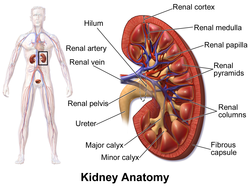
The functional substance, or parenchyma, of the human kidney is divided into two major structures: the outer renal cortex and the inner renal medulla. Grossly, these structures take the shape of eight to 18 cone-shaped renal lobes, each containing renal cortex surrounding a portion of medulla called a renal pyramid.[18] Between the renal pyramids are projections of cortex called renal columns.

The tip, or papilla, of each pyramid empties urine into a minor calyx; minor calyces empty into major calyces, and major calyces empty into the renal pelvis. This becomes the ureter. At the hilum, the ureter and renal vein exit the kidney and the renal artery enters. Hilar fat and lymphatic tissue with lymph nodes surround these structures. The hilar fat is contiguous with a fat-filled cavity called the renal sinus. The renal sinus collectively contains the renal pelvis and calyces and separates these structures from the renal medullary tissue.[19]

The kidneys possess no overtly moving structures.

Blood supply

[edit]

The kidneys receive blood from the renal arteries, left and right, which branch directly from the abdominal aorta. The kidneys receive approximately 20–25% of cardiac output in adult human.[18][20][21] Each renal artery branches into segmental arteries, dividing further into interlobar arteries, which penetrate the renal capsule and extend through the renal columns between the renal pyramids. The interlobar arteries then supply blood to the arcuate arteries that run through the boundary of the cortex and the medulla. Each arcuate artery supplies several interlobular arteries that feed into the afferent arterioles that supply the glomeruli.

Blood drains from the kidneys, ultimately into the inferior vena cava. After filtration occurs, the blood moves through a small network of small veins (venules) that converge into interlobular veins. As with the arteriole distribution, the veins follow the same pattern: the interlobular provide blood to the arcuate veins then back to the interlobar veins, which come to form the renal veins which exit the kidney.

Nerve supply

[edit]

The kidney and nervous system communicate via the renal plexus, whose fibers course along the renal arteries to reach each kidney.[22] Input from the sympathetic nervous system triggers vasoconstriction in the kidney, thereby reducing renal blood flow.[22] The kidney also receives input from the parasympathetic nervous system,[23] by way of the renal branches of the vagus nerve; the function of this is yet unclear.[22][24] Sensory input from the kidney travels to the T10–11 levels of the spinal cord and is sensed in the corresponding dermatome.[22] Thus, pain in the flank region may be referred from corresponding kidney.[22]

Microanatomy

[edit]

Nephrons, the urine-producing functional structures of the kidney, span the cortex and medulla. The initial filtering portion of a nephron is the renal corpuscle, which is located in the cortex. This is followed by a renal tubule that passes from the cortex deep into the medullary pyramids. Part of the renal cortex, a medullary ray is a collection of renal tubules that drain into a single collecting duct.[citation needed]

Renal histology is the study of the microscopic structure of the kidney. The adult human kidney contains at least 26 distinct cell types,[25] including epithelial, endothelial, stromal and smooth muscle cells. Distinct cell types include:

Gene and protein expression

[edit]

In humans, about 20,000 protein coding genes are expressed in human cells and almost 70% of these genes are expressed in normal, adult kidneys.[26][27] Just over 300 genes are more specifically expressed in the kidney, with only some 50 genes being highly specific for the kidney. Many of the corresponding kidney specific proteins are expressed in the cell membrane and function as transporter proteins. The highest expressed kidney specific protein is uromodulin, the most abundant protein in urine with functions that prevent calcification and growth of bacteria. Specific proteins are expressed in the different compartments of the kidney with podocin and nephrin expressed in glomeruli, Solute carrier family protein SLC22A8 expressed in proximal tubules, calbindin expressed in distal tubules and aquaporin 2 expressed in the collecting duct cells.[28]

Development

[edit]

The mammalian kidney develops from intermediate mesoderm. Kidney development, also called nephrogenesis, proceeds through a series of three successive developmental phases: the pronephros, mesonephros, and metanephros. The metanephros are primordia of the permanent kidney.[29]

Function

[edit]
The nephron, shown here, is the functional unit of the kidneys. Its parts are labelled except the (gray) connecting tubule located after the (dark red) distal convoluted tubule and before the large (gray) collecting duct (mislabeled collection duct).

The kidneys excrete a variety of waste products produced by metabolism into the urine. The microscopic structural and functional unit of the kidney is the nephron. It processes the blood supplied to it via filtration, reabsorption, secretion and excretion; the consequence of those processes is the production of urine. These include the nitrogenous wastes urea, from protein catabolism, and uric acid, from nucleic acid metabolism. The ability of mammals and some birds to concentrate wastes into a volume of urine much smaller than the volume of blood from which the wastes were extracted is dependent on an elaborate countercurrent multiplication mechanism. This requires several independent nephron characteristics to operate: a tight hairpin configuration of the tubules, water and ion permeability in the descending limb of the loop, water impermeability in the ascending loop, and active ion transport out of most of the ascending limb. In addition, passive countercurrent exchange by the vessels carrying the blood supply to the nephron is essential for enabling this function.

The kidney participates in whole-body homeostasis, regulating acid–base balance, electrolyte concentrations, extracellular fluid volume, and blood pressure. The kidney accomplishes these homeostatic functions both independently and in concert with other organs, particularly those of the endocrine system. Various endocrine hormones coordinate these endocrine functions; these include renin, angiotensin II, aldosterone, antidiuretic hormone, and atrial natriuretic peptide, among others.

Formation of urine

[edit]
Four main processes are involved in the creation of urine.

Filtration

[edit]

Filtration, which takes place at the renal corpuscle, is the process by which cells and large proteins are retained while materials of smaller molecular weights are[30] filtered from the blood to make an ultrafiltrate that eventually becomes urine. The adult human kidney generates approximately 180 liters of filtrate a day, most of which is reabsorbed.[31] The normal range for a twenty four hour urine volume collection is 800 to 2,000 milliliters per day.[32] The process is also known as hydrostatic filtration due to the hydrostatic pressure exerted on the capillary walls.

Reabsorption

[edit]
Secretion and reabsorption of various substances throughout the nephron

Reabsorption is the transport of molecules from this ultrafiltrate and into the peritubular capillary network that surrounds the nephron tubules.[33] It is accomplished via selective receptors on the luminal cell membrane. Water is 55% reabsorbed in the proximal tubule. Glucose at normal plasma levels is completely reabsorbed in the proximal tubule. The mechanism for this is the Na+/glucose cotransporter. A plasma level of 350 mg/dL will fully saturate the transporters and glucose will be lost in the urine. A plasma glucose level of approximately 160 is sufficient to allow glucosuria, which is an important clinical clue to diabetes mellitus.

Amino acids are reabsorbed by sodium dependent transporters in the proximal tubule. Hartnup disease is a deficiency of the tryptophan amino acid transporter, which results in pellagra.[34]

Selected substances reabsorbed in kidneys with influencing hormones[34]
Location of reabsorption Reabsorbed nutrient Notes
Early proximal tubule Glucose (100%), amino acids (100%), bicarbonate (90%), Na+ (65%), Cl (65%), phosphate (65%) and H2O (65%)
  • PTH will inhibit phosphate reabsorption.
  • AT II stimulates Na+, H2O and HCO3 reabsorption.
Thin descending loop of Henle H2O
  • Reabsorbs via medullary hypertonicity and makes urine hypertonic.
Thick ascending loop of Henle Na+ (10–20%), K+, Cl; indirectly induces para cellular reabsorption of Mg2+, Ca2+
  • This region is impermeable to H2O and the urine becomes less concentrated as it ascends.
Early distal convoluted tubule Na+, Cl
  • PTH causes Ca2+ reabsorption.
Collecting tubules Na+(3–5%), H2O
  • Na+ is reabsorbed in exchange for K+, and H+, which is regulated by aldosterone.
  • ADH acts on the V2 receptor and inserts aquaporins on the luminal side

Secretion

[edit]

Secretion is the reverse of reabsorption: molecules are transported from the peritubular capillary through the interstitial fluid, then through the renal tubular cell and into the ultrafiltrate.

Excretion

[edit]

The last step in the processing of the ultrafiltrate is excretion: the ultrafiltrate passes out of the nephron and travels through a tube called the collecting duct, which is part of the collecting duct system, and then to the ureters where it is renamed urine. In addition to transporting the ultrafiltrate, the collecting duct also takes part in reabsorption.

Hormone secretion

[edit]

The kidneys secrete a variety of hormones, including erythropoietin, calcitriol, and renin. Erythropoietin (EPO) is released in response to hypoxia (low levels of oxygen at tissue level) in the renal circulation. It stimulates erythropoiesis (production of red blood cells) in the bone marrow. Calcitriol, the activated form of vitamin D, promotes intestinal absorption of calcium and the renal reabsorption of phosphate. Renin is an enzyme which regulates angiotensin and aldosterone levels.

Blood pressure regulation

[edit]

Although the kidney cannot directly sense blood, long-term regulation of blood pressure predominantly depends upon the kidney. This primarily occurs through maintenance of the extracellular fluid compartment, the size of which depends on the plasma sodium concentration. Renin is the first in a series of important chemical messengers that make up the renin–angiotensin system. Changes in renin ultimately alter the output of this system, principally the hormones angiotensin II and aldosterone. Each hormone acts via multiple mechanisms, but both increase the kidney's absorption of sodium chloride, thereby expanding the extracellular fluid compartment and raising blood pressure. When renin levels are elevated, the concentrations of angiotensin II and aldosterone increase, leading to increased sodium chloride reabsorption, expansion of the extracellular fluid compartment, and an increase in blood pressure. Conversely, when renin levels are low, angiotensin II and aldosterone levels decrease, contracting the extracellular fluid compartment, and decreasing blood pressure.

Acid–base balance

[edit]

The two organ systems that help regulate the body's acid–base balance are the kidneys and lungs. Acid–base homeostasis is the maintenance of pH around a value of 7.4. The lungs are the part of respiratory system which helps to maintain acid–base homeostasis by regulating carbon dioxide (CO2) concentration in the blood. The respiratory system is the first line of defense when the body experiences and acid–base problem. It attempts to return the body pH to a value of 7.4 by controlling the respiratory rate. When the body is experiencing acidic conditions, it will increase the respiratory rate which in turn drives off CO2 and decreases the H+ concentration, therefore increasing the pH. In basic conditions, the respiratory rate will slow down so that the body holds onto more CO2 and increases the H+ concentration and decreases the pH.[35]

The kidneys have two cells that help to maintain acid-base homeostasis: intercalated A and B cells. The intercalated A cells are stimulated when the body is experiencing acidic conditions. Under acidic conditions, the high concentration of CO2 in the blood creates a gradient for CO2 to move into the cell and push the reaction HCO3 + H ↔ H2CO3 ↔ CO2 + H2O to the left. On the luminal side of the cell there is a H+ pump and a H/K exchanger. These pumps move H+ against their gradient and therefore require ATP. These cells will remove H+ from the blood and move it to the filtrate which helps to increase the pH of the blood. On the basal side of the cell there is a HCO3/Cl exchanger and a Cl/K co-transporter (facilitated diffusion). When the reaction is pushed to the left it also increases the HCO3 concentration in the cell and HCO3 is then able to move out into the blood which additionally raises the pH. The intercalated B cell responds very similarly, however, the membrane proteins are flipped from the intercalated A cells: the proton pumps are on the basal side and the HCO3/Cl exchanger and K/Cl co-transporter are on the luminal side. They function the same, but now release protons into the blood to decrease the pH.[36]

Regulation of osmolality

[edit]

The kidneys help maintain the water and salt level of the body. Any significant rise in plasma osmolality is detected by the hypothalamus, which communicates directly with the posterior pituitary gland. An increase in osmolality causes the gland to secrete antidiuretic hormone (ADH), resulting in water reabsorption by the kidney and an increase in urine concentration. The two factors work together to return the plasma osmolality to its normal levels.

Measuring function

[edit]

Various calculations and methods are used to try to measure kidney function. Renal clearance is the volume of plasma from which the substance is completely cleared from the blood per unit time. The filtration fraction is the amount of plasma that is actually filtered through the kidney. This can be defined using the equation. The kidney is a very complex organ and mathematical modelling has been used to better understand kidney function at several scales, including fluid uptake and secretion.[37][38]

Clinical significance

[edit]

Nephrology is the subspeciality under Internal Medicine that deals with kidney function and disease states related to renal malfunction and their management including dialysis and kidney transplantation. Urology is the specialty under Surgery that deals with kidney structure abnormalities such as kidney cancer and cysts and problems with urinary tract. Nephrologists are internists, and urologists are surgeons, whereas both are often called "kidney doctors". There are overlapping areas that both nephrologists and urologists can provide care such as kidney stones and kidney related infections.

There are many causes of kidney disease. Some causes are acquired over the course of life, such as diabetic nephropathy whereas others are congenital, such as polycystic kidney disease.

Medical terms related to the kidneys commonly use terms such as renal and the prefix nephro-. The adjective renal, meaning related to the kidney, is from the Latin rēnēs, meaning kidneys; the prefix nephro- is from the Ancient Greek word for kidney, nephros (νεφρός).[39] For example, surgical removal of the kidney is a nephrectomy, while a reduction in kidney function is called renal dysfunction.

Acquired disease

[edit]

Kidney injury and failure

[edit]

Generally, humans can live normally with just one kidney, as one has more functioning renal tissue than is needed to survive. Only when the amount of functioning kidney tissue is greatly diminished does one develop chronic kidney disease. Renal replacement therapy, in the form of dialysis or kidney transplantation, is indicated when the glomerular filtration rate has fallen very low or if the renal dysfunction leads to severe symptoms.[40]

Dialysis

[edit]
A depiction of peritoneal dialysis

Dialysis is a treatment that substitutes for the function of normal kidneys. Dialysis may be instituted when approximately 85%–90% of kidney function is lost, as indicated by a glomerular filtration rate (GFR) of less than 15. Dialysis removes metabolic waste products as well as excess water and sodium (thereby contributing to regulating blood pressure); and maintains many chemical levels within the body. Life expectancy is 5–10 years for those on dialysis; some live up to 30 years. Dialysis can occur via the blood (through a catheter or arteriovenous fistula), or through the peritoneum (peritoneal dialysis). Hemodialysis is typically administered three times a week for several hours at free-standing dialysis centers, allowing recipients to lead an otherwise essentially normal life.[41]

Congenital disease

[edit]

Diagnosis

[edit]

Many renal diseases are diagnosed on the basis of a detailed medical history, and physical examination.[45] The medical history takes into account present and past symptoms, especially those of kidney disease; recent infections; exposure to substances toxic to the kidney; and family history of kidney disease.

Kidney function is tested by using blood tests and urine tests. The most common blood tests are creatinine, urea and electrolytes. Urine tests such as urinalysis can evaluate for pH, protein, glucose, and the presence of blood. Microscopic analysis can also identify the presence of urinary casts and crystals.[46] The glomerular filtration rate (GFR) can be directly measured ("measured GFR", or mGFR) but this rarely done in everyday practice. Instead, special equations are used to calculate GFR ("estimated GFR", or eGFR).[47][46]

Imaging

[edit]

Renal ultrasonography is essential in the diagnosis and management of kidney-related diseases.[48] Other modalities, such as CT and MRI, should always be considered as supplementary imaging modalities in the assessment of renal disease.[48]

Biopsy

[edit]

The role of the renal biopsy is to diagnose renal disease in which the etiology is not clear based upon noninvasive means (clinical history, past medical history, medication history, physical exam, laboratory studies, imaging studies). In general, a renal pathologist will perform a detailed morphological evaluation and integrate the morphologic findings with the clinical history and laboratory data, ultimately arriving at a pathological diagnosis. A renal pathologist is a physician who has undergone general training in anatomic pathology and additional specially training in the interpretation of renal biopsy specimens.

Ideally, multiple core sections are obtained and evaluated for adequacy (presence of glomeruli) intraoperatively. A pathologist/pathology assistant divides the specimen(s) for submission for light microscopy, immunofluorescence microscopy and electron microscopy.

The pathologist will examine the specimen using light microscopy with multiple staining techniques (hematoxylin and eosin/H&E, PAS, trichrome, silver stain) on multiple level sections. Multiple immunofluorescence stains are performed to evaluate for antibody, protein and complement deposition. Finally, ultra-structural examination is performed with electron microscopy and may reveal the presence of electron-dense deposits or other characteristic abnormalities that may suggest an etiology for the patient's renal disease.

Other animals

[edit]

In the majority of vertebrates, the mesonephros persists into the adult, albeit usually fused with the more advanced metanephros; only in amniotes is the mesonephros restricted to the embryo. The kidneys of fish and amphibians are typically narrow, elongated organs, occupying a significant portion of the trunk. The collecting ducts from each cluster of nephrons usually drain into an archinephric duct, which is homologous with the vas deferens of amniotes. However, the situation is not always so simple; in cartilaginous fish and some amphibians, there is also a shorter duct, similar to the amniote ureter, which drains the posterior (metanephric) parts of the kidney, and joins with the archinephric duct at the bladder or cloaca. Indeed, in many cartilaginous fish, the anterior portion of the kidney may degenerate or cease to function altogether in the adult.[49]

In the most primitive vertebrates, the hagfish and lampreys, the kidney is unusually simple: it consists of a row of nephrons, each emptying directly into the archinephric duct. Invertebrates may possess excretory organs that are sometimes referred to as "kidneys", but, even in Amphioxus, these are never homologous with the kidneys of vertebrates, and are more accurately referred to by other names, such as nephridia.[49] In amphibians, kidneys and the urinary bladder harbour specialized parasites, monogeneans of the family Polystomatidae.[50]

The kidneys of reptiles consist of a number of lobules arranged in a broadly linear pattern. Each lobule contains a single branch of the ureter in its centre, into which the collecting ducts empty. Reptiles have relatively few nephrons compared with other amniotes of a similar size, possibly because of their lower metabolic rate.[49]

Birds have relatively large, elongated kidneys, each of which is divided into three or more distinct lobes. The lobes consists of several small, irregularly arranged, lobules, each centred on a branch of the ureter. Birds have small glomeruli, but about twice as many nephrons as similarly sized mammals.[49]

The human kidney is fairly typical of that of mammals. Distinctive features of the mammalian kidney, in comparison with that of other vertebrates, include the presence of the renal pelvis and renal pyramids and a clearly distinguishable cortex and medulla. The latter feature is due to the presence of elongated loops of Henle; these are much shorter in birds, and not truly present in other vertebrates (although the nephron often has a short intermediate segment between the convoluted tubules). It is only in mammals that the kidney takes on its classical "kidney" shape, although there are some exceptions, such as the multilobed reniculate kidneys of pinnipeds and cetaceans.[49]

Evolutionary adaptation

[edit]

Kidneys of various animals show evidence of evolutionary adaptation and have long been studied in ecophysiology and comparative physiology. Kidney morphology, often indexed as the relative medullary thickness, is associated with habitat aridity among species of mammals[51] and diet (e.g., carnivores have only long loops of Henle).[38]

Society and culture

[edit]

Significance

[edit]

Egyptian

[edit]

In ancient Egypt, the kidneys, like the heart, were left inside the mummified bodies, unlike other organs which were removed. Comparing this to the biblical statements, and to drawings of human body with the heart and two kidneys portraying a set of scales for weighing justice, it seems that the Egyptian beliefs had also connected the kidneys with judgement and perhaps with moral decisions.[52]

Hebrew

[edit]

According to studies in modern and ancient Hebrew, various body organs in humans and animals served also an emotional or logical role, today mostly attributed to the brain and the endocrine system. The kidney is mentioned in several biblical verses in conjunction with the heart, much as the bowels were understood to be the "seat" of emotion – grief, joy and pain.[53] Similarly, the Talmud (Berakhoth 61.a) states that one of the two kidneys counsels what is good, and the other evil.

In the sacrifices offered at the biblical Tabernacle and later on at the temple in Jerusalem, the priests were instructed[54] to remove the kidneys and the adrenal gland covering the kidneys of the sheep, goat and cattle offerings, and to burn them on the altar, as the holy part of the "offering for God" never to be eaten.[55]

India: Ayurvedic system

[edit]

In ancient India, according to the Ayurvedic medical systems, the kidneys were considered the beginning of the excursion channels system, the 'head' of the Mutra Srotas, receiving from all other systems, and therefore important in determining a person's health balance and temperament by the balance and mixture of the three 'Dosha's – the three health elements: Vatha (or Vata) – air, Pitta – bile, and Kapha – mucus. The temperament and health of a person can then be seen in the resulting color of the urine.[56]

Modern Ayurveda practitioners, a practice which is characterized as pseudoscience,[57] have attempted to revive these methods in medical procedures as part of Ayurveda Urine therapy.[58] These procedures have been called "nonsensical" by skeptics.[59]

Medieval Christianity

[edit]

The Latin term renes is related to the English word "reins", a synonym for the kidneys in Shakespearean English (e.g. Merry Wives of Windsor 3.5), which was also the time when the King James Version of the Bible was translated. Kidneys were once popularly regarded as the seat of the conscience and reflection,[60][61] and a number of verses in the Bible (e.g. Ps. 7:9, Rev. 2:23) state that God searches out and inspects the kidneys, or "reins", of humans, together with the heart.[62]

History

[edit]

Kidney stones have been identified and recorded about as long as written historical records exist.[63] The urinary tract including the ureters, as well as their function to drain urine from the kidneys, has been described by Galen in the second century AD.[64]

The first to examine the ureter through an internal approach, called ureteroscopy, rather than surgery was Hampton Young in 1929.[63] This was improved on by VF Marshall who is the first published use of a flexible endoscope based on fiber optics, which occurred in 1964.[63] The insertion of a drainage tube into the renal pelvis, bypassing the uterers and urinary tract, called nephrostomy, was first described in 1941. Such an approach differed greatly from the open surgical approaches within the urinary system employed during the preceding two millennia.[63]

Additional images

[edit]

See also

[edit]

References

[edit]
[edit]
Revisions and contributorsEdit on WikipediaRead on Wikipedia
from Grokipedia
The kidneys are a pair of bean-shaped, fist-sized organs located retroperitoneally in the posterior , one on each side of the spine between the twelfth thoracic and third , that serve as the primary organs of the by filtering blood to remove waste products, excess water, and toxins while regulating essential physiological balances. Each kidney measures approximately 10–12 cm in length, 5–7 cm in width, and 3–5 cm in thickness, with an average weight of 135–162 grams depending on sex, and is protected by a fibrous capsule, perinephric , and the . Internally, the kidney is divided into an outer and an inner , which contains renal pyramids that drain into minor calyces and ultimately the to form . The functional unit of the kidney is the , with about one million nephrons per kidney; each nephron consists of a —a network of capillaries that filters —and a tubule that reabsorbs necessary substances like , glucose, and electrolytes while secreting wastes. The kidneys receive approximately 20–25% of the via the renal arteries, filtering around 150–180 liters of daily to produce 1–2 liters of , thereby excreting nitrogenous wastes such as and . Beyond filtration, the kidneys play critical roles in maintaining by regulating volume and concentrations (including sodium, , calcium, and ), controlling acid-base balance through reabsorption and secretion, and producing hormones such as renin to manage , to stimulate production, and (active ) to support calcium absorption and bone health. These multifaceted functions underscore the kidneys' vital contribution to overall metabolic and cardiovascular stability, with dysfunction often leading to systemic complications like or .

Anatomy

Gross anatomy

The kidneys are paired retroperitoneal organs located on the posterior , positioned between the T12 and L3 vertebral levels, with the right kidney slightly inferior to the left due to the influence of the liver. They lie lateral to the vertebral column, anterior to the quadratus lumborum and psoas major muscles, and are partially protected by the 11th and 12th . Each kidney is bean-shaped, featuring a convex lateral and a concave medial , with typical dimensions of approximately 10-12 cm in length, 5-7 cm in width, and 3-5 cm in thickness. The average weight is about 150-170 g per kidney in , with the left kidney typically 10 g heavier than the right and males having slightly heavier kidneys than females. Externally, the medial concavity forms the hilum, a slit-like opening through which the enters, the and exit, and nerves and lymphatics pass. The hilum opens into the , a central cavity lined by extensions of the fibrous capsule and filled with , calyces, and the . The kidney is enclosed by a thin, fibrous that adheres closely to its surface, surrounded by perirenal fat for cushioning and the (Gerota's fascia anteriorly and Zuckerkandl's posteriorly) that anchors it to the . Internally, a coronal section reveals an outer and an inner , with the medulla organized into 8-18 renal pyramids that project their apices (renal papillae) into the . Between the pyramids are the renal columns of Bertin, which are extensions of cortical tissue. Urine from the pyramids drains through 7-9 minor calyces into 2-3 major calyces, which converge at the funnel-shaped and continue as the . Superiorly, each kidney is capped by an adrenal (suprarenal) gland, which is separated from the kidney by a thin layer of fat but functionally independent. Anteriorly, the right kidney relates to the liver, , and , while the left relates to the , , , and ; posteriorly, both contact the diaphragm, transverse fascia, and subcostal vessels and nerves. Anatomical variations include supernumerary kidneys, which are extremely rare additional functional kidneys arising from independent metanephric blastemas, with fewer than 100 cases reported in the medical literature. Ectopic positions, such as pelvic kidneys, also occur rarely (about 1 in 12,000 births), where the kidney fails to ascend to its normal retroperitoneal location during development.

Microscopic anatomy

The nephron serves as the functional unit of the kidney, consisting of a and an associated renal tubule. The , located in the renal cortex, comprises the —a network of fenestrated capillaries—and , a double-walled epithelial cup that envelops the . Podocytes, specialized epithelial cells of , feature interdigitating foot processes that form filtration slits, contributing to the glomerular filtration barrier alongside the (GBM). The GBM is a specialized composed primarily of , , nidogen, and proteoglycans, providing structural support and selective permeability. The renal tubule extends from and includes the proximal convoluted tubule (PCT), , (DCT), and collecting duct. The PCT, lined by cuboidal epithelial cells with a prominent of microvilli, occupies the . The descends into the medulla and ascends back to the cortex, featuring thin-walled segments in the descending and ascending limbs. The DCT, with its cuboidal and fewer microvilli, connects to the collecting duct, which converges with others to form papillary ducts draining into the . Nephrons exhibit regional variations: cortical nephrons, comprising about 85% of the total, have short loops of Henle confined mostly to the outer medulla, while juxtamedullary nephrons, located near the corticomedullary junction, possess long loops extending deep into the inner medulla. These differences influence the structural organization of the renal medulla. The juxtaglomerular apparatus (JGA), situated at the vascular pole of the renal corpuscle, regulates renal blood flow and includes three main components: juxtaglomerular cells (modified smooth muscle cells in the afferent arteriole that store renin), the macula densa (a plaque of tall, closely packed cells in the DCT wall sensing tubular fluid composition), and extraglomerular mesangial cells (supportive cells bridging the afferent and efferent arterioles). Supporting tissues in the kidney include interstitial cells, which are fibroblast-like cells residing in the renal interstitium, providing structural support and producing components. , arising from , closely surround the cortical tubules to facilitate exchange, while vasa recta—specialized straight capillaries—encircle the loops of Henle and collecting ducts in the medulla, maintaining the medullary osmotic gradient. Histological examination of kidney tissues often employs specific staining techniques to highlight structural details; for instance, periodic acid-Schiff () staining selectively visualizes basement membranes and brush borders by reacting with carbohydrate moieties in glycoproteins and glycoconjugates.

Vascular supply

The kidneys receive their arterial blood supply primarily from the renal arteries, which originate from the lateral aspect of the at the level of the L1 or L2 vertebral interspace. Each renal artery enters the kidney at the hilum and branches into anterior and posterior divisions, which further divide into segmental arteries supplying specific regions of the kidney. These segmental arteries give rise to interlobar arteries that ascend between the renal pyramids in the renal columns, followed by arcuate arteries that arch over the bases of the pyramids at the corticomedullary junction. From the arcuate arteries, interlobular arteries extend radially into the cortex, and the smallest branches, the , deliver blood to the glomerular capillaries within each . Venous drainage follows a parallel but reversed path to the arterial supply. Blood exits the glomeruli via , which lead into surrounding the cortical nephrons or vasa recta in the medullary regions. These capillaries converge into venules that join the interlobular veins, arcuate veins, and interlobar veins, ultimately forming the main at the hilum. The renal veins drain directly into the , with the left renal vein being longer and crossing anterior to the . Lymphatic vessels in the kidney originate as blind-ended capillaries in the cortical and follow a drainage pattern similar to the veins, collecting in hilar lymphatics before ascending to the lumbar lymph nodes and ultimately to the . The renal vasculature maintains stable blood flow through intrinsic autoregulatory mechanisms involving structural elements. The myogenic response occurs in the of the afferent wall, which contracts in response to increased pressure to prevent excessive flow. relies on the structural apposition of the cells in the distal tubule to the vascular pole of the via the extraglomerular mesangium, allowing sensing of tubular fluid composition to influence afferent tone. Anatomical variations in the renal vasculature are common, with approximately 25% of individuals having multiple renal arteries, including accessory or polar arteries that arise separately from the aorta or iliac arteries. These variations can affect surgical planning but do not typically impair function. In cases of renal ischemia, such as from main renal artery occlusion, collateral circulation may develop through capsular, ureteral, gonadal, and adrenal arterial networks to supply the kidney parenchyma.

Neural supply

The kidney receives neural innervation primarily through the , a network of autonomic and sensory nerves that surrounds the and enters the organ at the hilum. This plexus is formed by contributions from the celiac, aorticorenal, and intermesenteric ganglia, as well as originating from the thoracic segments T10 to L1. Sympathetic innervation dominates the efferent supply to the kidney, arising from preganglionic fibers in the intermediolateral cell column of the at levels T10 to L1, which in the celiac and aorticorenal ganglia. Postganglionic sympathetic fibers, releasing norepinephrine, travel via the to target renal vessels, juxtaglomerular cells, and tubules, mediating of arterioles to regulate renal flow and . These nerves also stimulate renin release from juxtaglomerular cells via β1-adrenergic receptors and enhance sodium reabsorption in the proximal and distal tubules through α1-adrenergic receptors. Parasympathetic innervation of the kidney is limited and controversial, with some anatomical evidence indicating minor contributions from preganglionic fibers of the that may reach the and supply nerves to the renal vasculature and . These fibers potentially play a minor role in modulating secretion and via receptors on endothelial and cells, though no robust functional impact has been consistently demonstrated. Sensory afferent innervation originates mainly from mechanoreceptors and chemoreceptors in the and cortex, with the highest density in the pelvic region, and projects to the dorsal horn at levels T10 to L1 via the and . These unmyelinated C-fibers and thinly myelinated Aδ-fibers convey sensations of pain, such as in , and detect stretch or distension to elicit reflexes, including nociceptive responses that radiate to the flanks and . A key reflex arc involving renal innervation is the renorenal reflex, where activation of afferent nerves in one kidney—such as by increased pelvic pressure from mechanoreceptors—inhibits efferent sympathetic activity in the contralateral kidney, promoting sodium excretion and maintaining . This ipsilateral excitatory and contralateral inhibitory response helps coordinate bilateral renal function.

Physiology

Glomerular filtration

Glomerular filtration is the initial process in urine formation, where is ultrafiltered across the glomerular capillaries into Bowman's space, producing a cell-free filtrate that enters the renal tubules. This process occurs in the , a tuft of capillaries within the of each , and is driven by hemodynamic forces that favor the movement of fluid from the blood into the urinary space. The glomerular filtration barrier consists of three layered structures that provide selective permeability: the fenestrated of the glomerular capillaries, the (GBM), and the filtration slits formed by foot processes. The fenestrated endothelium features pores approximately 70-100 nm in , allowing passage of and solutes while restricting larger blood components. The GBM, a gel-like composed primarily of , , and proteoglycans, further refines filtration by its negatively charged surface, which repels anionic molecules. slit diaphragms, bridged by proteins like nephrin, form narrow slits about 25-30 nm wide, serving as the final barrier to prevent passage of larger macromolecules. Filtration across this barrier is governed by Starling forces, which determine the net movement of fluid based on hydrostatic and gradients. The primary driving force is the glomerular capillary hydrostatic pressure, approximately 55 mmHg, which exceeds the opposing hydrostatic pressure in Bowman's space (about 15 mmHg) and the colloid in the glomerular capillaries (around 28 mmHg at the , rising to 35 mmHg at the due to water ). The net filtration pressure thus averages about 17 mmHg along the capillary length, promoting while increases progressively to oppose further filtration near the efferent end. The (GFR) quantifies the volume of filtrate produced per unit time and is normally about 125 mL/min in healthy adults, representing roughly 20% of the renal plasma flow. GFR is calculated using the clearance of an ideal marker like , which is freely filtered but neither reabsorbed nor secreted, via the formula: GFR=Uin×VPin\text{GFR} = \frac{U_{\text{in}} \times V}{P_{\text{in}}} where UinU_{\text{in}} is the urine concentration, VV is the , and PinP_{\text{in}} is the plasma concentration. The filtration fraction, defined as GFR divided by renal plasma flow, is typically 20%, indicating that one-fifth of plasma entering the is filtered, with the remainder exiting via the . The filtration barrier exhibits selective permeability, allowing unrestricted passage of , ions, glucose, and other small molecules (up to about 69 ) while retaining proteins like and all cellular elements. This selectivity arises from both size restrictions and charge repulsion, as the negatively charged on endothelial cells, GBM proteoglycans, and components deter filtration of similarly charged plasma proteins. GFR is influenced by renal plasma flow and the resistance of afferent and , which modulate glomerular hydrostatic pressure. Increased renal plasma flow enhances by delivering more fluid to the glomeruli, while of the afferent reduces inflow and thus GFR, and efferent raises glomerular pressure to potentially increase . These hemodynamic adjustments help maintain stable under varying conditions.

Tubular reabsorption and secretion

Tubular reabsorption and secretion are essential processes in the renal tubules that modify the glomerular filtrate by reclaiming vital substances and eliminating waste or xenobiotics, ensuring of electrolytes, , and nutrients. These processes occur along the segments—, , , and collecting duct—via and mechanisms driven by electrochemical gradients and . Approximately 99% of the filtered and solutes are reabsorbed, with the remainder forming . In the proximal tubule, the primary site of bulk reabsorption, about 65% of filtered sodium (Na⁺) and water are reclaimed isosmotically, along with nearly all glucose and . The basolateral Na⁺/K⁺-ATPase pump extrudes Na⁺ in exchange for K⁺ using ATP, establishing a low intracellular Na⁺ concentration that drives apical entry via secondary active transporters. Glucose enters via sodium-glucose linked transporters (SGLT2 in early segments and SGLT1 in later), accounting for 97% and the remainder of , respectively, preventing glucosuria under normal conditions. are similarly reabsorbed through Na⁺-coupled like B⁰AT1, recovering over 80% of the filtered load. (HCO₃⁻) , comprising 70–90% of the filtered amount, involves apical Na⁺/H⁺ exchanger (NHE3) secreting H⁺, which combines with filtered HCO₃⁻ to form CO₂ and H₂O via luminal IV; the CO₂ diffuses into cells for regeneration of HCO₃⁻ by intracellular II. The fine-tunes and establishes the medullary osmotic gradient. In the thick ascending limb, the Na⁺/K⁺/2Cl⁻ (NKCC2) reabsorbs 25–30% of filtered NaCl, operating with a 1:1:2 stoichiometry and powered by the Na⁺ gradient from basolateral Na⁺/K⁺-ATPase. This creates a lumen-positive potential that drives paracellular of cations like Ca²⁺ and Mg²⁺, while the impermeability of this segment to water dilutes the filtrate. The countercurrent multiplier system, facilitated by NKCC2 activity, generates hyperosmolarity in the medullary , essential for subsequent concentration. In the distal convoluted tubule and collecting duct, regulated reabsorption adjusts to physiological needs. Principal cells in the cortical collecting duct reabsorb Na⁺ via apical epithelial Na⁺ channels (ENaC), stimulated by aldosterone, with basolateral Na⁺/K⁺-ATPase maintaining the gradient; this process enhances K⁺ secretion through apical channels. Type A intercalated cells secrete H⁺ via apical vacuolar and H⁺/K⁺-ATPase, reclaiming K⁺ and contributing to acid-base balance, while type B cells perform the reverse for correction. Water reabsorption here is vasopressin-dependent via channels. Secretion primarily occurs in the proximal tubule via organic anion transporters (OAT1, OAT3) and organic cation transporters (OCT2), which actively export drugs, toxins, and metabolites from blood into the filtrate using the Na⁺ gradient and ATP-dependent mechanisms. H⁺ secretion in distal segments, as noted, aids in organic acid handling and regulation. Transport pathways include transcellular (across cell membranes via carriers and pumps) and paracellular (through tight junctions driven by electrochemical gradients) routes; for instance, Na⁺ and glucose use transcellular paths in the , while Cl⁻ and water follow paracellularly in the thick ascending limb. Energy demands are met primarily by ATP for primary active pumps like Na⁺/K⁺-ATPase, which consumes ~40% of renal oxygen, with secondary leveraging the resulting ion gradients for efficiency.

Urine concentration and excretion

The urine concentration mechanism in the kidney relies on the countercurrent multiplier system established by the loops of Henle and the countercurrent exchange in the vasa recta, which together create a hyperosmotic gradient in the renal medulla. In the descending limb of the , water is reabsorbed passively due to the increasing interstitial osmolality, while the ascending limb actively transports out of the tubule, making the tubular fluid hypoosmotic without water following. This process multiplies the osmotic from the cortex (approximately 300 mOsm/L) to the inner medulla, reaching up to 1200 mOsm/L at the papillary tip in humans. The vasa recta, parallel to the loops, function as a r, preserving the medullary hyperosmolality by minimizing solute washout through blood flow. In the collecting ducts, which traverse this gradient, the final concentration of urine occurs through regulated water reabsorption. Principal cells in the collecting duct express (AQP2) channels on their apical membrane, whose insertion is stimulated by antidiuretic hormone (ADH, or ). ADH binds to V2 receptors, activating a cAMP-protein A pathway that translocates AQP2 vesicles to the apical surface, increasing water permeability and allowing of into the hypertonic . Basolateral aquaporins AQP3 and AQP4 facilitate exit, enabling the tubule to equilibrate with the medullary osmolality, often concentrating to 1200 mOsm/L or more. Without ADH, AQP2 is internalized, rendering the duct impermeable to and producing dilute . Urea recycling further enhances the medullary osmotic gradient. , a major waste product, is reabsorbed in the and inner medullary collecting duct via urea transporters UT-A1 and UT-A3, which are upregulated by ADH. This reabsorbed diffuses into the , contributing up to 50% of the inner medullary osmolality, and is then taken up by the descending vasa recta or thin descending limbs of juxtamedullary nephrons for recirculation. This process traps in the medulla, amplifying the countercurrent system's effectiveness without additional energy expenditure. Under normal conditions, the kidneys produce approximately 1-2 liters of per day in adults, representing the net after of over 99% of the glomerular filtrate. is about 95% , with the remainder consisting primarily of (around 2%), (0.1%), and various ions such as sodium, potassium, chloride, and . This composition reflects the kidney's role in eliminating metabolic wastes while conserving essential solutes, with output varying based on hydration status and dietary intake. The elimination of urine occurs via the micturition reflex, triggered when volume reaches 300-400 mL. Stretch receptors in the wall signal the pontine micturition , leading to parasympathetic that contracts the (smooth muscle of the wall) while inhibiting sympathetic input to relax the . Voluntary control via somatic nerves relaxes the external urethral sphincter, allowing coordinated expulsion. Waste excretion, particularly nitrogenous products like , serves as a marker of renal function. clearance provides a clinical proxy for (GFR), calculated as: Ccr=Ucr×VPcrC_{cr} = \frac{U_{cr} \times V}{P_{cr}} where UcrU_{cr} is urine concentration, VV is , and PcrP_{cr} is plasma concentration. Normal values approximate 90-120 mL/min/1.73 m², reflecting the kidney's efficiency in clearing freely filtered wastes like , which is produced endogenously at a constant rate and minimally reabsorbed or secreted.

Endocrine functions

The kidneys function as endocrine organs by synthesizing and secreting hormones that regulate systemic processes such as , , mineral , and aging. These humoral factors are produced by specific renal cell types and respond to physiological cues like hypoxia or imbalances. Renin, a key , is produced and stored in juxtaglomerular cells located in the media of at the glomerular entrance. Upon release, renin cleaves circulating angiotensinogen, primarily from the liver, to form I, thereby initiating the renin-angiotensin-aldosterone system (RAAS). This mechanism contributes to regulation, as detailed in the relevant section. Erythropoietin (EPO) is secreted by peritubular interstitial fibroblast-like cells, primarily in the and outer medulla, in response to hypoxia. Hypoxia-inducible factor-2 (HIF-2) drives EPO transcription, leading to increased production that stimulates formation in the . , or 1,25-dihydroxyvitamin D, is activated in the through of 25-hydroxyvitamin D by the enzyme 1-α-hydroxylase in mitochondrial membranes. The precursor 25-hydroxyvitamin D is initially formed via 25- in the liver, with the kidney performing the final 1-α-hydroxylation step to generate the active hormone. promotes intestinal calcium absorption and renal calcium reabsorption by activating vitamin D receptors. Klotho, an anti-aging hormone, is primarily expressed and secreted by distal tubule epithelial cells in both membrane-bound and soluble forms. The soluble form circulates systemically, functioning as a co-receptor for fibroblast growth factor 23 (FGF23) to modulate phosphate and calcium handling. Prostaglandins, such as (PGE2) and (PGI2), are synthesized in the via the (COX) pathway and act as local vasodilators to maintain medullary blood flow. These lipid mediators are produced by interstitial cells and contribute to renal vascular tone regulation through autocrine and paracrine effects.

Blood pressure regulation

The kidneys play a central role in maintaining systemic through integrated mechanisms that respond to changes in perfusion , volume, and neural inputs. These processes ensure long-term by adjusting renal blood flow, (GFR), and sodium excretion, thereby influencing and . Key pathways include hormonal cascades, local feedback loops, and neural reflexes, which collectively prevent excessive fluctuations in arterial . A primary mechanism is the renin-angiotensin-aldosterone system (RAAS), which is activated when renal pressure decreases, as detected by in the of the . Renin, an secreted by juxtaglomerular cells, cleaves circulating angiotensinogen (produced by the liver) into angiotensin I, which is then converted to angiotensin II by (), primarily in the lungs. Angiotensin II exerts direct on systemic arterioles, increasing peripheral resistance and elevating ; it also stimulates the release of aldosterone from the , which promotes sodium in the distal tubules and collecting ducts of the kidney, thereby expanding volume and further supporting . Additionally, angiotensin II enhances sympathetic outflow and , contributing to volume retention. This cascade restores pressure but can lead to sustained elevation if dysregulated. Complementing RAAS, pressure natriuresis provides a direct physical link between arterial and sodium excretion, serving as a long-term controller of volume. As rises, renal interstitial hydrostatic increases, reducing sodium reabsorption in the tubules and promoting (sodium excretion in ), which decreases plasma volume and lowers . This relationship can be expressed as: UNaV=k(PMAPPthreshold)U_{Na}V = k \cdot (P_{MAP} - P_{threshold}) where UNaVU_{Na}V is urinary sodium excretion, kk is a proportionality constant reflecting renal sodium handling efficiency, PMAPP_{MAP} is , and PthresholdP_{threshold} is the pressure below which does not occur. This mechanism operates independently of hormonal input in the , ensuring that sodium balance adjusts to maintain pressure. (TGF) offers fine-tuned short-term regulation of GFR and renal blood flow to stabilize glomerular pressure against fluctuations. At the cells in the distal tubule, increased NaCl delivery (due to elevated GFR) is sensed via the Na-K-2Cl , triggering release, which constricts the afferent and reduces GFR. Conversely, low NaCl sensing dilates the , increasing GFR. This feedback loop, oscillating at approximately 30 mHz, maintains constant tubular flow and protects against pressure-induced hyperfiltration. Atrial natriuretic peptide (ANP), released from cardiac atria in response to volume expansion, counteracts RAAS by promoting and while inhibiting renin and aldosterone secretion. ANP dilates and constricts efferent ones, increasing GFR, and directly suppresses Na+ reabsorption in the collecting ducts via cGMP-mediated pathways, reducing and pressure. This opposition to RAAS prevents excessive during high-pressure states. Renal nerves, modulated by systemic baroreceptor reflexes, further integrate control. in the and detect pressure changes and reflexively adjust renal sympathetic nerve activity (RSNA); increases RSNA, enhancing renin release and Na+ retention, while decreases RSNA, promoting . Local renal in the directly sense afferent arteriolar pressure to modulate renin secretion, linking neural and hormonal pathways for rapid and sustained regulation.

Acid-base homeostasis

The kidneys play a central role in maintaining by regulating plasma (HCO₃⁻) concentration and excreting excess ions (H⁺), thereby stabilizing pH around 7.40. This involves two primary processes: of filtered HCO₃⁻ to prevent its loss and generation of new HCO₃⁻ through H⁺ , primarily as (NH₄⁺) and titratable acids. Under normal conditions, the kidneys handle a daily acid load of approximately 1 mEq/kg body weight, equivalent to about 70 mEq/day in a 70-kg , derived from dietary intake and endogenous . Bicarbonate reabsorption occurs predominantly in the proximal tubule, where about 90% of the filtered load (roughly 4,500 mmol/day) is reclaimed. This process relies on the apical Na⁺/H⁺ exchanger (NHE3), which secretes H⁺ into the tubular lumen in exchange for Na⁺, combining with filtered HCO₃⁻ to form carbonic acid (H₂CO₃). Carbonic anhydrase (CA) enzymes, both luminal (CA IV) and cytosolic (CA II), catalyze the rapid conversion: H++HCO3H2CO3CO2+H2O\mathrm{H}^{+} + \mathrm{HCO}_{3}^{-} \rightarrow \mathrm{H}_{2}\mathrm{CO}_{3} \rightarrow \mathrm{CO}_{2} + \mathrm{H}_{2}\mathrm{O} The CO₂ diffuses into the tubular cell, where it is rehydrated by intracellular CA to regenerate HCO₃⁻, which exits basolaterally via the Na⁺/HCO₃⁻ cotransporter (NBC1). The remaining 10% is fine-tuned in the distal nephron through similar mechanisms but at a lower capacity. Acid excretion primarily involves the production and secretion of NH₄⁺ and titratable acids to buffer and eliminate H⁺. In the proximal tubule, glutamine is deaminated by glutaminase to form NH₄⁺ and α-ketoglutarate, which is metabolized to generate new HCO₃⁻; this NH₄⁺ is secreted into the lumen via NHE3 and partially reabsorbed in the thick ascending limb via the Na⁺-K⁺-2Cl⁻ cotransporter (NKCC2), before final excretion in the collecting duct. Under basal conditions, NH₄⁺ accounts for 30–50 mmol/day of H⁺ excretion, increasing substantially during acidosis. Titratable acids, such as H₂PO₄⁻ (formed by H⁺ buffering phosphate), contribute an additional 20–40 mmol/day, representing about one-third to one-half of net acid excretion. New HCO₃⁻ generation occurs mainly in the distal tubule's α-intercalated cells, where vacuolar H⁺-ATPase pumps H⁺ into the lumen, creating a new HCO₃⁻ molecule from intracellular CO₂ and H₂O via CA; this HCO₃⁻ is transported basolaterally via the Cl⁻/HCO₃⁻ exchanger (AE1). This process is crucial for net acid elimination beyond filtered HCO₃⁻ reabsorption. In response to , the kidneys enhance H⁺ excretion by upregulating ammoniagenesis, NH₄⁺ (e.g., via Rh glycoproteins), and H⁺-ATPase activity, potentially increasing net acid excretion to over 200 mmol/day; conversely, suppresses these mechanisms to reduce H⁺ loss and promote HCO₃⁻ excretion. Aldosterone briefly stimulates distal H⁺ secretion, linking to broader tubular .

Osmoregulation

The kidneys play a central role in by maintaining within a narrow range of approximately 285–295 mOsm/kg through the precise balance of water reabsorption and relative to solutes. This process ensures cellular function and volume stability, primarily via adjustments in the collecting ducts where water permeability is hormonally regulated. Disruptions in this balance can lead to hypo- or hyperosmolality, prompting compensatory renal responses integrated with systemic signals. Antidiuretic hormone (ADH), also known as , is the primary regulator of renal water handling in response to changes in . Secreted from the , ADH binds to V2 receptors on the basolateral of principal cells in the collecting duct, activating a cAMP-mediated pathway that promotes the insertion of (AQP2) water channels into the apical . This increases water permeability, allowing osmotic equilibration with the hypertonic medullary interstitium and reducing urine volume to conserve . Concurrently, osmoreceptors in the detect elevations in (typically a 1–2% increase) and trigger both ADH release and the sensation of to stimulate intake, thereby restoring osmolality through both renal and behavioral mechanisms. In hypotonic states, suppressed ADH secretion minimizes AQP2 insertion, facilitating excretion. The kidney's ability to adjust is quantified by (CH2OC_{H_2O}), which measures the rate of solute-free or . It is calculated as CH2O=VCosmC_{H_2O} = V - C_{osm}, where VV is and CosmC_{osm} is osmolar clearance ( × VV divided by ). A positive CH2OC_{H_2O} indicates of dilute during hypo-osmolality, while a negative value (often denoted as TH2OcT^c_{H_2O}) reflects free in hyperosmolar conditions. In response to hypoosmolality, the kidneys produce maximally dilute with osmolality below 100 mOsm/L, whereas hyperosmolality elicits concentrated exceeding 1200 mOsm/L in humans. These extremes depend on the countercurrent multiplier system, where NaCl in the thick ascending limb establishes the initial gradient, augmented by recycling in the inner medulla. The medullary osmotic gradient, essential for urine concentration, is primarily generated by NaCl in the outer medulla and in the inner medulla, reaching up to 1200 mOsm/L at the papillary tip. contributes significantly by being reabsorbed from the collecting duct under ADH influence via urea transporters (UT-A1/3), recycling into the to amplify the gradient without additional energy expenditure. NaCl, actively transported out of the ascending limb, provides the foundational hypertonicity that drives water reabsorption in the descending limb and collecting duct. Disorders such as impair due to ADH deficiency (central) or renal resistance (nephrogenic), resulting in excessive dilute urine output and if water access is limited. In , insufficient ADH prevents AQP2 insertion, abolishing the kidney's concentrating ability.

Development and Genetics

Embryonic development

The development of the kidney occurs through three successive and overlapping stages derived from the of the nephrogenic cord: the pronephros, mesonephros, and metanephros. These stages represent a progression from transient, non-functional structures to the permanent organ, with the process beginning around week 4 of . The pronephros is the earliest and most rudimentary stage, forming in the cervical region during the 4th week of embryonic development. It consists of approximately 6 to 10 pairs of nephrotomes that connect to the pronephric duct, but it is non-functional in humans and rapidly regresses by the end of the 4th week, serving primarily as an inductive structure for subsequent stages. The mesonephros follows as an intermediate stage, developing caudally to the pronephros from weeks 5 to 8 in the thoracolumbar region. It forms a more complex structure with up to 40 functional tubules and glomeruli that temporarily produce between weeks 6 and 10, providing limited excretory function during early . Most mesonephric tubules regress by the end of the second month, though portions of the persist and contribute to the formation of genital ducts, such as the in males. The ureteric bud, which arises from the around week 5, plays a key role in initiating the next stage. The metanephros represents the definitive kidney, emerging around week 5 at the sacral level from the interaction between the ureteric bud and the , which derives from the . Through reciprocal induction, the ureteric bud branches repeatedly to form the collecting system, including the , calyces, and collecting ducts, while the metanephric mesenchyme differentiates into nephrons, starting with renal vesicles that progress to comma-shaped and S-shaped bodies. This process yields over 1 million nephrons per kidney, with the organ becoming functional by week 12. During development, the metanephric kidneys initially form in the and undergo cranial ascent to their final abdominal position between weeks 6 and 9, driven by differential body growth and medial rotation. This movement involves a shift in vascular supply from pelvic arteries to those arising from the , with the right kidney typically positioned slightly lower than the left due to the liver's influence. Nephrogenesis, the formation of new nephrons, continues throughout and is complete by week 36, after which no additional nephrons are produced. Genetic factors influence the induction process, though detailed molecular mechanisms are addressed elsewhere.

Genetic and molecular basis

The genetic foundation of kidney development and function is orchestrated by a network of s and signaling molecules that regulate and . Key s such as WT1, PAX2, GDNF, and SIX2 play pivotal roles in establishing the metanephric and ureteric interactions essential for kidney formation. The WT1 encodes a critical for the specification and maintenance of kidney cells, with mutations leading to developmental disorders like . PAX2, a paired box , is expressed in the ureteric and metanephric , promoting branching and induction. Complementing this, GDNF (glial cell line-derived neurotrophic factor) serves as an inductive signal from the metanephric to the ureteric , initiating reciprocal signaling loops that drive kidney . Meanwhile, SIX2 maintains the self-renewal and multipotency of cells in the cap , preventing premature differentiation and ensuring a sufficient pool for formation throughout development. At the protein level, the kidney exhibits spatially restricted expression patterns that underpin its filtration and transport functions. Nephrin, encoded by NPHS1, is a slit diaphragm protein selectively expressed in podocytes of the glomerulus, forming the molecular barrier that regulates selective permeability during ultrafiltration. In the tubular epithelium, aquaporins facilitate water reabsorption; for instance, AQP1 is abundantly expressed in the proximal tubule and descending thin limb, while AQP2 is localized to the principal cells of the collecting duct, where it responds to vasopressin to modulate water permeability. Isoforms of the Na⁺/K⁺-ATPase, the primary active transporter for sodium and potassium, show segment-specific distribution along the nephron, with α1 and β1 subunits predominant in the proximal tubule to support reabsorption, and variations in distal segments adapting to electrochemical gradients. Transcriptomic analyses reveal kidney-specific gene expression profiles that highlight functional specialization across cell types. For example, proximal tubule cells exhibit high expression of solute transporters such as SLC34A1 (for ) and SLC5A2 (for glucose), reflecting their role in bulk , as identified through bulk and single-nucleus RNA sequencing datasets. These patterns underscore the transcriptional diversity that enables the kidney's homeostatic roles. Epigenetic mechanisms, particularly , fine-tune during nephrogenesis by silencing or activating developmental loci. Dynamic events, mediated by DNA methyltransferases, regulate the differentiation of nephron progenitors and stromal cells, ensuring proper spatiotemporal control of genes like WT1 and SIX2. Advances in single-cell sequencing since 2020 have provided granular insights into kidney cellular heterogeneity, identifying over 20 distinct cell types in the human kidney, including rare populations like intercalated cells and endothelial subtypes. These studies, using techniques such as single-nucleus , have mapped transcriptional states in podocytes, tubular epithelia, and immune cells, revealing markers like NPHS1 for podocytes and AQP2 for principal cells, and highlighting developmental trajectories in organoids. Mutations in kidney-related genes exemplify how genetic alterations disrupt molecular pathways. In autosomal dominant polycystic kidney disease, heterozygous loss-of-function mutations in PKD1 (encoding polycystin-1) or PKD2 (encoding polycystin-2) impair ciliary signaling and calcium homeostasis in renal epithelial cells, leading to cyst initiation and progression. Over 1,250 PKD1 and 200 PKD2 variants have been documented, with PKD1 mutations associated with more severe phenotypes due to their prevalence and functional impact.

Postnatal maturation

The neonatal kidney exhibits immature function at birth, characterized by a low (GFR) of approximately 20 mL/min/1.73 m², which rapidly increases to around 40 mL/min/1.73 m² by the fifth day and reaching about 60 mL/min/1.73 m² by four weeks of age. This maturation continues progressively, attaining adult levels of roughly 120 mL/min/1.73 m² by 1 to 2 years of age. Tubular function lags behind glomerular maturation, resulting in a temporary glomerulotubular imbalance with reduced efficiency for solutes and water during the early postnatal period. Postnatally, no new nephrons form after birth, with the total nephron number fixed at approximately 600,000 to 1.1 million per kidney, determined during fetal development. Kidney growth occurs through and elongation of existing nephrons, with rapid size increases in the first two years of life; renal length expands from about 5 cm at birth to over 7 cm by age 2, and combined kidney weight rises from roughly 20-25 g per kidney in newborns to approximately 50-60 g by age 2, effectively more than doubling overall renal mass. Hormonal systems mature concurrently, with the renin-angiotensin-aldosterone system (RAAS) showing heightened activity in neonates to support and , gradually stabilizing as renal decreases and angiotensin II sensitivity refines for normal function. (EPO) production shifts primarily to the kidney shortly after birth, with peritubular fibroblasts becoming the key site, enhancing sensitivity to hypoxia and supporting postnatal . Males typically have larger kidneys than females even when adjusted for , with adult male kidneys averaging 150-200 g compared to 120-150 g in females, influencing baseline renal reserve. In later life, kidney function undergoes age-related decline starting around age 40, with GFR decreasing by approximately 1 mL/min/1.73 m² per year (or 10 mL/min per decade), accompanied by progressive affecting up to 10-20% of glomeruli by age 70. Environmental factors, particularly early postnatal nutrition, can influence renal maturation by promoting optimal hypertrophy and function, as inadequate intake in preterm infants may impair long-term glomerular development and increase susceptibility to reduced renal capacity.

Clinical Significance

Acute and chronic kidney diseases

(AKI) is a sudden episode of or damage that causes a buildup of waste products in the blood, leading to an abrupt decline in (GFR). AKI is classified into three main categories based on : prerenal, intrinsic, and postrenal. Prerenal AKI results from hypoperfusion of the kidneys due to reduced renal blood flow, often caused by conditions such as volume depletion, , , or . Intrinsic AKI involves direct damage to kidney structures, including (ATN) from ischemia or toxins, and from immune-mediated inflammation. Postrenal AKI arises from urinary tract obstruction, such as from kidney stones, tumors, or prostate enlargement, impeding urine flow and causing upstream pressure damage. The Kidney Disease: Improving Global Outcomes (KDIGO) criteria define AKI stages based on changes in serum creatinine (sCr) or urine output: Stage 1 involves an sCr increase of ≥0.3 mg/dL within 48 hours or 1.5-1.9 times baseline within 7 days, with urine output <0.5 mL/kg/h for 6-12 hours; Stage 2 features a 2.0-2.9 times sCr increase and urine output <0.5 mL/kg/h for ≥12 hours; Stage 3 includes a ≥3 times sCr rise, sCr ≥4 mg/dL, or initiation of renal replacement therapy, with urine output <0.3 mL/kg/h for ≥24 hours or anuria for ≥12 hours. These criteria facilitate early detection and risk stratification in clinical settings. Chronic kidney disease (CKD) is a progressive condition characterized by a gradual loss of kidney function over months or years, defined by abnormalities in kidney structure or function persisting for more than three months, with implications for health. CKD is staged from 1 to 5 based on estimated GFR (eGFR): Stage 1 (eGFR ≥90 mL/min/1.73 m² with evidence of kidney damage); Stage 2 (eGFR 60-89 mL/min/1.73 m²); Stage 3a (45-59), Stage 3b (30-44); Stage 4 (15-29); and Stage 5 (<15 mL/min/1.73 m², often end-stage renal disease). The primary causes of CKD are diabetes mellitus and , accounting for approximately 70% of cases globally, as these conditions damage glomerular capillaries and promote sclerosis. In both AKI and CKD, centers on , , and structural damage. initiates through release and immune cell infiltration, exacerbating tubular and interstitial changes. , a hallmark of progression, involves excessive deposition driven by transforming growth factor-β (TGF-β), which activates fibroblasts and myofibroblasts, leading to scarring and loss of functional nephrons. loss, particularly in glomerular diseases, reduces filtration barrier integrity, contributing to and further . Epidemiologically, AKI affects 13-18% of hospitalized patients worldwide, with an estimated annual incidence exceeding 13 million cases, often linked to critical illnesses like or . As of 2023, CKD prevalence stands at approximately 14% among adults aged 20 and older, impacting nearly 788 million people globally, with rising trends due to aging populations and metabolic diseases. Key risk factors for both AKI and CKD include advanced age, which impairs renal reserve; , which promotes glomerular hyperfiltration and inflammation; and (NSAID) use, which inhibits prostaglandins and reduces , significantly increasing AKI risk and accelerating CKD progression in vulnerable individuals.

Congenital and inherited disorders

Congenital anomalies of the kidney and urinary tract (CAKUT) represent a spectrum of structural malformations present at birth, affecting approximately 1 in 500 live births and accounting for 40-50% of end-stage renal disease cases in children. These include renal agenesis, where one or both kidneys fail to develop; unilateral renal agenesis occurs in about 1 in 1,000 to 2,000 live births and is more common in males, often resulting from failure of the ureteric bud to interact with the metanephric mesenchyme during embryogenesis. Horseshoe kidney, the most common renal fusion anomaly with a prevalence of 1 in 400 individuals, involves the lower poles of the kidneys fusing across the midline, typically held in place by mesenteric structures as the fetus develops. Ectopic kidneys, occurring when one or both kidneys fail to ascend to their normal retroperitoneal position, are less frequent and may be located in the pelvis or abdomen, predisposing to associated urinary tract issues. Inherited disorders of the kidney often stem from genetic mutations disrupting normal development or function, leading to progressive renal impairment. (ADPKD), the most common inherited kidney disorder with a prevalence of 1 in 400 to 1,000 individuals, arises from mutations in PKD1 or PKD2 genes, causing fluid-filled cysts due to defective primary cilia in renal epithelial cells and dysregulated intracellular signaling. These cysts enlarge over time, with about 50% of affected individuals progressing to end-stage renal disease (ESRD) by age 60. (ARPKD), rarer at 1 in 20,000 to 40,000 births, results from mutations in the PKHD1 gene (or occasionally DZIP1L), similarly involving ciliary dysfunction and leading to bilateral kidney enlargement with cysts originating from collecting ducts. , affecting around 1 in 50,000 people, is caused by mutations in COL4A3, COL4A4, or COL4A5 genes encoding chains essential for integrity, manifesting initially as persistent microscopic and progressing to and renal failure in many cases. Cystic kidney diseases like ADPKD and ARPKD highlight the role of genetic defects in cystogenesis, with ADPKD cysts forming from dilated renal tubules due to ciliary signaling abnormalities that impair fluid transport and control. In ARPKD, the cysts primarily affect the collecting ducts, often accompanied by congenital hepatic fibrosis, and the condition's severity correlates with the extent of ciliary protein dysfunction encoded by mutated genes. Syndromic forms of inherited kidney disorders integrate renal anomalies with extrarenal features; for instance, branchio-oto-renal (BOR) syndrome, an autosomal dominant condition caused by heterozygous mutations in the EYA1 gene on chromosome 8q13, features branchial arch anomalies, hearing loss, and renal malformations such as collecting system duplications or agenesis in approximately 67% of cases. Many congenital kidney disorders trace their embryological basis to malformations of the ureteric bud, which normally branches from the Wolffian duct around the 5th week of gestation to induce metanephric mesenchyme differentiation into nephrons; disruptions, such as failure of bud invasion or abnormal branching, underlie conditions like renal agenesis and duplicated collecting systems. Prenatal screening via detects many CAKUT anomalies, with identification rates of 60-85% when performed in the third trimester, particularly for or , enabling early postnatal .

Diagnostic approaches

Diagnostic approaches to involve a combination of tests, modalities, and invasive procedures to evaluate renal structure, function, and underlying pathology. Blood tests are fundamental for assessing kidney function by measuring waste products and estimating (GFR). Serum , a of muscle filtered by the kidneys, is commonly elevated in renal impairment, with levels above 1.2 mg/dL in men and 1.1 mg/dL in women indicating potential dysfunction. (BUN), which reflects from protein breakdown, typically ranges from 7 to 20 mg/dL but rises with reduced kidney clearance or . The estimated GFR (eGFR) provides a more accurate assessment of filtration capacity, calculated using the Chronic Kidney Disease Epidemiology Collaboration (CKD-EPI) equation: eGFR=141×min(Scrκ,1)α×max(Scrκ,1)1.209×0.993Age×gender factor\text{eGFR} = 141 \times \min\left(\frac{\text{Scr}}{\kappa}, 1\right)^{\alpha} \times \max\left(\frac{\text{Scr}}{\kappa}, 1\right)^{-1.209} \times 0.993^{\text{Age}} \times \text{gender factor} where Scr is serum creatinine (mg/dL), κ is 0.7 for females and 0.9 for males, α is -0.329 for females and -0.411 for males, and the gender factor is 1.018 for females and 1 for males; values below 60 mL/min/1.73 m² suggest chronic kidney disease. Urine tests complement blood analyses by detecting abnormalities in composition and excretion. Urinalysis evaluates for proteinuria, an excess of protein indicating glomerular damage, and hematuria, the presence of red blood cells suggesting inflammation or stones. The albumin-creatinine ratio (ACR) in a spot urine sample quantifies early albumin leakage, with levels exceeding 30 mg/g defining microalbuminuria, a key marker for incipient kidney injury particularly in diabetes. Imaging techniques provide structural insights without invasion in most cases. Renal ultrasound is the initial modality of choice, non-invasively measuring kidney size (normal 10-12 cm), detecting , cysts, or masses, and assessing for parenchymal disease. Computed tomography (CT) and (MRI) offer detailed vascular evaluation, tumor characterization, and stone detection; contrast-enhanced CT identifies , while MRI avoids radiation and excels in delineation for complex pathologies. Nuclear scintigraphy, or renography, uses radiotracers like technetium-99m mercaptoacetyltriglycine to quantify split renal function, , and drainage, aiding in of obstructive versus non-obstructive issues. Kidney biopsy remains the gold standard for definitive histopathological diagnosis, particularly when non-invasive tests are inconclusive. It is indicated for unexplained , , or rapidly progressive glomerular diseases to identify specific etiologies like . The technique, guided by , involves needle insertion through the skin to obtain cortical tissue samples, typically under with low complication rates (around 1-2% major ). Specimens are examined via light for architectural changes such as sclerosis or , for immune deposits, and electron for ultrastructural details like effacement. Functional tests directly measure kidney performance beyond estimates. Clearance studies, such as 24-hour clearance or clearance, calculate actual GFR by comparing substance rates to plasma levels, providing precise quantification when eGFR accuracy is doubted (normal GFR 90-120 mL/min/1.73 m²). Renography extends this by dynamically tracking tracer uptake and , enabling separate evaluation of each kidney's contribution to total function, often expressed as relative uptake percentages.

Therapeutic interventions

Therapeutic interventions for kidney diseases encompass a spectrum of approaches aimed at slowing disease progression, managing complications, and replacing kidney function when necessary. Conservative management focuses on non-dialytic strategies to preserve remaining kidney function, particularly in (CKD). control is a cornerstone, with (ACE) inhibitors recommended as first-line therapy to reduce and slow glomerular damage. The target is typically less than 130/80 mmHg to minimize cardiovascular risk and CKD progression. For patients with diabetic CKD, sodium-glucose cotransporter 2 (SGLT2) inhibitors such as dapagliflozin have demonstrated significant renoprotective effects, reducing the risk of CKD progression by approximately 39% in clinical trials. When kidney function declines to end-stage, renal replacement therapies become essential. is the most common modality, typically performed three to four times per week for 3-5 hours per session, with adequacy measured by Kt/V, targeting a value greater than 1.2 to ensure effective solute clearance and improve survival outcomes. offers a home-based alternative, with continuous ambulatory peritoneal dialysis (CAPD) involving manual exchanges of dialysate solution three to five times daily, allowing continuous removal of waste while maintaining patient mobility. Kidney transplantation provides the optimal long-term solution for eligible patients, utilizing kidneys from living or deceased donors. Post-transplant immunosuppression, primarily with calcineurin inhibitors like tacrolimus, is critical to prevent rejection, achieving one-year graft survival rates of approximately 93-98%. Supportive therapies address common CKD complications; erythropoiesis-stimulating agents such as epoetin alfa are used to treat anemia due to erythropoietin deficiency, targeting hemoglobin levels of 10-11.5 g/dL to alleviate symptoms and reduce transfusion needs. Phosphate binders, including calcium-based and non-calcium agents like sevelamer, are prescribed to control hyperphosphatemia by binding dietary phosphate in the gut, thereby preventing vascular calcification and bone disease. Emerging interventions hold promise for targeted therapies, particularly for genetic disorders like (PKD). CRISPR-based gene editing approaches, including base editing, have shown preclinical efficacy in correcting PKD1 mutations and reducing cyst formation in animal models during the 2020s. These strategies aim to address underlying genetic defects rather than symptoms. Overall management aligns with the Kidney Disease: Improving Global Outcomes (KDIGO) 2025 guidelines, which emphasize integrated care to delay progression, optimize cardiovascular health, and personalize renal replacement options based on patient comorbidities and preferences, including updates on use for eGFR estimation and expanded recommendations for CKD.

Comparative and Evolutionary Aspects

Kidneys in non-human animals

In mammals, kidney morphology varies, with some species exhibiting multilobar structures derived from evolutionary divergence from an ancestral unilobar form. For instance, pigs possess multilobar kidneys consisting of 8 to 18 distinct renal lobes, which enhance functional compartmentalization. Bird kidneys are typically organized into three main lobes, each comprising cortical and medullary regions with two nephron types: reptilian (loopless) and mammalian (looped), facilitating efficient filtration. These kidneys excrete nitrogenous waste primarily as , a semisoluble compound that minimizes loss in terrestrial and arid environments by allowing concentrated formation without excessive hydration needs. In reptiles and amphibians, the mesonephros persists as the primary functional kidney into adulthood in amphibians, unlike in reptiles, birds, and mammals where the metanephros becomes the adult kidney and the mesonephros regresses; reptilian kidneys often retain some mesonephric elements alongside the metanephros. These structures feature glomerular nephrons adapted to fluctuating aquatic and terrestrial osmoregulatory demands, supporting intermittent production tied to environmental . Fish kidneys display pronounced adaptations to habitat-specific osmoregulatory challenges. Freshwater teleosts produce copious dilute to counter osmotic water influx and ionic loss, with the kidney actively reabsorbing ions like sodium and to maintain balance. In contrast, marine teleosts generate minimal volume, concentrating divalent ions (e.g., ) for excretion while relying on cells for monovalent (e.g., sodium) regulation; some marine , such as certain anguillid eels, possess aglomerular kidneys that prioritize tubular over for salt handling. Among invertebrates, annelids like earthworms employ nephridia as the principal excretory organs; these are paired, segmentally distributed tubules that filter coelomic , reabsorb useful solutes, and expel ammonia-rich waste to the exterior, aiding in within moist soils. , conversely, utilize Malpighian tubules—fine, blind-ended structures extending from the gut—that actively transport and to form a rich in , which is then processed in the for reclamation and dry fecal pellet formation, enabling survival in desiccating conditions./41:_Osmotic_Regulation_and_the_Excretory_System/41.08:Excretion_Systems-_Flame_Cells_of_Planaria_and_Nephridia_of_Worms) Across mammals, kidney mass follows an allometric scaling relationship with body mass, typically comprising 0.2–1.5% of total body weight, which supports proportional adjustments in filtration capacity relative to metabolic demands.

Evolutionary adaptations

The kidneys of vertebrates originated as coelom-derived structures in deuterostomes, evolving from simple excretory organs that performed ultrafiltration for waste removal in early bilaterian ancestors approximately 500 million years ago. These primitive organs, akin to the pronephros, emerged to manage osmotic balance in aquatic environments, marking a foundational adaptation for internal fluid regulation in the vertebrate lineage. A pivotal evolutionary is the development of the in mammals and birds, which enables efficient water reabsorption and urine concentration in arid habitats. This countercurrent multiplier system allows desert-adapted species, such as the , to produce highly concentrated exceeding 6000 mOsm/L, minimizing water loss in water-scarce environments. Birds and reptiles exhibit uricotelism, excreting nitrogenous waste primarily as , a strategy that avoids the toxicity of while requiring minimal water for elimination compared to the ureotelism of mammals, which relies on synthesis. This facilitates terrestrial life by conserving and reducing osmotic stress from , which is highly toxic and demands substantial dilution in aquatic settings. During the marine-to-terrestrial transition, vertebrate underwent significant shifts, with early aquatic forms like supplementing kidney function via a specialized rectal to excrete excess salts and maintain urea-based iso-osmolality with . This glandular adaptation highlights how kidneys evolved alongside auxiliary structures to handle challenges before full reliance on renal mechanisms in terrestrial descendants. Conservation of across vertebrates underscores the genetic continuity in nephron patterning, where these transcription factors regulate segmental identity and from to mammals. Hox clusters direct the anterior-posterior organization of renal structures, ensuring adaptive nephron diversity despite environmental pressures over hundreds of millions of years. Fossil evidence for early vertebrate kidneys is largely inferential, drawn from the pronephric structures preserved in extant lampreys, which represent a basal model of the simple, tubular excretory system in Cambrian-era ancestors around 500 million years ago. Comparative anatomy of lamprey pronephros provides insights into the metameric, slit-bearing organs that predated more complex mesonephric and metanephric kidneys in jawed vertebrates.

Historical and Cultural Perspectives

Historical discoveries

The understanding of the kidney's , , and has evolved through key scientific milestones spanning millennia. In , (c. 460–370 BCE) documented dropsy—a swelling due to fluid accumulation—as a clinical entity potentially linked to renal impairment, marking one of the earliest descriptions of kidney-related in medical literature. Building on this, the Roman physician (129–c. 216 CE) advanced renal concepts by theorizing that formed as a filtrate from blood processed through the kidneys' fine structures, a view that influenced medical thought for over a millennium. During the Renaissance, the advent of microscopy enabled more precise anatomical insights. Marcello Malpighi, in 1666, provided the first microscopic description of the nephron, identifying the Malpighian corpuscles (now known as renal corpuscles) as consisting of glomeruli and Bowman's capsules, thus revealing the kidney's glandular nature. In the 19th century, clinical-pathological correlations deepened knowledge of kidney diseases. Richard Bright, in 1827, established the link between albuminuria, edema, and renal pathology in what became known as Bright's disease, now recognized as glomerulonephritis, through systematic postmortem examinations. Complementing this, William Bowman in 1842 described the structural relationship between the glomerular tuft and Bowman's capsule, elucidating the site of blood filtration in the nephron. The brought functional advancements via experimental . In the , James Wearn and Alfred Richards pioneered micropuncture techniques in kidneys, directly sampling tubular fluid to demonstrate selective and , foundational to understanding transport. Homer Smith, in the 1930s, developed the concept of renal clearance, quantifying (GFR) using substances like , which provided a measurable index of kidney function and revolutionized diagnostic . Mid-century discoveries illuminated hormonal regulation and life-saving therapies. The renin-angiotensin-aldosterone system (RAAS) was elucidated in the 1940s, with key work by Irvine Page and others identifying renin's role in control via angiotensin II and aldosterone, explaining many hypertensive and edematous states. Willem Kolff invented the first practical machine in 1945, successfully treating and establishing dialysis as a viable for end-stage renal . In 1954, Joseph Murray performed the first successful human kidney transplant between identical twins, overcoming immunological barriers and pioneering . Recent decades have refined assessment and molecular mapping. The Chronic Kidney Disease Epidemiology Collaboration (CKD-EPI) equation, introduced in 2009, improved GFR estimation over prior formulas by incorporating age, sex, race, and serum creatinine, enhancing early detection of . Since 2018, single-cell RNA sequencing has generated comprehensive kidney atlases, revealing cellular heterogeneity and transcriptional profiles across segments, as demonstrated in landmark studies mapping over 100 cell types. In 2024, surgeons at performed the first successful transplant of a genetically modified kidney into a living patient, marking a breakthrough in to address the global organ shortage.

Cultural and symbolic significance

In ancient Egyptian mummification practices, the kidneys were frequently left due to their retroperitoneal location, which made them difficult to access during the evisceration process, unlike more superficial organs such as the liver or lungs that were routinely removed and preserved in canopic jars. This selective preservation reflected the ' anatomical knowledge, as evidenced by examinations of mummified remains, where kidneys were often found intact or only partially disturbed. In Hebrew and Biblical traditions, the kidneys, referred to as "reins" in older translations, symbolized the innermost seat of , affections, and moral judgment, representing the core of a person's and . For instance, invokes divine examination of the "hearts and ," portraying the kidneys as the locus of deep feelings and ethical discernment, a metaphorical usage that underscores their role in spiritual across ancient Semitic cultures. In Indian Ayurvedic traditions, the kidneys, termed vrikka, are described as bean-shaped structures responsible for regulating and maintaining doshic equilibrium, particularly balancing vata, , and kapha to support overall vitality and prevent urinary imbalances. Herbal remedies like Punarnava () are employed to pacify excess kapha and vata doshas, promoting diuretic action and rejuvenation of the vrikka while aligning with Ayurveda's holistic approach to harmony. Greek philosophers, including , depicted the kidneys as essential for separating surplus fluids from the blood, with ureters channeling to the , viewing them as supportive structures that anchored major vessels and contributed to bodily equilibrium. Roman medical texts built on this, describing the kidneys' bean-like form and role in formation as part of a philosophical framework emphasizing humoral balance and physiological symmetry. During the medieval Islamic period, Avicenna's integrated the theory of four humors—, , yellow , and black —into discussions of kidney function, attributing renal disorders to imbalances in these humors and advocating treatments to restore aqueous humor through the kidneys. In parallel, medieval Christian anatomical texts in , influenced by translated Islamic works, began incorporating illustrations of the kidneys in surgical and humoral contexts, marking an early shift toward visual representation in monastic and university settings. In modern cultural contexts, kidneys feature in idioms symbolizing similarity or , such as "of my own kidney," which denotes individuals sharing akin dispositions or character traits. , particularly of kidneys, carries symbolic weight as an act of and life-giving , raising ethical discussions on , , and the to preserve life through transplantation.

References

  1. https://www.[researchgate](/page/ResearchGate).net/publication/13084171_The_Kidney_in_Ancient_Egyptian_Medicine_Where_Does_It_Stand
Add your contribution
Related Hubs
Contribute something
User Avatar
No comments yet.