



Community hub
Recent from talks
Contribute something to knowledge base
Content stats: 0 posts, 0 articles, 0 media, 0 notes
Members stats: 0 subscribers, 0 contributors, 0 moderators, 0 supporters
Subscribers
Supporters
Contributors
Moderators
Hub AI
Net positive suction head AI simulator
(@Net positive suction head_simulator)
Hub AI
Net positive suction head AI simulator
(@Net positive suction head_simulator)
Net positive suction head
In a hydraulic circuit, net positive suction head (NPSH) may refer to one of two quantities in the analysis of cavitation:
NPSH is particularly relevant inside centrifugal pumps and turbines, which are parts of a hydraulic system that are most vulnerable to cavitation. If cavitation occurs, the drag coefficient of the impeller vanes will increase drastically—possibly stopping flow altogether—and prolonged exposure will damage the impeller.
In a pump, cavitation will first occur at the inlet of the impeller. Denoting the inlet by i, the NPSHA at this point is defined as:
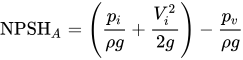
where is the absolute pressure at the inlet, is the average velocity at the inlet, is the fluid density, is the acceleration of gravity and is the vapor pressure of the fluid. Note that NPSH is equivalent to the sum of both the static and dynamic heads – that is, the stagnation head – minus the equilibrium vapor pressure head, hence "net positive suction head".


Applying the Bernoulli's equation for the control volume enclosing the suction free surface 0 and the pump inlet i, under the assumption that the kinetic energy at 0 is negligible, that the fluid is inviscid, and that the fluid density is constant:
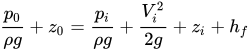
Using the above application of Bernoulli to eliminate the velocity term and local pressure terms in the definition of NPSHA:
Net positive suction head
In a hydraulic circuit, net positive suction head (NPSH) may refer to one of two quantities in the analysis of cavitation:
NPSH is particularly relevant inside centrifugal pumps and turbines, which are parts of a hydraulic system that are most vulnerable to cavitation. If cavitation occurs, the drag coefficient of the impeller vanes will increase drastically—possibly stopping flow altogether—and prolonged exposure will damage the impeller.
In a pump, cavitation will first occur at the inlet of the impeller. Denoting the inlet by i, the NPSHA at this point is defined as:
where is the absolute pressure at the inlet, is the average velocity at the inlet, is the fluid density, is the acceleration of gravity and is the vapor pressure of the fluid. Note that NPSH is equivalent to the sum of both the static and dynamic heads – that is, the stagnation head – minus the equilibrium vapor pressure head, hence "net positive suction head".
Applying the Bernoulli's equation for the control volume enclosing the suction free surface 0 and the pump inlet i, under the assumption that the kinetic energy at 0 is negligible, that the fluid is inviscid, and that the fluid density is constant:
Using the above application of Bernoulli to eliminate the velocity term and local pressure terms in the definition of NPSHA: