


Community hub
Recent from talks
Contribute something
Nothing was collected or created yet.
Netrin 1
View on Wikipedia


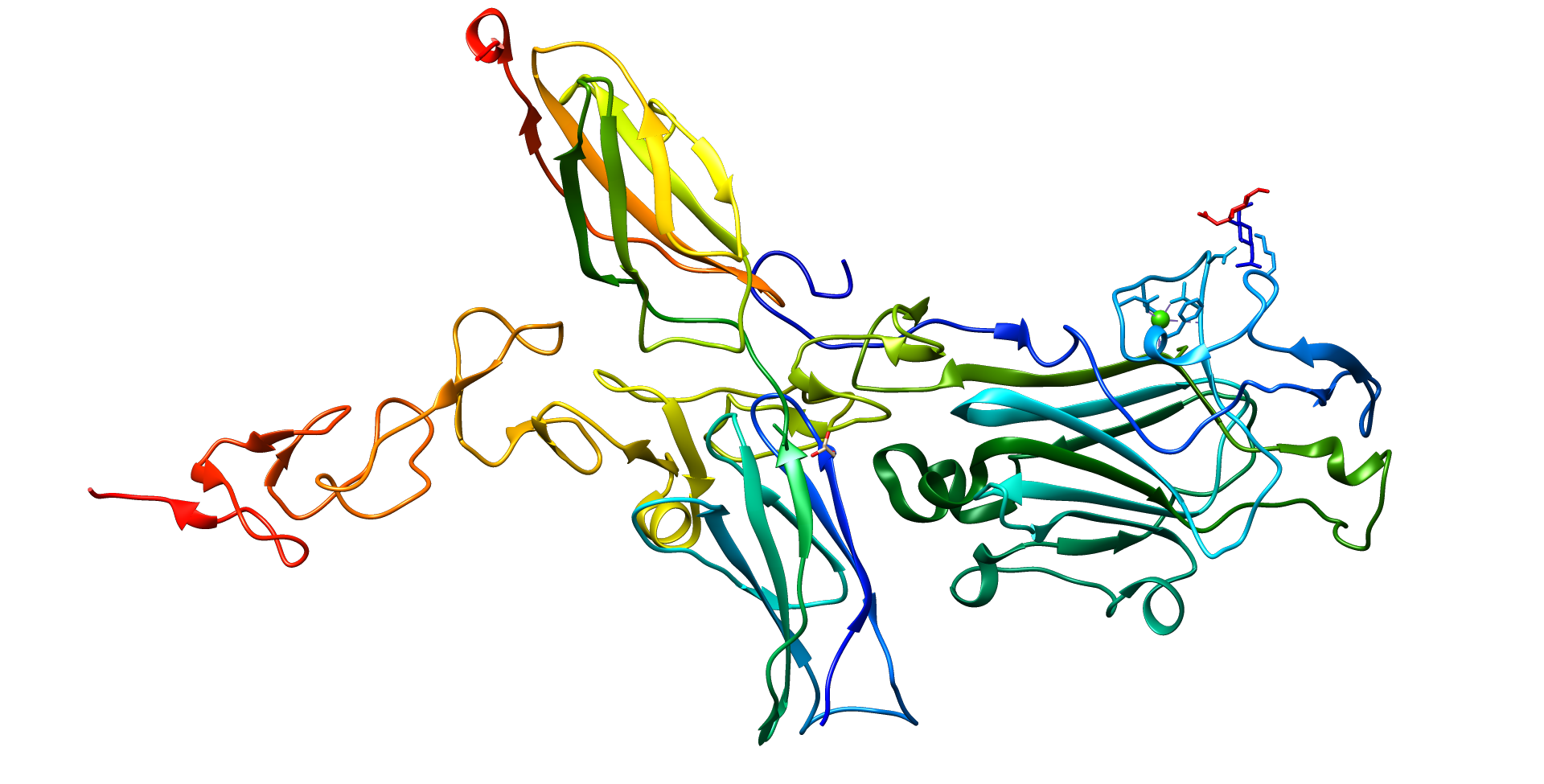
Netrin-1 is a protein that in humans is encoded by the NTN1 gene.[5][6]
Netrin is included in a family of laminin-related secreted proteins. The function of this gene has not yet been defined; however, netrin is thought to be involved in axon guidance and cell migration during development. Mutations and loss of expression of netrin suggest that variation in netrin may be involved in cancer development.[6]
Interactions
[edit]NTN1 has been shown to interact with Deleted in Colorectal Cancer,[5][7] and components of the extracellular matrix and the tumor microenvironment.[8]
Midline crossing of commissural axons
[edit]During the development of the central nervous system, when the dorsal and ventral signaling is being established, the floor plate is an important site for crossing for groups of neural processes at the dorsal midline. Once crossed through the floor plate, these groups are now referred to as commissural axons. These neuronal cell bodies are signaled by Netrin 1 to be attracted to the floor plate from the dorsal half of the neural tube. NTN1 is a gene that encodes for the protein, Netrin-1. In a study done in knockout mice with a depletion of floor plate Netrin-1, it was shown that corticospinal axon tract midline crossing was disrupted.[9] This study was done to show characteristics of patients with human congenital mirror movement disorder.
Afterwards, proper positioning of axons and midline crossing are pioneered by the Slit-Robo system where Slit proteins act as axonal repellents and Robo proteins (Robo-1, Robo-2, Robo-3) act in conjunction with Slit ligands to be their receptors.[10] Slit with Robo-1 and Robo-2 repel axonal extension at the midline thereby commissural axons expressing Robo-3 cross the midline by interfering with Slit/Robo-1, Robo-2 repulsive activity. After crossing the floor plate, Robo-3 is downregulated and Slit/Robo-1, Robo-2 continue to express their repulsiveness at the midline. Furthermore, mutations in Robo-3 cause horizontal gaze palsy with progressive scoliosis.
References
[edit]- ^ a b c GRCh38: Ensembl release 89: ENSG00000065320 – Ensembl, May 2017
- ^ a b c GRCm38: Ensembl release 89: ENSMUSG00000020902 – Ensembl, May 2017
- ^ "Human PubMed Reference:". National Center for Biotechnology Information, U.S. National Library of Medicine.
- ^ "Mouse PubMed Reference:". National Center for Biotechnology Information, U.S. National Library of Medicine.
- ^ a b Meyerhardt JA, Caca K, Eckstrand BC, Hu G, Lengauer C, Banavali S, Look AT, Fearon ER (January 1999). "Netrin-1: interaction with deleted in colorectal cancer (DCC) and alterations in brain tumors and neuroblastomas". Cell Growth Differ. 10 (1): 35–42. PMID 9950216.
- ^ a b "Entrez Gene: NTN1 netrin 1".
- ^ Geisbrecht, Brian V; Dowd Kimberly A; Barfield Ronald W; Longo Patti A; Leahy Daniel J (Aug 2003). "Netrin binds discrete subdomains of DCC and UNC5 and mediates interactions between DCC and heparin". J. Biol. Chem. 278 (35). United States: 32561–8. doi:10.1074/jbc.M302943200. ISSN 0021-9258. PMID 12810718.
- ^ Kryza D, Wischhusen J, Richaud M, Hervieu M, Sidi Boumedine J, Delcros JG, Besse S, Baudier T, Laval PA, Breusa S, Boutault E, Clermidy H, Rama N, Ducarouge B, Devouassoux-Shisheboran M, Chezal JM, Giraudet AL, Walter T, Mehlen P, Sarrut D, Gibert B.From netrin-1-targeted SPECT/CT to internal radiotherapy for management of advanced solid tumors. EMBO Mol Med. 2023 Apr 11;15(4):e16732. doi: 10.15252/emmm.202216732. Epub 2023 Mar 6. PMID 36876343
- ^ Pourchet, Oriane (Jan 19, 2021). "Loss of floor plate Netrin-1 impairs midline crossing of corticospinal axons and leads to mirror movements". Cell Reports. 34 (3) 108654. doi:10.1016/j.celrep.2020.108654. hdl:10261/308989. PMID 33472083. S2CID 231663364.
- ^ Blockus, Heike; Chedotal, Alain (Sep 1, 2016). "Slit-Robo signaling". Development. 143 (17): 3037–3044. doi:10.1242/dev.132829. PMID 27578174. S2CID 10315151.
Further reading
[edit]- Bouhidel JO, Wang P, Siu KL, Li H, Youn JY, Cai H (February 2015). "Netrin-1 improves post-injury cardiac function in vivo via DCC/NO-dependent preservation of mitochondrial integrity, while attenuating autophagy". Biochim. Biophys. Acta. 1852 (2): 277–89. doi:10.1016/j.bbadis.2014.06.005. PMC 4262720. PMID 24928309.
- Arakawa H (2005). "Netrin-1 and its receptors in tumorigenesis". Nat. Rev. Cancer. 4 (12): 978–87. doi:10.1038/nrc1504. PMID 15573119. S2CID 867903.
- Mehlen P, Furne C (2006). "Netrin-1: when a neuronal guidance cue turns out to be a regulator of tumorigenesis". Cell. Mol. Life Sci. 62 (22): 2599–616. doi:10.1007/s00018-005-5191-3. PMC 11139161. PMID 16158190. S2CID 29781275.
- Keino-Masu K, Masu M, Hinck L, et al. (1996). "Deleted in Colorectal Cancer (DCC) encodes a netrin receptor". Cell. 87 (2): 175–85. doi:10.1016/S0092-8674(00)81336-7. PMID 8861902. S2CID 18468998.
- Serafini T, Colamarino SA, Leonardo ED, et al. (1997). "Netrin-1 is required for commissural axon guidance in the developing vertebrate nervous system". Cell. 87 (6): 1001–14. doi:10.1016/S0092-8674(00)81795-X. PMID 8978605. S2CID 1008380.
- Togari A, Mogi M, Arai M, et al. (2001). "Expression of mRNA for axon guidance molecules, such as semaphorin-III, netrins and neurotrophins, in human osteoblasts and osteoclasts". Brain Res. 878 (1–2): 204–9. doi:10.1016/S0006-8993(00)02700-1. PMID 10996153. S2CID 28322080.
- Corset V, Nguyen-Ba-Charvet KT, Forcet C, et al. (2000). "Netrin-1-mediated axon outgrowth and cAMP production requires interaction with adenosine A2b receptor". Nature. 407 (6805): 747–50. Bibcode:2000Natur.407..747C. doi:10.1038/35037600. PMID 11048721. S2CID 4423128.
- Manitt C, Colicos MA, Thompson KM, et al. (2001). "Widespread expression of netrin-1 by neurons and oligodendrocytes in the adult mammalian spinal cord". J. Neurosci. 21 (11): 3911–22. doi:10.1523/JNEUROSCI.21-11-03911.2001. PMC 6762706. PMID 11356879.
- Srinivasan K, Strickland P, Valdes A, et al. (2003). "Netrin-1/neogenin interaction stabilizes multipotent progenitor cap cells during mammary gland morphogenesis". Dev. Cell. 4 (3): 371–82. doi:10.1016/S1534-5807(03)00054-6. PMID 12636918.
- Yebra M, Montgomery AM, Diaferia GR, et al. (2003). "Recognition of the neural chemoattractant Netrin-1 by integrins alpha6beta4 and alpha3beta1 regulates epithelial cell adhesion and migration". Dev. Cell. 5 (5): 695–707. doi:10.1016/S1534-5807(03)00330-7. PMID 14602071.
- Mazelin L, Bernet A, Bonod-Bidaud C, et al. (2004). "Netrin-1 controls colorectal tumorigenesis by regulating apoptosis". Nature. 431 (7004): 80–4. Bibcode:2004Natur.431...80M. doi:10.1038/nature02788. PMID 15343335. S2CID 4417992.
- Kato HD, Kondoh H, Inoue T, et al. (2004). "Expression of DCC and netrin-1 in normal human endometrium and its implication in endometrial carcinogenesis". Gynecol. Oncol. 95 (2): 281–9. doi:10.1016/j.ygyno.2004.07.050. PMID 15491747.
- Kruger RP, Lee J, Li W, Guan KL (2005). "Mapping netrin receptor binding reveals domains of Unc5 regulating its tyrosine phosphorylation". J. Neurosci. 24 (48): 10826–34. doi:10.1523/JNEUROSCI.3715-04.2004. PMC 6730211. PMID 15574733.
- Hérincs Z, Corset V, Cahuzac N, et al. (2005). "DCC association with lipid rafts is required for netrin-1-mediated axon guidance". J. Cell Sci. 118 (Pt 8): 1687–92. doi:10.1242/jcs.02296. PMID 15811950.
- Kim TH, Lee HK, Seo IA, et al. (2005). "Netrin induces down-regulation of its receptor, Deleted in Colorectal Cancer, through the ubiquitin-proteasome pathway in the embryonic cortical neuron". J. Neurochem. 95 (1): 1–8. doi:10.1111/j.1471-4159.2005.03314.x. PMC 2683579. PMID 16181408.
- Ly NP, Komatsuzaki K, Fraser IP, et al. (2006). "Netrin-1 inhibits leukocyte migration in vitro and in vivo". Proc. Natl. Acad. Sci. U.S.A. 102 (41): 14729–34. Bibcode:2005PNAS..10214729L. doi:10.1073/pnas.0506233102. PMC 1253572. PMID 16203981.
- Varadarajan, SG, Kong JH, Phan KD, Kao TJ, Panaitof SC, Cardin J, Eltzschig H, Kania A, Novitch BG, Butler SJ (2017). "Netrin1 produced by neural progenitors, not floor plate cells, is required for axon guidance in the spinal cord". Neuron. 94 (4): 790–799. doi:10.1016/j.neuron.2017.03.007. PMC 5576449. PMID 28434801.
External links
[edit]- NTN1 human gene location in the UCSC Genome Browser.
- NTN1 human gene details in the UCSC Genome Browser.
 | This article on a gene on human chromosome 17 is a stub. You can help Wikipedia by expanding it. |