



Community hub
Community hub
Recent from talks
Knowledge base stats:
Talk channels stats:
Members stats:
New Guinea singing dog
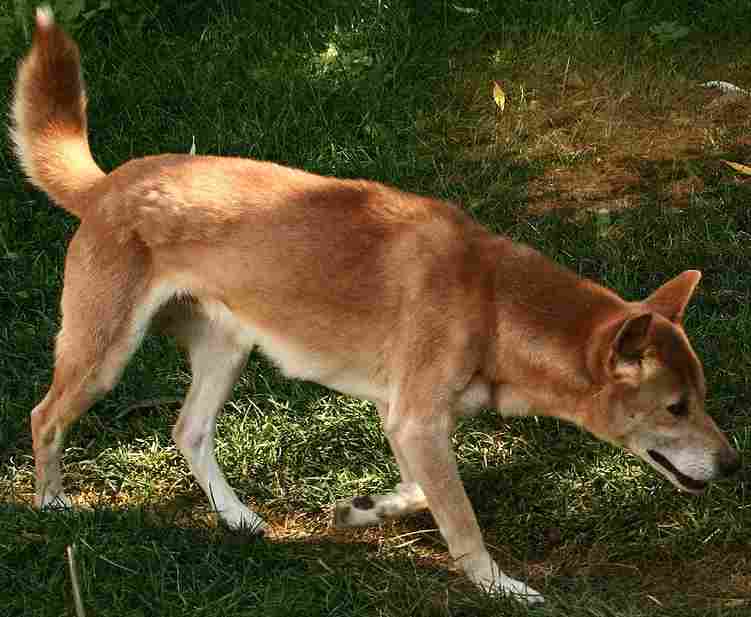
The New Guinea singing dog or New Guinea Highland dog (Canis lupus hallstromi, Canis hallstromi, Canis lupus dingo, or Canis familiaris) is an ancient (basal) lineage of dog found in the New Guinea Highlands, on the island of New Guinea. Once considered to be a separate species in its own right, under the name Canis hallstromi, it is closely related to the Australian dingo. The dog is relatively unusual among canines; it is one of the few to be considered "barkless", and is known for the unusual "yodel" style of vocalizing that gives it its name.
In 1989, the Australian mammalogist Tim Flannery took a photo of a black-and-tan dog in Telefomin District. He noted that these dogs lived with local tribal peoples in the mountains, and that feral populations lived in the alpine and sub-alpine grasslands of the Star Mountains and the Wharton Range. The photo was published in his book, Mammals of New Guinea. In 2012, Australian wilderness-adventure guide Tom Hewett took a photo of a tawny, thick-coated dog in the Puncak Mandala region of West Papua, Indonesia. In 2016, a literature review found no definitive evidence that the earliest possible dogs, within captive populations of New Guinea singing dogs, were wild animals; successive generations of puppies were raised as members of village populations, thus being domestic dogs.
In 2020, a genetic study found that the New Guinea Highland wild dogs were genetically basal to the dingo and the New Guinea singing dog, and therefore the potential originator of both.
In 1999, a study of mitochondrial DNA (mtDNA) indicated that the domestic dog may have originated from multiple grey wolf populations, with the dingo and New Guinea singing dog "breeds" having developed at a time when human populations were more isolated from each other. In the third edition of Mammal Species of the World published in 2005, the mammalogist W. Christopher Wozencraft listed under the wolf Canis lupus its wild subspecies, and proposed two additional subspecies: "familiaris Linnaeus, 1758 [domestic dog]" and "dingo Meyer, 1793 [domestic dog]". Wozencraft included hallstromi – the New Guinea singing dog – as a taxonomic synonym for the dingo. Wozencraft referred to the mtDNA study as one of the guides in forming his decision. The inclusion of familiaris and dingo under a "domestic dog" clade has been noted by other mammalogists. This classification by Wozencraft is debated among zoologists.
The New Guinea singing dog's taxonomic status is debated, with proposals that include treating it within the species concept (range of variation) of the domestic dog Canis familiaris, a distinct species Canis hallstromi, and Canis lupus dingo when considered a subspecies of the wolf. In 2019, a workshop hosted by the IUCN/SSC Canid Specialist Group considered the New Guinea singing dog and the dingo to be feral dogs Canis familiaris, and therefore should not be assessed for the IUCN Red List.
During the Torres expedition to the south coast of New Guinea and the Torres Strait in 1606, small dogs were recorded by Captain Don Diego de Prado y Tovar:
We found small dumb dogs that neither bark nor howl, and do not cry out even if beaten with sticks
On 26 October 1897, the Lieutenant-Governor of British New Guinea, Sir William MacGregor, was on Mount Scratchley, Central Province, Papua New Guinea. At an elevation of 7,000 ft (2,100 m) he recorded that "animals are rare," but listed "wild dog." MacGregor obtained the first specimen and later Charles Walter De Vis wrote a description of it in 1911. De Vis summarised from his description that:
Hub AI
New Guinea singing dog AI simulator
(@New Guinea singing dog_simulator)
New Guinea singing dog
The New Guinea singing dog or New Guinea Highland dog (Canis lupus hallstromi, Canis hallstromi, Canis lupus dingo, or Canis familiaris) is an ancient (basal) lineage of dog found in the New Guinea Highlands, on the island of New Guinea. Once considered to be a separate species in its own right, under the name Canis hallstromi, it is closely related to the Australian dingo. The dog is relatively unusual among canines; it is one of the few to be considered "barkless", and is known for the unusual "yodel" style of vocalizing that gives it its name.
In 1989, the Australian mammalogist Tim Flannery took a photo of a black-and-tan dog in Telefomin District. He noted that these dogs lived with local tribal peoples in the mountains, and that feral populations lived in the alpine and sub-alpine grasslands of the Star Mountains and the Wharton Range. The photo was published in his book, Mammals of New Guinea. In 2012, Australian wilderness-adventure guide Tom Hewett took a photo of a tawny, thick-coated dog in the Puncak Mandala region of West Papua, Indonesia. In 2016, a literature review found no definitive evidence that the earliest possible dogs, within captive populations of New Guinea singing dogs, were wild animals; successive generations of puppies were raised as members of village populations, thus being domestic dogs.
In 2020, a genetic study found that the New Guinea Highland wild dogs were genetically basal to the dingo and the New Guinea singing dog, and therefore the potential originator of both.
In 1999, a study of mitochondrial DNA (mtDNA) indicated that the domestic dog may have originated from multiple grey wolf populations, with the dingo and New Guinea singing dog "breeds" having developed at a time when human populations were more isolated from each other. In the third edition of Mammal Species of the World published in 2005, the mammalogist W. Christopher Wozencraft listed under the wolf Canis lupus its wild subspecies, and proposed two additional subspecies: "familiaris Linnaeus, 1758 [domestic dog]" and "dingo Meyer, 1793 [domestic dog]". Wozencraft included hallstromi – the New Guinea singing dog – as a taxonomic synonym for the dingo. Wozencraft referred to the mtDNA study as one of the guides in forming his decision. The inclusion of familiaris and dingo under a "domestic dog" clade has been noted by other mammalogists. This classification by Wozencraft is debated among zoologists.
The New Guinea singing dog's taxonomic status is debated, with proposals that include treating it within the species concept (range of variation) of the domestic dog Canis familiaris, a distinct species Canis hallstromi, and Canis lupus dingo when considered a subspecies of the wolf. In 2019, a workshop hosted by the IUCN/SSC Canid Specialist Group considered the New Guinea singing dog and the dingo to be feral dogs Canis familiaris, and therefore should not be assessed for the IUCN Red List.
During the Torres expedition to the south coast of New Guinea and the Torres Strait in 1606, small dogs were recorded by Captain Don Diego de Prado y Tovar:
We found small dumb dogs that neither bark nor howl, and do not cry out even if beaten with sticks
On 26 October 1897, the Lieutenant-Governor of British New Guinea, Sir William MacGregor, was on Mount Scratchley, Central Province, Papua New Guinea. At an elevation of 7,000 ft (2,100 m) he recorded that "animals are rare," but listed "wild dog." MacGregor obtained the first specimen and later Charles Walter De Vis wrote a description of it in 1911. De Vis summarised from his description that: