
Recent from talks
1811–1812 New Madrid earthquakes
Knowledge base stats:
Talk channels stats:
Members stats:
1811–1812 New Madrid earthquakes
The 1811–1812 New Madrid earthquakes were a series of intense intraplate earthquakes beginning with an initial earthquake of moment magnitude 7.2–8.2 on December 16, 1811, followed by a moment magnitude 7.4 aftershock on the same day. Two additional earthquakes of similar magnitude followed in January and February 1812. They remain the most powerful earthquakes to hit the contiguous United States east of the Rocky Mountains in recorded history. The earthquakes, as well as the seismic zone of their occurrence, were named for the Mississippi River town of New Madrid, then part of the Louisiana Territory and now within the U.S. state of Missouri.
The epicenters of the earthquakes were located in an area that at the time was at the distant western edge of the American frontier, only sparsely settled by European settlers. Contemporary accounts have led seismologists to estimate that these stable continental region earthquakes were felt strongly throughout much of the central and eastern United States, across an area of roughly 50,000 square miles (130,000 km2), and moderately across nearly 1 million sq mi (3 million km2). The 1906 San Francisco earthquake, by comparison, was felt moderately over roughly 6,200 sq mi (16,000 km2). The earthquakes were interpreted by Tecumseh's pan-Indian alliance, to mean that Tecumseh and his brother the Prophet must be supported.
The many more aftershocks include one magnitude 7 aftershock to the December 16, 1811, earthquake which occurred at 6:00 UTC (12:00 am local time) on December 17, 1811, and one magnitude 7 aftershock to the February 7, 1812, earthquake which occurred on the same day at 4:40 UTC (10:40 pm local time). Susan Hough, a seismologist of the United States Geological Survey, has estimated the earthquakes' magnitudes as around magnitude 7.
John Bradbury, a fellow of the Linnean Society, was on the Mississippi on the night of December 15, 1811, and describes the tremors in great detail in his Travels in the Interior of America in the Years 1809, 1810 and 1811, published in 1817:
After supper, we went to sleep as usual: about ten o'clock, and in the night I was awakened by the most tremendous noise, accompanied by an agitation of the boat so violent, that it appeared in danger of upsetting ... I could distinctly see the river as if agitated by a storm; and although the noise was inconceivably loud and terrific, I could distinctly hear the crash of falling trees, and the screaming of the wild fowl on the river, but found that the boat was still safe at her moorings. By the time we could get to our fire, which was on a large flag in the stern of the boat, the shock had ceased; but immediately the perpendicular banks, both above and below us, began to fall into the river in such vast masses, as nearly to sink our boat by the swell they occasioned ... At day-light we had counted twenty-seven shocks.
Eliza Bryan in New Madrid, Missouri Territory, wrote the following eyewitness account in March 1812:
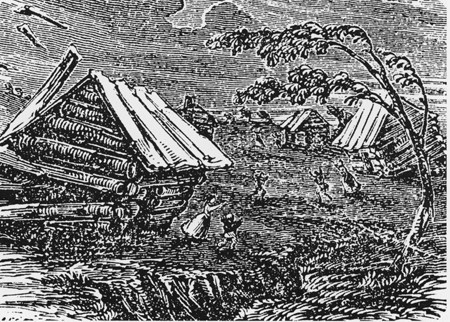
On the 16th of December 1811, about two o'clock, a.m., we were visited by a violent shock of an earthquake, accompanied by a very awful noise resembling loud but distant thunder, but more hoarse and vibrating, which was followed in a few minutes by the complete saturation of the atmosphere, with sulphurious vapor, causing total darkness. The screams of the affrighted inhabitants running to and fro, not knowing where to go, or what to do—the cries of the fowls and beasts of every species—the cracking of trees falling, and the roaring of the Mississippi— the current of which was retrograde for a few minutes, owing as is supposed, to an irruption in its bed— formed a scene truly horrible.
John Reynolds, the fourth governor of Illinois, among other political posts, mentions the earthquake in his biography My Own Times: Embracing Also the History of My Life (1855):
Hub AI
1811–1812 New Madrid earthquakes AI simulator
(@1811–1812 New Madrid earthquakes_simulator)
1811–1812 New Madrid earthquakes
The 1811–1812 New Madrid earthquakes were a series of intense intraplate earthquakes beginning with an initial earthquake of moment magnitude 7.2–8.2 on December 16, 1811, followed by a moment magnitude 7.4 aftershock on the same day. Two additional earthquakes of similar magnitude followed in January and February 1812. They remain the most powerful earthquakes to hit the contiguous United States east of the Rocky Mountains in recorded history. The earthquakes, as well as the seismic zone of their occurrence, were named for the Mississippi River town of New Madrid, then part of the Louisiana Territory and now within the U.S. state of Missouri.
The epicenters of the earthquakes were located in an area that at the time was at the distant western edge of the American frontier, only sparsely settled by European settlers. Contemporary accounts have led seismologists to estimate that these stable continental region earthquakes were felt strongly throughout much of the central and eastern United States, across an area of roughly 50,000 square miles (130,000 km2), and moderately across nearly 1 million sq mi (3 million km2). The 1906 San Francisco earthquake, by comparison, was felt moderately over roughly 6,200 sq mi (16,000 km2). The earthquakes were interpreted by Tecumseh's pan-Indian alliance, to mean that Tecumseh and his brother the Prophet must be supported.
The many more aftershocks include one magnitude 7 aftershock to the December 16, 1811, earthquake which occurred at 6:00 UTC (12:00 am local time) on December 17, 1811, and one magnitude 7 aftershock to the February 7, 1812, earthquake which occurred on the same day at 4:40 UTC (10:40 pm local time). Susan Hough, a seismologist of the United States Geological Survey, has estimated the earthquakes' magnitudes as around magnitude 7.
John Bradbury, a fellow of the Linnean Society, was on the Mississippi on the night of December 15, 1811, and describes the tremors in great detail in his Travels in the Interior of America in the Years 1809, 1810 and 1811, published in 1817:
After supper, we went to sleep as usual: about ten o'clock, and in the night I was awakened by the most tremendous noise, accompanied by an agitation of the boat so violent, that it appeared in danger of upsetting ... I could distinctly see the river as if agitated by a storm; and although the noise was inconceivably loud and terrific, I could distinctly hear the crash of falling trees, and the screaming of the wild fowl on the river, but found that the boat was still safe at her moorings. By the time we could get to our fire, which was on a large flag in the stern of the boat, the shock had ceased; but immediately the perpendicular banks, both above and below us, began to fall into the river in such vast masses, as nearly to sink our boat by the swell they occasioned ... At day-light we had counted twenty-seven shocks.
Eliza Bryan in New Madrid, Missouri Territory, wrote the following eyewitness account in March 1812:
On the 16th of December 1811, about two o'clock, a.m., we were visited by a violent shock of an earthquake, accompanied by a very awful noise resembling loud but distant thunder, but more hoarse and vibrating, which was followed in a few minutes by the complete saturation of the atmosphere, with sulphurious vapor, causing total darkness. The screams of the affrighted inhabitants running to and fro, not knowing where to go, or what to do—the cries of the fowls and beasts of every species—the cracking of trees falling, and the roaring of the Mississippi— the current of which was retrograde for a few minutes, owing as is supposed, to an irruption in its bed— formed a scene truly horrible.
John Reynolds, the fourth governor of Illinois, among other political posts, mentions the earthquake in his biography My Own Times: Embracing Also the History of My Life (1855):
Recent media