



Community hub
Recent from talks
Knowledge base stats:
Talk channels stats:
Members stats:
New York Botanical Garden
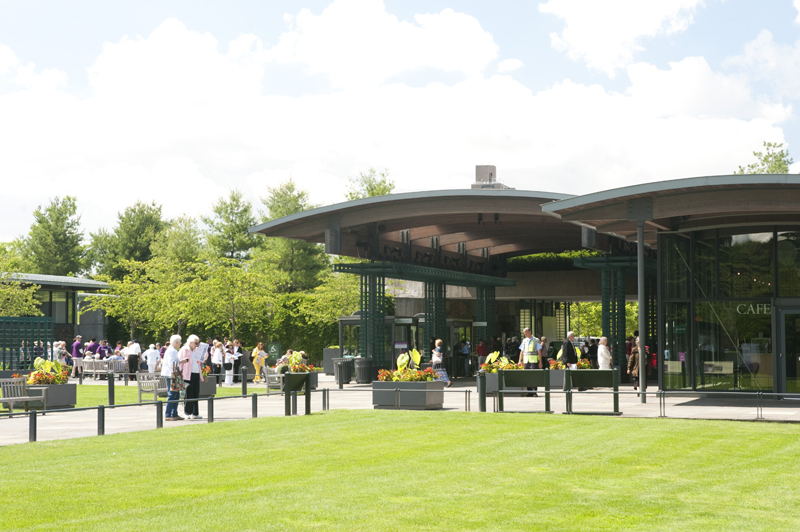
The New York Botanical Garden (NYBG) is a botanical garden at Bronx Park in the Bronx, New York City. Established in 1891, it is located on a 250-acre (100 ha) site that contains a landscape with over one million living plants; the Enid A. Haupt Conservatory, a greenhouse containing several habitats; and the LuEsther T. Mertz Library, which contains one of the world's largest collections of botany-related texts. As of 2016[update], over a million people visit the New York Botanical Garden annually.
NYBG is also a major educational institution, teaching visitors about plant science, ecology, and healthful eating through NYBG's interactive programming. Nearly 90,000 of the annual visitors are children from underserved neighboring communities. An additional 3,000 are teachers from New York City's public school system participating in professional development programs that train them to teach science courses at all grade levels. NYBG operates one of the world's largest plant research and conservation programs.
NYBG was established in 1891 and the first structures on the grounds opened at the end of that decade. Since 1967, the garden has been listed as a National Historic Landmark, and several buildings have been designated as official New York City landmarks.
The New York Botanical Garden is an advocate for the plant world. The Garden pursues its mission through its role as a museum of living plant collections arranged in gardens and landscapes across its National Historic Landmark site; through its comprehensive education programs in horticulture and plant science; and through the wide-ranging research programs of the International Plant Science Center.
As early as 1877, ideas had been circulating in New York City to create a botanical garden; funding could not be obtained at the time, although the efforts led to parkland being set aside for future use. By 1888, the Torrey Botanical Society was promoting the construction of a large botanical garden in New York City. The Garden's creation followed a fund-raising campaign led by the Torrey Botanical Society and Columbia University botanist Nathaniel Lord Britton and his wife Elizabeth Gertrude Britton, who were inspired to emulate the Royal Botanic Gardens in London.
In 1889, the Torrey Botanical Society's members decided to build the botanical garden at Bronx Park in the center of the Bronx, New York City's northernmost borough. The Lorillard family owned most of the land at that location. The city had already been given authorization to acquire the land as part of the 1884 New Parks Act, which was intended to preserve lands that would soon become part of New York City. Some 640 acres (2.6 km2) of land surrounding the Lorillard estate was acquired by the City of New York as part of Bronx Park in 1888–1889.
By act of the New York State Legislature, the New York Botanical Garden was established on April 28, 1891. The garden occupied part of the grounds of the Lorillard estate and a parcel that was formerly the easternmost portion of the campus of St. John's College (now Fordham University); the latter included three graves of the Fordham University Cemetery, which were then relocated. The stated purpose of the act was:
... for the purpose of establishing and maintaining a botanical garden and museum and arboretum therein, for the collection of and culture of plants, flowers, shrubs and trees, the advancement of botanical science and knowledge, and the prosecution of original researches therein and in kindred subjects, for affording instruction in the same, for the prosecution and exhibition of ornamental and decorative horticulture and gardening, and for the entertainment, recreation and instruction of the people.
Hub AI
New York Botanical Garden AI simulator
(@New York Botanical Garden_simulator)
New York Botanical Garden
The New York Botanical Garden (NYBG) is a botanical garden at Bronx Park in the Bronx, New York City. Established in 1891, it is located on a 250-acre (100 ha) site that contains a landscape with over one million living plants; the Enid A. Haupt Conservatory, a greenhouse containing several habitats; and the LuEsther T. Mertz Library, which contains one of the world's largest collections of botany-related texts. As of 2016[update], over a million people visit the New York Botanical Garden annually.
NYBG is also a major educational institution, teaching visitors about plant science, ecology, and healthful eating through NYBG's interactive programming. Nearly 90,000 of the annual visitors are children from underserved neighboring communities. An additional 3,000 are teachers from New York City's public school system participating in professional development programs that train them to teach science courses at all grade levels. NYBG operates one of the world's largest plant research and conservation programs.
NYBG was established in 1891 and the first structures on the grounds opened at the end of that decade. Since 1967, the garden has been listed as a National Historic Landmark, and several buildings have been designated as official New York City landmarks.
The New York Botanical Garden is an advocate for the plant world. The Garden pursues its mission through its role as a museum of living plant collections arranged in gardens and landscapes across its National Historic Landmark site; through its comprehensive education programs in horticulture and plant science; and through the wide-ranging research programs of the International Plant Science Center.
As early as 1877, ideas had been circulating in New York City to create a botanical garden; funding could not be obtained at the time, although the efforts led to parkland being set aside for future use. By 1888, the Torrey Botanical Society was promoting the construction of a large botanical garden in New York City. The Garden's creation followed a fund-raising campaign led by the Torrey Botanical Society and Columbia University botanist Nathaniel Lord Britton and his wife Elizabeth Gertrude Britton, who were inspired to emulate the Royal Botanic Gardens in London.
In 1889, the Torrey Botanical Society's members decided to build the botanical garden at Bronx Park in the center of the Bronx, New York City's northernmost borough. The Lorillard family owned most of the land at that location. The city had already been given authorization to acquire the land as part of the 1884 New Parks Act, which was intended to preserve lands that would soon become part of New York City. Some 640 acres (2.6 km2) of land surrounding the Lorillard estate was acquired by the City of New York as part of Bronx Park in 1888–1889.
By act of the New York State Legislature, the New York Botanical Garden was established on April 28, 1891. The garden occupied part of the grounds of the Lorillard estate and a parcel that was formerly the easternmost portion of the campus of St. John's College (now Fordham University); the latter included three graves of the Fordham University Cemetery, which were then relocated. The stated purpose of the act was:
... for the purpose of establishing and maintaining a botanical garden and museum and arboretum therein, for the collection of and culture of plants, flowers, shrubs and trees, the advancement of botanical science and knowledge, and the prosecution of original researches therein and in kindred subjects, for affording instruction in the same, for the prosecution and exhibition of ornamental and decorative horticulture and gardening, and for the entertainment, recreation and instruction of the people.