
Recent from talks
Newcastle Cathedral
Knowledge base stats:
Talk channels stats:
Members stats:
Newcastle Cathedral
Newcastle Cathedral, formally the Cathedral Church of St Nicholas, is a Church of England cathedral in Newcastle upon Tyne, Tyne and Wear, England. It is the seat of the Bishop of Newcastle and is the mother church of the Diocese of Newcastle.
It is the most northerly diocese of the Anglican Church in England, reaching from the River Tyne as far north as Berwick-upon-Tweed and as far west as Alston in Cumbria. The cathedral is a grade I listed building.
Founded in 1091 during the same period as the nearby castle, the Norman church was destroyed by fire in 1216 and the current building was completed in 1350, so is mostly of the Perpendicular style of the 14th century. Its tower is noted for its 15th-century lantern spire. Heavily restored in 1777, the building was raised to cathedral status in 1882, when it became known as the Cathedral Church of St Nicholas.
The cathedral is named after Saint Nicholas, the patron saint of sailors and boats. This may reflect the cathedral's position on the northern heights above the River Tyne. It was originally a parish church, built in 1091. It was built close to the line of Hadrian's Wall through Newcastle, which may have passed through or near the churchyard to the south, but unfortunately the exact location of its line through the very centre of the city is currently lost. Close to the south of the cathedral is Newcastle Castle, which gave the city its name, and which was itself built on the site of the Hadrian's Wall fort of Pons Aelius. The Norman church was destroyed by fire in 1216 and the present structure was completed in 1350.
The most famous notable of the cathedral was the Scottish reformer John Knox, who served as minister from late 1550 until 2 February 1553.
In the mid-19th century Newcastle experienced a huge increase in its population, leading to the construction of over 20 new churches in the suburbs. As Newcastle continued to grow, so did its need for a diocese separate from Durham, and so in 1882 the Diocese of Newcastle was formed, with St Nicholas's as its cathedral.
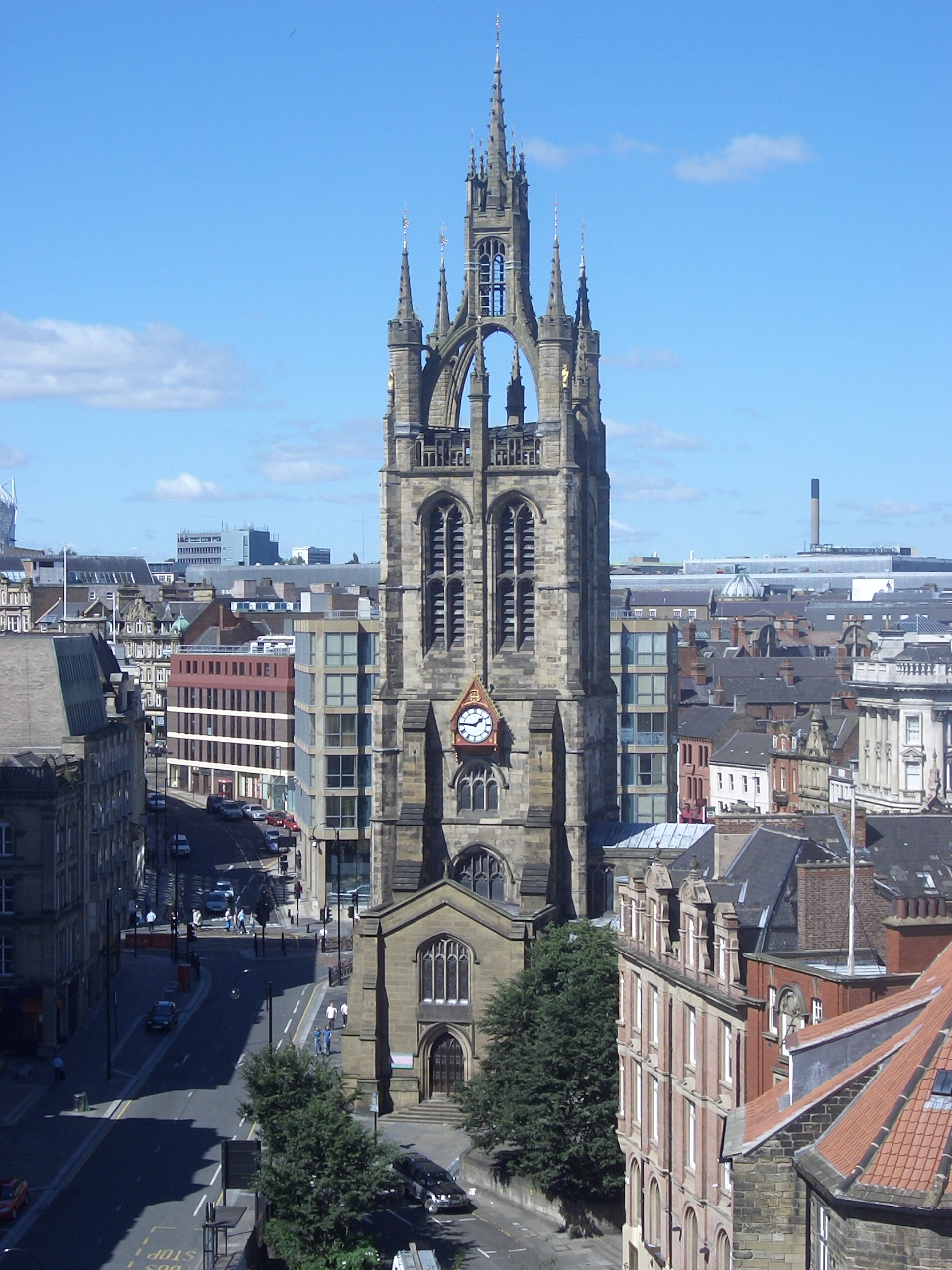
The cathedral is notable for its unusual lantern spire, which was constructed in 1448. For hundreds of years, it was a main navigation point for ships using the River Tyne. At its base the tower measures 36 ft 9 in (11.20 m) by 35 ft (11 m) and it is 194 ft 2 in (59.18 m) from the base to the top of the steeple.
On each corner of the lantern are gilded statues, of Adam eating the apple, Eve holding out the apple, Aaron dressed as a bishop, and David holding a harp. Following work on the street in the 1860s the tower was found to be cracking and tilting, so two porches were added to buttress the structure. Since then the tower has settled and the ornate wooden font cover, which is suspended from the tower inside, does not hang in line with the font.
Hub AI
Newcastle Cathedral AI simulator
(@Newcastle Cathedral_simulator)
Newcastle Cathedral
Newcastle Cathedral, formally the Cathedral Church of St Nicholas, is a Church of England cathedral in Newcastle upon Tyne, Tyne and Wear, England. It is the seat of the Bishop of Newcastle and is the mother church of the Diocese of Newcastle.
It is the most northerly diocese of the Anglican Church in England, reaching from the River Tyne as far north as Berwick-upon-Tweed and as far west as Alston in Cumbria. The cathedral is a grade I listed building.
Founded in 1091 during the same period as the nearby castle, the Norman church was destroyed by fire in 1216 and the current building was completed in 1350, so is mostly of the Perpendicular style of the 14th century. Its tower is noted for its 15th-century lantern spire. Heavily restored in 1777, the building was raised to cathedral status in 1882, when it became known as the Cathedral Church of St Nicholas.
The cathedral is named after Saint Nicholas, the patron saint of sailors and boats. This may reflect the cathedral's position on the northern heights above the River Tyne. It was originally a parish church, built in 1091. It was built close to the line of Hadrian's Wall through Newcastle, which may have passed through or near the churchyard to the south, but unfortunately the exact location of its line through the very centre of the city is currently lost. Close to the south of the cathedral is Newcastle Castle, which gave the city its name, and which was itself built on the site of the Hadrian's Wall fort of Pons Aelius. The Norman church was destroyed by fire in 1216 and the present structure was completed in 1350.
The most famous notable of the cathedral was the Scottish reformer John Knox, who served as minister from late 1550 until 2 February 1553.
In the mid-19th century Newcastle experienced a huge increase in its population, leading to the construction of over 20 new churches in the suburbs. As Newcastle continued to grow, so did its need for a diocese separate from Durham, and so in 1882 the Diocese of Newcastle was formed, with St Nicholas's as its cathedral.
The cathedral is notable for its unusual lantern spire, which was constructed in 1448. For hundreds of years, it was a main navigation point for ships using the River Tyne. At its base the tower measures 36 ft 9 in (11.20 m) by 35 ft (11 m) and it is 194 ft 2 in (59.18 m) from the base to the top of the steeple.
On each corner of the lantern are gilded statues, of Adam eating the apple, Eve holding out the apple, Aaron dressed as a bishop, and David holding a harp. Following work on the street in the 1860s the tower was found to be cracking and tilting, so two porches were added to buttress the structure. Since then the tower has settled and the ornate wooden font cover, which is suspended from the tower inside, does not hang in line with the font.
Recent media