
Recent from talks
Newfoundland dollar
Knowledge base stats:
Talk channels stats:
Members stats:
Newfoundland dollar
The dollar was the currency of the colony of Newfoundland and, later, the Dominion of Newfoundland, from 1865 until 1949, when Newfoundland became a province of Canada. It was subdivided into 100 cents.
In 1865, Newfoundland adopted the gold standard, and the dollar replaced the pound at a rate of 1 dollar = 4 shillings 2 pence sterling or 1 pound = $4.80, slightly higher than the Canadian dollar (worth 4s 1.3d). The significance of this rating was that two cents was equal to one penny sterling. It was seen as a compromise between adopting the British system or the American system. It also aligned the Newfoundland unit to the dollar unit in the British Eastern Caribbean colonies. The West Indian dollar was directly descended from the Spanish dollar (pieces of eight). Newfoundland was unique in the British Empire in that it was the only part to introduce its own gold coin in conjunction with its gold standard. Newfoundland two-dollar coins were minted intermittently until the Newfoundland banking crash of 1894. In 1895, following this banking crisis, the Canadian banks moved into Newfoundland and the value of the Newfoundland dollar was adjusted to set it equal to the Canadian dollar, a devaluation of 1.4%. The Newfoundland dollar was replaced by the Canadian dollar at par when Newfoundland joined Canada in 1949.
The other British North American colonies adopted the American unit around the same time that Newfoundland adopted the West Indian unit. The small disparity between the American unit and the West Indian unit was because in 1792, Alexander Hamilton at the U.S. Treasury Department took an average weight of worn Spanish dollars to be the new American unit of currency.[citation needed]
The Newfoundland decimal coinage corresponded exactly to the dollar unit that was used in another British colony in South America. British Guiana used accounts based on the Spanish dollar, but these accounts were used in conjunction with the sterling coinage.
Coins of the Newfoundland dollar continue to be legal tender in all of Canada, as are banknotes.[citation needed]
In 1865, coins were introduced in denominations of 1, 5, 10 and 20 cents, and 2 dollars. The 1 cent was struck in bronze, the 5, 10 and 20 cents in silver and the 2 dollars (also denominated as "Two Hundred Cents" and "One Hundred Pence") in gold. Silver 50 cents were introduced in 1870, with the 20 cents replaced by a 25-cent coin in 1917. A smaller 1-cent coin was introduced in 1938.
In 1865, one chartered bank, the Commercial Bank of Newfoundland, began issuing notes denominated in pounds and dollars, using a rate of 4 dollars = 1 pound. As this rate matched the rate used in Canada at the time, it may be that these notes were not intended for use as Newfoundland dollars. In the 1880s, both the Commercial Bank and the Union Bank of Newfoundland issued notes denominated solely in dollars. Denominations of 2, 5, 10, 20 and 50 dollars were issued. However, in 1894, both banks crashed.
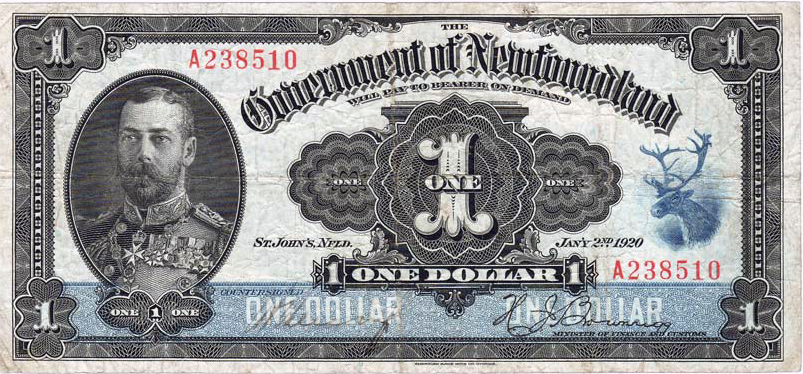
The Department of Public Works introduced government cash notes in 1901 in denominations of 40, 50 and 80 cents, 1 and 5 dollars. In 1910, 25 cents and 2 dollars were added. In 1920, the Treasury introduced 1- and 2-dollar notes.
Hub AI
Newfoundland dollar AI simulator
(@Newfoundland dollar_simulator)
Newfoundland dollar
The dollar was the currency of the colony of Newfoundland and, later, the Dominion of Newfoundland, from 1865 until 1949, when Newfoundland became a province of Canada. It was subdivided into 100 cents.
In 1865, Newfoundland adopted the gold standard, and the dollar replaced the pound at a rate of 1 dollar = 4 shillings 2 pence sterling or 1 pound = $4.80, slightly higher than the Canadian dollar (worth 4s 1.3d). The significance of this rating was that two cents was equal to one penny sterling. It was seen as a compromise between adopting the British system or the American system. It also aligned the Newfoundland unit to the dollar unit in the British Eastern Caribbean colonies. The West Indian dollar was directly descended from the Spanish dollar (pieces of eight). Newfoundland was unique in the British Empire in that it was the only part to introduce its own gold coin in conjunction with its gold standard. Newfoundland two-dollar coins were minted intermittently until the Newfoundland banking crash of 1894. In 1895, following this banking crisis, the Canadian banks moved into Newfoundland and the value of the Newfoundland dollar was adjusted to set it equal to the Canadian dollar, a devaluation of 1.4%. The Newfoundland dollar was replaced by the Canadian dollar at par when Newfoundland joined Canada in 1949.
The other British North American colonies adopted the American unit around the same time that Newfoundland adopted the West Indian unit. The small disparity between the American unit and the West Indian unit was because in 1792, Alexander Hamilton at the U.S. Treasury Department took an average weight of worn Spanish dollars to be the new American unit of currency.[citation needed]
The Newfoundland decimal coinage corresponded exactly to the dollar unit that was used in another British colony in South America. British Guiana used accounts based on the Spanish dollar, but these accounts were used in conjunction with the sterling coinage.
Coins of the Newfoundland dollar continue to be legal tender in all of Canada, as are banknotes.[citation needed]
In 1865, coins were introduced in denominations of 1, 5, 10 and 20 cents, and 2 dollars. The 1 cent was struck in bronze, the 5, 10 and 20 cents in silver and the 2 dollars (also denominated as "Two Hundred Cents" and "One Hundred Pence") in gold. Silver 50 cents were introduced in 1870, with the 20 cents replaced by a 25-cent coin in 1917. A smaller 1-cent coin was introduced in 1938.
In 1865, one chartered bank, the Commercial Bank of Newfoundland, began issuing notes denominated in pounds and dollars, using a rate of 4 dollars = 1 pound. As this rate matched the rate used in Canada at the time, it may be that these notes were not intended for use as Newfoundland dollars. In the 1880s, both the Commercial Bank and the Union Bank of Newfoundland issued notes denominated solely in dollars. Denominations of 2, 5, 10, 20 and 50 dollars were issued. However, in 1894, both banks crashed.
The Department of Public Works introduced government cash notes in 1901 in denominations of 40, 50 and 80 cents, 1 and 5 dollars. In 1910, 25 cents and 2 dollars were added. In 1920, the Treasury introduced 1- and 2-dollar notes.
Recent media