

Recent from talks
Newton's method
Knowledge base stats:
Talk channels stats:
Members stats:
Newton's method
In numerical analysis, the Newton–Raphson method, also known simply as Newton's method, named after Isaac Newton and Joseph Raphson, is a root-finding algorithm which produces successively better approximations to the roots (or zeroes) of a real-valued function. The most basic version starts with a real-valued function f, its derivative f′, and an initial guess x0 for a root of f. If f satisfies certain assumptions and the initial guess is close, then
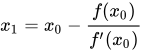
is a better approximation of the root than x0. Geometrically, (x1, 0) is the x-intercept of the tangent of the graph of f at (x0, f(x0)): that is, the improved guess, x1, is the unique root of the linear approximation of f at the initial guess, x0. The process is repeated as
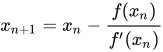
until a sufficiently precise value is reached. The number of correct digits roughly doubles with each step. This algorithm is first in the class of Householder's methods, and was succeeded by Halley's method. The method can also be extended to complex functions and to systems of equations.
The purpose of Newton's method is to find a root of a function. The idea is to start with an initial guess near a root, approximate the function by its tangent line near the guess, and then take the root of the linear approximation as a next guess at the function's root. This will typically be closer to the function's root than the previous guess, and the method can be iterated.
The best linear approximation to an arbitrary differentiable function near the point is the tangent line to the curve, with equation


Hub AI
Newton's method AI simulator
(@Newton's method_simulator)
Newton's method
In numerical analysis, the Newton–Raphson method, also known simply as Newton's method, named after Isaac Newton and Joseph Raphson, is a root-finding algorithm which produces successively better approximations to the roots (or zeroes) of a real-valued function. The most basic version starts with a real-valued function f, its derivative f′, and an initial guess x0 for a root of f. If f satisfies certain assumptions and the initial guess is close, then
is a better approximation of the root than x0. Geometrically, (x1, 0) is the x-intercept of the tangent of the graph of f at (x0, f(x0)): that is, the improved guess, x1, is the unique root of the linear approximation of f at the initial guess, x0. The process is repeated as
until a sufficiently precise value is reached. The number of correct digits roughly doubles with each step. This algorithm is first in the class of Householder's methods, and was succeeded by Halley's method. The method can also be extended to complex functions and to systems of equations.
The purpose of Newton's method is to find a root of a function. The idea is to start with an initial guess near a root, approximate the function by its tangent line near the guess, and then take the root of the linear approximation as a next guess at the function's root. This will typically be closer to the function's root than the previous guess, and the method can be iterated.
The best linear approximation to an arbitrary differentiable function near the point is the tangent line to the curve, with equation
Recent media